-
.jpg)
Post-Classical Glass Paste Cameo of Saint Demetrius
17th-18th century A.D. or earlierSold for (Inc. bp): £3,380
Discoid inlay with facing figure modelled in the half-round, clad in reticulated armour with pauldron and pteruges, cloak to the shoulders, small targe-type shield with cross in circle motif, grasping a spear held across the body; bare-headed with curly hair and beaded nimbus surrounding; legend in the field 'ΟΔΗΜΗΤΡΙΟC' (Dimitrios). 9.43 grams, 31 mm
Private English collection, formed between the late 1970s and early 1990s. Private collection, London, UK. This lot has been checked against the Interpol Database of stolen works of art and is accompanied by search certificate number no.13150-248707. -
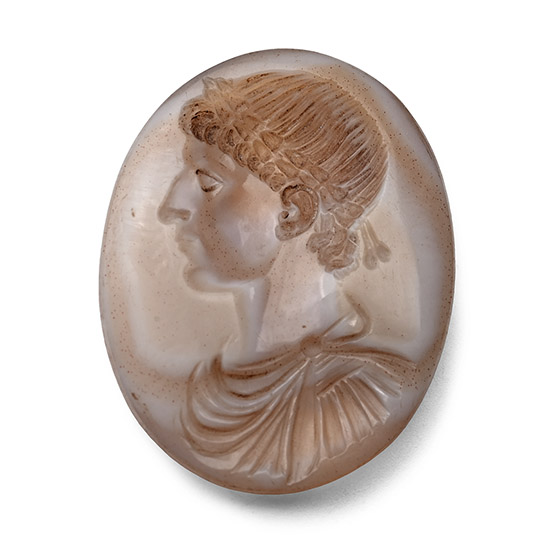
Neoclassical Agate Gemstone of a Late Roman Emperor
Italy, 17th-18th century A.D.Sold for (Inc. bp): £1,170
Intaglio profile bust with heavy jewelled diadem to the brow, ties to the rear, mantle clasped at the shoulder with a small disc brooch; supplied with a museum-quality impression. 1.75 grams, 21 mm
Private English collection, formed between the late 1970s and early 1990s. Private collection, London, UK. -
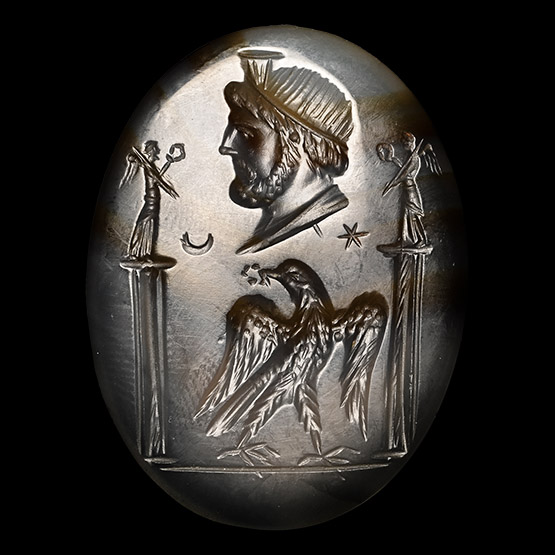
Large Post-Classical Agate Gemstone with Zeus Serapis Allegory
17th century A.D. or laterSold for (Inc. bp): £910
Ellipsoid in plan with chamfer to reverse edge; incuse scene comprising a baseline with fluted column at each surmounted by an inward-facing profile; at base, a perching eagle with head turned and wreath in its beak; above, profile bust of Serapis with modius, crescent moon and sunburst; supplied with a museum-quality impression. 14.4 grams, 40 mm
Private collection, England. -
.jpg)
Neoclassical Tinted Green Agate Gemstone with a Votive Scene
18th century A.D.Sold for (Inc. bp): £1,170
Intaglio votive scene with female figure kneeling before a flaming altar; upper right, three lines of enigmatic inscription; supplied with a museum-quality impression. 2.07 grams, 20 mm
Acquired on the European art market. Private collection, England. -
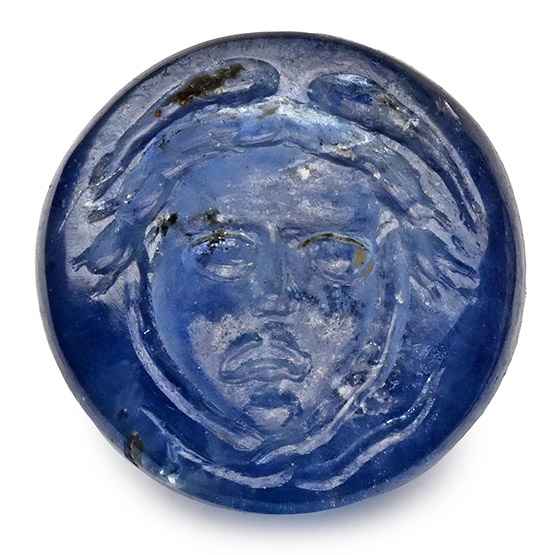
Ancient Style Sapphire Gemstone with Head of Medusa
18th-19th century A.D.Sold for (Inc. bp): £1,170
Incuse gorgoneion with writhing snakes. 0.37 grams, 6 mm
Acquired on the European art market. Private collection, England. -
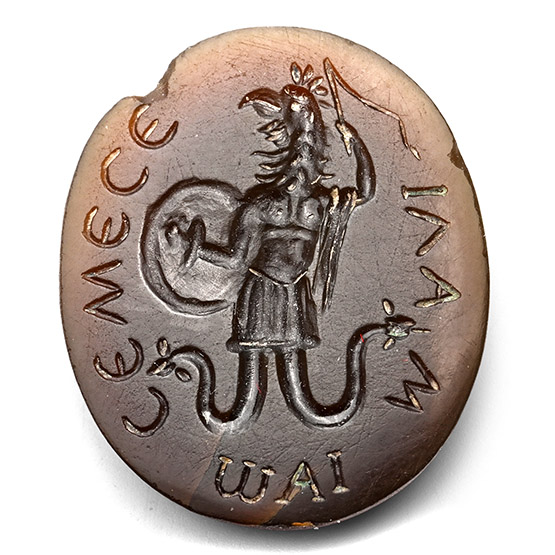
Post-Classical Agate Gnostic Gemstone with Anguiped
18th-19th century A.D. or earlierSold for (Inc. bp): £572
Incuse motif of serpent-legged rooster facing left holding a shield and solar whip; enigmatic agical inscriptions surrounding; supplied with a museum-quality impression. 3.41 grams, 23 mm
Collection of Mr and Mrs V.A., Monte Carlo, 1960s. Acquired on the European art market. Private collection, England. -
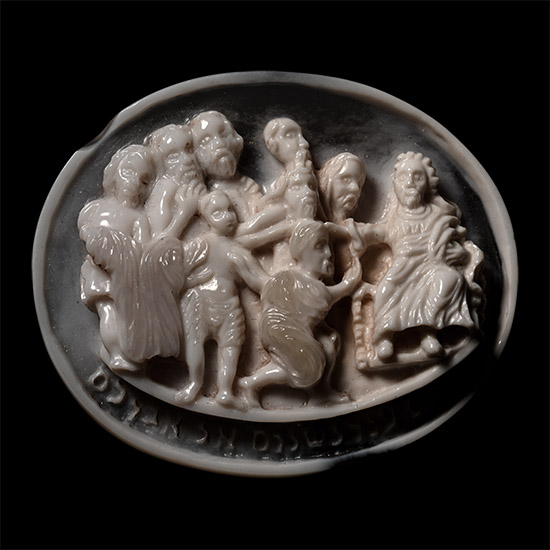
Post Medieval Agate Cameo with Scene from the Old Testament
19th-20th century A.D.Sold for (Inc. bp): £650
Ellipsoid panel with thick outer rim, the inner panel with scene carved in high-relief depicting a bearded figure enthroned extending one hand towards a group of eight attendants, one holding up an empty garment; Hebrew legend beneath. 50 grams, 66 mm
French art market, 2023. Private collection, England. -
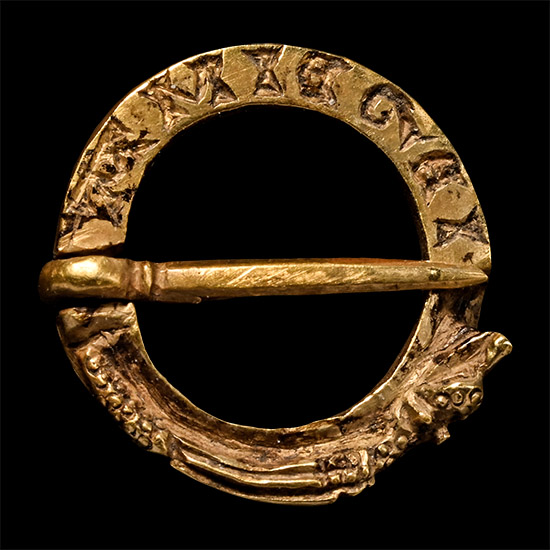
Medieval Gold Dragon Ring Brooch with Inscription
Circa 14th century A.D.Sold for (Inc. bp): £1,040
Annular type with serpent or dragon modelled in the lower segment and legend in Lombardic capitals 'AMIE GEI' with the second word abbreviated for 'GEINT(E)'. 1.13 grams, 11 mm
From a UK private collection since the 1970s.
'Amie geint(e)' means ‘beautiful lover (fem.)’, or ‘noble lover’ (gei as a spelling for gai, which, if permissible, would yield an unabbreviated inscription meaning ‘happy/cheerful beloved’, has not been noted – there are no spellings with -e- recorded). -
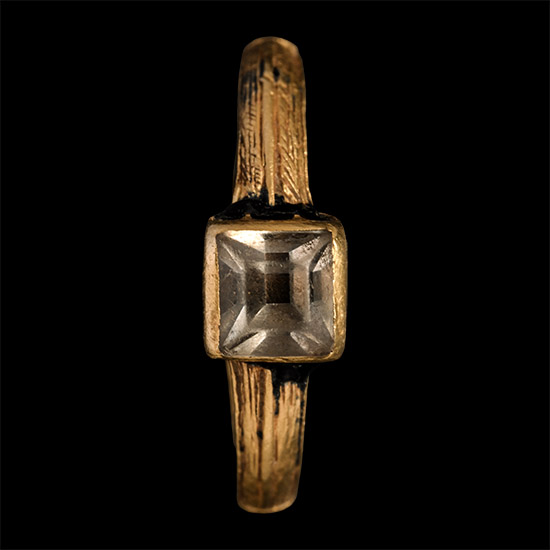
Post Medieval Enamelled Gold Ring with Table-Cut Rock Crystal Gemstone
Netherlands, 17th century A.D.Sold for (Inc. bp): £1,560
D-section hoop with carinated profile, ribbing to the shoulders, square bezel with arcade detailing to the base, and inset table-cut crystal. 3.10 grams, 23.84 mm overall, 17.41 mm internal diameter (approximate size British N 1/2, USA 6 3/4, Europe 14.35, Japan 13)
By repute from Maastricht, Netherlands. Acquired on the European art market. -
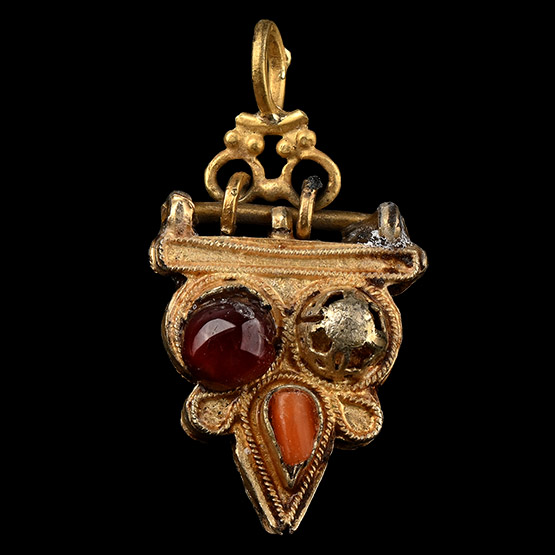
Medieval Gold Pendant with Gemstones
14th-16th century A.D.Sold for (Inc. bp): £572
Triangular plaque with two plano-convex cabochon gemstones and a third tubular carnelian bead in a teardrop cell; articulated suspension ring with granulated detailing. 3.7 grams, 32 mm
From the collection of a late Japanese gentleman, 1970-2000s. -
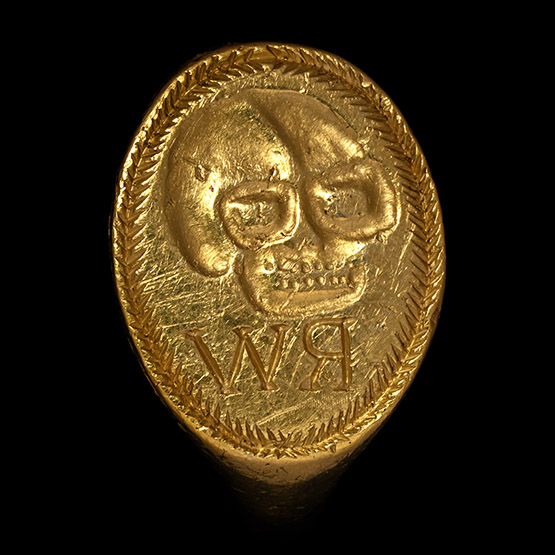
Post Medieval Gold Memento Mori Ring with Skull
17th-19th century A.D.Sold for (Inc. bp): £3,380
Ellipsoid plaque with wreath border enclosing an incuse skull in three-quarter view and initials 'RW' below. 7.73 grams, 21.01 mm overall, 19.06 x 18.44 mm internal diameter (approximate size British R, USA 8 1/2, Europe 18 3/4, Japan 18)
Private collection, Europe. Acquired on the English art market. This lot has been checked against the Interpol Database of stolen works of art and is accompanied by a search certificate number no.13046-248360.
The memento mori jewellery of the 16th and 17th centuries served as wearable ‘reminders of mortality’. Typical motifs within this genre included skulls, skeletons, crossbones, hourglasses, coffins, the gravedigger’s pick and shovel, and various other emblems of death and decay. -
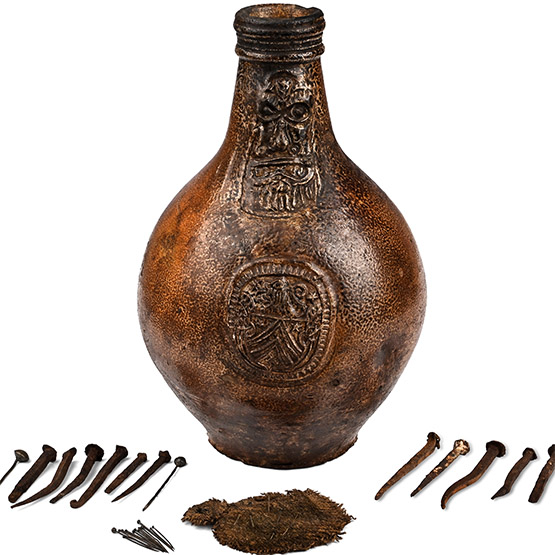
Very Large Glazed Bellarmine Witch's Bottle with Contents
Late 16th-early 17th century A.D.Sold for (Inc. bp): £9,750
Vessel of squat spherical form with a broad cylindrical neck, strap handle and foot with rolled rim, bearded face (Bartmann 'mask') and other detailing; with original contents comprising: eight iron clout nails with square-section shank and domed head; three similar with flat head; base metal dress pin with hollow-formed spherical head; similar with biconvex head; fragment of coarse-woven textile with five pins in situ; thirteen unassociated pins. 1.7 kg total, bottle: 26.5 cm
From the private collection of a London, UK, gentleman.
Witch bottles were a response to the common belief in witchcraft, which was feared in the Puritan culture of those times. The process involved heating the victim’s urine in a bottle, mixed with human hair and metal nails and pins, sometimes inserted into a cloth panel representing the victim's heart. The bottle was then either buried under the hearth of a house (East Anglian tradition) or thrown into a river (London tradition). The heating of the bottle was supposed to transfer to the body of the witch who had caused the victim to be afflicted.

