-
.jpg)
Massive Medieval Gilt Oak Hammer Beam Roof Angel Pair
Possibly East Anglia, 1470-1500 A.D.Sold for (Inc. bp): £5,200
Comprising a matched pair of substantial hammer beams from a truss roof, each with a longitudinal slot in the upper face at the rear and socketted brace; slightly tapering square-section body with tiered feather carved detailing, collar of domed bosses on the neck of an angelic head with flounced curls of hair, fleshy facial details with carved eyes and pupils; drilled to accept trennels, some in place; some gilding and pigment present; some longitudinal splitting. 80.5 kg total, 142 cm each
From a family collection for over 60 years. From a late friend of Mr Robin Cox of Newark, UK. Accompanied by an academic report by Dr Raffaele D’Amato. This lot has been checked against the Interpol Database of stolen works of art and is accompanied by search certificate number no.13033-247084. -
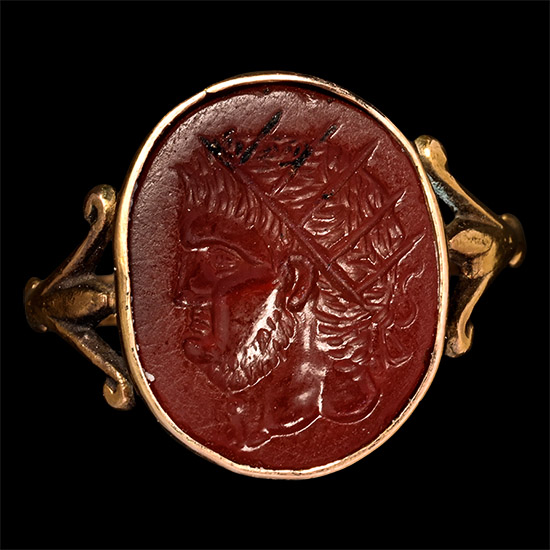
Renaissance Carnelian Intaglio of the Roman Emperor Nero in Gold Ring
Italy, 16th-17th century A.D.Sold for (Inc. bp): £1,755
With narrow shank and fleur-de-lys to each shoulder supporting an ellipsoid cell with inset carnelian intaglio profile bust of Nero with solar crown; supplied with a museum-quality impression. 3.64 grams, 22.23 mm overall, 20.44 mm internal diameter (approximate size British P, USA 7 1/2, Europe 16.23, Japan 15)
Private collection, Europe. Acquired on the English art market.
Nero, who reigned as Roman Emperor from 54 to 68 AD, is one of history’s most infamous rulers, known for his extravagant lifestyle, ruthless rule, and controversial actions. Born as Lucius Domitius Ahenobarbus, he was adopted by his great-uncle, Emperor Claudius, and ascended the throne at the age of 16, initially under the guidance of his mother, Agrippina the Younger, his tutor Seneca, and the Praetorian Prefect Burrus. Early in his reign, Nero promoted arts and cultural projects and enjoyed popularity, but as he gained autonomy, he became increasingly tyrannical. He allegedly ordered the deaths of his mother, wife, and other prominent figures. Nero is often (though likely inaccurately) associated with the Great Fire of Rome in 64 AD, after which he blamed and persecuted Christians, marking one of the earliest recorded persecutions of the group. His reign ended in turmoil and revolt, leading to his suicide in 68 AD, which marked the end of the Julio-Claudian dynasty. His legacy remains controversial, remembered as both a patron of the arts and an archetype of a decadent, cruel autocrat. -
.jpg)
Renaissance Carnelian Gemstone Depicting the God Mercury in Gold Ring
16th-17th century A.D.Sold for (Inc. bp): £1,170
Cloison with incuse figure of Mercury standing with caduceus and marsupium; set into a later gold ring; supplied with a museum-quality impression. 4.63 grams, 24.38 mm overall, 18.99 mm internal diameter (approximate size British R 1/2, USA 8 3/4, Europe 19.38, Japan 18)
Private collection, Europe. Acquired on the English art market. -
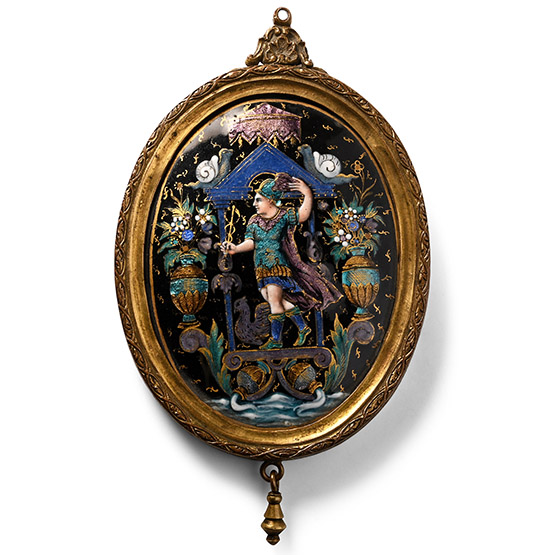
Post Medieval Gilt Enamelled Mirror Case Depicting the Roman God Mercury
Limoges, early 17th century A.D.Sold for (Inc. bp): £4,160
Oval in plan with a vivid polychrome enamel scene on a black ground to the upper face of the lid, within a gilt-copper frame: Mercury, identifiable by his winged helmet and caduceus, standing beneath a classical arch flanked by stylised columns and vases of flowers; above the entablature, a canopy held aloft by two snails, with twin ewers crowning the upper corners and issuing stylised streams; the architectural and ornamental elements highlighted with translucent and opaque enamel, highlighted with gilding and intricate punchwork; the frame with a guilloche border, surmounted by a pierced rocaille loop with a scallop motif, and terminating below in a turned pendant finial; the sides of the frame engraved with a delicate foliate frieze, the reverse flat-chased with three vases of stylised flowers issuing from scrolled supports, framed above by draped swags, butterflies, and a winged cherubic mask; the case hinges open at the top, the interior, originally fitted with mirrored glass, now partially oxidised but retaining areas of reflection. 168 grams, 14.4 cm
Private collection, France. Private collection, UK. This lot has been checked against the Interpol Database of stolen works of art and is accompanied by search certificate number no.12998-246011.
The enamel composition is directly derived from a print by Étienne Delaune (1518/19-1583), from his series Grotesques à Fond Noir, Dieux et Déesses, created in France c.1550-1572, before he departed for Strasbourg. Delaune’s engravings were a principal source for Limoges enamellers of the late 16th and early 17th centuries, particularly in the production of oval mirror plaques for personal toilette or cabinet display. -
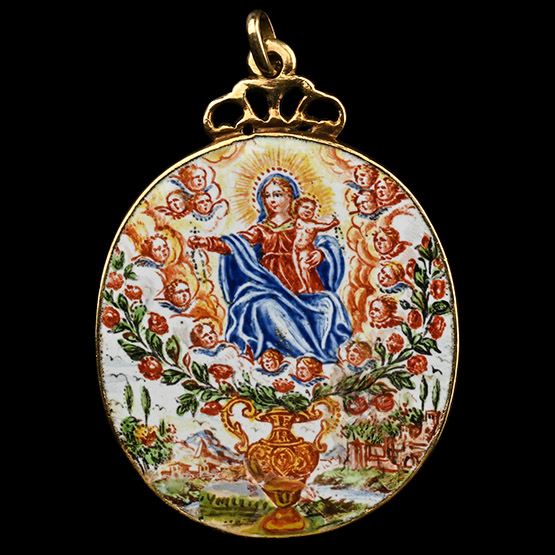
Enamelled Gold Pendant Depicting the Virgin and Child with Saints
Sicily, 17th-18th century A.D.Sold for (Inc. bp): £3,900
Decorated to obverse with a vase abundant with flowers in a mountainous landscape, with reserved roundels containing the images of Saints Anthony of Padua, John the Baptist and Saint Dominic de Guzmán; reverse with another vase in a landscape emitting a rose garland supporting an image of the Virgin and Child in Majesty, amidst clouds and angels. 24 grams, 61 mm
Private collection, Europe. Acquired on the French art market. This lot has been checked against the Interpol Database of stolen works of art and is accompanied by search certificate number no.13057-248398.
The pendant is decorated in the manner of Giuseppe Bruno who was an enameler from Messina, Sicily (active c.1652-82). -
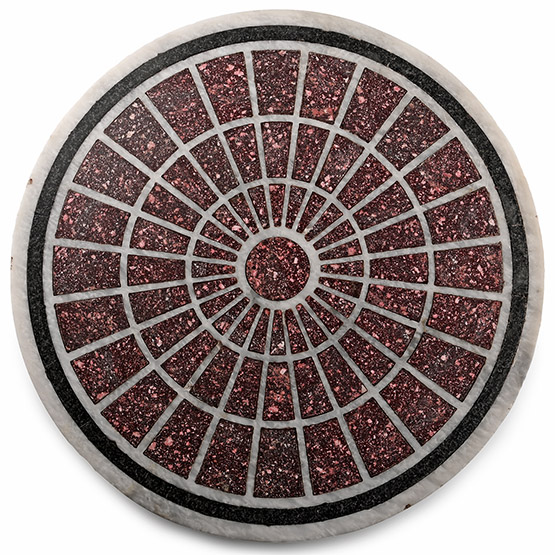
Imperial Porphyry Specimens from the Grand Tour Set into a Marble Table Top
Late 19th-early 20th century A.D.Sold for (Inc. bp): £3,640
Porphyry specimens set into a circular marble 'table top' with a black band border similar to items from the workshop of Francesco Sibilio. 14.75 kg, 39.3 cm
Acquired from Diana Steel in Suffolk around 2000. From the private collection of a Somerset gentleman. -
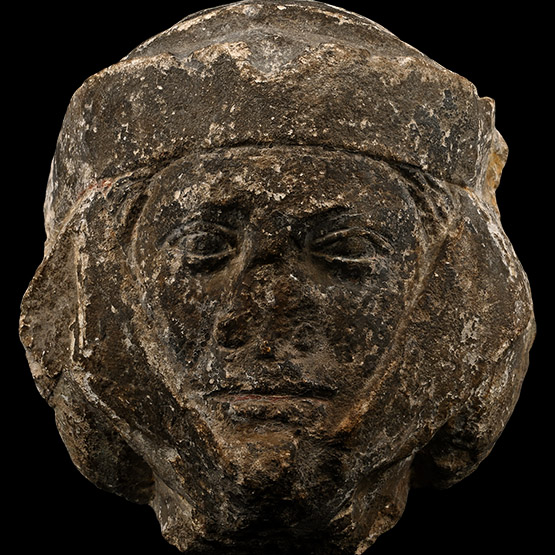
Medieval Stone Female Head
France, 14th century A.D.Sold for (Inc. bp): £780
Carved in the half-round with filet brow-band and chin-band; narrow triangular face with slit mouth and lentoid eyes; lateral bunches of hair beneath the wimple; mounted on a custom-made stand. 3.11 kg total, 24 cm high including stand
Private collection, UK. -
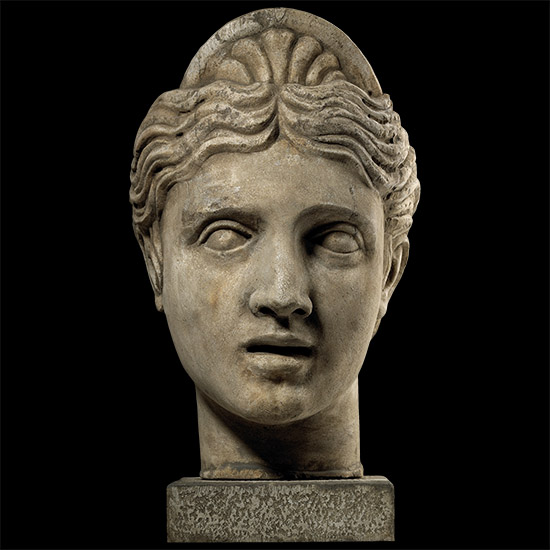
Post Medieval Marble Portrait of the Greek Goddess Hera
17th-18th century A.D.Sold for (Inc. bp): £5,980
Modelled in the round with gracile features, braided hair, arched diadem to the brow. 32 kg, 42 cm high including stand
Private collection, England. This lot has been checked against the Interpol Database of stolen works of art and is accompanied by search certificate no.13081-249676.
The type of sculpture seems to be inspired by the type of the Barberini Hera, a Roman copy from the imperial age, today in the Chiaramonti Museum (Vatican Museums). The sculpture was discovered by the antiquarian Leonardo Agostini in the late 17th century, during excavations on the Viminal Hill. The site was located beneath the convent affiliated with the church of San Lorenzo in Panisperna, an area known to have hosted the ancient Baths of Olympiades. Its identification as the Barberini Hera was established by its early owner, Cardinal Francesco Barberini. -
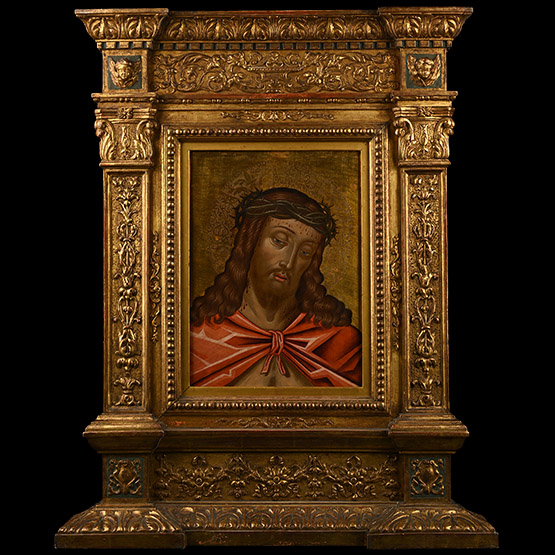
Large Veneto-Cretan Icon of 'Ecce Homo' in Gilt Wooden Frame
17th century A.D.Sold for (Inc. bp): £10,400
With the portrait of Christ in tempera and gold on wood panel, with mounting slots to reverse; gessoed board with gilt surface, reserved portrait bust in three-quarters view on a textured field with tendrils, scrolls and other ornament within the nimbus; Christ shown with shoulder-length auburn hair and short beard wearing a scarlet cloak fastened at the centre of the neck and crown of thorns on his head; facial expression of suffering and pain, with drops of blood on his forehead; the icon set in a carved gilded wooden frame with a beaded edge, flanked by two small pillars with rich vegetal decoration and angel heads in the upper part. 7.75 kg, 79 x 58.5 cm
Acquired on the European art market. Private collection, London, UK. Accompanied by an academic report by Dr Raffaele D’Amato. This lot has been checked against the Interpol Database of stolen works of art and is accompanied by search certificate number no.13061-249291.
This splendid specimen represents Christ as ‘Ecce Homo’, when Pilate, in the desperate attempt to save Jesus from Crucifixion, presented him to the people of Jerusalem dressed in a red cloak and wearing the crown of thorns (John, XIX,5). -
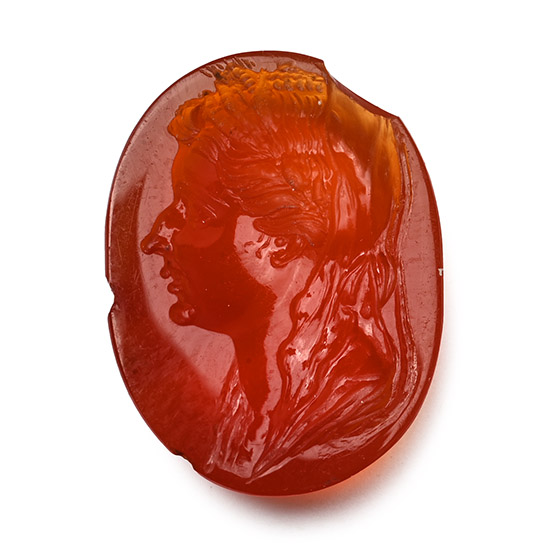
Neoclassical Carnelian Gemstone with Bust of the Roman Empress Livia as the Greek Goddess Ceres
Italy, 18th century A.D.Sold for (Inc. bp): £650
Intaglio profile bust of Empress Livia with laurel wreath to her long hair, presented in the guise of Ceres; supplied with a museum-quality impression. 1.51 grams, 19 mm
Private English collection, formed between the late 1970s and early 1990s. Private collection, London, UK.
Livia Drusilla (59 B.C.-A.D. 29) was Roman empress from 27 B.C.-A.D. 14 as the wife of Emperor Augustus. She was known as Julia Augusta after her admission into the Julian family in AD 14. Charis (Greek: Χάρις meaning 'Grace') was a goddess in Greek mythology, one of the 'Charites' or 'Graces' associated with charm, beauty, nature, creativity and fertility. -
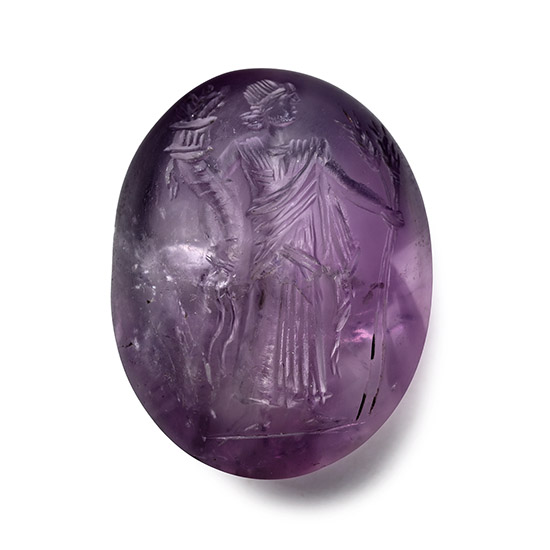
Post-Classical Amethyst Gemstone of the Roman Goddess Fortuna
19th century A.D. or laterSold for (Inc. bp): £1,300
Biconvex in section with intaglio Fortuna standing in ankle-length robe on a baseline, supporting a cornucopia in one arm and holding two stems; supplied with a museum-quality impression. 6.15 grams, 24 mm
Private English collection, formed between the late 1970s and early 1990s. Private collection, London, UK. -
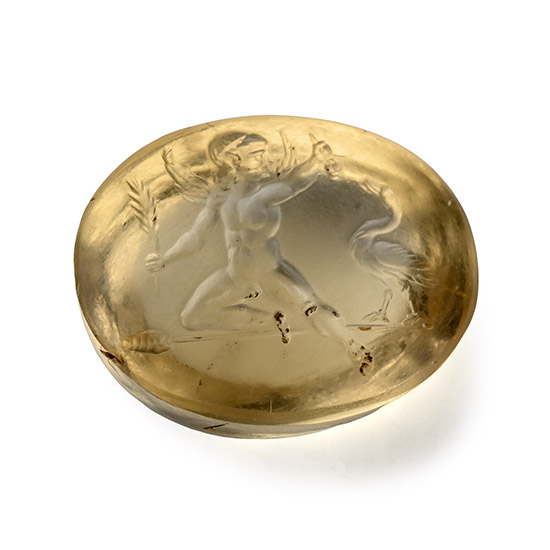
Neoclassical Citrine Gemstone with Putto and Goose
18th-19th century A.D.Sold for (Inc. bp): £1,430
Plano-convex type with incuse scene of a putto kneeling on an arrow with one leg extended over it, holding the flight-feather of a bird in one hand and encouraging a goose to feed from the other hand; with traces of copper tooling; supplied with a museum-quality impression. 1.32 grams, 12 mm
Private English collection, formed between the late 1970s and early 1990s. Private collection, London, UK.
Perhaps the putto is encouraging the goose to approach him so that he can pluck its flight-feathers for use on the shafts of his arrows.

