-
.jpg)
Large Post Medieval Merchant’s Seal Ring Engraved with 'BG' and Shield
Germany, 16th century A.D.Sold for (Inc. bp): £12,350
Engraved with the owner's initials ‘B G’ above a tilting shield with flanche; merchant's mark motif of capital 'A' and a cross. 20.03 grams, 28.33 mm overall, 23.00 x 18.47 mm internal diameter (approximate size British T 1/2, USA 9 3/4, Europe 21.89, Japan 21)
Private collection, Europe. Acquired on the English art market. This lot has been checked against the Interpol Database of stolen works of art and is accompanied by a search certificate number no.13051-248349.
Merchants' marks were chosen by their owners as a form of personal cypher, and so it is almost impossible to decipher the owner of many merchants' marks, as they were not governed by the strict regulation and recording that heraldry laws dictated. Merchants' rings were engraved with geometric symbols used to mark their goods or personal belongings and used instead of a coat of arms for those not entitled to them. Most merchants in the sixteenth and seventeenth centuries had marks, easily identifiable and formed with a few strokes. Many such rings also bear religious or talismanic inscriptions or imagery, combining a spiritual with a commercial function. The shape of the shield on this example draws direct parallels to the heraldic shields and jewels of this period in Germany. -
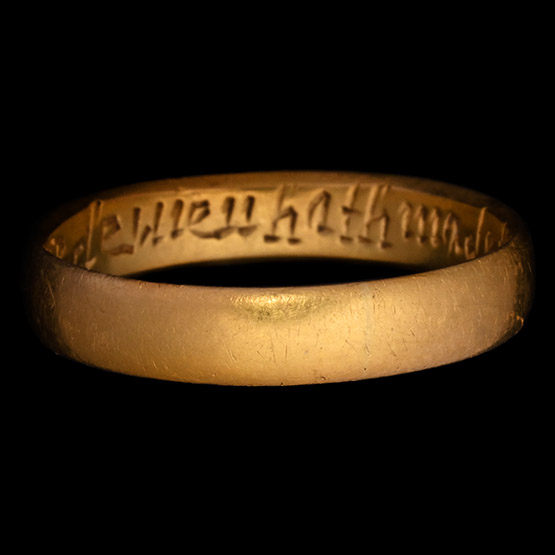
Large Post Medieval 'Providence Divine Hath Made Thee Mine' Gold Posy Ring
Circa 18th century A.D.Sold for (Inc. bp): £2,080
D-shaped in section with minuscule italic inscription to inner face 'prouidence deuien hath made thee mine'. 5.12 grams, 22.51 mm overall, 19.59 mm internal diameter (approximate size British T, USA 9 1/2, Europe 21.26, Japan 20)
From a collection which predates 1982. Property of a Somerset collector, UK, since circa 2013. -
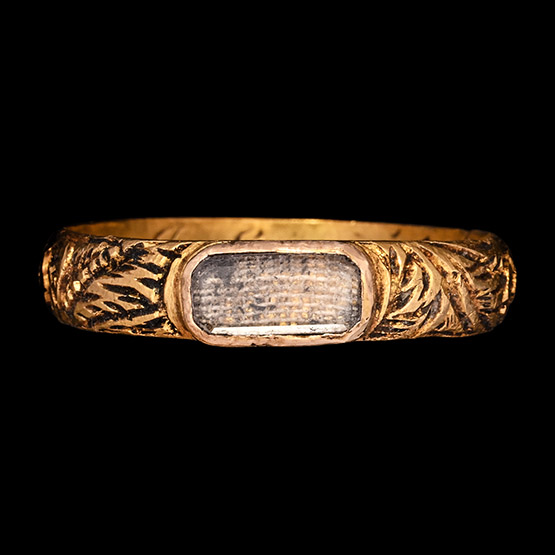
Stuart Period Gold Mourning Ring with Rock Crystal Gemstone
England, 18th century A.D.Sold for (Inc. bp): £2,860
Decorated with black enamelled foliate engraving; bezel set with a table cut rock crystal compartment containing some hair of the deceased; inner face engraved ‘Capt(ain). G Squrritt ob 1 Jan 1724’ and the maker's mark ‘GE’. 3.33 grams, 20.04 mm overall, 17.17 mm internal diameter (approximate size British M, USA 6, Europe 12.46, Japan 12)
Private collection, Europe. Acquired on the English art market. This lot has been checked against the Interpol Database of stolen works of art and is accompanied by search certificate number no.13055-248357.
Mourning rings were made to commemorate the death of an individual. Similar examples are held in the British Museum's collection, including AF.1547; AF.1551; AF.1550; AF.1552; AF.1549. While the majority of mourning rings tend to refer to the deceased by initials and death only, this ring mentions the deceased's family name in full, which is usually the case for people of note/influence. -
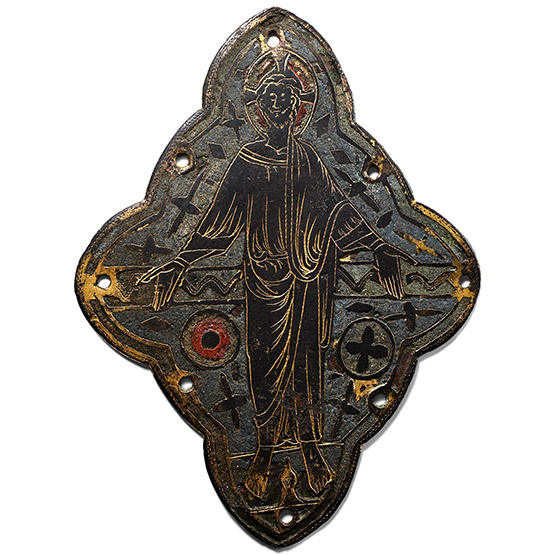
Large Medieval Gilt Bronze Champleve Plaque Depicting Christ in Majesty
Limoges, 13th century A.D.Sold for (Inc. bp): £3,900
Decorated in blue, green and red champlevé enamel, displaying the engraved figure of a standing Christ, his hands gesturing outwards towards the viewer; traces of original gilding; originally the central panel of a processional cross. 124 grams, 15.2 cm
Private collection, Europe. Acquired on the French art market. This lot has been checked against the Interpol Database of stolen works of art and is accompanied by search certificate number no.13092-248393.
From the 12th to 14th century, there was a large industry producing metal objects decorated in enamel using the champlevé technique, of which most of the survivals and probably most of the original production, are religious objects such as reliquaries, crosses and statues of saints. The centre of this production was Limoges, France. -
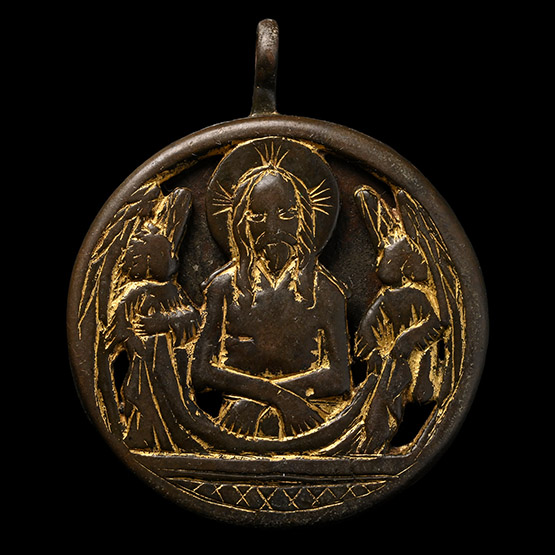
Medieval Gilt Copper Devotional Reliquary Pendant
Germany, 15th century A.D.Sold for (Inc. bp): £572
A large circular openwork pendant with a fitted lid, the lid depicting Christ between two angels holding a shroud; the reverse with seated and crowned Virgin Mary holding infant Jesus on her lap. 57.2 grams, 57 mm
Private collection, UK. -
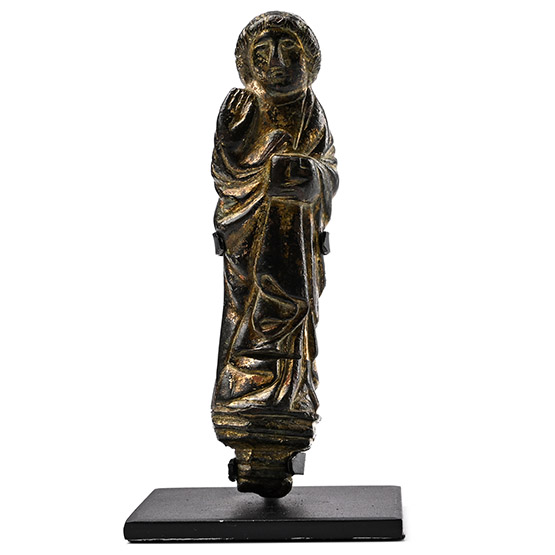
Medieval Gilt Bronze Figure of Saint John the Evangelist
15th century A.D.Sold for (Inc. bp): £585
Modelled in the round columnar figure with right hand raised and left hand holding a book; wearing a floor-length robe, standing on a tiered hexagonal base; mounted on a custom-made stand. 230 grams total, 10.1 cm including stand
Private collection, Europe. Acquired on the English art market. -
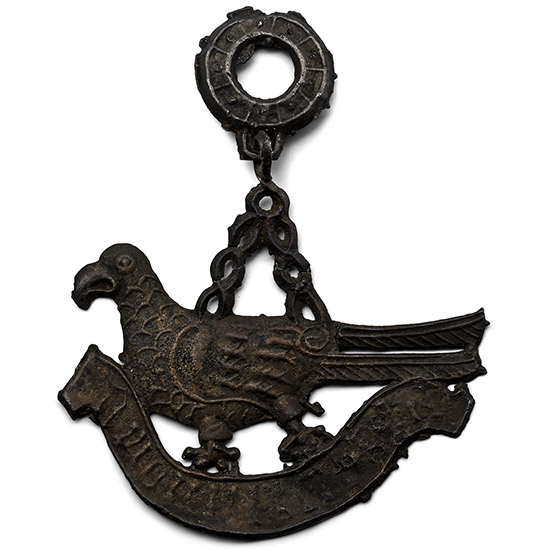
Large Medieval Pewter 'Love Conquers All' Secular Badge
Circa 14th-15th century A.D.Sold for (Inc. bp): £572
Formed as a standing bird (dove or popinjay) facing left with elongated tail and curved beak, standing on a scroll with partially faded inscription 'AMOR VINCIT OMNIA' (love conquers all), attachment ring to the top; complete and undamaged. 11 grams, 76 mm
Ex European collection. Ex Cambridgeshire, UK, collection. -
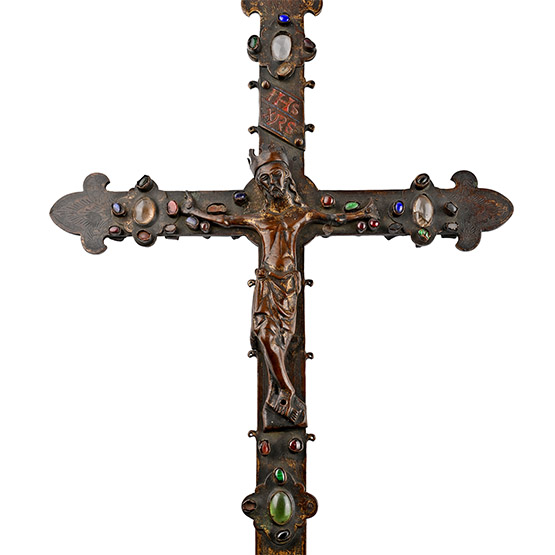
Large Medieval Limoges Gilt Copper Processional Cross
France, early 13th century A.D. and laterSold for (Inc. bp): £13,000
A substantial and finely worked crucifix, of elongated proportions, the surface retaining traces of original mercury gilding, with the arms of the cross enriched by inset red, blue and green cabochons arranged in the manner of a crux gemmata; on the obverse, a slender corpus with clearly defined ribs, a gently inclined head, and a well-articulated drapery falling from the gathered perizonium, the face exhibiting serene, introspective expression, over the crowned head a rhomboid appliqué with Gothic inscription in red enamel 'HIS XRS' (Iesus Hominum Salvator Χριστός = The Saviour Jesus Christ), four lobed appliqués on the arms, each with a large central cabochon flanked by smaller cabochons in high settings; the reverse with the surface decorated with rosettes and other vegetal motifs enamelled in champlevé on the four arms, central circular appliqué with rich floral decoration and numerous cabochons. 3.55 kg, 74.6 cm
Maintained within a family’s ancestral country residence, where it formed part of a small group of inherited ecclesiastical objects retained in private hands throughout the 19th and 20th centuries, thence by descent to the present owner. Accompanied by an academic report by Dr Raffaele D'Amato. This lot has been checked against the Interpol Database of stolen works of art and is accompanied by search certificate number no.13030-247521.
A distinguished item of enduring Northumbrian heritage, preserved within the same local family household for several generations. By established family tradition, the crucifix is thought to possess early devotional associations with the Raymes Chapel of St Andrew’s Church, Bolam, a site historically connected with notable gentry of the district. The cross is an exceptional example of Late Romanesque art, combining champlevé enamel appliqués - flat panels with geometric ornament – and the arms of the cross decorated in champlevé. However, this piece is a composite artwork: the circular floral plaque from Limoges, on the reverse, dates from the second quarter of the 13th century, while the facade plaques, of similar origin, come from the end of that same century; the figure of Christ from Central France seems to belong to a later medieval period. -
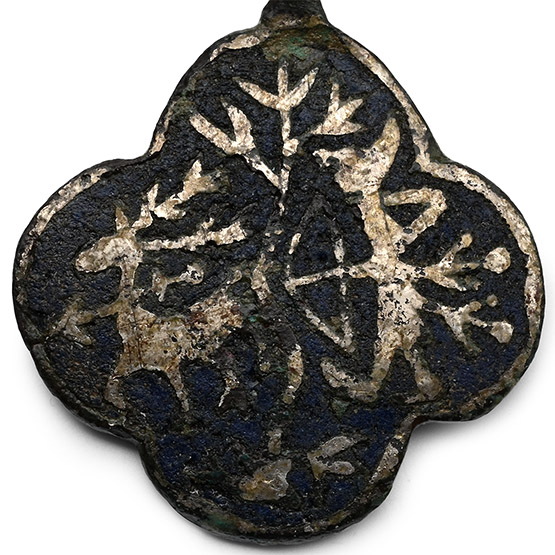
Medieval Knight's Heraldic Horse Harness Pendant with Royal Hunting Scene
13th century A.D.Sold for (Inc. bp): £2,340
Quatrefoil-type with integral loop and broad lobes; niello surface with reserved image of a bowman (right) with arrow nocked and one arm bent, advancing towards a stag (left) with tined antlers, an arrow having pierced it through the neck; scene divided by a median vertical tree with three radiating boughs. 11.36 grams, 38 mm
Found by Robert Wiseman in Longdon, Worcestershire, UK, circa 2015, next to a trackway leading to St John the Baptist church that was built by the military order of the Knights Hospitaller in the 12th century. Recorded with Mark Lodwick of the National Museum of Wales, Cardiff, UK.
Described by Phil Parkes, the conservator at the National Museum of Wales, as the best of its type that he had ever seen or worked on to clean and preserve, in 30 years. -
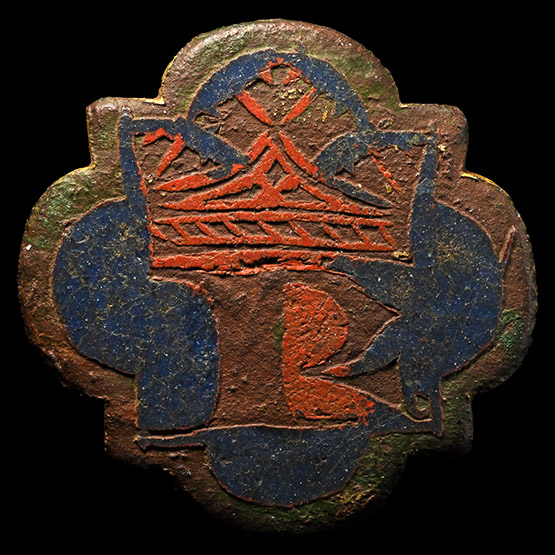
Large Medieval Enamelled Bronze 'Crowned R' Stud
15th century A.D.Sold for (Inc. bp): £520
Quatrefoil type with interstitial points, reserved capital 'R' on a blue enamelled field, reserved crown above. 24.4 grams, 42 mm
Found Norfolk, UK. -
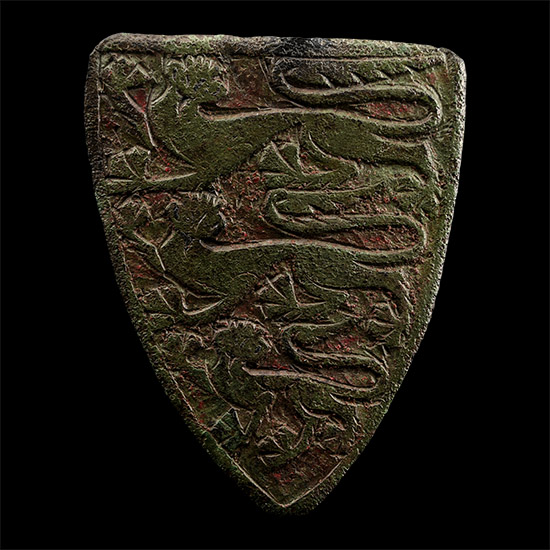
Large Medieval Knight's Bronze Royal Heraldic Horse Harness Mount
13th-15th century A.D.Sold for (Inc. bp): £2,340
Heater-shaped with low relief of three lions passant guardant. 34.6 grams, 70 mm
From the private collection of the late Graham Slater (1927-2024), Cambridge, UK, acquired 1980s-1990s. -
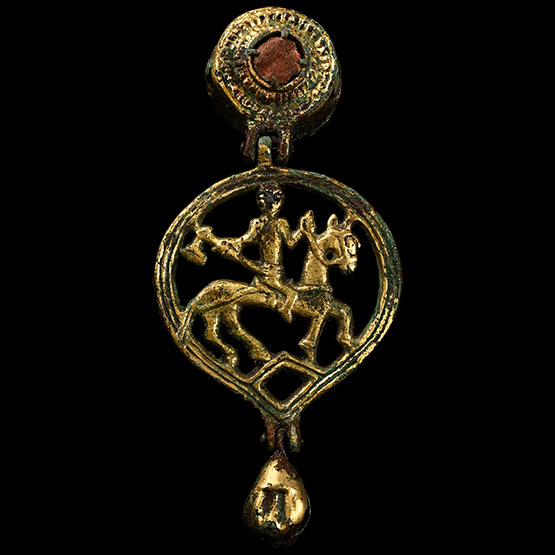
Medieval Knight's Gilt Bronze Horse Harness Pendant and Hanger with Axe-Wielding Rider
11th-12th century A.D.Sold for (Inc. bp): £3,380
Comprising: discoid plate with two concentric pelleted bands and central cell with claw setting, glass insert, attached to backplate by four shot bars; hinge below connected to an openwork teardrop pendant with profile image of a horseman advancing on a chevron baseline, his upper bdy turned to face the viewer, holding a large axe braced against his hip; hinge below connected to a bulb dangle with corrugated detailing. 29 grams, 10.2 cm
From the private collection of a London gentleman, from his grandfather's collection formed before the early 1970s. This lot has been checked against the Interpol Database of stolen works of art and is accompanied by search certificate number no.13147-248006.

