-
.jpg)
Viking Age Silver Filigree Teardrop Pendant
Circa 9th-11th century A.D.Sold for (Inc. bp): £2,080
Hollow-formed with integral suspension lug above, applied granulation and filigree forming a stylised face; cleaned and polished. 5.34 grams, 51 mm
Private collection formed in Europe in the 1980s. Westminster collection, central London, UK. -
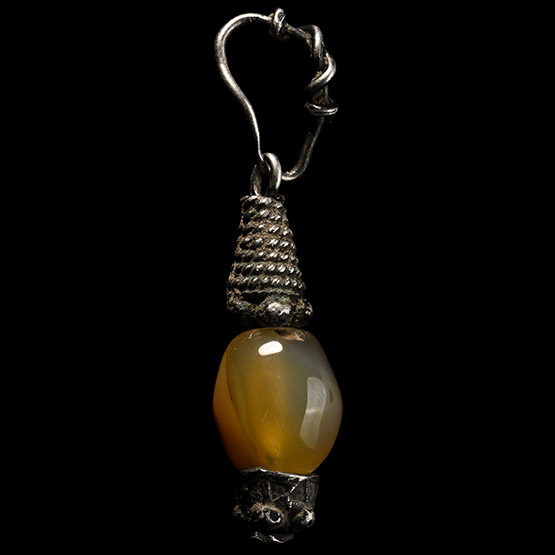
Viking Age Silver Pendant with Agate Bead
Circa 9th-11th century A.D.Sold for (Inc. bp): £247
Comprising a conical braided band with suspension loop above, oval agate bead, silver cap below. 10.4 grams, 57 mm
Private collection formed in Europe in the 1980s. Westminster collection, central London, UK. -
.jpg)
Langobardic Gold Bishop's Ring Bezel with Large Amethyst
7th-8th century A.D.Sold for (Inc. bp): £15,600
Square-section inverted pyramid bezel with ornamented faces, set with a polished amethyst pebble; restored hoop, flanked by outward-facing birds with hooked beaks and large ring-and-dot eyes; keeled decorative hoop with three integral collars at the base. 11.38 grams, 34.70 mm overall, 17.74 mm internal diameter (approximate size British M 1/2, USA 6 1/4, Europe 13.09, Japan 12)
Private English collection, formed between the late 1970s and early 1990s. Private collection, UK. This lot has been checked against the Interpol Database of stolen works of art and is accompanied by search certificate number no.12983-245992.
The Langobards (or Lombards) were a Germanic people who invaded and ruled much of the Italian Peninsula from 568 to 774 AD. Their kingdom, known for its fusion of Germanic and Byzantine artistic traditions, persisted until the Carolingian conquest under Charlemagne. A Bishop’s ring is a large, often ornate ring worn by bishops as a symbol of their office and spiritual authority. Traditionally, it signifies the bishop’s commitment to the Church and is considered a mark of his episcopal dignity. -
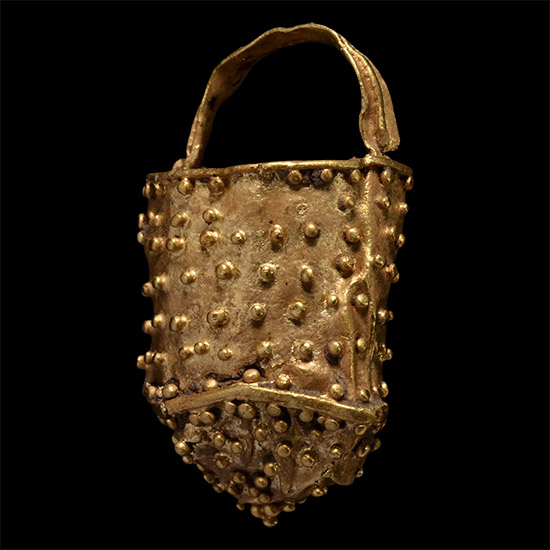
Pre-Viking Gold Aroma Bucket Pendant
4th-7th century A.D.Sold for (Inc. bp): £260
Miniature drum-shaped vessel covered in filigree bobbles with strap handle. 0.72 grams, 15 mm
Private collection formed in Europe in the 1980s. Westminster collection, central London, UK.
Pendants in the form of miniature buckets have been found in a number of pagan Anglo-Saxon and Viking contexts and are generally made of bronze or iron, with gold examples being rare; three gold examples were found with the hoard from Hoen, Norway. Bronze bucket amulets have been found at Driffield in Yorkshire, and Vimose bog in Denmark, among other places. In form they represent wooden buckets bound with bronze or iron bands which have been found in Anglo-Saxon and Viking graves and are believed to have held mead or ale and were used to replenish the cups from which warriors drank. As amulets they probably represent the ecstatic power of alcoholic drink and the role of women as the dispensers of these precious beverages. -
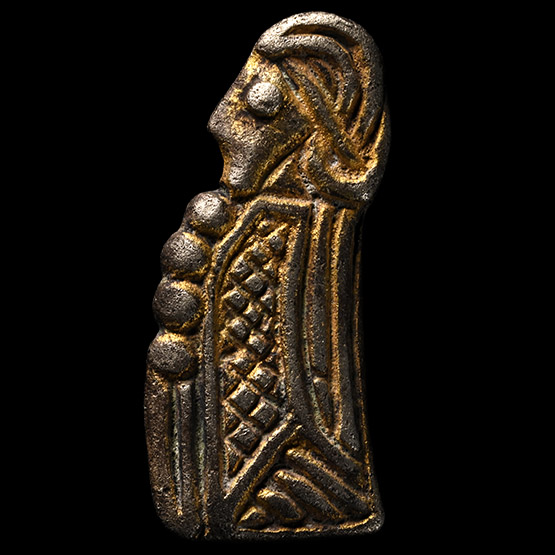
Viking Age Silver Maiden Pendant
Circa 10th century A.D.Sold for (Inc. bp): £2,210
Profile image of a female in floor-length robe with mantle to the shoulders, stylised headdress and long band of plaited hair to the rear edge; pierced lug to the reverse. 5.2 grams, 33 mm
Private collection formed in Europe in the 1980s. Westminster collection, central London, UK. -
.jpg)
Medieval Silver-Gilt Ring with Male Head Gemstone and Inscriptions
15th century A.D.Sold for (Inc. bp): £4,680
With applied outer layer of gold engraved with flowers and the words, “en bon an” (twice) (‘a good year’); the flat bezel with a recessed centre set with a medieval mother-of-pearl intaglio depicting a male bust in profile; supplied with a museum-quality impression. 4.72 grams, 23.64 mm overall, 20.45 mm internal diameter (approximate size British R 1/2, USA 8 3/4, Europe 19.38, Japan 18)
Found whilst searching with a metal detector in Dorset, UK, on Sunday, 30th December 2018. Acquired on the English art market. Accompanied by a copy of the British Museum's Portable Antiquities Scheme (PAS) report no.DEV-5E4EDA. This lot has been checked against the Interpol Database of stolen works of art and is accompanied by search certificate no.13069-248371.
The inscription is in black letter appears to read “en bon an”, a good year. The inscription is paralleled on a good number of 15th century rings, often also decorated with flowers and branches between the words, such as British Museum catalogue numbers AF.1057 and 1960,1103.1. -
.jpg)
Medieval Gold Ring with Cabochon
Circa 12th-14th century A.D.Sold for (Inc. bp): £572
Slender round-section hoop with bezel formed as a cup with claw setting for a dark blue gemstone. 3.3 grams, 23.81 mm overall, 15.35x18.64 mm internal diameter (approximate size British L, USA 5 3/4, Europe 1.24, Japan 10)
Ex German art market, 2000s. Acquired from an EU collector living in London. From the collection of a Surrey, UK, gentleman. -
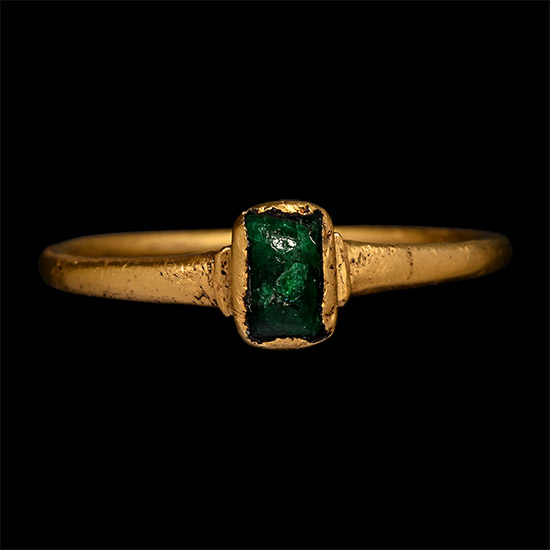
Medieval Gold Ring with Green Cabochon
13th-14th century A.D.Sold for (Inc. bp): £1,300
Hoop of slender profile with cup bezel, inset green glass cabochon. 2.61 grams, 24.57 mm overall, 18.62 mm internal diameter (approximate size British Q 1/2, USA 8 1/4, Europe 18.12, Japan17)
Formerly the property of a lady, acquired Brussels, Belgium. From a Bristol, UK, collection. Ex Buckinghamshire, UK, collection. Accompanied by an illustrated certificate of authenticity signed by J. Murray. -
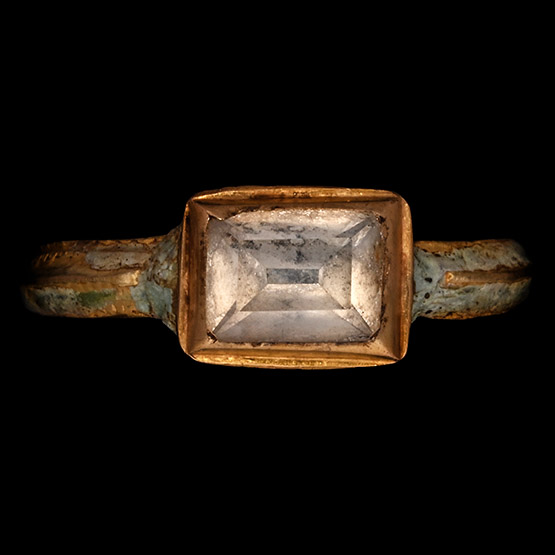
Stuart Period Enamelled Gold Ring with Table-Cut Rock Crystal
England, 17th century A.D.Sold for (Inc. bp): £2,600
D-section hoop with enamel panels to the shoulders, arcade to the rectangular bezel with inset table-cut crystal. 2.17 grams, 21.88 mm overall, 16.84 mm internal diameter (approximate size British M, USA 6, Europe 12.46, Japan 12)
Found whilst searching with a metal detector near Harlaxton, Lincolnshire, UK, on Wednesday 17th November 2021. Acquired on the English art market. Accompanied by a copy of the British Museum's Portable Antiquities Scheme (mPAS) report no.LIN-CCA6D4. This lot has been checked against the Interpol Database of stolen works of art and is accompanied by a search certificate number no.13050-248358.
Finger rings with a principal stone and subsidiary settings in separate collets came into use in the early 13th century, and this form of simple collet continued in use until the 15th century. A gold medieval finger ring with a similar bezel, but with subsidiary settings, is recorded on the PAS database (LIN-EC74C7, 2020T819). Other gold finger rings with a principal stone (albeit with subsidiary settings) and similar framed bezel recorded as treasure on the PAS database, including one from Soberton, Hampshire (HAMP-1DCFF0, 2017T156) and Huntingdon district area, CAM-4A8AB6, 2020T089. -
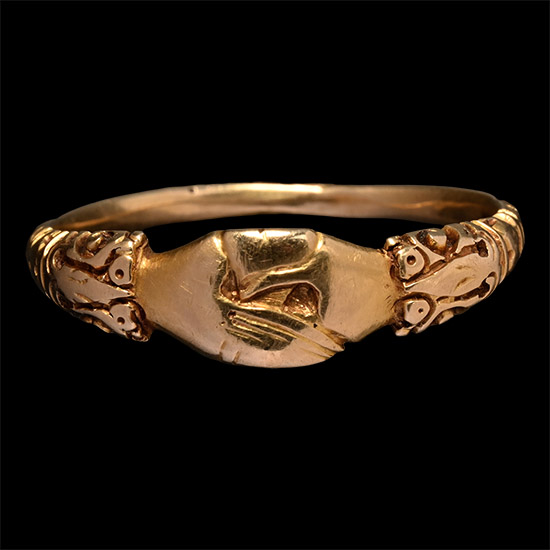
Post Medieval Gold Fede Ring
England, 16th-17th century A.D.Sold for (Inc. bp): £1,690
Slender shank and expanding shoulders formed as lace cuffs, the bezel a pair of clasped hands gripping a heart. 3.71 grams, 23.07 mm overall, 20.14 mm internal diameter (approximate size British T, USA 9 1/2, Europe 21.26, Japan 20)
Private collection, Europe. Acquired on the English art market.
The two clasping hands with elaborate cuffs clutch a heart. This ring features the ancient fede motif of two hands clasped together, however in their grasp is a heart. These symbols represented love and fidelity. The ring was likely a token of love symbolising everlasting devotion, or possibly a betrothal ring. The word Fede takes its name from the Italian word for faith or trust with the two clasped hands symbolising an attachment that usually led to marriage. The motif of the two clasped hands was already in use in ancient Rome, it was a symbol of pledging of vows, which derives from the Roman ‘dextarum iunctio’ (right hand joined). Fede rings remained popular throughout Europe until well into the 19th century with their peak of manufacture during the Middle Ages and the Renaissance. -
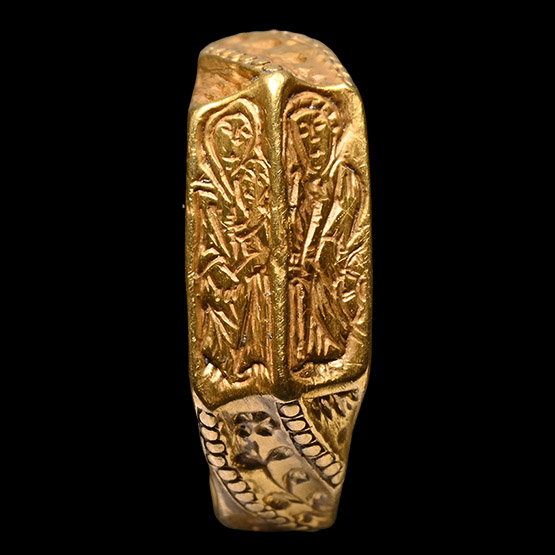
Medieval Iconographic Gold Ring with Mary, Jesus and Saint Catherine
15th century A.D.Sold for (Inc. bp): £5,460
The lower shank with twisted ropework detailing and carinated bands, the shoulders with raised median beaded bands flanked by flowers; the bezel in two panels, each with a reserved standing figure, a female saint in floor-length robe; Virgin Mary on the left panel holding infant Jesus; St Catherine supporting her attribute, a wheel. 6.17 grams, 21.27 mm overall, 16.93 x 17.98 mm internal diameter (approximate size British N, USA 6 1/2, Europe 13.72, Japan 13)
From a South London family collection of religious artefacts formed in the late 1970s to mid 1980s; thence by descent. Accompanied by an academic report by Dr Raffaele D’Amato. This lot has been checked against the Interpol Database of stolen works of art and is accompanied by search certificate number no.13032-247895.
This type of ring has been found in England, Scotland, Ireland and therefore appears to originate from the English regions, or from the territories under English domination. For the identification and use of these so-called iconographic finger rings and further parallels, you can see two detailed comparative examples in the Koch Collection. Many of these iconographic rings also had engraved love inscriptions, although not in our case. These finger rings differ only slightly in ring shape and decoration, but vary in the depictions of saints. -
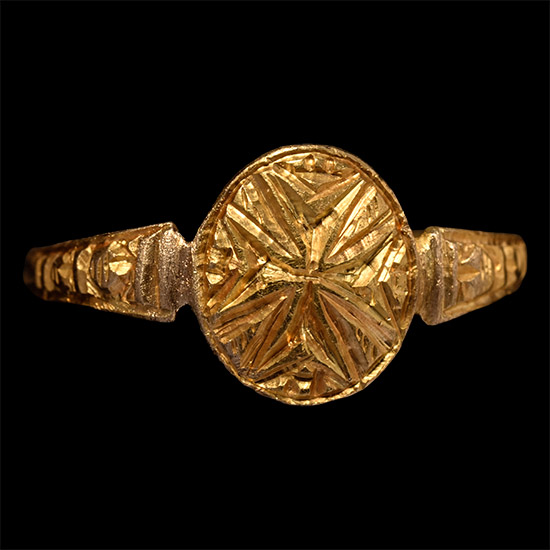
'The Dummer' Medieval Knight's Hospitaller Gold Ring
England, circa 1500-1540 A.D.Sold for (Inc. bp): £4,680
Featuring a sub-circular integral bezel decorated with an eight-armed Maltese cross with some incised decoration in its foils and a sub-circular border with traces of enamel in the field; the moulded shoulders bordered by a long triangle terminating with a long sub-oval indentation, slightly raised and decorated with two parallel lines and two circles with lines through the middle, possibly a stylised letter 'G', the shoulders tapering slightly to the narrowest section of the now straightened narrow and undecorated band. 1.21 grams, 18.40 mm overall, 16.62 mm internal diameter (approximate size British L 1/2, USA 6, Europe 11.87, Japan 11)
Found Dummer, Basingstoke and Deane, Hampshire, UK; declared as Treasure under the Treasure Act and disclaimed. Accompanied by a copy of a letter explaining that the Crown’s interest in this find has been disclaimed. Accompanied by a copy of the Report on find of Potential Treasure for H M Coroner no.2023 T292. Accompanied by a copy of the British Museum's Portable Antiquities Scheme (PAS) report no.HAMP-463CD7.
This motif is symbolic of membership in an Order of Knights Hospitaller, such as the Order of St John. In England, these Knights ceased to hold property after 1540 and the English Reformation. This suggests that the ring is from the earlier part of the sixteenth century. However, the letter 'G' is a prominent symbol of Freemasonry, where it typically stands for Geometry and/or God, the 'Grand Architect of the Universe'.

