-
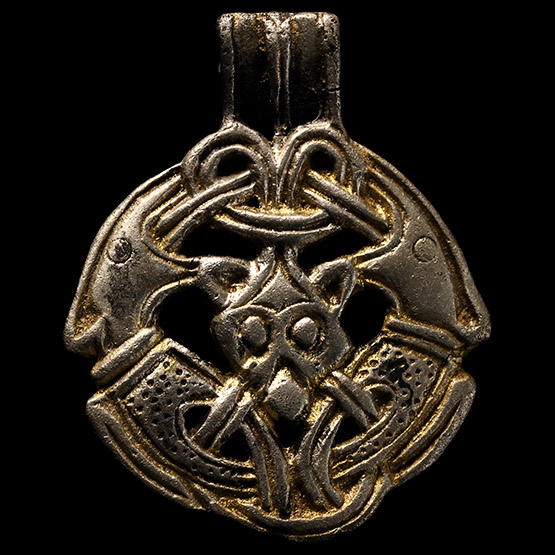
Viking Age Silver Beast Pendant
Circa 9th-11th century A.D.Sold for (Inc. bp): £975
Openwork panel in the form of two opposed beasts with their open jaws interlaced to form a loop; central facing mask; ribbed suspension tube above. 7.09 grams, 39 mm
Private collection formed in Europe in the 1980s. Westminster collection, central London, UK. -
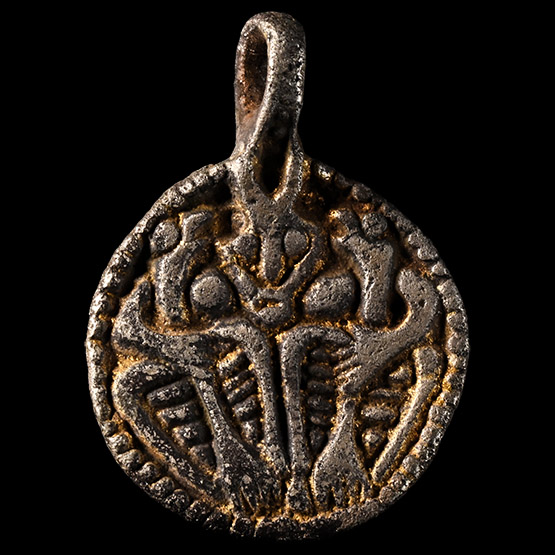
Viking Age Silver Pendant with Odin and Ravens
Circa 9th-11th century A.D.Sold for (Inc. bp): £663
A discoid pendant with integral loop, beaded border enclosing a low-relief gilded image of a male facing mask between two birds embraced at the necks. 2.98 grams, 22 mm
Private collection formed in Europe in the 1980s. Westminster collection, central London, UK. -
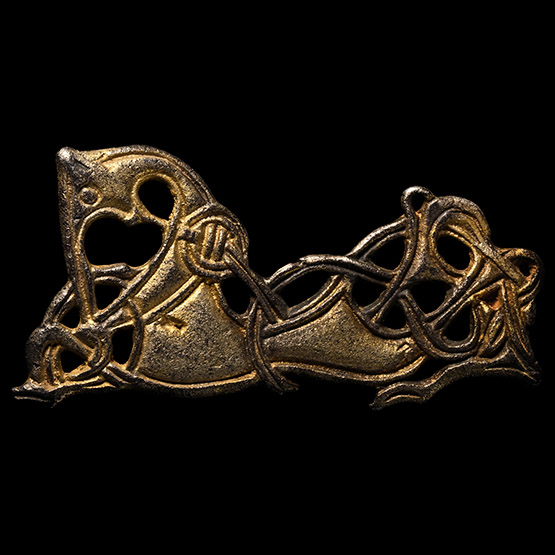
Scandinavian Viking Silver-Gilt Oseberg Style Brooch
9th century A.D.Sold for (Inc. bp): £3,120
Plate brooch formed as an advancing animal executed in early Oseberg Style with looped tendrils around the body; pin-lugs and catch to reverse. 8.88 grams, 50 mm
Private collection formed in Europe in the 1980s. Westminster collection, central London, UK. This lot has been checked against the Interpol Database of stolen works of art and is accompanied by search certificate number no.13091-248792.
Remarkably similar to the famous brooch from Lamøen, Vestfold, Norway, the brooch retains much of its original gilding. -
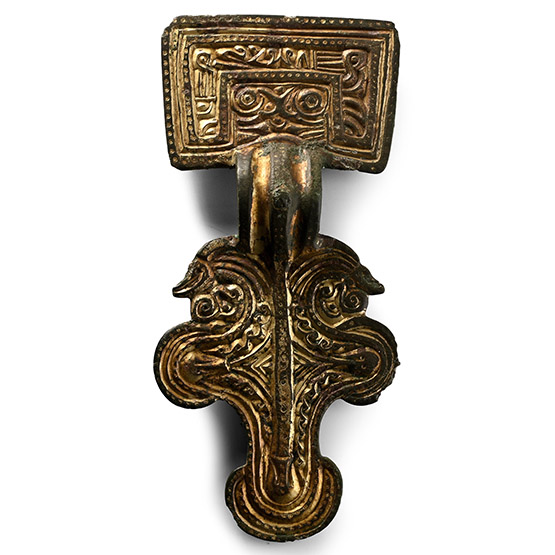
Large Anglo-Saxon Gilt Bronze Great Square-Headed Brooch
Late 5th-6th century A.D.Sold for (Inc. bp): £5,200
Comprising a rectangular headplate with outer concentric bands of punched points, inner of Style I animals, raised border, and inner panel of scrolls; bow with three raised vertical ribs; footplate with lateral lappets featuring profile horse-heads; median bar with punched points, lozenge panels with scrolled border and rounded lateral and finial lugs; pin-lugs and catch to the reverse. 83 grams, 13.5 cm
Found Seaham, Co Durham, UK. Property of a Durham private collector. This lot has been checked against the Interpol Database of stolen works of art and is accompanied by search certificate number no.12982-245110. -
.jpg)
Anglo-Saxon Bronze Applied Disc Brooch
Circa 5th-6th century A.D.Sold for (Inc. bp): £293
Discoid in plan with pin-lug, chord, pin and catch to the reverse; applied rim secured by four domed rivets; low-relief hexafoil motif with interstitial ring-and-dot motifs, segmented border. 16.9 grams, 48 mm
Found Cambridgeshire, UK. Acquired on the UK art market in the 1980s. From the private collection of an Essex gentleman.
Applied brooches are a recognised form of early Anglo-Saxon costume, associated mostly with Saxon areas such as Sussex and the Thames valley. The majority of such brooches are made up from a plain backplate with the pin and catch attached, and a thin front plate with repoussé ornament. The present example appears to be formed as a decorative body with an applied rim; there is evidence for this construction technique in the form of two unassociated rims from a grave at Fairford (Gloucestershire) (MacGregor & Bolick, item 1.39). -
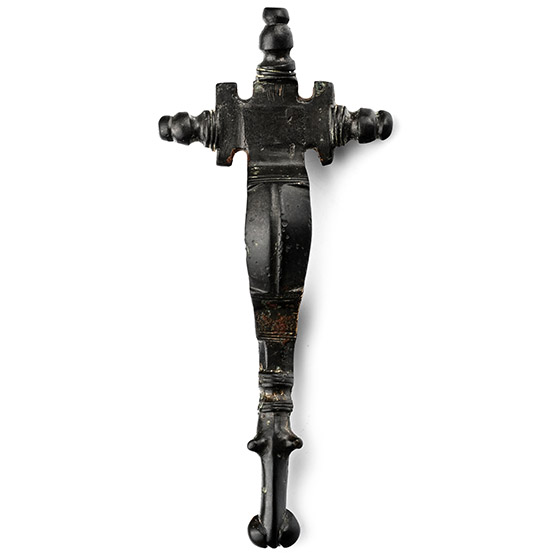
Anglo-Saxon Bronze Cruciform Long Brooch
6th century A.D.Sold for (Inc. bp): £351
Comprising a rectangular headplate and three radiating knops, broad bow and horse-head footplate with scrolled nostril, suspension loop to the reverse; accompanied with note reading: 'Anglo-Saxon, Bronze Cruciform Brooch, C. 6th century AD, Bronze cruciform brooch of fine quality. Features an integral top & side with semi-circular knobs & moulded collars. it has short wings & a high arched bow with a central groove & faceted corners, with a fine zoomorphic foot. Provenance: M. O'Bee collection, found in Lincolnshire in the 1970's.' 19.2 grams, 80 mm
Found in Lincolnshire, UK, in the 1970s. M. O'Bee collection. Accompanied by a previous catalogue information ticket. -
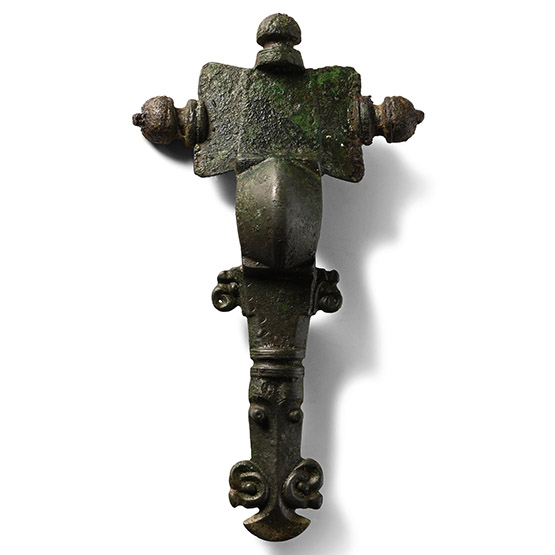
Large Anglo-Saxon Bronze Cruciform Brooch
Late 5th-6th century A.D.Sold for (Inc. bp): £650
Comprising a rectangular headplate with a central trapezoidal panel, three radiating collared D-section knops; a deep carinated bow with chamfered step at each end; trapezoidal foot with lateral coiled lappets; gusseted collar and carinated horse-head finial with scrolled nostrils; ferrous mass to reverse with impressed fabric, catchplate. 68 grams, 12.6 cm
Found Seaham, Co Durham, UK. Property of a Durham private collector. -
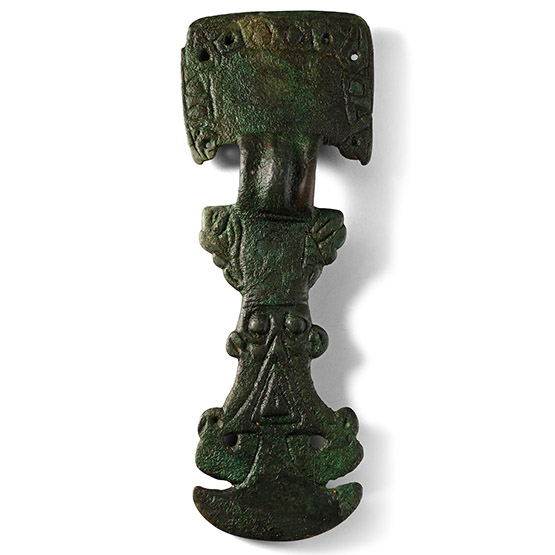
Large Anglo-Saxon Bronze Great Square-Headed Brooch
Late 5th-6th century A.D.Sold for (Inc. bp): £910
Comprising a rectangular headplate with openwork masks to the outer edge, imprint of fabric to the central panel; shallow bow with three vertical ribs; lappets below the bow, footplate developing to a triangular facing mask with domed eyes and concentric triangles, openwork finial with pelta-shaped panel; pin-lug and catch with ancient repair to the reverse. 72 grams, 13.9 cm
Found Seaham, Co Durham, UK. Property of a Durham private collector. -
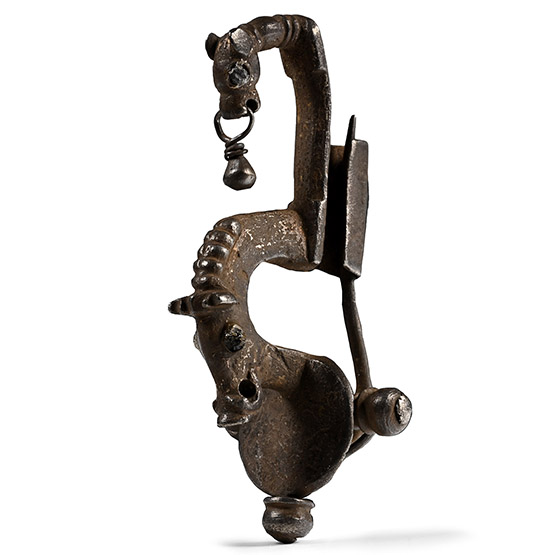
Dark Age Silver Boar Bow Brooch
5th-7th century A.D.Sold for (Inc. bp): £1,560
Comprising a circular headplate with pointillé tendril ornament, and three radiating lugs, each with a flared collar below; deep D-section bow with boar-head modelling including open mouth and tusks, bristles and pricked ears; parallel-sided chamfered edges, recurved finial with dog-head detailing and teardrop dangle in the mouth; spring and pin to the reverse. 28 grams, 65 mm
with Artemis Gallery, Münich, before 1998. Acquired by the present owner from the above in 2001. Accompanied by an academic report by Dr Raffaele D'Amato. This lot has been checked against the Interpol Database of stolen works of art and is accompanied by search certificate number no.12226-222179.
As the boar's mouth is modelled open, it is likely that it also had a dangle similar to that of the dog's head. The artistic effect of the brooch is to symbolise the chase, with the boar fleeing and the hound in close pursuit behind. This kind of fibula was used by the Romano-British people of Britannia, as attested by specimens found in Britain (BM inventory no.PRB 1954.12-6.1). -
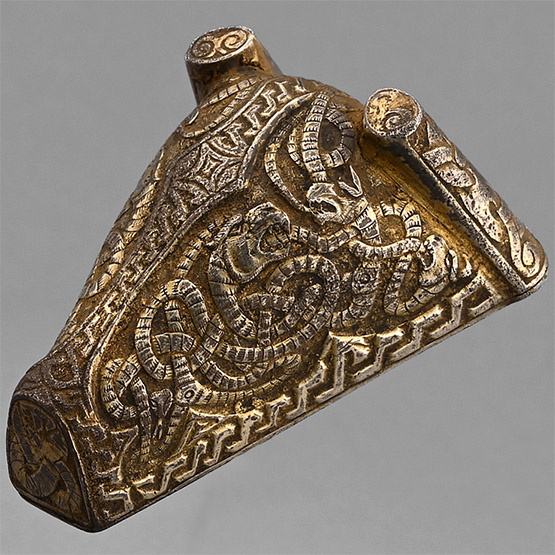
Viking Silver-Gilt Bronze Boar-Headed Brooch
Circa 9th-11th century A.D.Sold for (Inc. bp): £5,460
Hollow-formed with an applied backplate; the heavily decorated body with upstanding ears and a clubbed end to the muzzle; a narrow median raised band separating the face into two panels, each decorated with interlaced ornament in low relief depicting serpents locked in combat, their bodies dramatically entwined; the rear panel with four 'forearm and hand' motifs surrounding a central lozenge with pellet; rectangular guilloche to the lower borders, muzzle-band, rear panel and median upper band; Jellinge Style scrollwork to the outer and upper faces of the conical 'ears'; a hinged pin to the underside with curved catch, applied plate to the underside with two bands of punched lozenge decoration; mounted on a custom-made stand. 140 grams, 65 mm (220 grams total, 11 cm including stand)
Private collection, New York, USA. with Artemis Gallery, Colorado, USA, 15 February 2018, no.58. Private American collection, New York, USA. TimeLine Auctions, 5 March 2024, no.391. Private collection, London. This lot has been checked against the Interpol Database of stolen works of art and is accompanied by search certificate number no.13146-248323.
Box-shaped hollow animal-head brooches originated on the island of Gotland, Sweden, although they have been found in other parts of the Viking world. They were made to be worn in pairs, high on the chest of women's 'hangerok' apron-dresses with chains and swags of beads suspended between them. They are found in women's burials alongside utility items such as a knife or tweezers, and formed part of the costume of females from prosperous families. This example shows exceptionally fine decoration and would have been a treasured item, denoting the wealth and status of the family of the woman who wore it. -
.jpg)
Viking Silver Freyr and Freyja Casket Mount
9th-10th century A.D.Sold for (Inc. bp): £1,690
Rectangular with beaded border and pin-hole to each corner; low-relief scene of a male standing left wearing an open-fronted coat extending his arms towards an opposed female in floor-length robe, holding a hooked staff and with her long hair draped to her rear. 2.39 grams, 22 mm
Ex Paul Revell, circa 1985. From a private UK collection, 1980s onwards. -
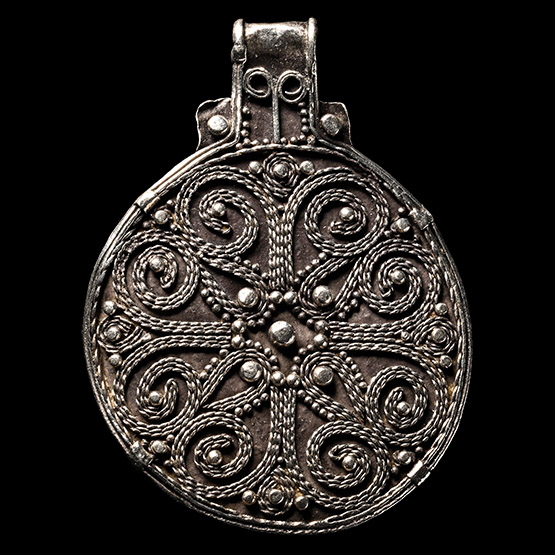
Viking Age Silver Filigree Pendant with Scroll Cross
Circa 9th-11th century A.D.Sold for (Inc. bp): £1,950
Discoid with applied filigree looped bands, granules and other detailing; cleaned and polished. 4.1 grams, 40 mm
Private collection formed in Europe in the 1980s. Westminster collection, central London, UK.

