-
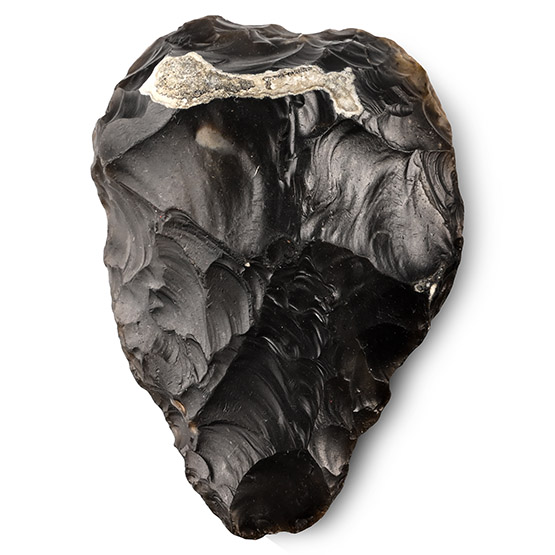
'British Museum Recorded' Stone Age Homo Heidelbergensis Flint Handaxe from Happisburgh
Lower Palaeolithic Period, circa 600,000-250,000 B.P.Sold for (Inc. bp): £2,340
Small sub-cordate handaxe of Wymer's type G, of glassy black flint with a few paler inclusions towards the butt; strip of light grey cortex remaining to the dorsal face at this end; flake scars appearing to be soft hammer struck with quite thin and invasive removals. 100 grams, 79 mm
Found Happisburgh, Norfolk, UK, Tuesday 1st October 2019 - Saturday 30th November 2019. Acquired from the finder Mr P Macro. Accompanied by a copy of the British Museum's Portable Antiquities Scheme (PAS) report no.NMS-3AE638.
Discovery by P Macro after the 'Beast from the East Storm', which stripped the beach of the sand and helped to erode the Palaeolithic artefacts from the ancient Thames river bed. During the time the artefacts were dropped, the Thames ran through North Norfolk and what is now Happisburgh before it was pushed down to its current position in London via the Ice Age glacial melts. The site of Happisburgh in Norfolk has helped to push the history of inhabitation of the British Isles back by 200,000 making it a site of special importance. The blank for this piece was probably a large struck primary flake; the ventral face (non-cortical side) has an unmodified section of this visible still, and ripples and fissures are observable. The point has a tranchet blow to the ventral face (edge type vi) to sharpen it, the dorsal face has been effectively thinned, making the lateral cutting edges very acute and sharp. This thinning has produced a slight curve to the point when viewed from the side. -
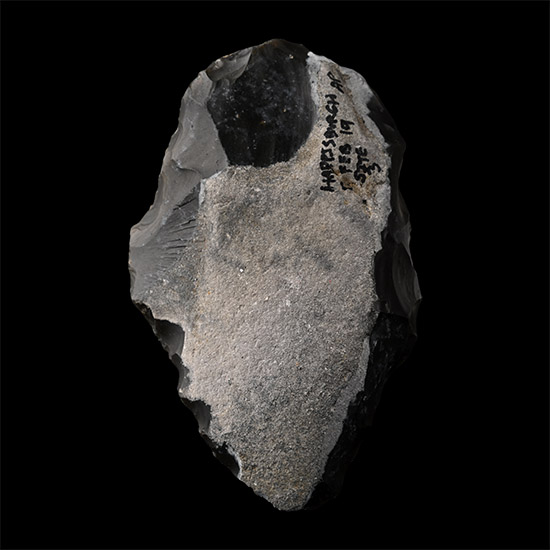
Stone Age Homo Heidelbergensis Flint Handaxe from Happisburgh
Lower Palaeolithic Period, circa 600,000-250,000 B.P.Sold for (Inc. bp): £351
Ovate in plan with concave underside; marked 'Happisburgh 7 Feb 19 Site 3 AP'; mounted on a custom-made stand. 99 grams, 89 mm without stand
Found by Mr Anthony Pryke in Happisburgh, Norfolk, UK, February 2019 near site 3.
Discovery by Mr A Pryke after the 'Beast from the East Storm' which stripped the beach of the sand and helped to erode the Palaeolithic artefacts from the ancient Thames river bed. During the time the artefacts were dropped, the Thames ran through North Norfolk and what is now Happisburgh before it was pushed down to its current position in London via the Ice age glacial melts. The site of Happisburgh in Norfolk has helped to push the history of inhabitation of the British Isles back by 200,000 making it a site of special importance. -
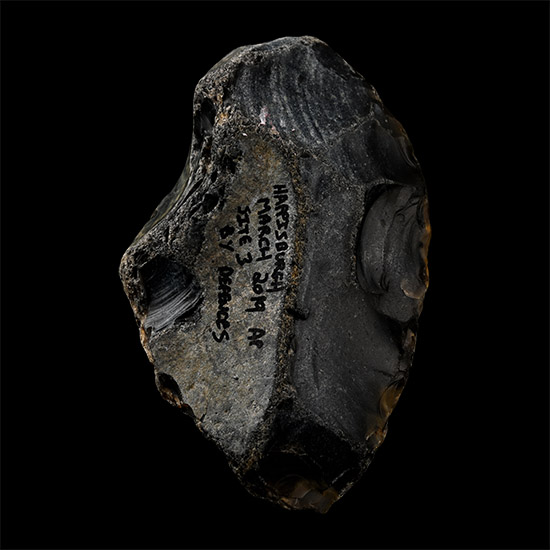
Stone Age Homo Heidelbergensis Uniface Flint Handaxe from Happisburgh
Lower Palaeolithic Period, circa 600,000-250,000 B.P.Sold for (Inc. bp): £351
Formed from a cobble and marked 'Happisburgh March 2019 AP Site 3 by Defences'; mounted on a custom-made stand. 237 grams, 10.3 cm without stand
Found by Mr Anthony Pryke in Happisburgh, Norfolk, UK, March 2019, near site 3.
Discovery by Mr A Pryke after the 'Beast from the East Storm', which stripped the beach of the sand and helped to erode the Palaeolithic artefacts from the ancient Thames river bed. During the time the artefacts were dropped, the Thames ran through North Norfolk and what is now Happisburgh before it was pushed down to its current position in London via the Ice Age glacial melts. The site of Happisburgh in Norfolk has helped to push the history of inhabitation of the British Isles back by 200,000 making it a site of special importance. -
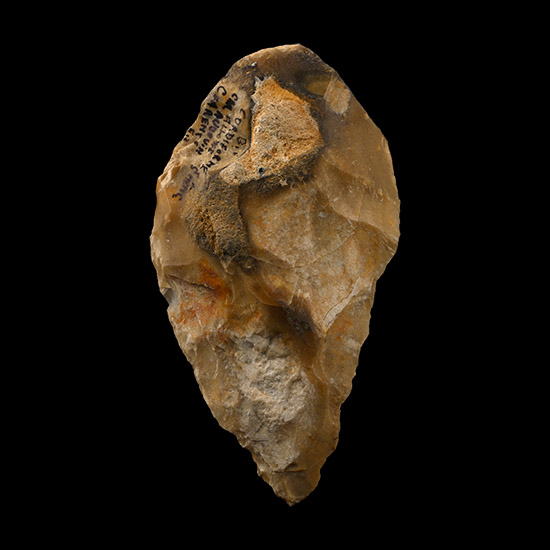
Stone Age Acheulean Flint Handaxe
Lower Palaeolithic Period, circa 600,000-350,000 B.P.Sold for (Inc. bp): £468
Well made with a thin sharp profile, likely made by Homo Heidelbergensis; marked at the butt 'Bif Cordiforme Allonge St. Même Audoin Charente'; mounted on a custom-made stand. 235 grams, 13 cm without stand
From the well regarded long closed quarry site of St Meme, Charente, France. From an old large French collection. Acquired on the European art market. From a UK private collection. -
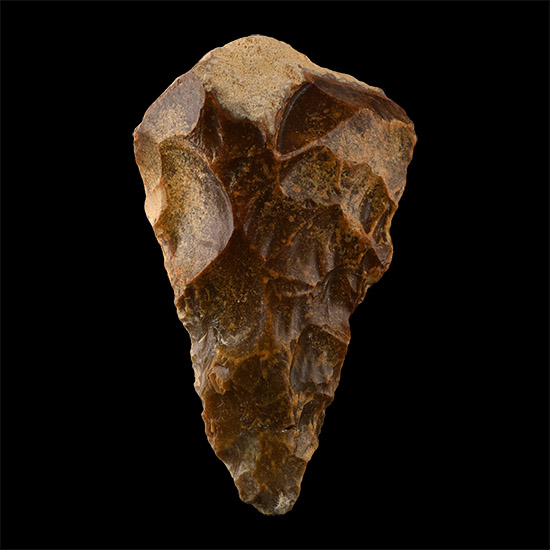
Stone Age Acheulean Ficron Flint Handaxe
Lower Palaeolithic Period, circa 600,000-350,000 B.P.Sold for (Inc. bp): £468
Well made with a ficron shape, the tip snapped in a clean break (this has been professionally glued back into place); likely made by Homo Heidelbergensis; marked to butt 'ST Même FR'; mounted on a custom-made stand. 418 grams, 13.4 cm without stand
From the well regarded long closed quarry site of St Meme, Charente, France. From an old large French collection. Acquired on the European art market. From a UK private collection. -
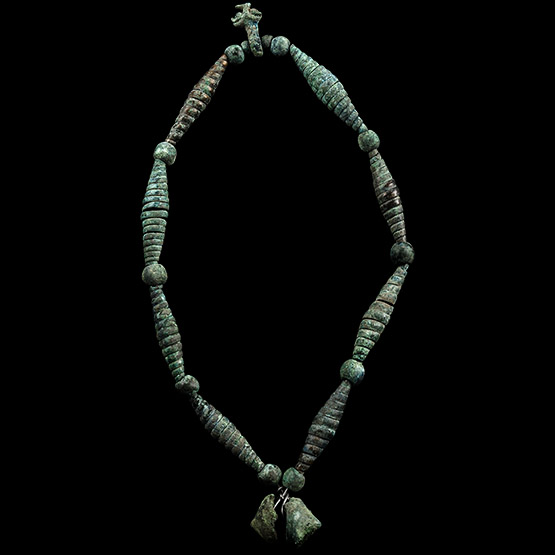
Bronze Age Coiled Bead Necklace with Pendants
12th-8th century B.C.Sold for (Inc. bp): £845
Restrung necklace of fusiform beads, each formed with a coil of flat-section bronze strip; interstitial oval beads with conical bosses at each finial; centrepiece a lobed stud. 116 grams, 50 cm
Private European collection, 1990s. Private collection, London, UK. -
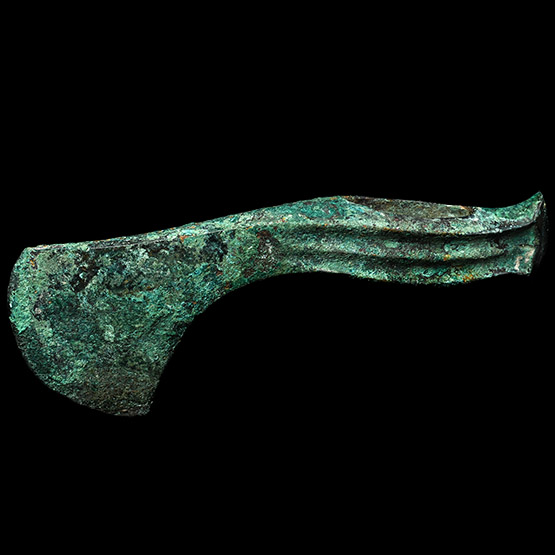
Large Bronze Age Socketted Axehead
Koban Culture, 12th-8th century B.C.Sold for (Inc. bp): £702
Substantial hexagonal-section neck developing to a broad blade with rounded edge and scooped underside; ellipsoid-section socket with three lateral ribs to each face, flared edge to rear. 458 grams, 18.5 cm
Private European collection, 1990s. Private collection, London, UK. -
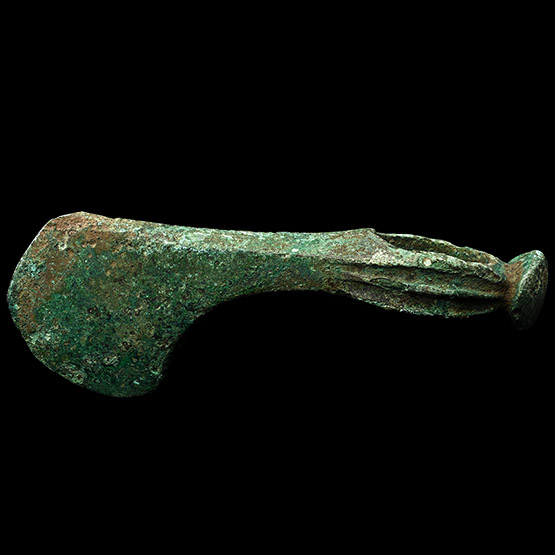
Large Bronze Age Socketted Axehead
Koban Culture, 12th-8th century B.C.Sold for (Inc. bp): £702
Substantial hexagonal-section neck developing to a thick blade with rounded edge and scooped underside; ellipsoid-section socket with three lateral ribs to each face, carinated knop to rear. 732 grams, 20.8 cm
Private European collection, 1990s. Private collection, London, UK. -
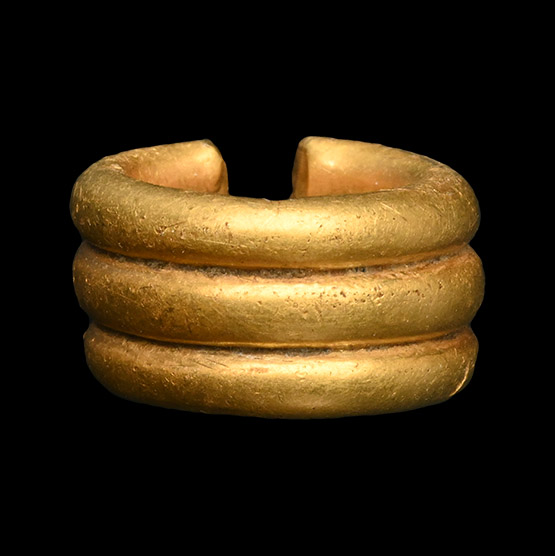
Bronze Age Gold Tripartite Penannular Ring
Middle Bronze Age, circa 1300-1550 B.C.Sold for (Inc. bp): £1,820
Penannular in form, composed of three individual rods soldered into a single unit. 6.30 grams, 13.30 mm overall, 8.15 mm internal diameter
Found on 29th December 2022 from Bawdsey, Suffolk, UK. Declared as treasure and subsequently disclaimed as 2023 T70. Recorded and accompanied by a copy of the British Museum's Portable Antiquities Scheme (PAS) report no.SF-5342CD. -
.jpg)
French Celtic Bronze Neck Torc
Iron Age, 4th-3rd century B.C.Sold for (Inc. bp): £2,080
Round-section collar with La Tène scrolls and bosses to the upper face, bulbs flanking the centrepiece of three discoid cells with inset glass segmented bosses, each surmounted by a domed stud; bosses replaced; handwritten note by Philippe Chauchoy stating 'Torque celtique en bronze garanti authentique, avec cabochons refaits - Fin du IVe-début IIIe siècle av[ant] J.C.' 149 grams, 15.4 cm
Ex Philippe Chauchoy, Amiens, Northern France, 1994. From the private collection of a West Midlands lady collector. Accompanied by an original handwritten and signed information card from Philippe Chauchoy, dated 6th June 1994. -
.jpg)
Celtic Enamelled Bronze Chariot Lynch Pin Terminal
1st century B.C.-1st century A.D.Sold for (Inc. bp): £468
Square-section shank with flange and tapering bulb, disc finial with reserved comma-trumpet design and red enamelled field. 64.8 grams, 54 mm
Found Norfolk, UK. -
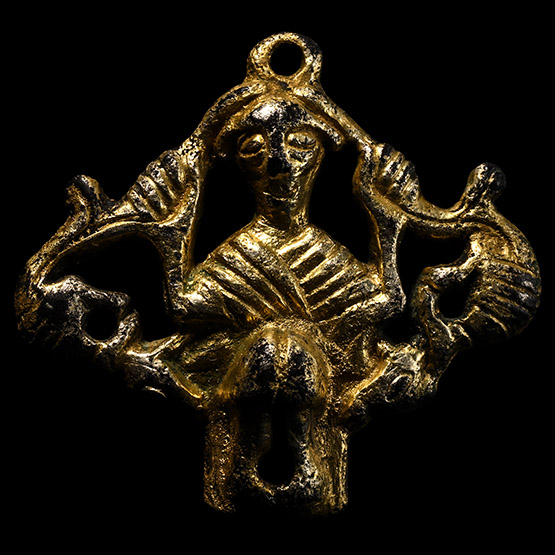
Viking Silver-Gilt Seated Freyja Mount
Circa 9th-10th century A.D.Sold for (Inc. bp): £2,470
A parcel-gilt plaque pendant with facing seated figure, probably the goddess Freyja, modelled in the half-round; the hands raised to grip lateral ribbed strands of hair, the garment formed as two crossed bands on the chest, the knees prominent and feet placed together; emerging from each strand of hair, a feline with curled tail, ribbed body, foreleg curled over the neck, notched fingers and triangular face with lappet and snubbed snout; loop above the head, three holes to the edges. 30.6 grams, 46 mm
Private collection formed in Europe in the 1980s. Westminster collection, central London, UK. This lot has been checked against the Interpol Database of stolen works of art and is accompanied by search certificate number no.13159-248791.
The figure represents a seated female accompanied by two cats. In the Icelandic poem Gylfaginning (The Deceiving of Gylfi), Freyja is said to be seated in her chariot drawn by two cats. Her hall in heaven is called Sessrumnir, meaning 'with room for many seats'. She is also associated with a high seat from which prophecy is made, similar to that of Odin.

