-
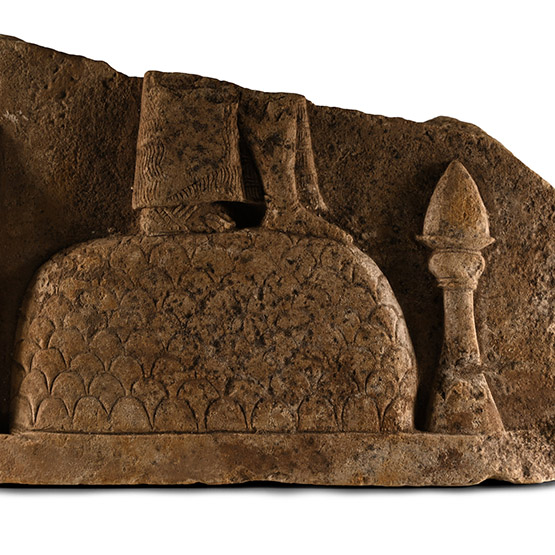
Neo-Assyrian Stone Relief with Standing Figure
9th-8th century B.C.Sold for (Inc. bp): £3,900
Corner fragment from a high-relief pictorial panel with raised border; domed dais with low-relief scaled detailing; lower legs and sandaled feet in advancing pose with ankle-length open-fronted robe, horizontal woven texture and curled fleece; high-relief stele with flared base, bulbous upper and sugar-loaf finial; pitted surface, with tooling to reverse. 2.81 kg, 24.3 cm
Ex German collection, c.1980. with Toufic Arakji, Hamburg, 1997. Private collection, Europe. Accompanied by an academic report by Dr Raffaele D'Amato. This lot has been checked against the Interpol Database of stolen works of art and is accompanied by search certificate no.12579-232134.
Stylistically, the figure seems to be linked to the kingdom of Ashurnasirpal II (883-859 B.C.) or his son Shalmaneser III (858-824 B.C.). The exposed lower leg with exaggerated musculature is seen in many Assyrian and Babylonian depictions of divine and heroic figures. The position of the figure, corresponding to some reliefs kept in the Louvre, where a spirit is worshipping a poppy flower (Houston, 1954, pl.V.1), and the high-relief carving, strongly refer to a cult scene. -
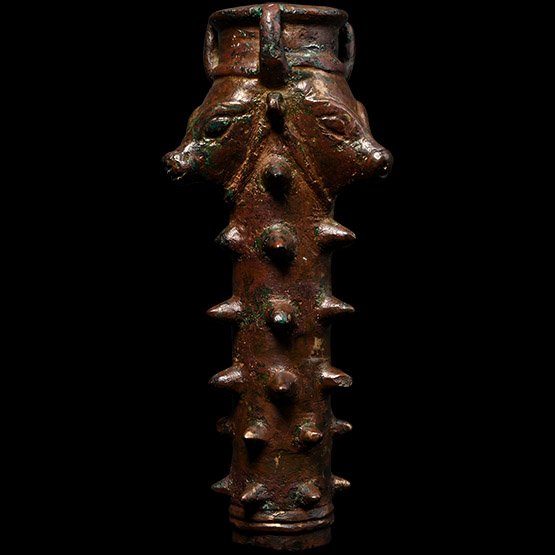
Elamite Sar-e-Gorz Spiked Bronze Macehead
Late 2nd-early 1st millennium B.C.Sold for (Inc. bp): £2,340
With three adjoining bull heads in high-relief to the top, with three ears and three horns serving all three heads; the horns curving towards the rim of the closed top; the shaft adorned with vertical rows of pointed spikes; hollow socket tube with ring collar at the base; mounted on a collector base. 443 grams total, 18 cm including stand
London, UK gallery, 1971-early 2000s. Private collection, London. Accompanied by an academic report by Dr Raffaele D’Amato. This lot has been checked against the Interpol Database of stolen works of art and is accompanied by search certificate number no.11997-22061. -
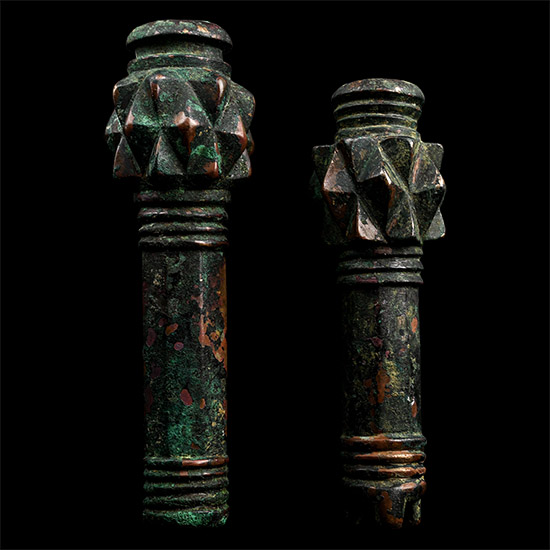
Luristan Bronze Macehead Collection
Circa 900-800 B.C.Sold for (Inc. bp): £1,300
With long septagonal and octagonal shank, rounded knobs around the swollen head, flanked by horizontal bands. 876 grams total, 15.5-17.3 cm
UK private collection before 2000. Acquired on the UK art market. Private collection, London, UK. -
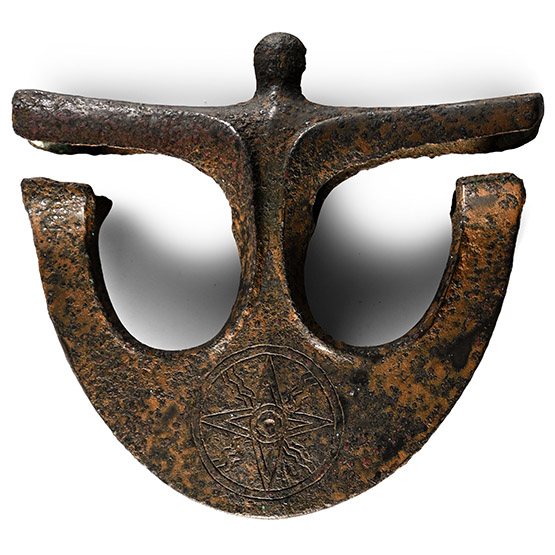
Mesopotamian Bronze 'Anchor' Axehead with Incised Star Sign of the Sun God Shamash
Late 3rd millennium B.C.Sold for (Inc. bp): £4,160
Comprising a crescentic blade with two spurs at each end intended to brace against the shaft, a narrow neck, flared socket with vertical spurs and a knop finial projecting from the rear; ribbed decoration on the rear edge; one side of the blade incised with a symbol of the god sun Shamash, depicted as a four-pointed star with wavy rays alternating with straight rays, a winged solar disc inside. 294 grams, 12.7 cm
UK private collection before 2000. Acquired on the UK art market. Private collection, London, UK. Accompanied by an academic report by Dr Raffaele D’Amato. This lot has been checked against the Interpol Database of stolen works of art and is accompanied by search certificate number no.13043-248308.
This specific type of weapon is called an ‘anchor’ axe because of its shape. Anchor axes have been excavated in Egypt, at Byblos and Ur. Many of them have been said to come from Iran as well, especially from the area of Gilan. The present specimen, in which the shaft hole is joined to the blade by the central tang, is of the same specific type as that excavated in Ur. According to Calmeyer, these axes developed in Mesopotamia. Moorey further explains that the large numbers of these axes reported from Iran could derive from Mesopotamian imports. The Mesopotamian origin of our axe could be further confirmed by the incised motif on the blade, the symbol of the sun god Shamash. The ‘star of Shamash’, typically represented as a four-pointed star with wavy lines placed between the points, is attested as early as the period of Sargon of Accad, who dominated Mesopotamia in 2200 B.C. This symbol can be visible on various Mesopotamian artworks, like the ‘Kudurru’ of Ritti-Marduk at the British Museum; however, dated to 1125-1104 B.C. Another representation is visible on the Tablet of Shamash at the BM, dated 800 B.C. It is also possible, therefore, that the symbol of Shamash was incised on the axe in a later period, but not later than 800 B.C. -
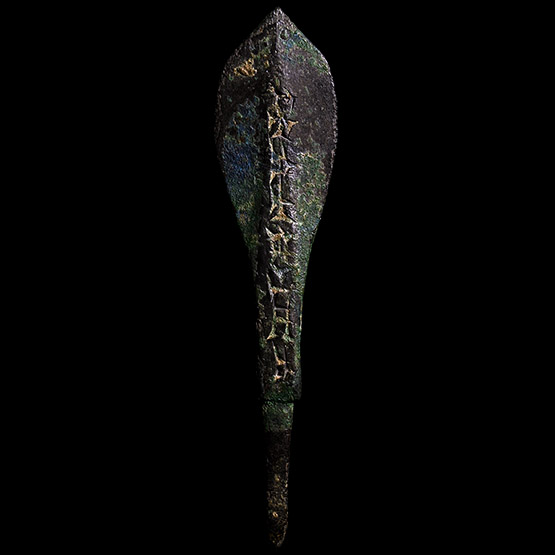
Babylonian Bronze Arrow Owned by Eulmas-sakin-sumi, King of Babylon
Late Middle Babylonian Period, 1004-988 B.C.Sold for (Inc. bp): £9,100
A two-edged leaf-shaped blade and square-section tapering tang, on one side inscribed in Akkadian cuneiform text: 'Eulmaš-šākin-šumi'; and the other side inscribed in Akkadian cuneiform text: 'É-ul-maš-GAR-MU'; reading (property) 'Of Eulmash-shakin-shumi, king of the world'; there are now seventeen known examples compared to fourteen known in 1968. 9.37 grams, 66 mm
UK private collection before 2000. Acquired on the UK art market. Private collection, London, UK. This lot has been checked against the Interpol Database of stolen works of art and is accompanied by search certificate number no.13145-248307.
King Eulmash-shakin-shumi was the founder of the 6th Dynasty of Babylon, named the Bῑt-Bazi Dynasty after the Kassite tribal group from which its leaders were drawn. They were possibly situated near the juncture of the Diyala River and the Tigris River. There are discrepancies in the information surviving about his reign; whilst the Dynastic Chronicle states that he ruled for fourteen years, the King List A suggests a rule of seventeen years. The events leading to the king's rise to power unfolded in the context of the chaotic close of the Second Sealand Dynasty, and in the midst of the turmoil inflicted by the famine-induced Aramean migrations. During this period, Eulmaš-šākin-šumi appears to have seized the throne and possibly moved his capital to Kar-Marduk, a hitherto unknown location, and easily defensible. Upon his death, King Eulmash-shakin-shumi was buried in the Palace of Kar-Marduk, the dynastic capital. A 9th century stele relating to temple endowments at Sippar relates that the king restored food offerings to Shamash, and entrusted a garden plot in a part of Babylon known as the 'New City' to the then high priest there. The weapons unearthed with inscriptions such as the one offered here were likely votive, as opposed to military pieces. -
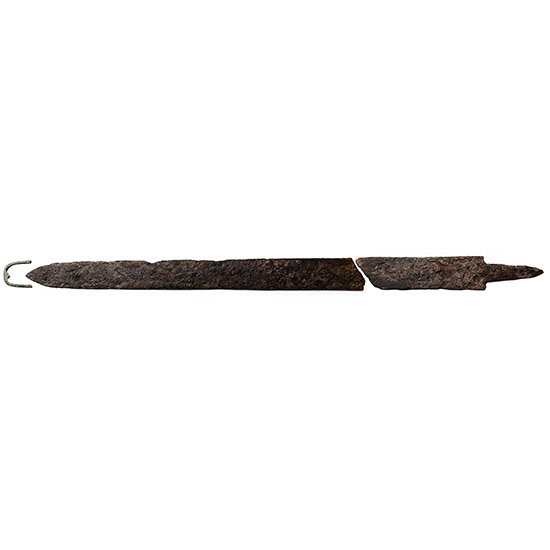
Saxon Sacrificed Iron Spatha with Bronze Chape
5th-6th century A.D.Sold for (Inc. bp): £1,300
Double-edged long sword (spatha) of type Osterburken-Kemathen; the blade with squared shoulders, broken into two parts for sacrificial reasons, tapering towards the point; sturdy tang partially preserved; wooden traces of the scabbard and hilt still visible; accompanied by a bronze outer rim of a scabbard; restored. 630 grams total, 78 cm long
From the private collection of a London gentleman, from his grandfather's collection formed before the early 1970s.
The deliberate fragmentation of a sword, often into three pieces, was a symbolic act of ‘killing’ the weapon, which was then placed as a grave good or offered in a ceremonial context. This was a Germanic custom already visible in the Vandal Przeworsk culture around the 3rd or 4th century A.D., which continued in Northern European areas until the 5th and the 6th centuries A.D. -
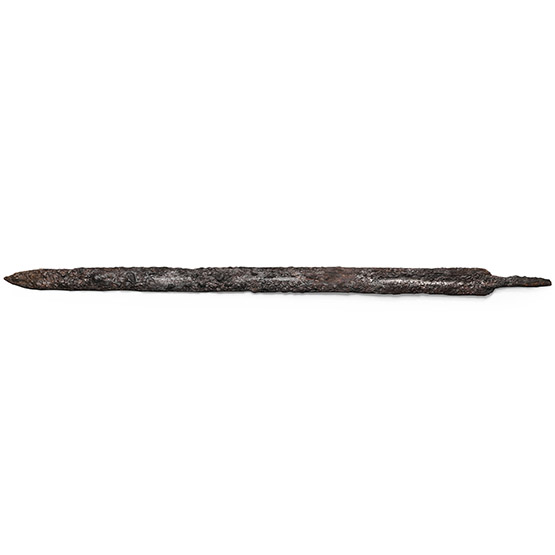
Merovingian Iron Pattern-Welded Sword
Circa 6th century A.D.Sold for (Inc. bp): £975
A double-edged spatha with a lentoid parallel-sided blade and pointed tip; evidence of battle nicks on both cutting edges; long tang and traces of wooden scabbard on the blade; signs of damask pattern running along the length of the blade, especially on the upper part; cleaned and conserved. 694 grams, 86.5 cm
From the private collection of a London gentleman, from his grandfather's collection formed before the early 1970s. Accompanied by an academic report by Dr Raffaele D’Amato. This lot has been checked against the Interpol Database of stolen works of art and is accompanied by search certificate number no.12919-245174.
Usually the term ‘damascened’ is only used for blades, describing the way in which their individual rods are forged to create a desired pattern effect that remained visible on the surfaces of the finished product (technique B.II.1.2.). The shape and regularity of the pattern was essentially dependent on the number and nature of the individual rods and on the skills of the blacksmith. The scholars differentiate on this basis more or less careful and complicated variants (e.g. striped, diamond, herringbone, angular, rosette, mosaic, etc.), in which the individual rods from different iron lamellae, which are parallel or twisted (torsion pattern-welding), were built up often in connection with each other (technique B.II.1.2.1-2). Combining striped rods that were partially straight and partially twisted - clockwise or counter-clockwise - allowed the formation of a very decorative blade. -
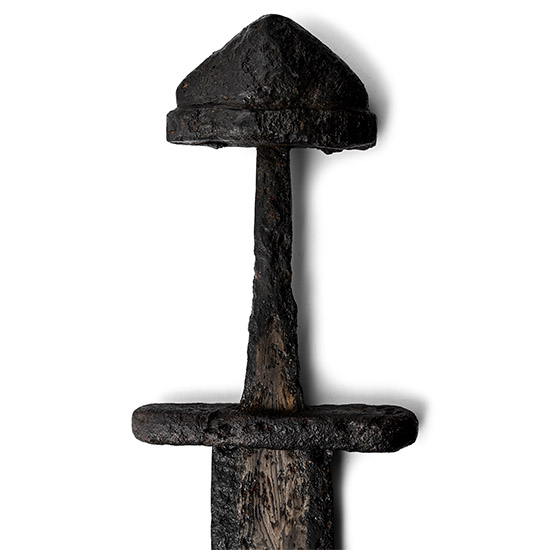
Viking Iron Pattern-Welded Sword
8th-9th century A.D.Sold for (Inc. bp): £8,450
Double-edged cutting sword of Petersen type A with a finely tapering blade, showing pattern-welding; upper and lower guards with strongly curved sides; the cross-guard boat-shaped with an acute tapering tang; the pommel attached with two nails to the original boat-shaped upper guard. 809 grams, 85.5 cm
From the private collection of a London gentleman, from his grandfather's collection formed before the early 1970s. Accompanied by an academic report by Dr Raffaele D’Amato. This lot has been checked against the Interpol Database of stolen works of art and is accompanied by search certificate no. 13064-249347.
Petersen originally individuated eight examples of this sword’s typology, one of the first categories of Viking swords, although these swords were also widely used in the Carolingian Empire and widespread among the Italic population as well (frescoes from the Necropolis of S.Andrea Priu, Sardegna, 8th or 9th century AD), where specimens are still attested in the 10th century A.D (D’Amato-Salimbeti, 2020, p.23). The evenly wide, three-sided pommel, narrower than the guard, was the most characteristic element of such swords, and in some cases it was divided into three segments, or even seven segments (swords from Neri, Opstryn s., Stryn, Nordfjord). Thes tend to be confused with the similar pommels of the swords of H typology (Petersen, 1919, pp.89ff.), but in these latter swords the guards are wider and with an elliptical cross-section. -
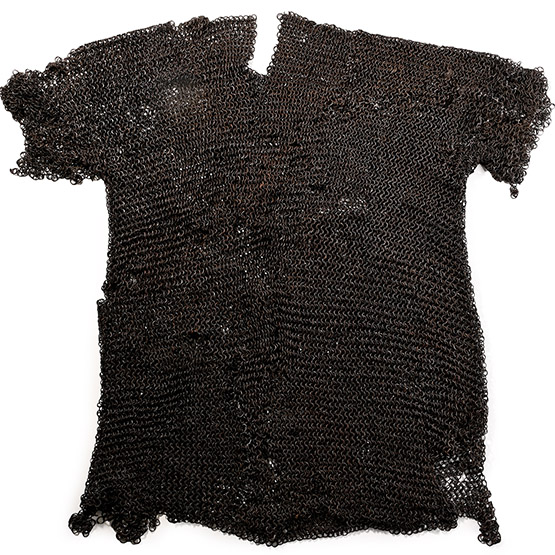
Frankish Warrior's Iron Byrnie Chain Mail Armour
Northern Europe, circa 6th-10th century A.D.Sold for (Inc. bp): £4,680
A nearly complete short-sleeved ring armour composed of interlocking links in the four-through-one formation with alternating rivetted rings. 4.71 kg, 65 x 75 cm
From the private collection of a London gentleman, from his grandfather's collection formed before the early 1970s. Accompanied by an academic report by Dr Raffaele D’Amato. This lot has been checked against the Interpol Database of stolen works of art and is accompanied by a search certificate number no.13041-248010.
The rings are arranged in rows, and the links within the same row do not join. Instead, each ring connects to two rings in the row above and two in the row beneath. A great majority of all-rivetted mail comes from Southern Scandinavia and Northern Europe, notably Sweden, northern Germany and Poland. All-rivetted mail already occurs there during the Roman Iron Age, and continues into the Migration, the Vendel, and then the Viking periods. Rivetted rings were usually fabricated by shaping metal wire into a circle with the ends overlapping several mm. Here, the riveted rings seem to be of reshaped oval form. -
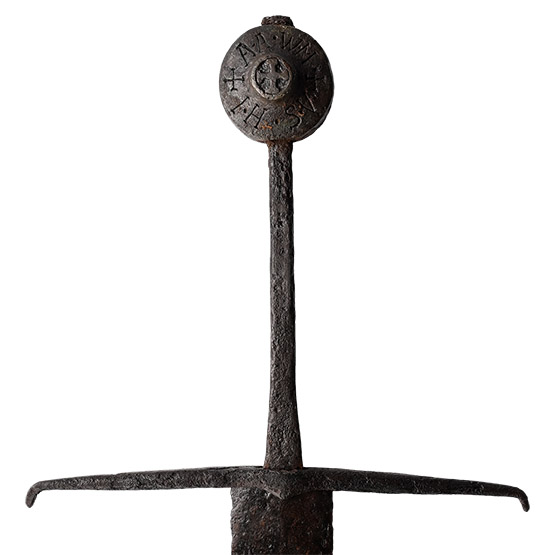
Medieval Knight's Iron Hand-and-a-Half Sword with Inscribed Bronze Pommel
Germany, 14th century A.D.Sold for (Inc. bp): £14,300
Longsword of Oakeshott's Type XVa, cross style 8, bronze pommel style J (recessed); strongly tapering, pointed blade of ‘flattened diamond’ section, cross style tapering gradually outward to sharply downturned tips; long grip with slight taper, disc pommel with chamfered edges and a potent cross in the centre surrounded by an inscription (on both sides) '+ IH SU + AAWM'. 1.25 kg, 113 cm
From the private family collection of a lady, UK; acquired in Germany mid 20th century. Accompanied by an academic report by Dr Raffaele D’Amato. This lot has been checked against the Interpol Database of stolen works of art and is accompanied by search certificate number no.13034-24799.
Some wheel pommels of this date have engraved, or inset roundels with armorial or devotional emblems, and a number of sword blades of this date bear religious inscriptions in the form of a prayer. The inscription on the pommel between the two potent crosses is intriguing. The letters 'IH SU' are a clear reference to the name of the Saviour, and can be translated as Ihesu-Jesus, or also Ihesu Merci (Jesus have mercy), a simple prayer for the person carrying the sword. The letters 'A.A. W.M.' could refer to the name of the owner of the sword (WM = Wilhelm) or the maker of the weapon. It is difficult to consider the letters as an abbreviation of the prayer ‘Ave Maria’, usually shortened in the German medieval inscriptions as A.M. -
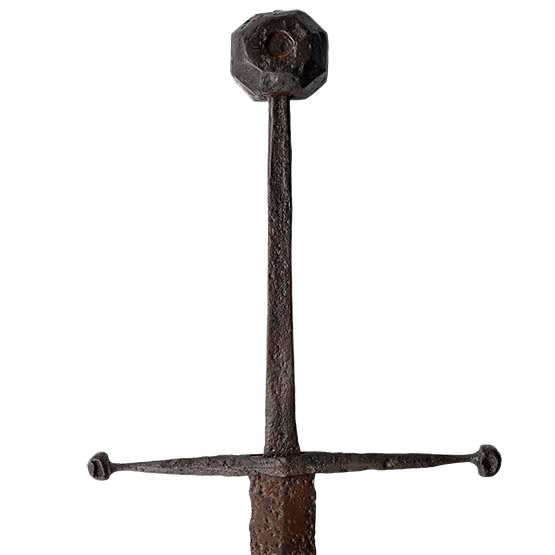
Medieval Knight's Iron Hand-and-a-Half Sword with Icosikaidigon Pommel
Europe, 14th-15th century A.D.Sold for (Inc. bp): £8,450
Longsword of Oakeshott's Type XVIII b, cross style 11, pommel style I1, with a strongly tapering pointed blade with a shallow ‘flattened diamond’ cross-section without fullers; the edges straight and tapering without curving to the point; guard characterised by a well-defined cross-guard with knobbed ends, long grip slightly tapering towards the facetted pommel. 1.43 kg, 114.5 cm
From the private family collection of a lady, UK; acquired in Germany, mid 20th century. Accompanied by an academic report by Dr Raffaele D'Amato. This lot has been checked against the Interpol Database of stolen works of art and is accompanied by search certificate number no. 13035-248000. -
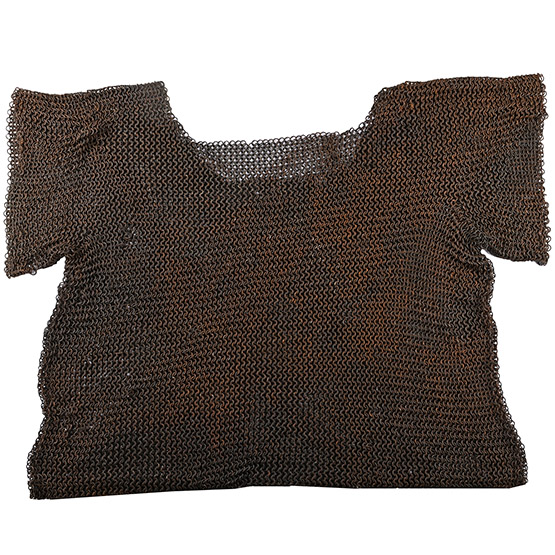
Medieval Warrior's Iron Chain Mail Armour Shirt
Circa 15th century A.D.Sold for (Inc. bp): £1,820
A butted short-sleeved chainmail shirt made of thick oval rings assembled in the usual system of one-to-four; in an excellent state of preservation, with over 95% of the rings intact, very few broken or corroded, with no later additions. 9.93 kg, 87 x 56 cm
Acquired on the German art market before 2000. Private collection, South Germany. Accompanied by an academic report by Dr Raffaele D'Amato. This lot has been checked against the Interpol Database of stolen works of art and is accompanied by search certificate no.13066-249665.
In the German-manufactured ring mail armours, in the 15th century A.D., the rings protecting the breast were very thick, whereas the sleeved mail armours were thinner. Master armourers from Nuremberg were famous for this production across Europe.

