-
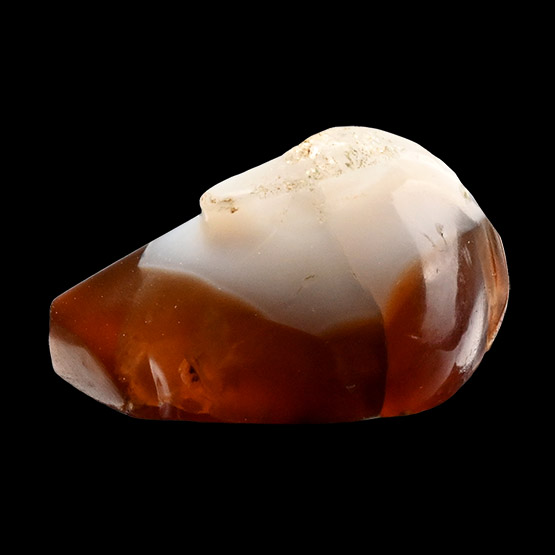
Neo-Babylonian Agate Duck Weight
Circa 700-600 B.C.Sold for (Inc. bp): £585
Carved in banded agate so that the head and upper back are in opaque white stone, the rest in translucent orange-tan stone. 4.76 grams, 23 mm
Acquired in 1996. Private collection, Switzerland, thence by descent. Private collection, since the late 1990s. -
.jpg)
Hittite Haematite Stamp Seal with Animals
17th–16th century B.C.Sold for (Inc. bp): £1,170
Finely carved with a tubular loop, discoid plaque to the underside with an incuse image of horned animals hunted by lions. 22 grams, 24 mm
From a pre-1992 collection, Geneva and London. -
.jpg)
Large Amlash Terracotta Idol
1st millennium B.C.Sold for (Inc. bp): £2,340
Comprising a thin, extended neck developing into a largely unmarked face, represented only as a low-relief oval across its width; small arms folded into the chest emerging just beside two raised breasts; body curving inwards to suggest a feminine waist, before widening dramatically at the hips and buttocks; legs tapering gradually towards the base, with small marks delineating toes; mounted on a custom-made stand. 386 grams total, 23 cm including stand
Dr Werner Alder, Carona, Switzerland, acquired in the 1960s. Private collection M.R., Lugano, Switzerland. Accompanied by an academic report by Dr Raffaele D’Amato. Accompanied by a thermoluminescence analysis report no.N126a11 from Oxford Authentication. This lot has been checked against the Interpol Database of stolen works of art and is accompanied by search certificate number no.13015-246792.
The Amlash ceramics of Iron-Age Iran are named after a small modern town in the northern province of Gilan, just south of the Caspian Sea. Although the town is in close vicinity to Mesopotamia, the objects found there have a distinct local style, perhaps due to the natural boundaries of the Elburz and Zagros mountain ranges. The ceramic vessels and statuettes of both humans and animals from this region are by far the most important source we have on the Amlash culture of this period. Much of what has survived seems to have held spiritual or ritual functions, for example, votive idols and libation vessels. Human representations are generally found in burial sites and may therefore represent deities or specific individuals. These terracotta figurines, distinguished by their exaggerated, rounded hips and thighs, are believed to date from the late 2nd to early 1st millennium B.C. and are widely interpreted as fertility symbols or representations of a mother goddess. -
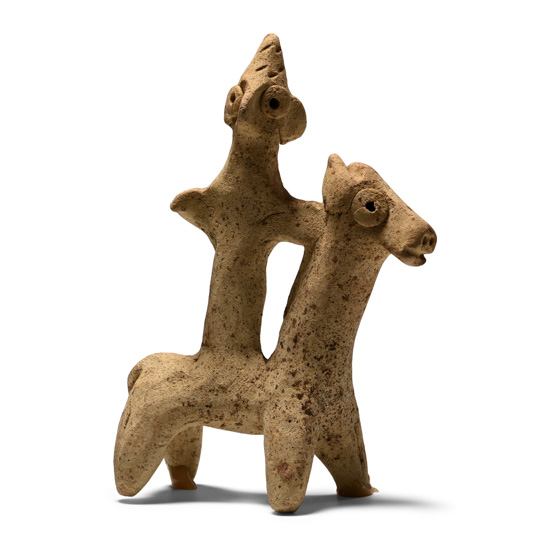
Syro-Hittite Terracotta Horse and Rider
Early 1st millennium B.C.Sold for (Inc. bp): £1,170
Modelled standing facing, with stub legs, ears pinned backwards, stylised detailing to the eyes and muzzle; the rider shown mounted sideways indicating a female rider, holding the horse's cropped mane with the left hand, the right hand extended outwards, pinched face with applied circular eyes, detailing to conical headpiece; mounted on a custom-made display base. 317 grams total, 15 cm high including stand
Collection of a deceased London gentleman, 1979-1999, by descent. From the private collection of John Meredith, acquired since the 1990s; thence by descent. Accompanied by a copy of a thermoluminescence analysis report no.N122k29 from Oxford Authentication. -
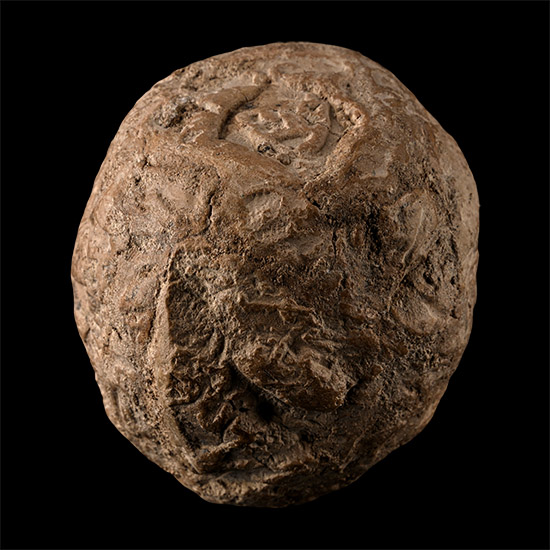
Sumerian Terracotta Bulla
4th millennium B.C.Sold for (Inc. bp): £468
A bulla with oval stamped impression of two animals. 147 grams, 60 mm
Specialised collection of cuneiform texts, the property of a London gentleman and housed in London before 1988. Thence by descent to family members. Examined by Professor Wilfrid George Lambert FBA (1926-2011), historian, archaeologist, and specialist in Assyriology and Near Eastern archaeology, in the late 1980s and early 1990s. The collection is exceptional for the variety of types, including some very rare and well preserved examples. Accompanied by a copy of a previous catalogue page.
Small globular and hollowed clay balls are defined as 'bulla'. They are also known as ‘bulla-envelopes', some of which are plain and some displaying epigraphic, zoomorphic and/or figural decoration, impressed by either cylinder or stamp seals. Bulla first emerged in Mesopotamia and their earliest occurrence can be traced to circa 8000 B.C. Most know decorated bullae come from the Uruk area and offer an insight into its culture. This bulla represents a religious scene, indicated by the combination of the pyramid-shaped byre and the 'sacred herd', which are seen on the early Uruk seals. The symbol of the Mother-Goddess, presented in conjunction with the representations of sheep herd and byre, gave such imagery symbolic significance. The impression with two sheep depicted under the byre, might have been impressed by a stamp seal of the early Uruk period. -
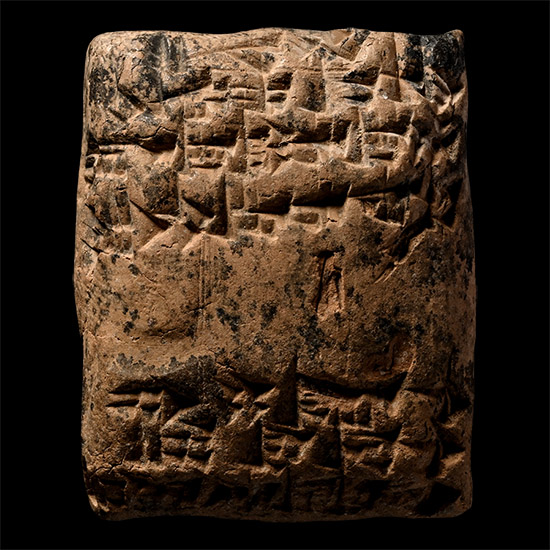
Old Babylonian Terracotta Cuneiform Tablet For an Interest Free Loan From the Moon God Nanna
1834-1823 B.C.Sold for (Inc. bp): £1,755
A pillow-shaped tablet, with cuneiform text to the broad faces and an edge, reading: '12 shekels of interest-free silver, from (the moon-god) Nanna, debt of Bitanum. Before Qišti-Enlil Before Dadiya Before Sîn-šemi In the month of Innana, the 5th. The year (the king) built the temple of Ninug... inside (the city of) Maškan-šapir.' 55 grams, 47 mm
Ex private collection. with Bonhams, Antiquities, London, 21 October 1999, no.260 (Part). Private central European collection. Accompanied by copies of the relevant Bonhams catalogue pages. This lot has been checked against the Interpol Database of stolen works of art and is accompanied by search certificate number no.12244-219769. -
.jpg)
Old Babylonian Terracotta Cuneiform Tablet for the Loan of Money During the Reign of Sin-iqišam King of Larsa
1840-1836 B.C.Sold for (Inc. bp): £1,755
A pillow-shaped tablet, with cuneiform text to the broad faces and an edge, reading: 'Idnin-Sîn and Sutitum have obtained from the god Šamaš (a loan of) 5/6 mine 5 shekels of silver, the silver (has) an interest of 4 shekels 1/3. He° will have to repay the money at the time of sowing. Before (the god) Ea, Before (the goddess) Sugallitum Before (the god) Nanna Before Dani Seal of one (of the) witnesses... In the month of Tebitum The year of Sin-iqišam the king.' 85 grams, 59 mm
Ex private collection. with Bonhams, Antiquities, London, 21 October 1999, no.260 (Part). Private central European collection. Accompanied by copies of the relevant Bonhams catalogue pages. This lot has been checked against the Interpol Database of stolen works of art and is accompanied by search certificate number no.12244-219769. -
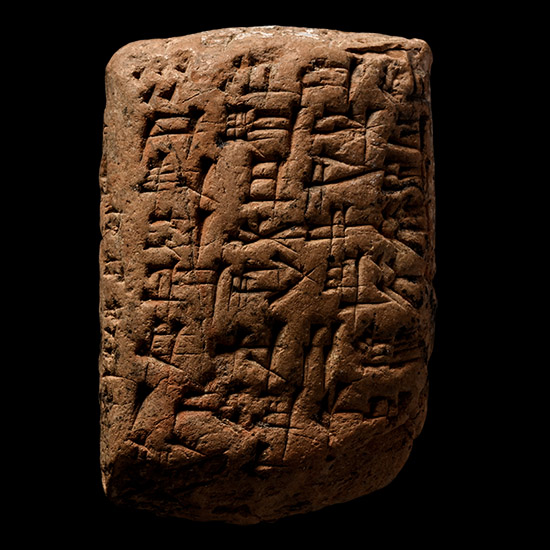
Old Babylonian Terracotta Cuneiform Tablet For the Sale of a Palm Grove during the Reign of Nur-Adad King of Larsa
1865-1850 B.C.Sold for (Inc. bp): £1,755
A pillow-shaped tablet, with cuneiform text on the broad faces and an edge, reading: '50 sar of orchard, planted with palm trees, next to Kunia, next to Amurutu, on the first small side: Rabutum. Sîn-pilah bought from Huzalum. He paid him its full price of 1/3 silver mine. He swore in the name of Nur-Adad the king that no one would constest in the future. In front of Itišumum In front of Sinennam Before Sugalum Before Kurušum Before Awīl-Amurrim the scribe In the month of šabatu, the year Nur-Adad (offered) a throne of justice (?) ...' 52 grams, 56 mm
Ex private collection. with Bonhams, Antiquities, London, 21 October 1999, no.260 (Part). Private central European collection. Accompanied by copies of the relevant Bonhams catalogue pages. This lot has been checked against the Interpol Database of stolen works of art and is accompanied by search certificate number no.12244-219769. -
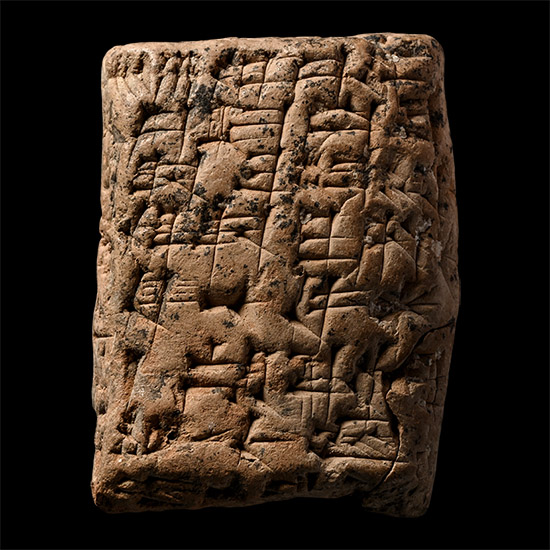
Old Babylonian Terracotta Cuneiform Tablet for The Sale of a Palm Grove during the Reign of Sumu-el
1894-1866 B.C.Sold for (Inc. bp): £1,690
A pillow-shaped tablet, with cuneiform text to the broad faces and an edge, reading: '36 sar of orchard, planted with palm trees, next to Batuli and next to Kutanum, Sin-pilah bought from Bedi-el. He paid its full price 10... of silver. He swore in the name of the king that in the future no one would dispute. Before ... Before Sîn Dayan In front of Naqimum In front of Damu In front of Munakum In the month of Kislimu, the 4th year of the priest of Nanna.' 39 grams, 47 mm
Ex private collection. with Bonhams, Antiquities, London, 21 October 1999, no.260 (Part). Private central European collection. Accompanied by copies of the relevant Bonhams catalogue pages. This lot has been checked against the Interpol Database of stolen works of art and is accompanied by search certificate number no.12244-219769. -
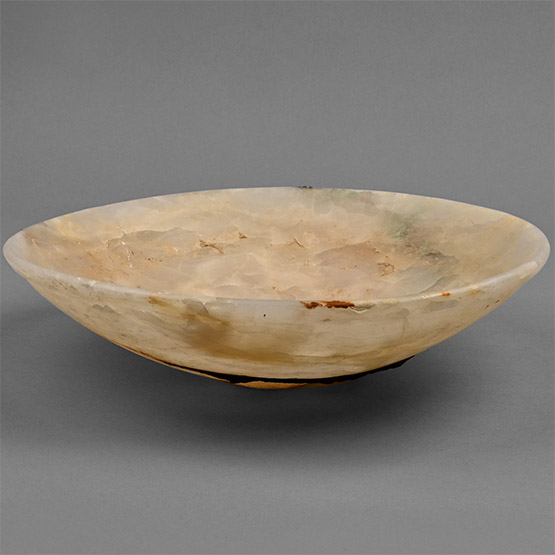
Large Bactrian Alabaster Bowl with Bronze-Encrusted Base
3500-3100 B.C.Sold for (Inc. bp): £780
Broad shallow bowl with integral basal ring, carination below the rim, encrusted bronze circle to the underside. 2.21 kg, 30 cm wide
Private collection, Kent, UK. -
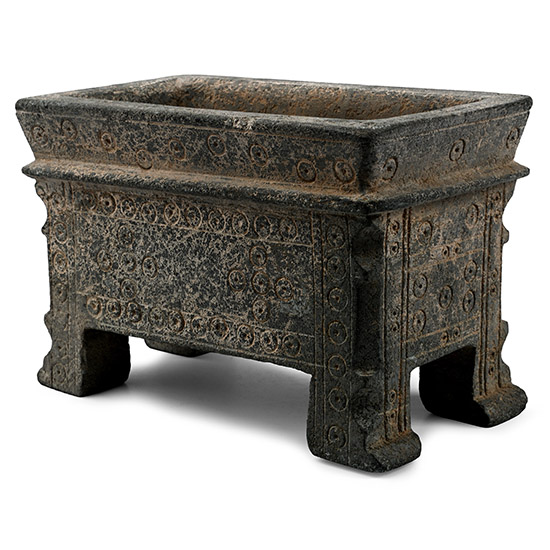
Western Asiatic Rectangular Stone Vessel
1st millennium B.C.Sold for (Inc. bp): £1,300
Rectangular-section body on four feet, slightly flared rim with a band, with ring-and-dot markings to the outer face. 1.37 kg, 14.7 cm
From a West London collection and formerly in a Mayfair gallery. -
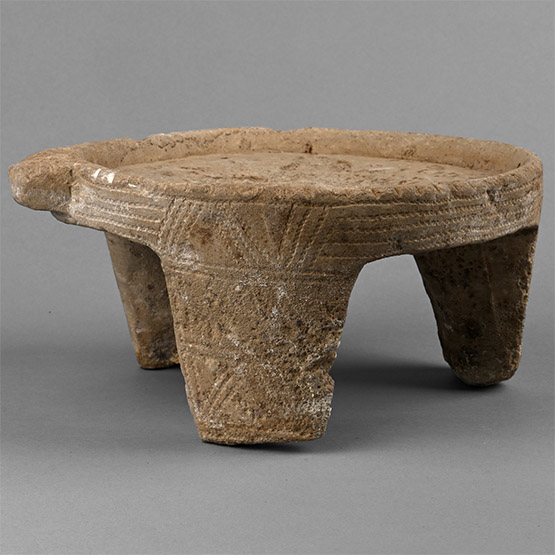
Hittite Limestone Altar
2nd-1st millennium B.C.Sold for (Inc. bp): £780
Carved from a limestone block with three trapezoidal stub legs, horizontal dished centre with notched edge to the raised rim and U-section pouring lip; panel of geometric linear ornament to the outer face of the body and legs; integral T-shaped reinforcing arms to underside. 3.5 kg, 26.3 cm wide
Private collection, Israel. with Archaeological Centre, Auction 59, no.433. Accompanied by a copy of the Archaeological Centre online catalogue page.

