-
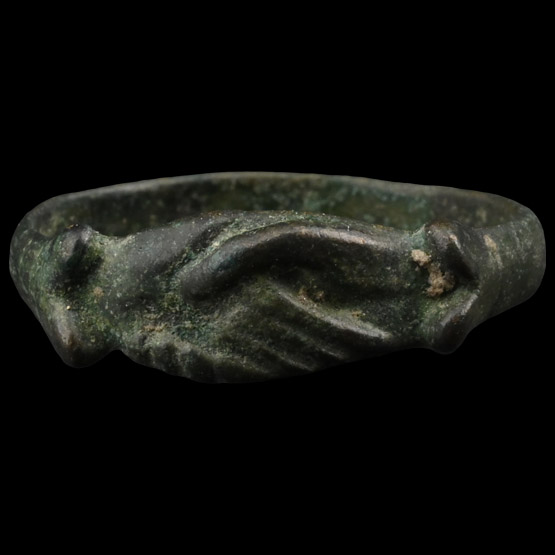
Medieval Bronze Clasped Hands Wedding Ring
16th-18th century A.D.Sold for (Inc. bp): £169
Bezel formed as two clasped hands, each emerging from a lobed cuff. 2 grams, 20.43 mm overall, 18.10 mm internal diameter (approximate size British O 1/2, USA 7 1/4, Europe 15.61, Japan 15)
Ex German art market, 2000s. Acquired from an EU collector living in London. From the collection of a Surrey, UK, gentleman. -
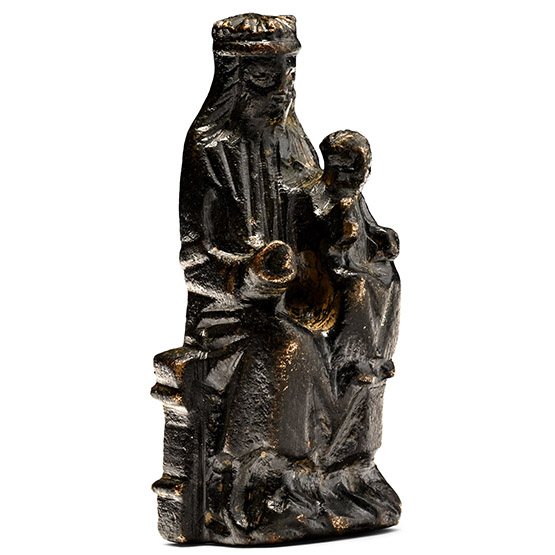
Medieval Bronze Seated Figure of Madonna and Child
England, 14th century A.D.Sold for (Inc. bp): £416
Modelled in the half-round, Mary crowned and seated, holding the infant Jesus on her left knee, the infant having his right hand raised in blessing gesture. 24.6 grams, 40 mm
Private collection, UK. -
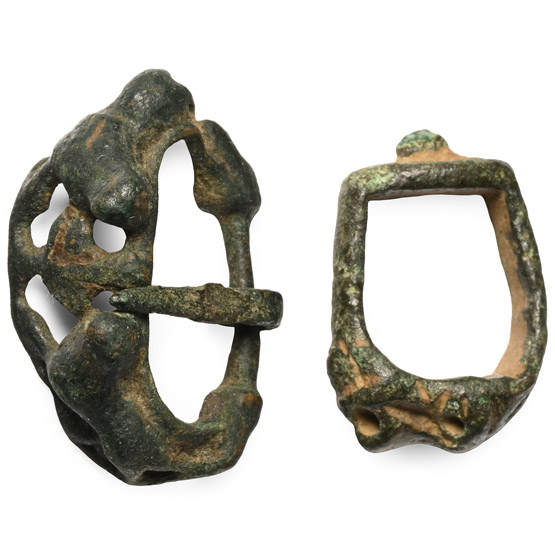
Medieval Bronze Animal Buckle Group
Circa 12th-13th century A.D.Sold for (Inc. bp): £13
Group of two buckle loops, one beast-head detailing to the upper face, the other in openwork with two beasts flanking a shield. 9.55 grams total, 21-27 mm
Found Norfolk, UK. -
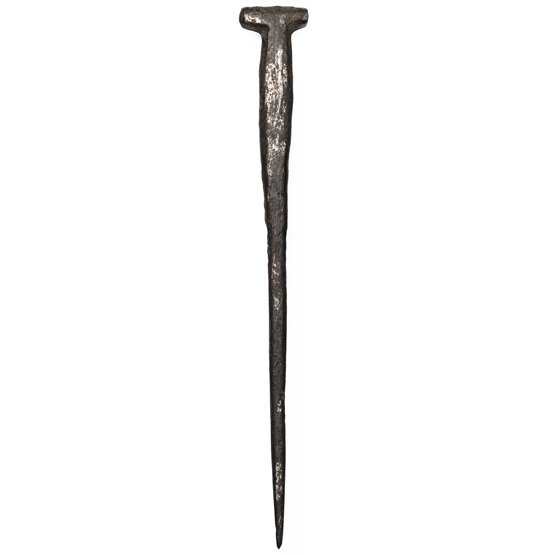
Medieval 'Thames' Iron Stylus
14th-16th century A.D.Sold for (Inc. bp): £39
With square-section tapering body and tubular finial. 4.38 grams, 75 mm
Found on the Thames foreshore, London, UK. Ex Cambridgeshire, UK, gentleman's collection. -
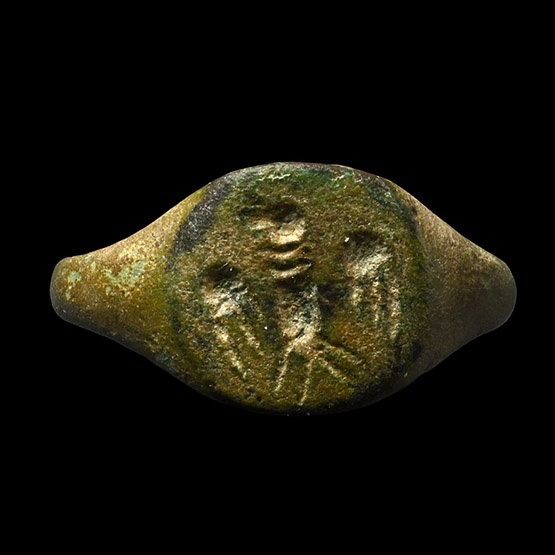
Medieval Ring with Spread Eagle
11th century A.D.Sold for (Inc. bp): £39
D-section hoop and a discoid bezel with an incuse image of an eagle with its wings spread. 3.35 grams, 22.64 mm overall, 19.25 mm internal diameter (approximate size British S 1/2, USA 9 1/4, Europe 20.63, Japan 19)
Acquired on the UK and EU art market before 2000. From the private collection of a Surrey, UK, gentleman.
In this category of rings, the oval hoop gradually widens into a full shoulder and a massive, flattened bezel. The bezel is an ellipsoidal field, decorated with the image of an imperial eagle. The eagle was a common motif in Romanesque art, both in the West and the East. -
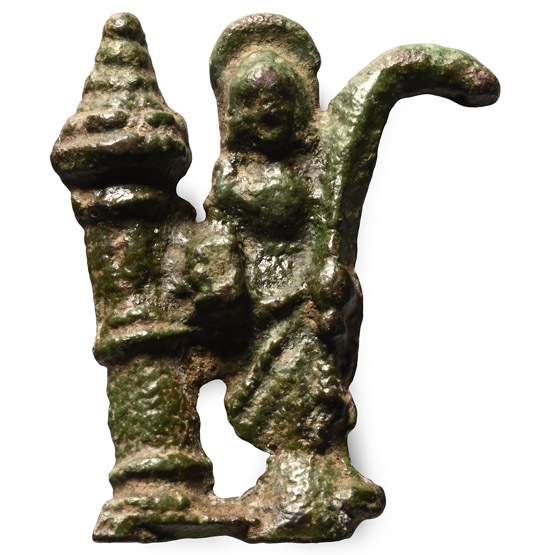
Medieval Bronze Pilgrim's Badge of Saint Barbara
14th-15th century A.D.Sold for (Inc. bp): £65
Nimbate Saint Barbara standing next to a tower with three windows and holding a palm frond, modelled in the half-round; remains of stud to the reverse. 3.05 grams, 24 mm
Acquired on the UK art market in the 1980s. From the private collection of an Essex gentleman.
According to the legendary accounts of her life that circulated from the seventh century, Barbara was the daughter of a rich pagan named Dioscorus. She was carefully guarded by her father who kept her locked up in a tower in order to preserve her from the outside world. Having secretly become a Christian, she rejected an offer of marriage that she received through him. Before going on a journey, her father commanded that a private bath-house be erected for her use near her dwelling, and during his absence Barbara had three windows put in it, as a symbol of the Holy Trinity, instead of the two originally intended. When her father returned, she acknowledged herself to be a Christian; upon this she was ill-treated by him and dragged before the prefect of the province, Martinianus, who had her cruelly tortured and finally condemned her to death by beheading. The father himself carried out the death-sentence, but in punishment for this he was struck by lightning on the way home and his body consumed. This summary omits picturesque details found in some versions. These recount that, when her father discovered that she was a Christian, he wanted to kill her, but her prayers created an opening in the tower wall and she escaped. Pursued by her father and guards, she hid in a gorge in the mountains. She stayed hidden here until a shepherd betrayed her. As legend has it, the shepherd was transformed into a marble statue and his herd into grasshoppers. When tortured, Barbara held true to her faith. During the night, the dark prison was bathed in light and new miracles occurred. Every morning her wounds were healed. Torches that were to be used to burn her went out as soon as they came near her. According to one version, she died on 4 December 306 in her native Nicomedia, Bithynia, Asia Minor. Saint Barbara is one of the Fourteen Holy Helpers (also known as Helpers in Need). Her association with the lightning that killed her father has caused her to be invoked against lightning and fire; by association with explosions, she is also the patron of artillery and mining. Her feast on 4 December was included in the Tridentine Calendar, having been introduced in Rome in the twelfth century. In 1729 that date was assigned to the celebration of Saint Peter Chrysologus, reducing that of Saint Barbara to a commemoration in his Mass. In 1969, because the accounts of her life and martyrdom were judged to be entirely fabulous, lacking clarity even about the place of her martyrdom, it was removed from that calendar. But she is still mentioned in the Roman Martyrology, which, in addition, lists another ten martyr saints named Barbara. Orthodox Christians have never ceased to venerate Saint Barbara, who is very popular among them. For them too her feast day is 4 December. In the 12th century, the relics of Saint Barbara were brought from Constantinople to the St. Michael's Golden-Domed Monastery in Kiev, where they were kept until the 1930s, when they were transferred to St. Vladimir's Cathedral in the same city. -
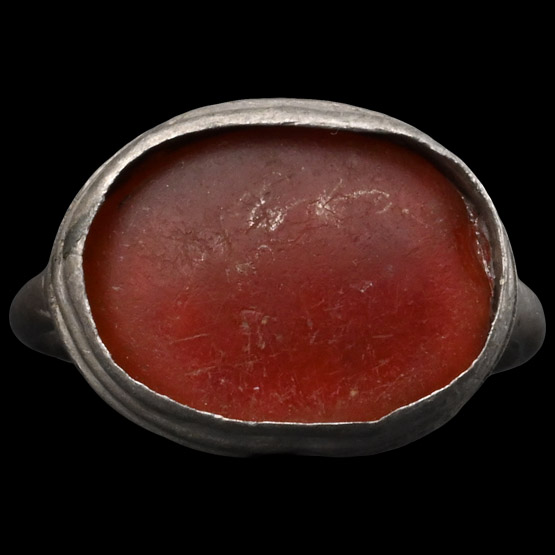
Medieval Silver Ring with Red Cabochon
Circa 14th-15th century A.D.Sold for (Inc. bp): £78
D-section hoop and ellipsoid bezel with ribbed cell, inset carnelian cloison. 7.50 grams, 26.98 mm overall, 19.94 mm internal diameter (approximate size British S 1/2, USA 9 1/4, Europe 20.63, Japan 19)
Ex German art market, 2000s. Acquired from an EU collector living in London. From the collection of a Surrey, UK, gentleman. -
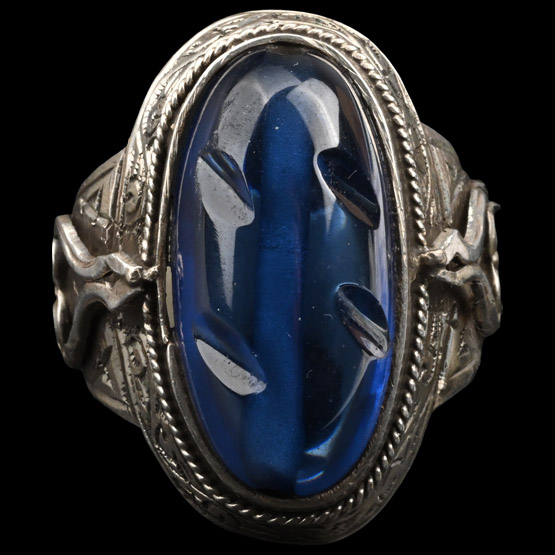
Silver-Coloured Metal Ring with Bead Gem
Late 20th-21st century A.D.Sold for (Inc. bp): £26
With broad hoop, applied scroll to each shoulder, filigree collar to the cell, inset ellipsoid cabochon with wheel-cut fluting. 20.18 grams, 33.67 mm overall, 23.08 mm internal diameter (approximate size British U 1/2, USA 10 1/4, Europe 23.15, Japan 22)
Private collection, UK. -
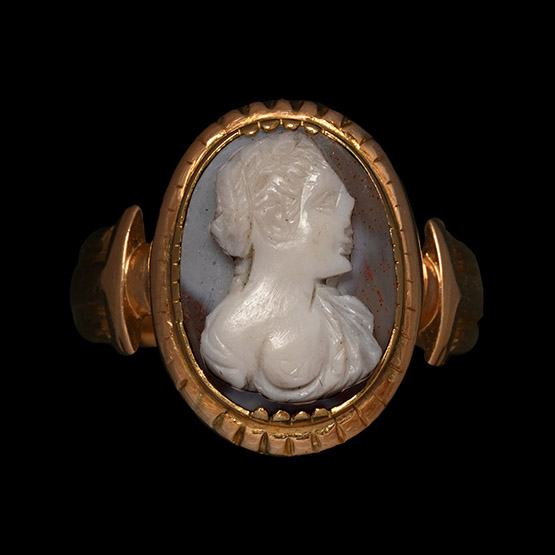
Renaissance Sardonyx Cameo of a Female Bust in Gold Ring
Italy, 16th-17th century A.D.Sold for (Inc. bp): £520
Carved with a bust of a young female in three-quarter view, wearing a loose palla with one breast exposed; set into an antique gold ring. 6.05 grams, 26.23 mm overall, 19.05 mm internal diameter (approximate size British S, USA 9, Europe 20, Japan 19)
Private collection, Europe. Acquired on the English art market. -
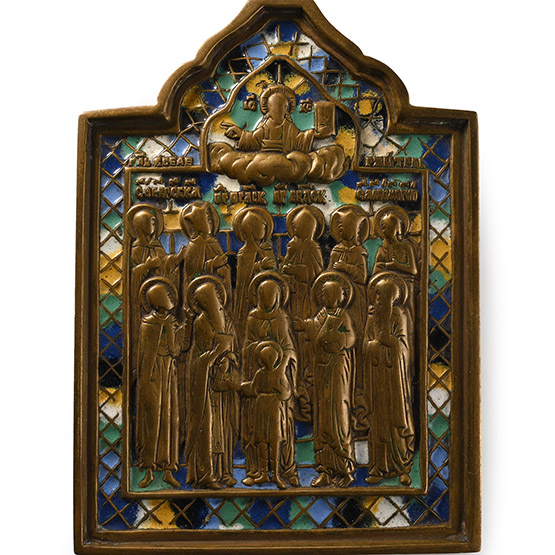
Russian Orthodox Enamelled Bronze Travel Icon with Saint Julyttas and Her Son Cyricus
19th century A.D.Sold for (Inc. bp): £208
With polychrome enamel in green, blue and yellow, framed by a square border with pointed doom, representing Saint Julyttas and her son Cyricus, surrounded by Saints; on the top, Christ Pantokrator, nimbate, making the gesture of blessing and holding a Gospel, seated upon a cloud and surrounded by Cyrillic letters 'ΙC ΧΡ' (Jesus Christ); Cyrillic inscriptions above some of the saints. 325 grams, 13.5 cm
Acquired from Chris Martin-Zakheim, Iconastas, 5 Piccadilly Arcade, London SW1. From the private collection of a West London, UK, gentleman, formed since the early 2000s.
Made of bronze with brightly coloured enamels, this icon was intended for private devotion, often carried by pilgrims and Orthodox believers for spiritual protection. St. Julyttas and her son Cyricus (Ки́рик и Иули́тта), among the most venerated figures in Russian tradition, are depicted in the centre, surrounded by other saints, a symbol of the communion of the righteous. -
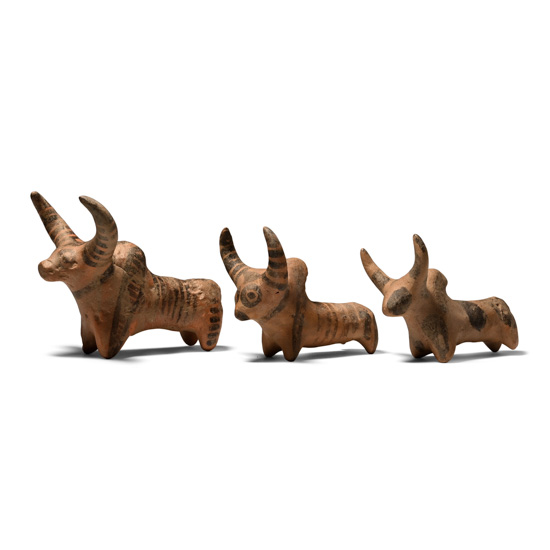
Indus Valley Style Terracotta Bull Group
20th century A.D.Sold for (Inc. bp): £104
A group of three zebu bulls, each with painted details. 294 grams total, 85-105 mm
Very fine condition.
Ex Lockdales, Suffolk, UK, auction 156, nos.892 and 906; and 159, no.1513. From the private collection of John Meredith, acquired since the 1990s; thence by descent. -
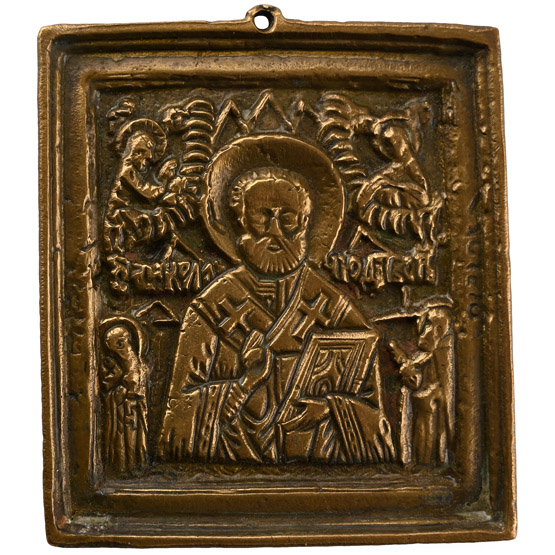
Eastern European Saint Nicholas Bronze Icon
Circa 19th century A.D.Sold for (Inc. bp): £26
Rectangular panel with raised rim and low-relief image of Saint Nicholas holding a book, right hand raised in blessing gesture; flanked with saints. 63 grams, 62 mm
Ex Constable collection, 1990s. Ex P. Morris collection.

