-
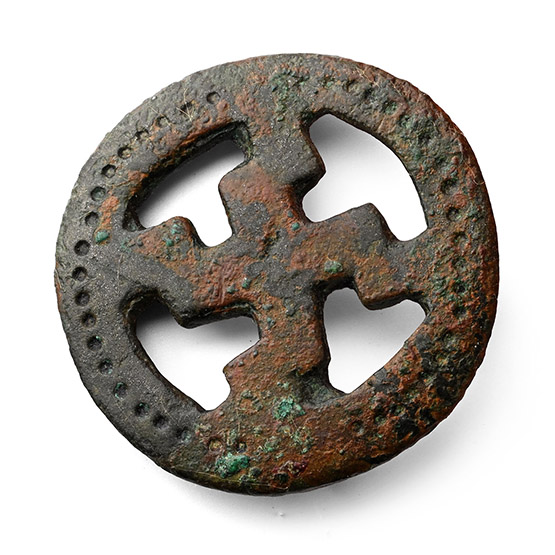
Anglo-Saxon Bronze Gammadion Disc Brooch
6th century A.D.Sold for (Inc. bp): £195
Disc brooch with four L-shaped voids spaced to form a reserved swastika motif, band of punched pellets to the rim, remains of the pin-lug and catchplate to the reverse. 20 grams, 41 mm
Found East Anglia, UK.
The swastika, also known as a gammadion, was an ancient sun symbol that is commonly found in many cultures across the Northern hemisphere. In the Viking period it was associated with Thor and is commonly found on rune-stones and amulets connected to him. -
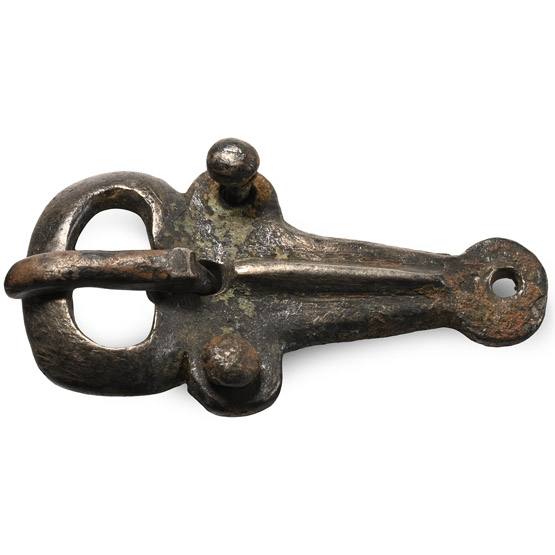
Saxon Silver Buckle
Circa 6th century A.D.Sold for (Inc. bp): £117
Triangular plate with integral loop, three mounting pins; narrow curved tongue. 19.5 grams, 54 mm
London, UK, collection, 1990s. -
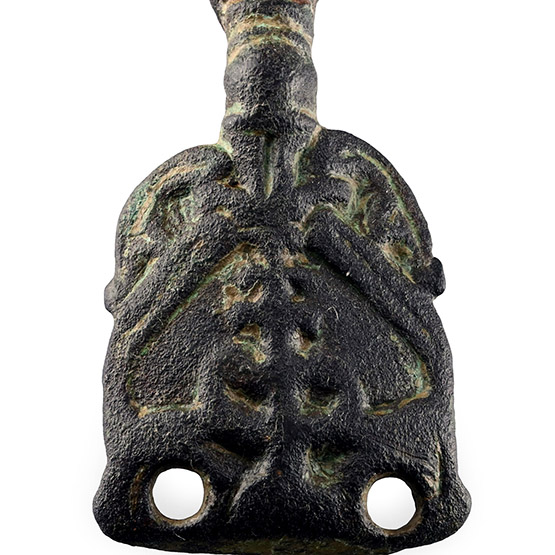
Anglo-Scandinavian Viking Bronze Skeletal Apex Stirrup Mount
11th century A.D.Sold for (Inc. bp): £221
Of Williams's Class A, Type 6, with D-shaped body, suspension loop formed above the beast-head in plan with rivet in situ, plaque with sinuous tendrils and ribs-and-pelvis motif, remains of ledge to the reverse. 20.86 grams, 50 mm
Found Elmdon, Essex, Uttlesford, UK. From a Colchester, UK, collection. Accompanied by an illustrated display card. Accompanied by a copy of the British Museum's Portable Antiquities Scheme (PAS) report no.ESS-6FCF0A. -
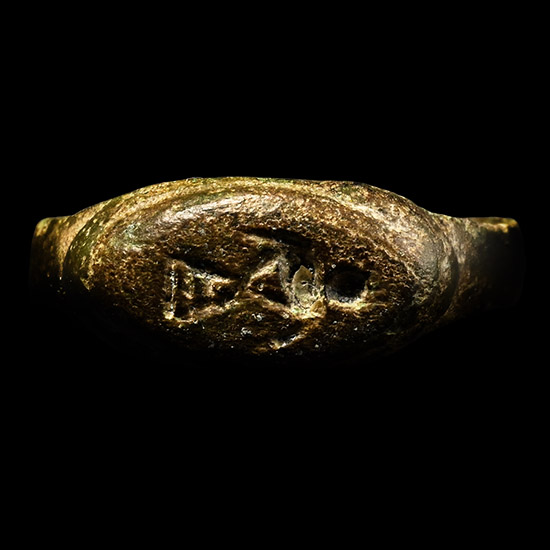
Merovingian Bronze Ring with Female Figure
6th-7th century A.D.Sold for (Inc. bp): £52
D-section hoop and a raised lentoid bezel with an incuse image of a facing woman dressed in a long skirt. 4.98 grams, 25.85 mm overall, 19.73 mm internal diameter (approximate size British U, USA 10, Europe 22.52, Japan 21)
Acquired on the UK and EU art market before 2000. From the private collection of a Surrey, UK, gentleman.
The ring belongs to the Type 4a of Hadjadj classification, i.e. rings with a sinuous and continuous profile. The image on the bezel is reminiscent of motifs linked to the Romano-Celtic mythology, and that of the mother goddess. -
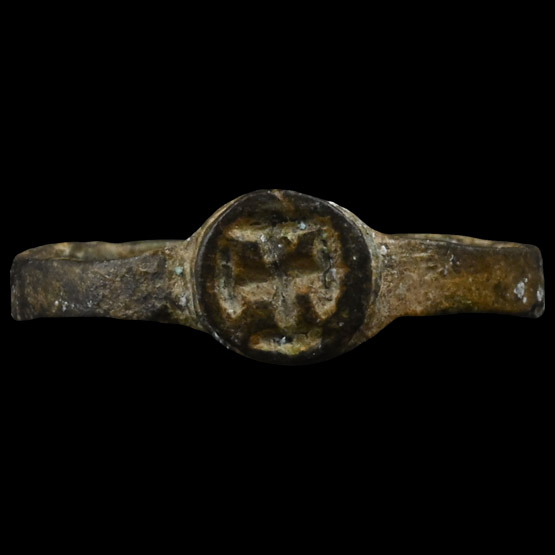
Merovingian Child's Ring with Cross
Circa 600-700 A.D.Sold for (Inc. bp): £20
Comprising a slender flat-section hoop with a raised circular bezel with incuse cross potent. 1.07 grams, 19.18 mm overall, 16.41 mm internal diameter (approximate size British K, USA 5 1/4, Europe 9.95, Japan 9)
Acquired on the UK and EU art market before 2000. From the private collection of a Surrey, UK, gentleman.
The ring belongs to Type 4b of Hadjadj classification. The image is a clear early Christian motif. A considerable proportion of rings found in the graves show portraits, names or monograms, and emblems such as the cross, the fish, the dove, i.e. early Christian symbols, most of these have the designs cut in a metal bezel. -
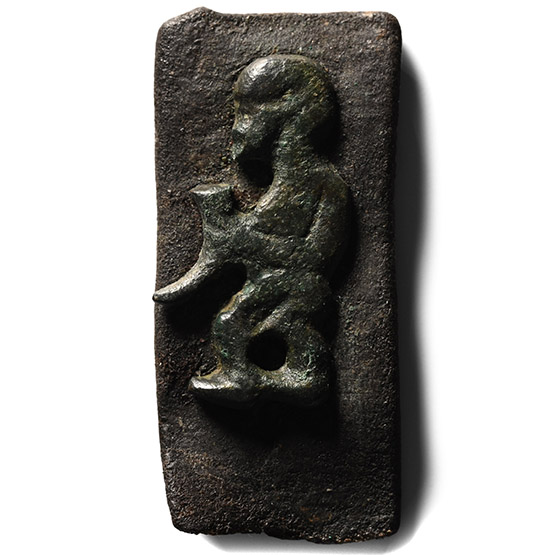
Scandinavian Pre-Viking Bronze Mount on Original Leather Strap Section
6th-7th century A.D.Sold for (Inc. bp): £260
Modelled in the half-round, profile figure with drinking horn, attached to a fragment of leather strap. 2.84 grams, 34 mm
From the private collection of a London gentleman, from his grandfather's collection formed before the early 1970s. -
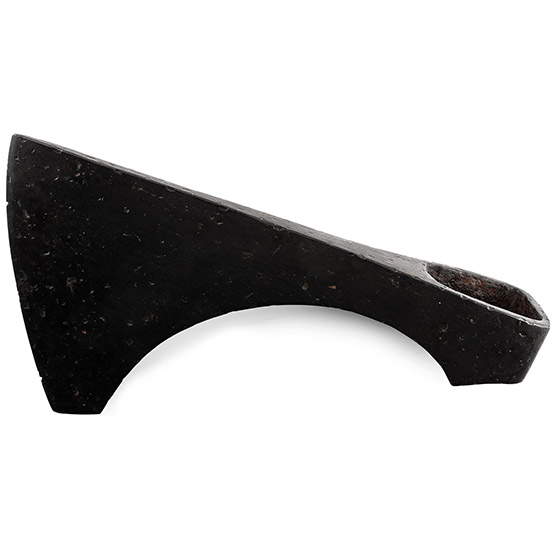
Viking Age Iron Socketted Bearded Axehead
Circa 10th-11th century A.D.Sold for (Inc. bp): £468
Finely curved, broad blade with a chin to the lower edge, a rounded socket with lateral triangular extensions; professionally cleaned, conserved, and restored. 411 grams, 18.5 cm
From the family collection of a South East London collector; formerly acquired in the late 1950s.
This type of bearded axe seems to correspond to the E2 category of the Viking axe classification, but also has affinity with the Slavic axes of type Y. Usually, these bearded axeheads (skeggöks) had a longer edge, designed to split tree trunks into planks and beams. Some of the bearded axes were known as halfÞynna öx; the neck on such a 'half thin axe' was thinly forged, to make it lighter. -
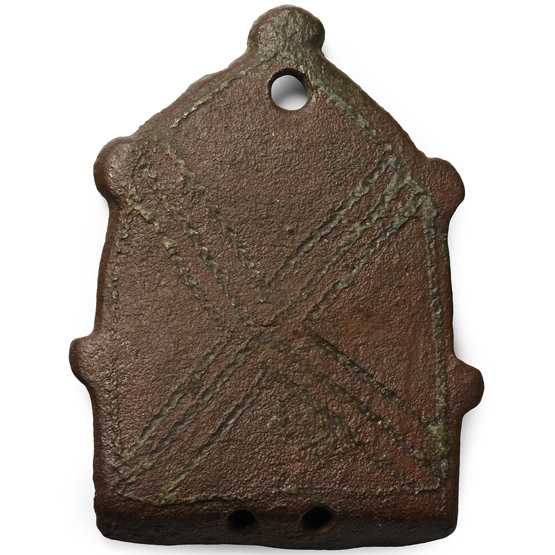
Large Anglo-Scandinavian Viking Bronze Stirrup Apex Mount with Saltire Cross
11th century A.D.Sold for (Inc. bp): £39
Tongue-shaped in plan with knop finial at the apex, four lateral lugs, ledge to bottom edge; pierced below the apex and with two small piercings on the ledge; incised border and trilinear incised saltire motif with niello fill; Williams's Class C. 35.9 grams, 61 mm
Found Norfolk, UK.
An unusual mount in some respects: the body is both long and sturdy, but the ledge is very narrow, and the two mounting holes are close together (which would be a weakness when mounting on a strap); the decoration is remarkably unambitious for so large a piece whose flat panel offers a great deal of scope for ornament. -
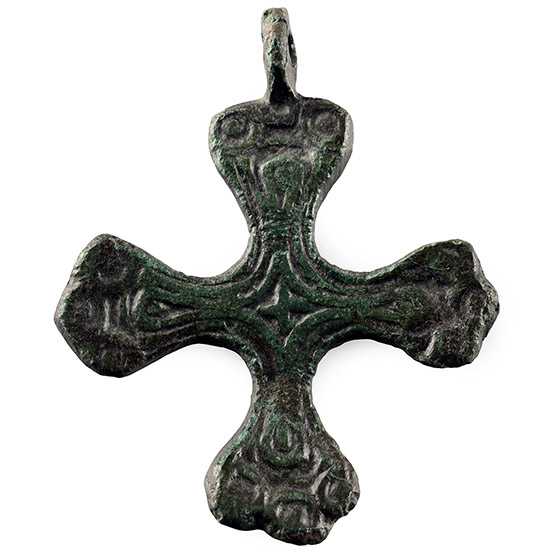
Viking Period Bronze Cross Pendant
Circa 9th-11th century A.D.Sold for (Inc. bp): £182
An expanding arm cross with an integral suspension loop, each arm with three ring-and-dot motifs at the finials, low-relief linear decoration and a central cross motif. 7 grams, 44 mm
UK gallery, early 2000s. -
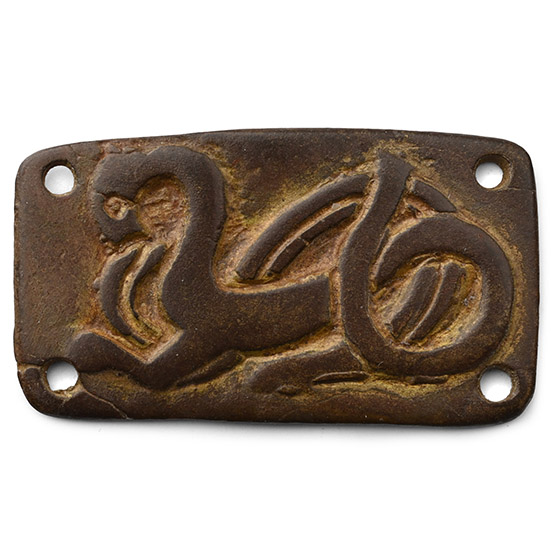
Anglo-Scandinavian Viking Bronze Belt Mount with Entwined Beast
10th-11th century A.D.Sold for (Inc. bp): £260
Rectangular panel pierced at each corner for attachment; low-relief 'hippocamp' zoomorphic figure with arched neck, curved beak, coiled rear body. 6.1 grams, 36 mm
Found East Anglia, UK. Acquired on the UK art market.
The design shows elements of Irish influence. -
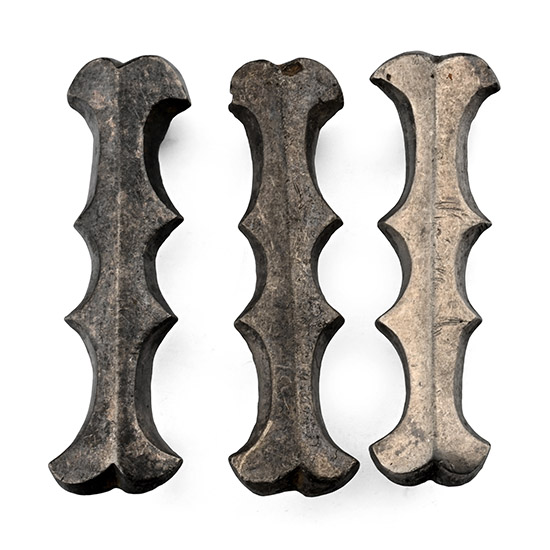
Viking Period Silver Belt Mount Group
Circa 9th-11th century A.D.Sold for (Inc. bp): £91
Each a rectangular bar with median carination, splayed ends, scooped edges; mounting pins to reverse. 27.7 grams total, 43.8-44.5mm
From an old English collection, 1980s. -
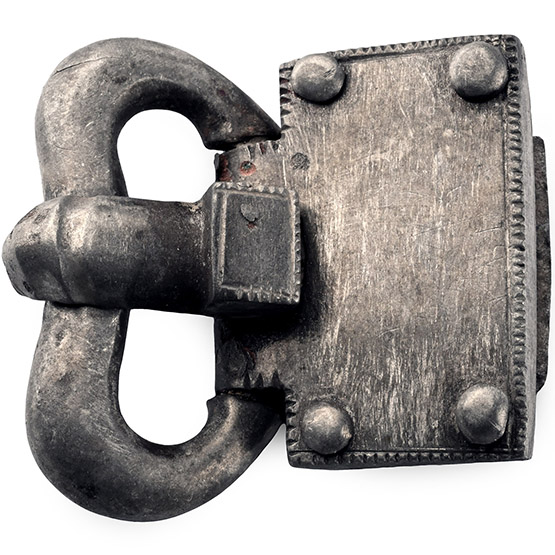
Saxon Period Silver Buckle
Circa 6th century A.D.Sold for (Inc. bp): £169
Comprising a rectangular plate with notched edges and a kidney-shaped loop, a hooked tongue with a rectangular plate at the base; four rivets on the plate. 41.1 grams, 42 mm
UK gallery, early 2000s.

