-
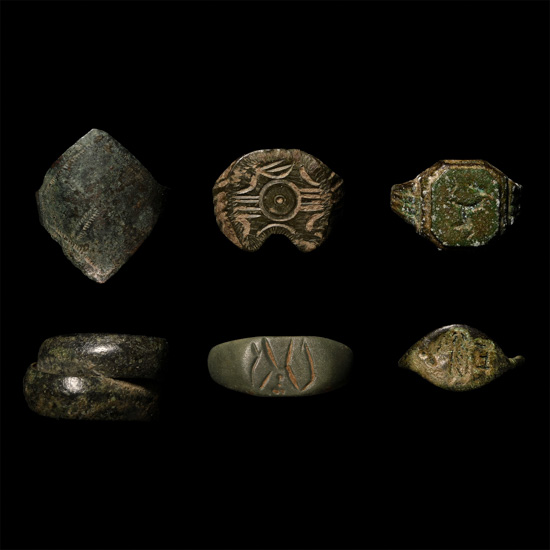
Celtic to Medieval Bronze Ring Collection
1st century B.C.-16th century A.D.Sold for (Inc. bp): £130
Comprising: five rings with decorative bezels, one coiled ring with D-section hoop. 23.99 grams total, 20-24 mm
Acquired on the UK and EU art market before 2000. From the private collection of a Surrey, UK, gentleman.
The collection includes one complete copper-alloy finger ring of late Iron Age to Roman date (200 BC - AD 200). It is coiled into a spiral of two turns. Both extremities terminated in a square end with rounded corners. -
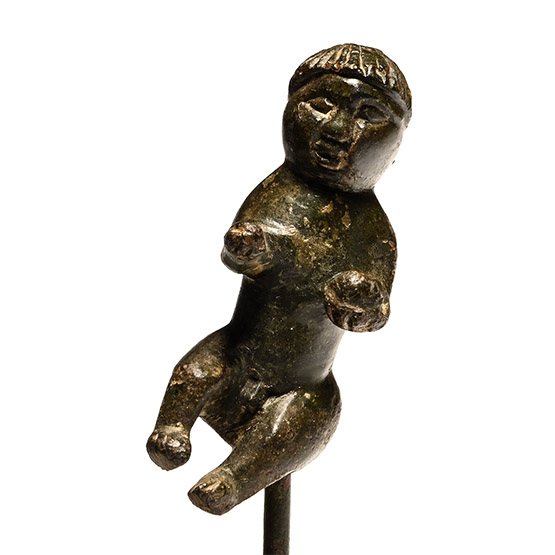
'The Cox Green' Romano-British Bronze Naked Figure of a Child
1st-3rd century A.D.Sold for (Inc. bp): £845
Modelled in the round in seated pose with a ball (or nut, or fruit) in his left hand; the hair short and combed radially from the crown; mounted on a custom-made stand. 57.3 grams, 78 mm
Found Cox Green, Windsor and Maidenhead, UK, on Sunday 1st September 2019. Accompanied by a copy of the British Museum's Portable Antiquities Scheme (PAS) report no.BERK-3D408B. -
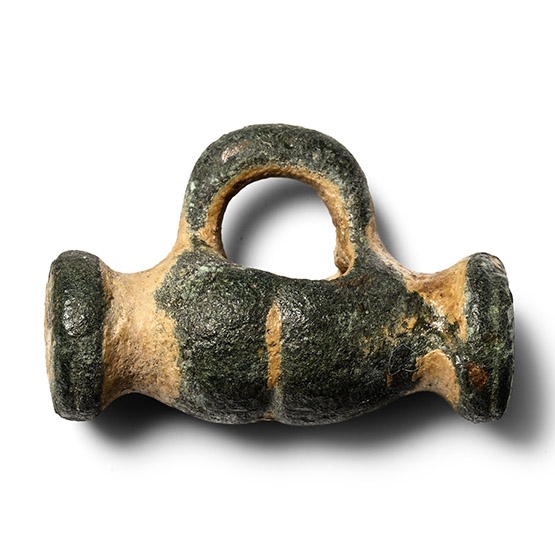
Celtic Bronze Toggle Fastener
Iron Age, 2nd century B.C.-1st century A.D.Sold for (Inc. bp): £59
With median loop and gusseted disc finials, baluster-shaped in profile. 11.5 grams, 26 mm
Found whilst searching with a metal detector near Bottisham, East Cambridgeshire, UK, on Friday 13th December 2024. Accompanied by a copy of the British Museum's Portable Antiquities Scheme (PAS) report no.SF-026B7D. -
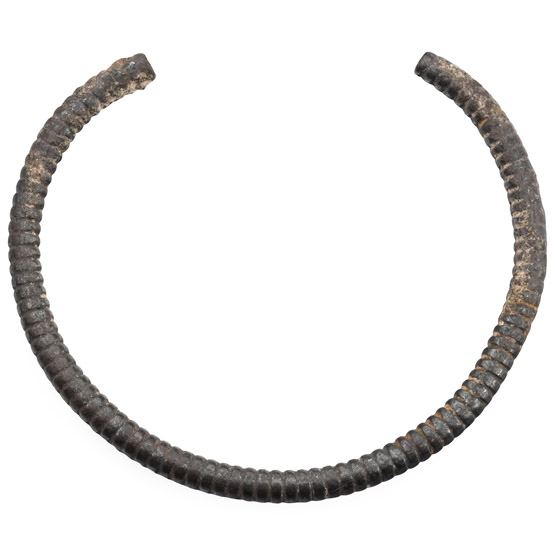
Romano-Celtic Silver Ribbed Bracelet
1st century B.C.-1st century A.D.Sold for (Inc. bp): £65
Penannular with ribbed round-section shank. 11.57 grams, 57 mm
Ex German art market, 2000s. Acquired from an EU collector living in London. From the collection of a Surrey, UK, gentleman. -
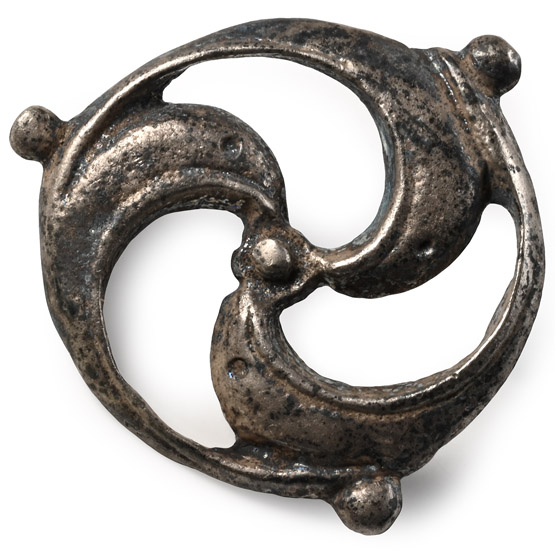
Romano-Celtic Silver Triskele Dolpin Brooch
Circa 2nd century A.D.Sold for (Inc. bp): £241
Discoid in plan with central granule and three more to the rim; openwork comma-leaf motif; pin-lugs and catch to reverse. 8.23 grams, 31 mm
Ex German art market, 2000s. Acquired from an EU collector living in London. From the collection of a Surrey, UK, gentleman. -
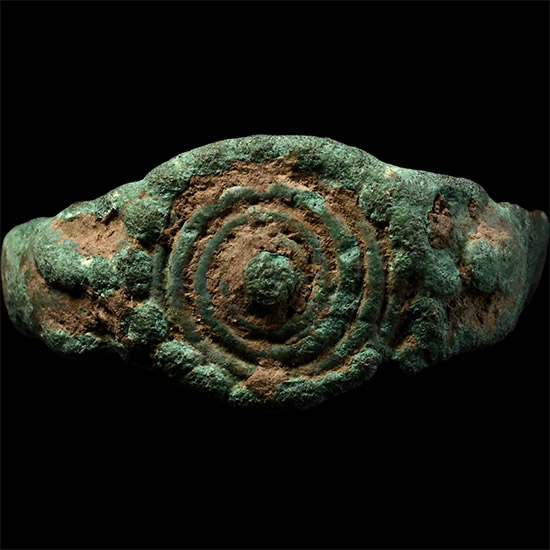
British Celtic Bronze Ring with Concentric Design
1st century B.C.-1st century A.D.Sold for (Inc. bp): £59
Flat-section hoop and a discoid bezel with a low-relief concentric circle motif, a raised pellet at the centre. 2.25 grams, 21.70 mm overall, 17.82 mm internal diameter (approximate size British O 1/2, USA 7 1/4, Europe 15.61, Japan 15)
Found Norfolk, UK. Acquired on the UK and EU art market before 2000. From the private collection of a Surrey, UK, gentleman.
Similar types of Celto-Roman bronze rings were found in the Thames in spoil heaps dating to the 1st century A.D. The most prolific finger rings in use throughout the Roman occupation were in bronze, and some forms were borrowed from Celtic arts and patterns. -
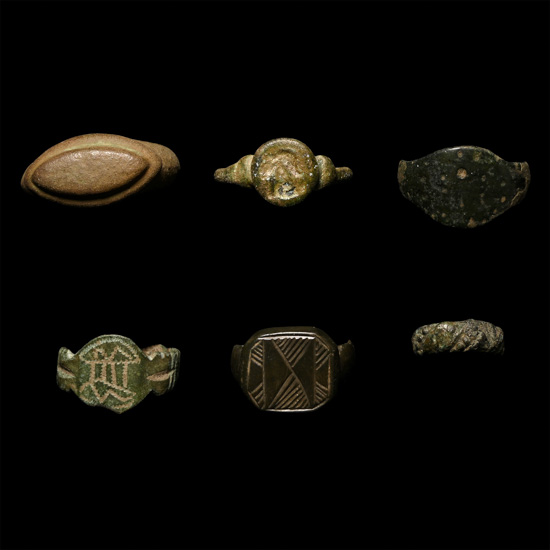
Celtic to Medieval Bronze Ring Collection
1st century B.C.-16th century A.D.Sold for (Inc. bp): £124
Comprising five rings with decorative bezels and one small faux-twist ring. 31.8 grams total, 14-28 mm
Acquired on the UK and EU art market before 2000. From the private collection of a Surrey, UK, gentleman.
The collection includes possible signet rings that find their parallels with artefacts from Eastern Europe, especially in the area of Smederevo. A 15th A.D. date, for some of them, can be proposed on the basis of parallels from the Balkans. -
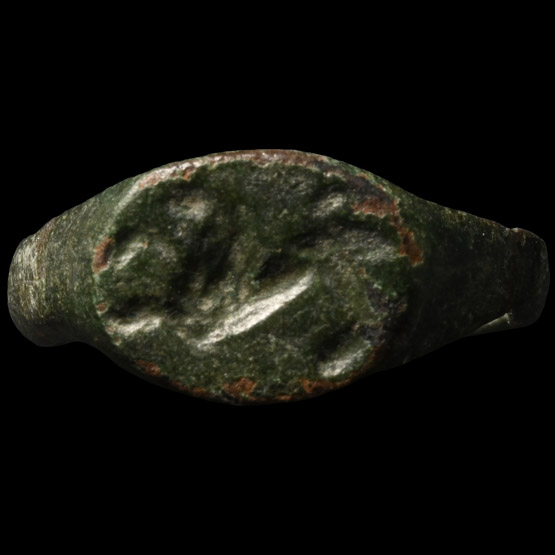
Romano-Celtic Bronze Ring with Horse
1st century B.C.-1st century A.D.Sold for (Inc. bp): £78
D-section hoop and integral ellipsoid bezel with incuse running hare motif. 1.65 grams, 17.03 mm overall, 14.02 mm internal diameter (approximate size British F, USA 2 3/4, Europe 3.67, Japan 3)
Acquired on the UK art market in the 1980s. From the private collection of an Essex gentleman. -
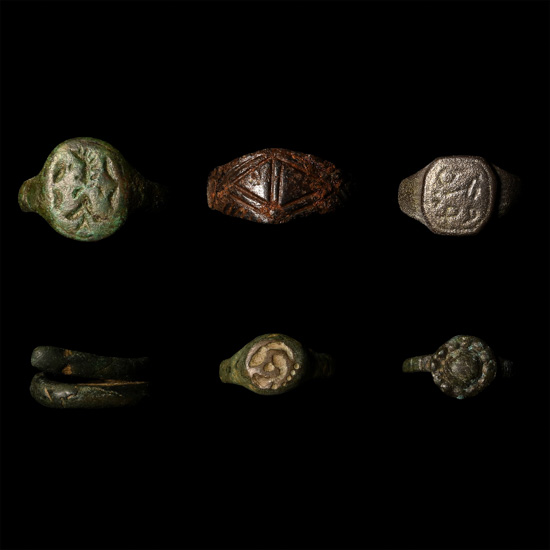
Celtic to Medieval Bronze Ring Collection
1st century B.C.-16th century A.D.Sold for (Inc. bp): £130
Comprising: five rings with decorative bezels; a coiled ring with linear decoration. 23.39 grams total, 20-25 mm
Acquired on the UK and EU art market before 2000. From the private collection of a Surrey, UK, gentleman.
The collection includes one complete copper-alloy finger ring of late Iron Age to Roman date (200 BC - AD 200). It is coiled into a spiral of two and a half turns. Both extremities terminate in a square end with rounded corners. -
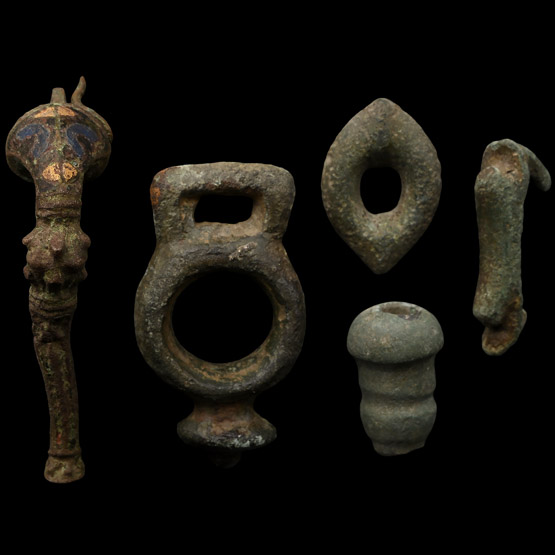
Celtic and Romano British Bronze Artefact Collection
Iron Age, 1st century B.C.-1st century A.D.Sold for (Inc. bp): £26
Including large enamelled trumpet brooch, terret mounts, and other items. 118 grams total, 27-64 mm
Found Norfolk, UK. -
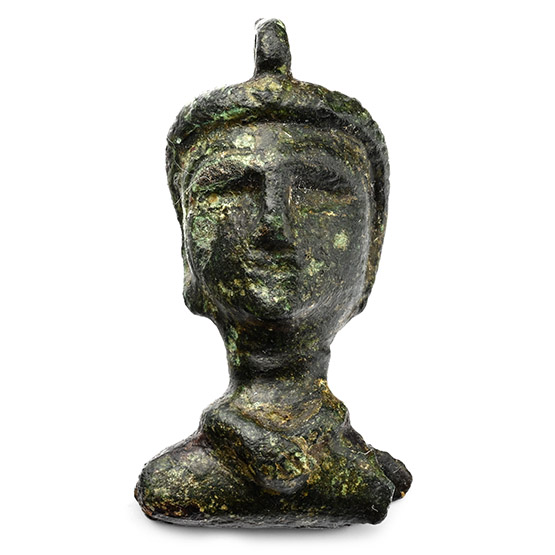
Celtic Bronze God Cauldron Mount
Iron Age, 1st century B.C.-1st century A.D.Sold for (Inc. bp): £468
Modelled in the half-round as a male bust with serpent headdress and torc; the hair depicted with a braided outer band framing the face and terminating at the jawline; the brow broad and heavy with raised eyebrows and sunken eye-sockets, narrow nose and small flat mouth; fleshy cheeks and chin; the slender neck with V-shaped collar or torc; the shoulders and chest with a slot to the lower edge to accept a gerrous insert; at the apex a S-curved crest extending to the rear and terminating in a narrow loop. 51.28 grams, 47 mm
Acquired on the UK art market in the 1980s. From the private collection of an Essex gentleman.
The format, workmanship and proportions of the piece recall a number of Gallic images of Iron Age date. The slanting eye sockets below a heavy brow appear, for example, on the idol from Neuvy Pailloux (Boucher, item 47), as does the collar with a centrepiece below the chin on the same item. The thick band of hair appears on a bronze figurine from Neuvy-en-Sullias (Boucher, item 55) and several others (e.g. items 56, 71), but its placement and curvature also suggest a ram's horns. The curved crest may represent a serpent, or more likely the neck of a swan or goose, as seen in a figure of Mars from Chaudon (Rolland, item 24; Boucher, item 69). The likely function of the piece is difficult to determine since it is too short to form an effective handle or hilt for a dagger, yet the width of the slot (about 1.mm) suggests that it was meant to accept a thin iron sheet. It is possible that the piece was intended to be a decorative mount for the rim of a bowl or cauldron. -
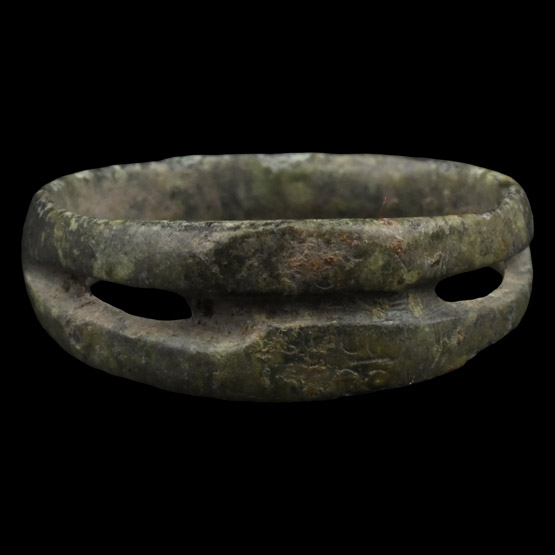
Romano-Celtic Bronze Double Bezel Ring
1st century B.C.-2nd century A.D.Sold for (Inc. bp): £39
Comprising a D-section hoop with the bezel formed of two rods joined at the centre. 3.38 grams, 23.00 mm overall, 17.62 mm internal diameter (approximate size British P, USA 7 1/2, Europe 16.23, Japan 15)
Acquired on the UK and EU art market before 2000. From the private collection of a Surrey, UK, gentleman.
A similar ring was found in Cologne, Luxembourg Strasse, this type of ring often being found in gold.

