-
.jpg)
'The Ceres Collection' Italic Agate Gemstone of a Boar in Silver Ring
2nd-1st century B.C.Sold for (Inc. bp): £572
Oval in plan and plano-convex in section, depicting a boar at bay from a hound; set in a later heavy silver mount with French maker's mark and French assay mark; supplied with a museum-quality impression. 12.35 grams, 25.62 mm overall, 18.51 mm internal diameter (approximate size British N 1/2, USA 6 3/4, Europe 14.35, Japan 13)
American family collection, New York, formed 1930s-1990s. with Bonhams, London, 17 September 2014, no.96. Private collection, England. -
.jpg)
Roman Cornucopia and Poppy Gemstone in Iron Ring
2nd-1st century B.C.Sold for (Inc. bp): £1,235
With broad plaque and inset cabochon intaglio, cornucopia flanked by budding flowers; set into a possibly later iron ring; supplied with a museum-quality impression. 9.07 grams, 24.90 mm overall, 16.14 x 17.64 mm internal diameter (approximate size British L 1/2, USA 6, Europe 11.87, Japan 11)
UK private collection before 2000. Acquired on the UK art market. Private collection, London, UK. -
.jpg)
Roman Carnelian Gemstone with Minerva in Iron Bezel
Circa 2nd century A.D.Sold for (Inc. bp): £520
Ferrous bezel with inset intaglio of Minerva standing with spear and shield, one hand extended with patera. 3.5 grams, 23 mm
Ex gentleman's specialist collection, 1990-2015. -
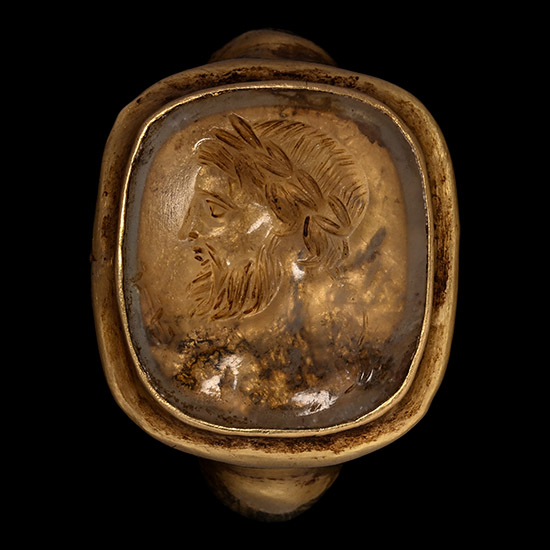
Eastern Roman Gold Ring with Rock Crystal Gemstone of Asclepius the God of Medicine
2nd century A.D.Sold for (Inc. bp): £3,640
D-section hoop with expanding shoulders enclosing a rectangular bezel, intaglio depicting a profile bearded bust wearing a laurel wreath; supplied with a museum-quality impression. 9.14 grams, 26.16 mm overall, 18.96 x 17.33 mm internal diameter (approximate size British P, USA 7 1/2, Europe 16.23, Japan 15)
Ex London gentleman's collection, 1990s. This lot has been checked against the Interpol Database of stolen works of art and is accompanied by search certificate number no.13128-249407. -
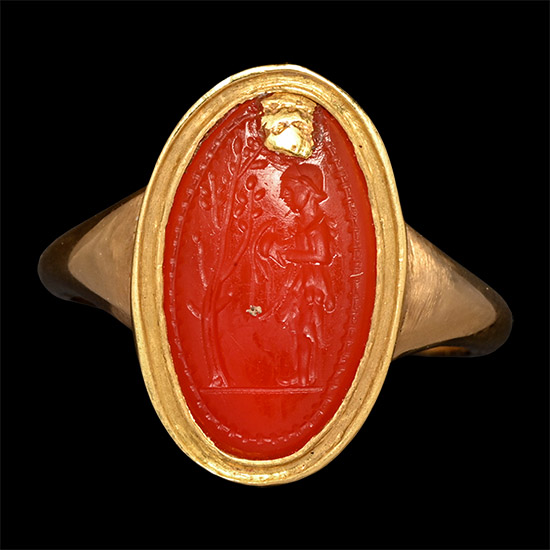
Italic Carnelian Gemstone Depicting the Goddess Athena Before a Tree in Gold Ring
Circa 2nd century B.C.-1st century A.D.Sold for (Inc. bp): £2,210
With a standing figure wearing chiton facing a tree, possibly Athena facing an olive tree; set into a later gold ring; supplied with a museum-quality impression. 8.18 grams, 23.95 mm overall, 17.27 mm internal diameter (approximate size British N 1/2, USA 6 3/4, Europe 14.35, Japan 13)
Private collection, Europe. Acquired on the English art market. This lot has been checked against the Interpol Database of stolen works of art and is accompanied by search certificate number no.13129-248338. -
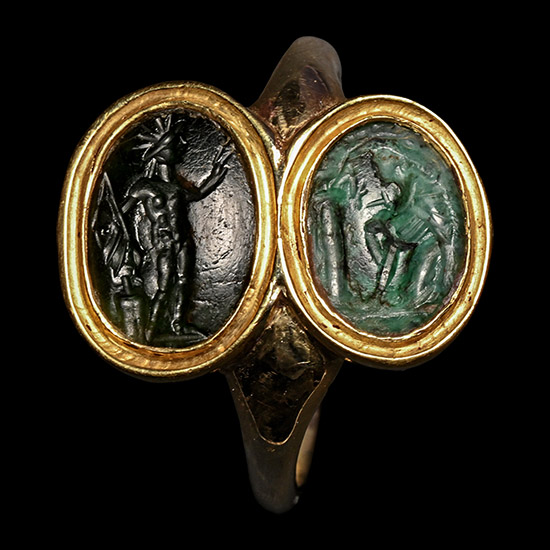
Roman Chrome Chalcedony Intaglios in Double Bezel Gold Ring
1st-2nd century A.D.Sold for (Inc. bp): £2,340
One intaglio carved with the image of an elderly man seated before a column, the other with the figure of the sun god Sol; set into a later gold ring; supplied with a museum-quality impression. 7.59 grams, 23.27 mm overall, 19.02 mm internal diameter (approximate size British Q, USA 8, Europe 17.49, Japan 16)
Private collection, Europe. Acquired on the English art market. This lot has been checked against the Interpol Database of stolen works of art and is accompanied by search certificate number no.13131-248400.
Chrome chalcedony was widely used in jewellery and seals throughout the Roman Empire; it disappeared from use in the ancient world in the 2nd century when the known deposits were mined out. -
.jpg)
Roman Nicolo Gemstone of the Bust of an Ephebos in Grand Tour Gold Ring
2nd century A.D.Sold for (Inc. bp): £1,690
Nicolo cloison with profile bust of an adolescent (Greek ephebos) with tousled hair; set in a later gold ring; supplied with a museum-quality impression. 3.84 grams, 21.26 mm overall, 17.32 mm internal diameter (approximate size British L 1/2, USA 6, Europe 11.87, Japan 11)
Private collection, England. -
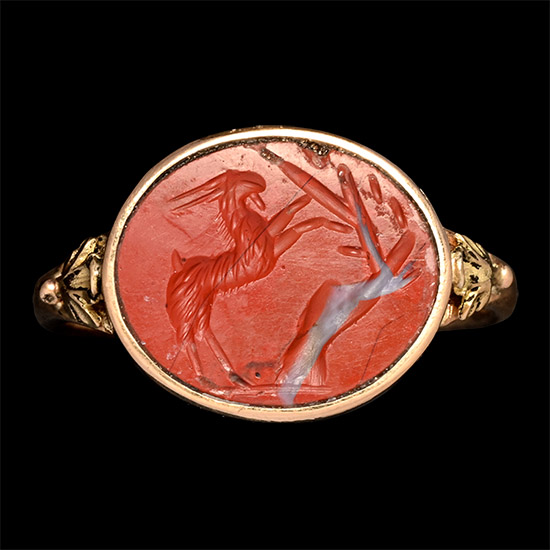
Roman Jasper Gemstone of a Grazing Goat in Gold Ring
2nd-3rd century A.D.Sold for (Inc. bp): £910
Intaglio of a bearded goat standing on its hind legs against a tree on which it browses; large fruits hanging from two of the boughs; from a third bough to the right of the tree hangs what may be a dead hare, or possibly another fruit; set into a later gold ring; supplied with a museum-quality impression. 4.10 grams, 20.70 mm overall, 17.90 x 14.56 mm internal diameter (approximate size British L, USA 5 3/4, Europe 11.24, Japan 10)
Private collection, Europe. Acquired on the English art market.
A single transparent vein in the jasper running from top left to bottom right has been utilised by the engraver to emphasise the trunk of the tree. -
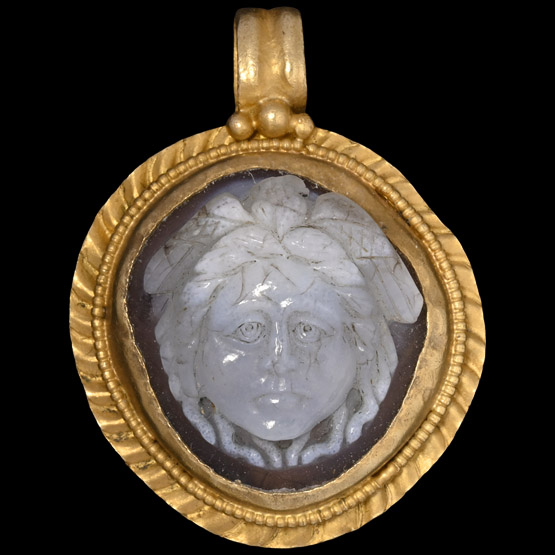
Roman Gold Pendant with Medusa Cameo
2nd-3rd century A.D.Sold for (Inc. bp): £2,340
A pendant with crimped flange rim, beaded wire collar to the cell and ribbed loop with granules; inset agate cameo gorgoneion mask. 7.33 grams, 28 mm
Private collection, acquired before 1980. Acquired on the UK art market. Private collection, England. This lot has been checked against the Interpol Database of stolen works of art and is accompanied by search certificate number no.13133-249606. -
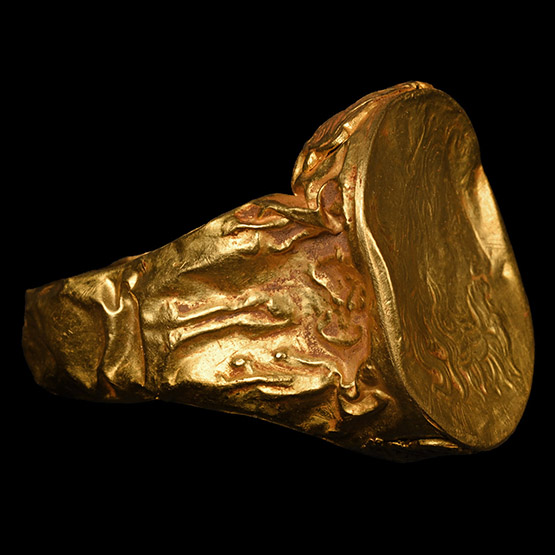
Very Large Roman Gold Ring with Engraved Head of the God Neptune and Warships
1st century B.C.-1st century A.D.Sold for (Inc. bp): £3,640
A substantial hollow-form ring with a hexagonal plaque to the base of the hoop, expanding shoulders with a low-relief image of a standing nude goddess; raised oval bezel with an applied repoussé disc of a warship to each end; applied bezel with a chiselled image of god of the sea Neptune facing right, depicted with thick, lustrous beard and hair, the hair tied with a thin ribbon. 7.40 grams, 37.31 mm overall, 22.71 x 27.56 mm internal diameter (approximate size British Z+3, USA 13 3/4, Europe 32.57, Japan 31)
Ex Angelopolo collection, Vienna. Acquired in the mid 1980s-1990s. Private collection, Switzerland, thence by descent. Private collection, since the late 1990s. Accompanied by an academic report by Dr Raffaele D’Amato. This lot has been checked against the Interpol Database of stolen works of art and is accompanied by search certificate number no.12571-232087. This lot has been cleared against the Art Loss Register database, and is accompanied by an illustrated lot declaration signed by the Head of the Antiquities Department, Dr Raffaele D'Amato.
The ring carries a rare combination of the god Neptune (Greek Poseidon) with two warships. This can only mean that it belonged to a navarcha, a commander of a fleet or a warship. In the turbulent era of the civil wars that followed the death of Caesar, important naval conflicts sealed the fate of the Roman Res Publica. Sextus Pompeius, son of the great Pompey, was able to build a naval power in the South of the Italian Peninsula, especially in Sicily, adopting the image of the god Neptune who - with an image very similar to that of our ring - was represented on the coins he minted, together with naval triumphs and warships. The ships depicted on the ring belong to the Liburna type, protagonist of the famous battle of Actium in 31 B.C. They were smaller and faster ships, armed with 82 oars disposed upon two orders, about 33 meters long, with 114 oarsmen, 10-15 sailors, and 40 marines. The Liburna’s hull had a pointed, streamlined prow built for speed, as well a fully-detailed ram (rostrum). -
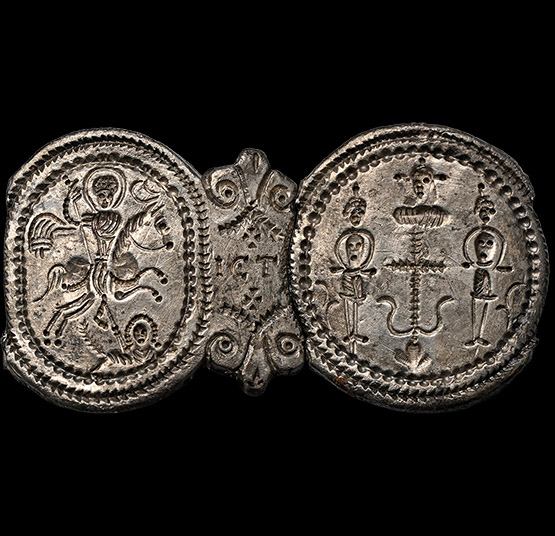
Byzantine Silver Bracelet Sections with Warrior Saint and Crucifixion
6th-7th century A.D.Sold for (Inc. bp): £936
Two fragments from a military bracelet (brachiolion) comprising: a disc with double border of pellets, at the centre two standing figures of the two robbers flanking a stylised Stavrosis (crucifixion), composed of a stylised cross surmounted by the nimbate head of Christ; the other an ellipsoid panel and portion of the shank with pelta-shaped motifs flanking 'ICT' (IesouC Theou = Jesus son of God) legend, the panel with double border of pellets enclosing image of nimbate Saint George on horseback with scale armour and spearing the dragon with a long spear (doru). 9.67 grams total, 26 mm each
Ex private Dorset, UK, collection circa 1980s. Property of a London, UK, antiquarian. Accompanied by an academic report by Dr Raffaele D’Amato. This lot has been checked against the Interpol Database of stolen works of art and is accompanied by a search certificate number no.13042-248494.
The importance of the depicted subject, the Stavrosis or Crucifixion, lies in its rarity. We know of very few representations of this subject in the early period of Christian art. Since the 6th-7th centuries, the iconographic type of military saints on horseback, Saint George, Saint Demetrios, Saint Theodore and Saint Sisinnios appear in the artistic milieu of the Middle East at the end of the 5th century-early 6th century AD. Among this iconography, the figure of Saint George, killer of the Dragon, stood out. The warrior saint was represented armed like a true Christian warrior of the Roman Empire, and the style of his armament here, also for comparison with similar images, points to a 6th-7th century dating, a period when the Eastern Roman Empire was still at the height of its power and exerted its influence over Eastern and Western Europe. -
.jpg)
Byzantine Gold Marriage Ring with Busts
Circa 6th-7th century A.D.Sold for (Inc. bp): £10,400
D-section hoop with carination, flat chamfered shoulders each with an engraved cross moline within a wreath; trumpet-shaped bezel with two facing busts and processional cross between, the bodies with inset carnelian studs; legend 'OMONOIA' (harmony) below. 13.76 grams, 25.37 mm overall, 18.77 mm internal diameter (approximate size British Q, USA 8, Europe 17.49, Japan 16)
From the collection of a late English gentleman, 1990s. This lot has been checked against the Interpol Database of stolen works of art and is accompanied by a search certificate number no.13047-248619.
The marriage ring is one of the typologies in which figural decorations are frequently found. Generally speaking, marriage rings are engraved with a representation of a husband and wife, sometimes accompanied by Christ, and usually engraved with wishes for 'harmony, health and the grace of God'. Rings of this type had been used since the late 4th century A.D. and remained extremely popular in Byzantium in the 6th and 7th centuries.

