-
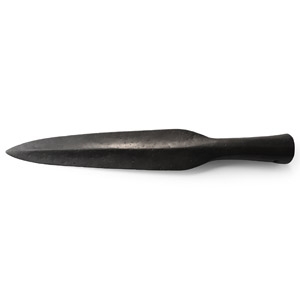
Very Large Finno-Ugrian Iron Socketted Spearhead
Circa 12th-13th century A.D.Sold for (Inc. bp): £111
Leaf-shaped blade with raised midrib extending to facetted-section tapering socket with fastening hole; professionally cleaned, conserved, and restored. 745 grams, 38.7 cm
Cleaned, conserved and restored.
From the family collection of a South East London collector; formerly acquired in the late 1950s.
The more common weapons of Finno-Ugrian people were axes commonly found from all Finnic areas, as well as spears. Among Baltic and Finnic people, especially in Finland and Karelia, knives called 'puukko' were common, as well as axes, spears, flat bows and longbows. Swords were usually imported from Germanic areas, Sweden, or from elsewhere in Scandinavia, some having often typically Scandinavian animal ornaments, although Finnish-made items have also been found. -
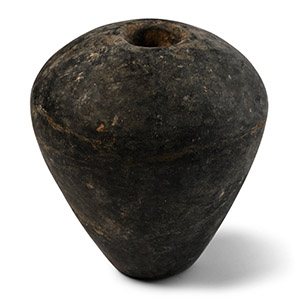
Mesopotamian Veined Mottled Grey Stone Macehead
3rd-2nd millennium B.C.Sold for (Inc. bp): £117
Piriform with vertical socket expanding towards the narrower end; polished surface. 424 grams, 72 mm
Ex 1990s collection and with a central London gallery. -
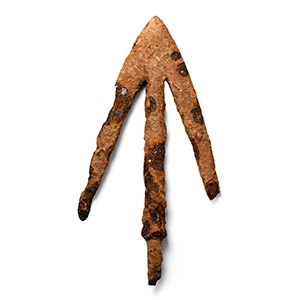
Medieval Iron Swallow-Tailed Arrowhead
10th-14th century A.D.Sold for (Inc. bp): £26
With narrow curved edges and stepped tang. 17.6 grams, 84 mm
From the private collection of author and historian Dr DeWitt Bailey, one of the global authorities on the confederate army in the US civil war; thence by descent to his grandson. -
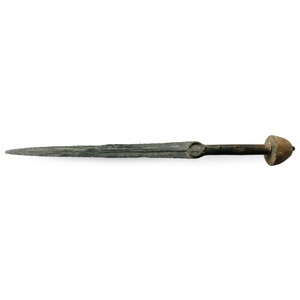
Luristan Bronze Short Sword
2nd-1st millennium B.C. and laterSold for (Inc. bp): £442
With leaf-shaped two-edged blade, crescent guard; restored hilt with columnar grip and stone pommel. 521 grams, 58 cm
From a North West London collection; previously acquired in the 1980s. -
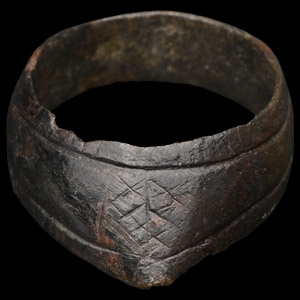
Byzantine Decorated Bronze Archer's Thumb Ring
10th-15th century A.D.Sold for (Inc. bp): £39
With triangular flange to one edge, incised hatching. 7.35 grams, 34.98 mm overall, 21,50 x 25.28 mm internal diameter (approximate size British Y 1/2, USA 12 1/4, Europe 28.2, Japan 27)
From a private Tyneside collection, formed since the early 2000s. -
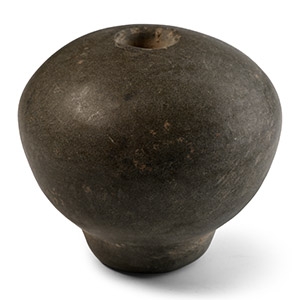
Mesopotamian Grey Stone Macehead
3rd-2nd millennium B.C.Sold for (Inc. bp): £124
Biconvex in profile with low tubular socket. 442 grams, 73 mm
Ex 1990s collection and with a central London gallery. -
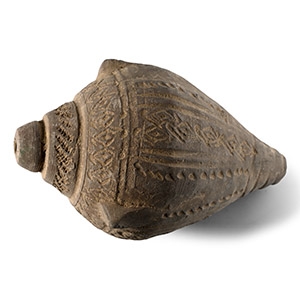
Byzantine 'Greek Fire' Ceramic Fire Bomb or Hand Grenade
9th-11th century A.D.Sold for (Inc. bp): £169
A piriform missile with domed filler-hole and vertical segmented bands with impressed geometric designs; intended to be filled with explosive liquid and a wick, and used as a hand grenade. 461 grams, 13.5 cm
From an important specialist collection, London, UK, 1990s onwards. Accompanied by an academic paper by military specialist Dr Raffaele D'Amato, dated 15 July 2019 and titled 'Eastern Roman Empire - Greek Fire Bomb or Hand Grenade (μεσαίον kακάβιον) 9th-11th century AD'.
Apart from the use of siphons or manual flame-throwers called cheirosiphona, special corps of Roman soldiers employed terracotta grenades, in the form of small jars, abundantly evidenced in archaeological excavations. They were called μεσαία kακαβιά or κυτροκακάβια where the former had a bulbous shape and the latter a more cylindrical form. -
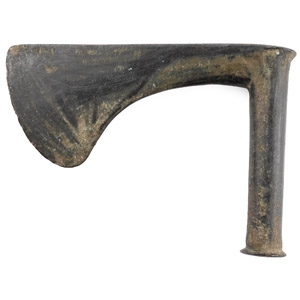
Luristan Bronze Socketted Axehead
1st millennium B.C.Sold for (Inc. bp): £156
With slender socketted shaft, thick blade broadening towards the cutting edge. 364 grams, 15.2 cm
From an old Carmarthen, UK, collection; acquired 1950s. From the property of a late Lincolnshire, UK, gentleman. -
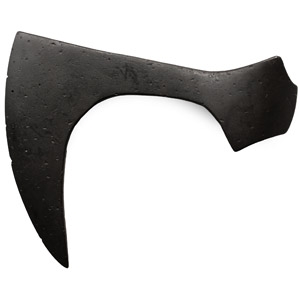
Viking Age Iron Socketted Hooked Axehead
Circa 9th-12th century A.D.Sold for (Inc. bp): £260
With long, deeply curved blade, short neck, socket with triangular wings above and below; professionally cleaned, conserved, and restored. 460 grams, 15 cm
Cleaned, conserved and restored.
From the family collection of a South East London collector; formerly acquired in the late 1950s.
These axes are typical of Baltic workmanship. During this age, the axes were the favourite weapons of many Baltic people, including the Curonian army which included lightly armed soldiers who fought with spears, shields, fighting knives and axes. A heavily armed soldier could also carry a sword, a helmet, a shield, and a wide-bladed axe. -
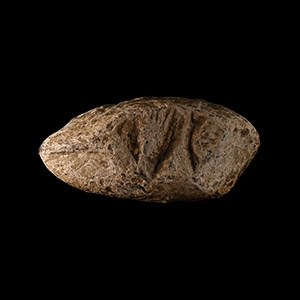
Greek Lead Slingshot
3rd-1st century B.C.Sold for (Inc. bp): £26
Biconical in profile with casting seam and reserved legend 'ΠΕΤΑ'. 30.89 grams, 29 mm
Acquired on the German art market before 2000. Private collection, Munich, Germany.
The term ‘peta’ likely refers to the petaon, a type of ancient Greek leather-pouch or hand-sling, which was used to throw a projectile with a heavy, flat dart known as a kestros. It was not connected with the slingshots, but its meaning was probably linked to the missile throwing activity. -
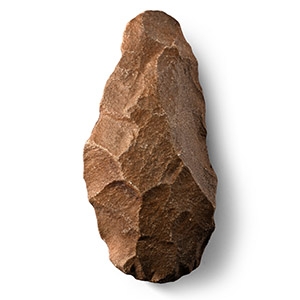
Stone Age Acheulian Knapped Axehead
Palaeolithic Period, circa 300,000-200,000 B.P.Sold for (Inc. bp): £85
Lentoid in section with rounded butt. 412 grams, 15.2 cm
Found Erg Belfelfoul, Algeria, 1967. From an old Hamburg, Germany collection. From the property of a late Lincolnshire, UK, gentleman. -
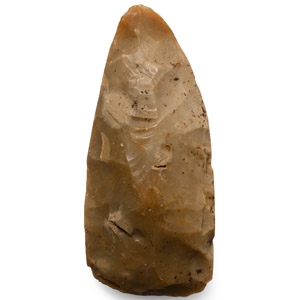
French Stone Age Flint Axehead
Neolithic Period, circa 6000 B.P.Sold for (Inc. bp): £85
Lentoid in section and tongue-shaped in plan with mottled surface. 150 grams, 11.1 cm
Found Bois du Vernay, Rigny-sur-Arroux, France. From a collection built in the mid 1900s. Acquired on the European art market. From the private collection of an East Anglian, UK, specialist collector.

