-
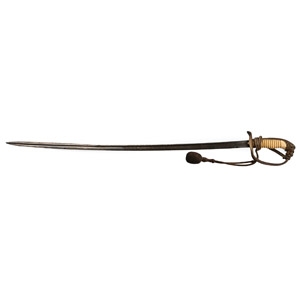
Kriegsmarine WWI German Naval Officer's Sword
Early 20th century A.D.Sold for (Inc. bp): £364
Comprising a slender single-edged blade with etched maritime design; the hilt composed of a ribbed bone handle, a lion-head pommel, and an ornate guard with a folding edge to one side. 728 grams, 87.5 cm
From the private collection of author and historian Dr DeWitt Bailey, one of the global authorities on the confederate army in the US civil war; thence by descent to his grandson. -
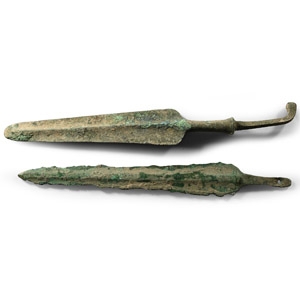
Luristan Bronze Spearhead Group
13th-11th century B.C.Sold for (Inc. bp): £46
Comprising a tanged spearhead with heavily ridged and tapered blade, short collared shaft and square-section tapered tang bent at the tip; a spearhead with foliate narrow blade, short tang with fastening hole. 300 grams total, 26.2-28.7 cm
Acquired 1980-2015. Ex Abelita family collection. This lot is accompanied by an illustrated lot declaration signed by the Head of the Antiquities Department, Dr Raffaele D’Amato.
Both types of spearheads were found in Amlash and Marlik, and are connected with the types 1 and 2 of the Khorasani classification. The type 1 is characterised by a bent tang and was the evolution of a typology which began much earlier in Mesopotamia and the fertile crescent, the type 4 of the Stronach classification, with a straight square-section tang, usually thickened at the base with a button tang. -
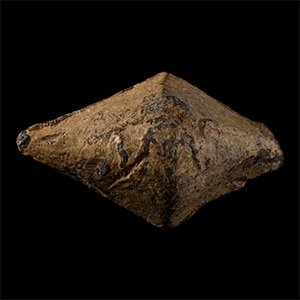
Roman Lead Cnaeus Pompey Battle of Munda Slingshot
1st century B.C.Sold for (Inc. bp): £208
A facetted lentoid-section sling shot (glans) with inscription in Latin letters 'CN' (Cneius) 'MAG' (Magnus) on one side, and 'IMP' for 'IMPERATOR' (victorious general) to the other side, i.e Gnaeus Pompeius Magnus Imperator (Pompey the Great the victorious general). 79.4 grams, 44 mm
Previously from a private Spanish collection. Ex London, UK, gentleman. Accompanied by a copy of a Spanish export licence.
The shot (Völling type 1C) is marked with the abbreviated name of Gnaeus Pompey; it was used in quantity at the Battle of Monda (or Munda) against Julius Caesar, 17th March 45 BC. The projectiles could be of different material: in lead (glandes) or in pottery or stone (lapides missiles). Sometimes they were signed with the name of the general, as is our specimen. -
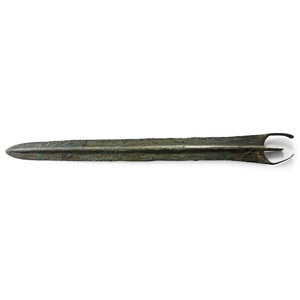
Luristan Bronze Short Sword Blade
2nd-1st millennium B.C.Sold for (Inc. bp): £117
With double-edged blade with central midrib, lateral extensions at the shoulders, and short tang. 341 grams, 47.5 cm
Property of a London gentleman; acquired London art market, 2000s. -
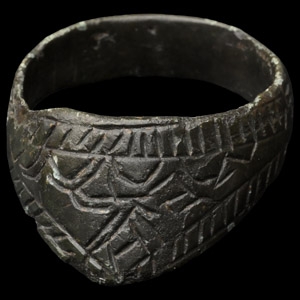
Byzantine Decorated Bronze Archer's Thumb Ring
10th-15th century A.D.Sold for (Inc. bp): £39
With a carinated profile to the hoop, incised horizontal ropework bands, triangular flange extension with geometric detailing. 7.90 grams, 34.83 mm overall, 22.91 x 22.21 mm internal diameter (approximate size British Z +1, USA 12 3/4, Europe 29.99, Japan 28)
From a private Tyneside collection, formed since the early 2000s. -
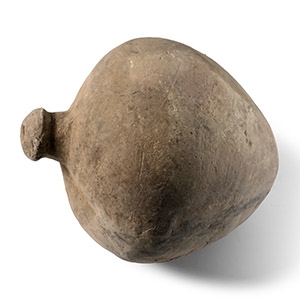
Byzantine 'Greek Fire' Ceramic Fire Bomb or Hand Grenade
9th-11th century A.D.Sold for (Inc. bp): £117
Ovoid in profile with rounded base; intended to be filled with explosive liquid and a wick, and used as a hand grenade. 922 grams, 14 cm
From an important specialist collection, London, UK, 1990s onwards. Accompanied by an academic paper by military specialist Dr Raffaele D'Amato, dated 15 July 2019 and titled 'Eastern Roman Empire - Greek Fire Bomb or Hand Grenade (μεσαίον kακάβιον) 9th-11th century AD'.
Apart from the use of siphons or manual flame-throwers called cheirosiphona, special corps of Roman soldiers employed terracotta grenades, in the form of small jars, abundantly evidenced in archaeological excavations. They were called μεσαία kακαβιά or κυτροκακάβια where the former had a bulbous shape and the latter a more cylindrical form. -
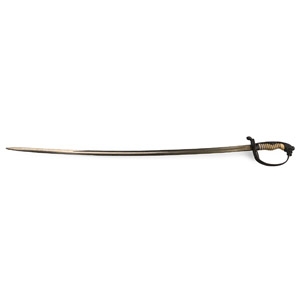
Kriegsmarine WWI German Naval Officer's Sword
Early 20th century A.D.Sold for (Inc. bp): £111
Comprising a slender single-edged blade; the hilt composed of a wire-bound ribbed bone handle, a lion-head pommel with inset eyes (one absent), and an ornate guard with a folding edge to one side. 612 grams, 94.5 cm
From the private collection of author and historian Dr DeWitt Bailey, one of the global authorities on the confederate army in the US civil war; thence by descent to his grandson. -
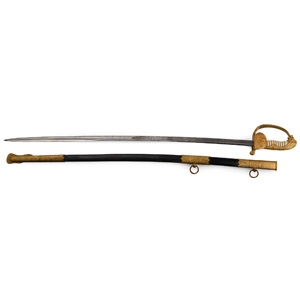
Kriegsmarine WWI German Naval Officer's Sword and Scabbard
Early 20th century A.D.Sold for (Inc. bp): £780
Comprising a slender single-edged blade with etched maritime designs; the hilt composed of a wire-bound ribbed bone handle, a lion-head pommel with inset eyes (one absent), and an ornate guard with folding edges, one side with a socket for securing the scabbard; accompanied by a leather scabbard with ornate metal fittings. 847 grams total, 93 cm
From the private collection of author and historian Dr DeWitt Bailey, one of the global authorities on the confederate army in the US civil war; thence by descent to his grandson. -
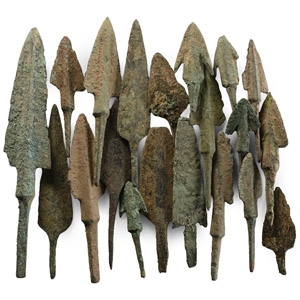
Greek and Luristan Bronze Arrowhead Collection
2nd-1st millennium B.C.Sold for (Inc. bp): £117
Mainly triangular-headed barbed and tanged types with midrib. 156 grams total, 3.7-11 cm
Ex London, UK, collection, 1990s. -
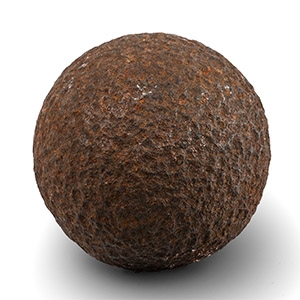
Civil War or Later Iron Cannonball
17th century A.D. or laterSold for (Inc. bp): £124
Rough-cast cannonball for a minion-type cannon, approximately 3 pounds in weight and 2 7/8 inches diameter. 1.39 kg, 70 mm
From the collection of a Buckinghamshire, UK, collector established from the earlier 1960s. -
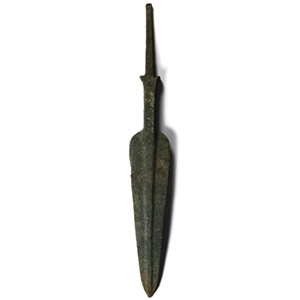
Amlash Type Bronze Spearhead
12th-11th century B.C.Sold for (Inc. bp): £91
Leaf-shaped blade and rectangular-section shank developing from the raised midrib, flared below with a rectangular-section tang. 300 grams, 36.5cm
Ex London art market, 1980-1990s. This lot is accompanied by an illustrated lot declaration signed by the Head of the Antiquities Department, Dr Raffaele D'Amato.
The weapon belongs to the type 1 of the spear-head classification of Khorasani, mainly from Marlik or Amlash areas. Similar pieces have been dated by Stutzinger to 1200-1100 B.C. -
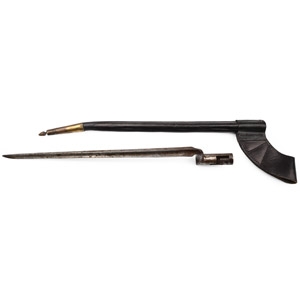
US Confederate Bayonet with Scabbard
19th century A.D.Sold for (Inc. bp): £59
Comprising a tubular socket for fixing to a muzzle of a weapon, long tapering triangular blade with a raised rib on the underside and a 'US / JB(?)' stamp at the base; with a later(?) civil war type scabbard. 500 grams total, 64.5 cm
From the private collection of author and historian Dr DeWitt Bailey, one of the global authorities on the confederate army in the US civil war; thence by descent to his grandson.

