-
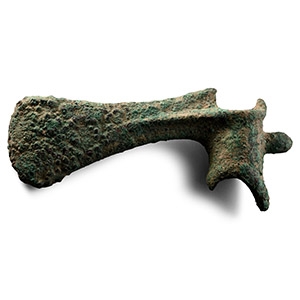
Luristan Bronze Socketted Axehead
2nd-1st millennium B.C.Sold for (Inc. bp): £72
Trapezoidal blade and a cylindrical socket with a collared base, lateral horizontal rib to each face, lobe to the rear; the blade long and with a slightly convex blunt edge. 232 grams, 13.1 cm
Ex Norri collection, Milton Keynes, UK, 1980s-1990s. -
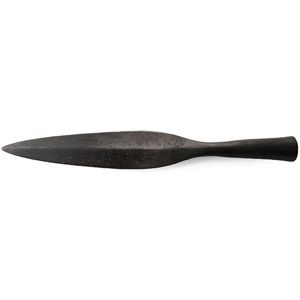
Viking Age Iron Socketted Spearhead
Circa 9th-11th century A.D.Sold for (Inc. bp): £91
Leaf-shaped blade with raised midrib extending to round-section tapering socket with fastening hole; professionally cleaned, conserved, and restored. 204 grams, 29 cm
From the family collection of a South East London collector; formerly acquired in the late 1950s. -
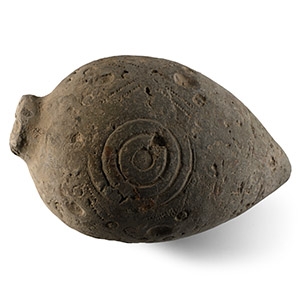
Byzantine 'Greek Fire' Ceramic Fire Bomb or Hand Grenade
9th-11th century A.D.Sold for (Inc. bp): £117
Piriform in profile,incised concentric rings on the shoulder; intended to be filled with explosive liquid and a wick, and used as a hand grenade. 604 grams, 14 cm
From an important specialist collection, London, UK, 1990s onwards. Accompanied by an academic paper by military specialist Dr Raffaele D'Amato, dated 15 July 2019 and titled 'Eastern Roman Empire - Greek Fire Bomb or Hand Grenade (μεσαίον kακάβιον) 9th-11th century AD'.
Apart from the use of siphons or manual flame-throwers called cheirosiphona, special corps of Roman soldiers employed terracotta grenades, in the form of small jars, abundantly evidenced in archaeological excavations. They were called μεσαία kακαβιά or κυτροκακάβια where the former had a bulbous shape and the latter a more cylindrical form. -
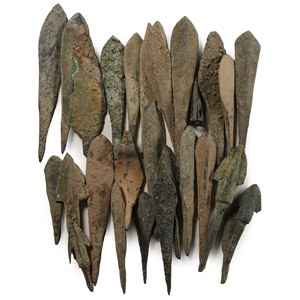
Western Asiatic Bronze Arrowhead Collection
19th-6th century B.C.Sold for (Inc. bp): £117
Including triangular, leaf-shaped, barbed, paddle-shaped with a flat, comparatively wide mid-rib, and others. 176 grams total, 25-77 mm
Ex London art market, 1980-1990s. This lot is accompanied by an illustrated lot declaration signed by the Head of the Antiquities Department, Dr Raffaele D'Amato.
Some of the represented arrowheads (paddle-shaped) were typical of the Old Babylonian Empire. The shoulders were pronounced and the arrowhead had a rectangular-section tapering tang. This simple form was popular throughout and such items are comparatively common finds in the Holy Land. -
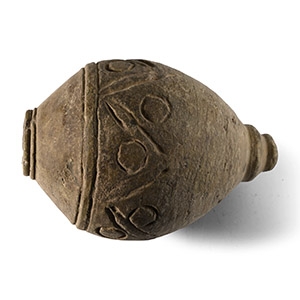
Byzantine 'Greek Fire' Ceramic Fire Bomb or Hand Grenade
9th-11th century A.D.Sold for (Inc. bp): £117
A piriform missile with ribbed filler-hole, diagonals and impressed discs to the shoulder; intended to be filled with explosive liquid and a wick, and used as a hand grenade. 928 grams, 14 cm
From an important specialist collection, London, UK, 1990s onwards. Accompanied by an academic paper by military specialist Dr Raffaele D'Amato, dated 15 July 2019 and titled 'Eastern Roman Empire - Greek Fire Bomb or Hand Grenade (μεσαίον kακάβιον) 9th-11th century AD'.
Apart from the use of siphons or manual flame-throwers called cheirosiphona, special corps of Roman soldiers employed terracotta grenades, in the form of small jars, abundantly evidenced in archaeological excavations. They were called μεσαία kακαβιά or κυτροκακάβια where the former had a bulbous shape and the latter a more cylindrical form. -
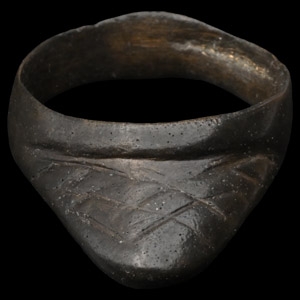
Byzantine Decorated Bronze Archer's Thumb Ring
5th-7th century A.D.Sold for (Inc. bp): £26
With horizontal ribbing, triangular flange extension with hatched detailing. 2.92 grams, 28.41 mm overall, 17.62 x 16.16 mm internal diameter (approximate size British M, USA 6, Europe 12.46, Japan 12)
From a private Tyneside collection, formed since the early 2000s. -
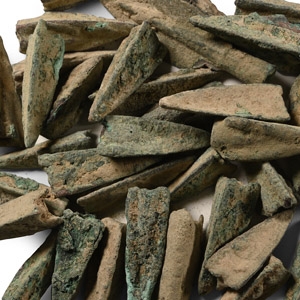
Greek Period Bronze Arrowhead Collection
Circa 5th-3rd century B.C.Sold for (Inc. bp): £117
Including triangular-section, leaf-shaped and other types. 115 grams total, 19 - 44 mm
Acquired in the 1990s. Ex Abelita family collection. This lot is accompanied by an illustrated lot declaration signed by the Head of the Antiquities Department, Dr Raffaele D'Amato. -
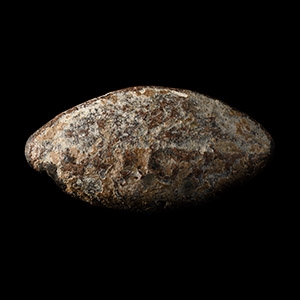
Greek Lead Slingshot
3rd-1st century B.C.Sold for (Inc. bp): £78
Biconical in profile with casting seam and reserved legend 'ΛY-P-N' = maybe ΛYKOΦ-PONO = Lykophronos (name). 25.6 grams, 31 mm
Acquired on the German art market before 2000. Private collection, Munich, Germany.
The leaden bullets, which were thrown from slings, were called in Greek molivdainai (μολύβδαιναι), and in Latin glandes; the former indicating the material ‘lead’, the latter the shape ‘acorns’. These bullets were cast in a mould and bore letters or devices, or both, on two sides or on only one. In form they were more like an almond than an acorn, but many are pointed at both ends. -
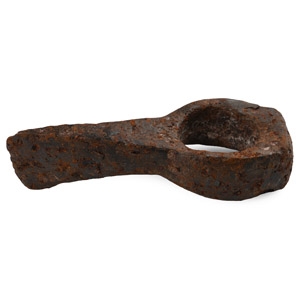
Scythian Iron Axehead
5th-3rd century B.C.Sold for (Inc. bp): £46
Substantial small axehead with triangular-section blade, curved cutting edge, hammer-face to rear of socket. 298 grams, 11.7 cm
Acquired on the UK market before 1992. Property of a North London, UK, gentleman. From the property of a late Lincolnshire, UK, gentleman. -
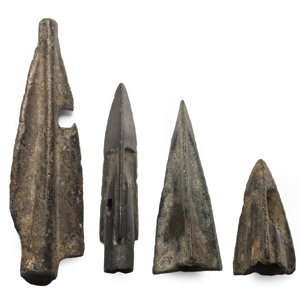
Greek Bronze Arrowhead Group
5th-3rd century B.C.Sold for (Inc. bp): £33
Triangular-section, barbed-and-socketted, and other types. 8.93 grams total, 16-38 mm
From a private Tyneside collection, formed since the early 2000s. -
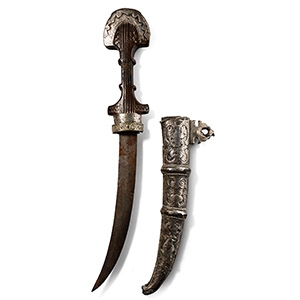
Persian Dagger in White Metal and Copper Scabbard
19th century A.D.Sold for (Inc. bp): £85
Two-edged jambiya with narrow curved blade, brass bolster with silver facing and applied undulating band; hardwood grip, silver facing to pommel; silver-cased brass sheath with raised foliage ornament, pierced D-shaped suspension lug. 393 grams, 39 cm
Acquired during the 1960s. From an old North London oriental and ethnographical collection. From the property of a late Lincolnshire, UK, gentleman. -
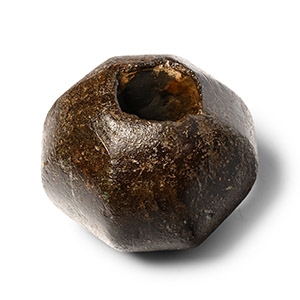
Large Medieval Bronze Sword Pommel
1300-1400 A.D.Sold for (Inc. bp): £104
Of 'wheel' type, Ward Perkins 1940, Type VIII; octagonal in plan with chamfered edges and roughly circular in section, a rectangular perforation running through the length of the object, wider at the blade end and narrowing at the butt end; at the base; the perforation off-centre and worn to one edge. 114 grams, 48 mm
Found whilst searching with a metal detector in Warslow and Elkstones, Staffordshire Moorlands, West Midlands, UK. Accompanied by a copy of the British Museum's Portable Antiquities Scheme (PAS) report no.WWID-94E7C5.

