-
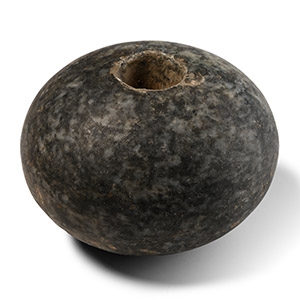
Mesopotamian Mottled Grey Stone Macehead
3rd-2nd millennium B.C.Sold for (Inc. bp): £117
With squat oblate body and central mounting hole. 434 grams, 73 mm
Ex 1990s collection and with a central London gallery. -
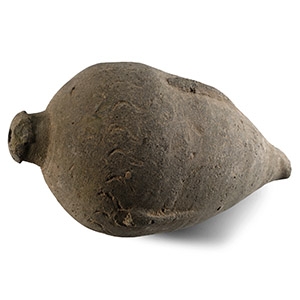
Byzantine 'Greek Fire' Ceramic Fire Bomb or Hand Grenade
9th-11th century A.D.Sold for (Inc. bp): £117
Cylindrical body with pointed tip, two vertical lugs on the upper body; intended to be filled with explosive liquid and a wick, and used as a hand grenade. 513 grams, 14.5 cm
From an important specialist collection, London, UK, 1990s onwards. Accompanied by an academic paper by military specialist Dr Raffaele D'Amato, dated 15 July 2019 and titled 'Eastern Roman Empire - Greek Fire Bomb or Hand Grenade (μεσαίον kακάβιον) 9th-11th century AD'.
Apart from the use of siphons or manual flame-throwers called cheirosiphona, special corps of Roman soldiers employed terracotta grenades, in the form of small jars, abundantly evidenced in archaeological excavations. They were called μεσαία kακαβιά or κυτροκακάβια where the former had a bulbous shape and the latter a more cylindrical form. -
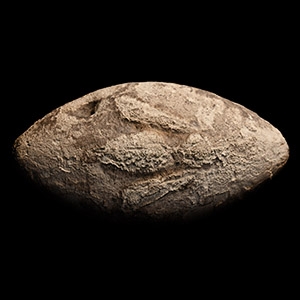
Hellenistic Rhodian Lead Slingshot with Bee
3rd century B.C.Sold for (Inc. bp): £208
Lentoid-section and depicting a bee to one side and inscription 'ΚΑΛΑ' on the other. 27.2 grams, 31 mm
Ex Norri collection, Milton Keynes, UK, 1980s-1990s.
The slingshots with an inscription ΚΑΛΑ are believed to originate from the island of Rhodes. On these sling bullets ΚΑΛΑ should be translated as “nice things.” Together with the Balearic slingers, Rhodian slingers were considered to be the best of the Hellenistic world, and they were also used in the Roman army. -
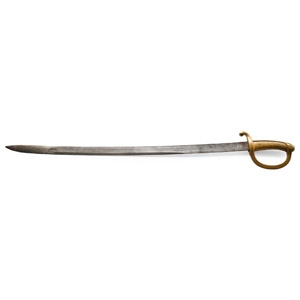
Spanish Military Briquet Sabre
Dated 1902 A.D.Sold for (Inc. bp): £156
Comprising: slightly swept single-edge blade with scooped point and ricasso; brass hilt with finger-guard, lobed quillon, ribbed grip; blade stamped 'Arta. Faba. de Toldo 1902'. 1.04 kg, 83.5 cm
From a private Tyneside collection, formed since the early 2000s. -
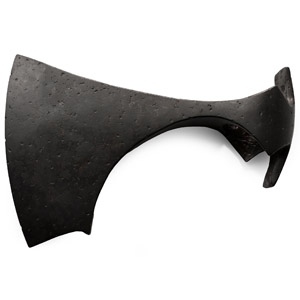
Viking Age Iron Socketted Bearded Axehead
Circa 10th-11th century A.D.Sold for (Inc. bp): £1,040
Finely curved broad blade with chin to the lower edge, rounded socket with lateral triangular extensions and a rectangular extension to the rear; professionally cleaned, conserved, and restored. 632 grams, 19 cm
Cleaned, conserved and restored.
From the family collection of a South East London collector; formerly acquired in the late 1950s.
This type of bearded axe seems to correspond to the E2 category of the Viking axe classification, but also has affinity with the Slavic type of axes Y. Usually these bearded axeheads (skeggöks) had a longer edge, designed to split tree trunks into planks and beams. Some of the bearded axes were known as halfÞynna öx; the neck on such a 'half thin axe' was thinly forged, to make it lighter. -
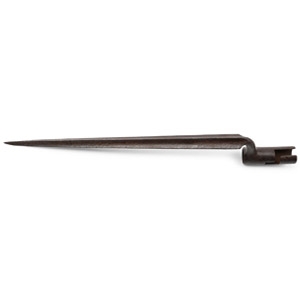
US Confederate Bayonet
19th century A.D.Sold for (Inc. bp): £85
Comprising a tubular socket for fixing to a muzzle of a weapon, long tapering triangular blade with a raised rib on the underside and a rectangular stamp at the base. 390 grams, 46.5 cm
From the private collection of author and historian Dr DeWitt Bailey, one of the global authorities on the confederate army in the US civil war; thence by descent to his grandson. -
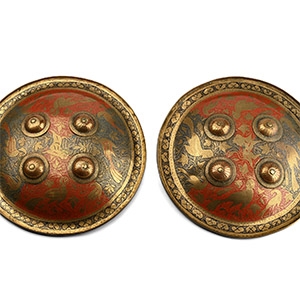
Indo-Persian Enamelled Brass Shield Pair
20th century A.D.Sold for (Inc. bp): £156
Each with flange rim and four applied bosses to the face for attachment of the rear straps, design of reserved foliage, birds and harpies on an enamelled field. 996 grams total, 27.3 cm
Property of a Berkshire, UK, gentleman collector. -
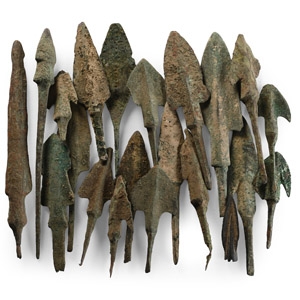
Greek and Luristan Bronze Arrowhead Collection
2nd-1st millennium B.C.Sold for (Inc. bp): £117
Mainly triangular-headed and leaf-shaped tanged types. 168 grams total, 3.9-10.3 cm
Ex London, UK, collection, 1990s. -
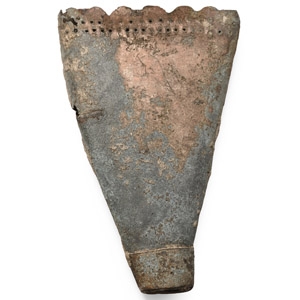
Medieval Bronze Sword Chape
15th-16th century A.D.Sold for (Inc. bp): £20
Scalloped border on the upper edge, sharply tapering body with collar at the narrow end. 16.7 grams, 71 mm
Ex European collection, 1990s. Ex Cambridgeshire, UK, collection. -
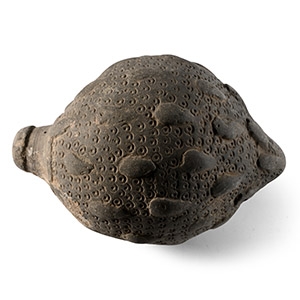
Byzantine 'Greek Fire' Ceramic Fire Bomb or Hand Grenade
9th-11th century A.D.Sold for (Inc. bp): £156
Piriform in profile with domed mouth; raised lugs to the body with impressed texture in between; intended to be filled with explosive liquid and a wick, and used as a hand grenade. 719 grams, 14 cm
From an important specialist collection, London, UK, 1990s onwards. Accompanied by an academic paper by military specialist Dr Raffaele D'Amato, dated 15 July 2019 and titled 'Eastern Roman Empire - Greek Fire Bomb or Hand Grenade (μεσαίον kακάβιον) 9th-11th century AD'.
Apart from the use of siphons or manual flame-throwers called cheirosiphona, special corps of Roman soldiers employed terracotta grenades, in the form of small jars, abundantly evidenced in archaeological excavations. They were called μεσαία kακαβιά or κυτροκακάβια where the former had a bulbous shape and the latter a more cylindrical form. -
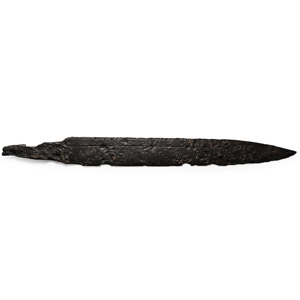
Saxon Iron Single-Edged Seax Sword Blade
7th-8th century A.D.Sold for (Inc. bp): £247
Of Wheeler's Type I with point at the median line, broad with thick back and wide, flat tang for a whittle-tang hilt assemblage; incised lines to both faces following the profile of the back and cutting edge. 610 grams, 50 cm
Private collection, UK. -
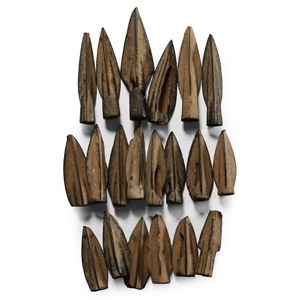
Greek and Other Bronze Arrowhead Collection
Circa 5th-3rd century B.C.Sold for (Inc. bp): £117
The group comprising triangular trilobate types, all socketted. 63.5 grams total, 24-42 mm
Ex London art market, 1980-1990s. This lot is accompanied by an illustrated lot declaration signed by the Head of the Antiquities Department, Dr Raffaele D'Amato.
In the Greek warfare, archers were mainly employed by Scythians and Cretans. Both used composite bows made of wood, horn, bone and sinew. This explains the great range of Scythian arrowheads found on the Greek sites.

