-
.jpg)
Roman Marble Figure of a Phrygian Deity on Horseback
Circa 2nd century A.D.Sold for (Inc. bp): £14,040
The rider, Mithras-Sabatios, wearing a distinctive knee-length belted tunic and Persian trousers, with a riding cloak secured at each shoulder and the end folded over as a cowl; the left hand gathering the reins and the right extending a patera in offering; the horse surmounting a capital, with its remains preserved beneath the belly; mounted on a custom-made stand. 4.3 kg, 25.5 cm
Private collection, Bavaria, since the 1980s. Anonymous Sale; Gorny & Mosch, 29 June 2011, no.234. Acquired by the present owner at the above sale. Accompanied by a copy of the relevant Gorny & Mosch catalogue pages. Accompanied by an academic report by Dr Raffaele D’Amato. This lot has been checked against the Interpol Database of stolen works of art and is accompanied by search certificate number no.12965-245245.
The composition closely recalls a small bronze of Mithras on horseback in the J. Paul Getty Museum (Getty Villa), acc. no. 71.AB.160. The rider's Eastern (Persian) costume suggests his identification with Mithras, the focus of a mystery religion which spread among the Roman legions from the 1st century BC onwards. The horse appears to be passing over a column, indicating that the piece likely formed part of a larger furniture mount or architectural fitting. If so, this would be an exceptionally rare representation, as equestrian images of Mithras are markedly less common than the familiar tauroctony. -
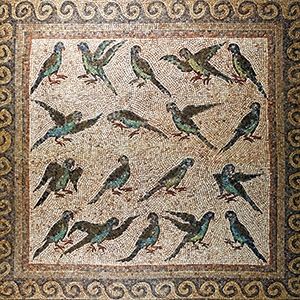
Large Late Roman Mosaic with Inlaid Glass Birds
6th century A.D.Sold for (Inc. bp): £149,500
Rectangular panel of decorative mosaic tesserae comprising: wave pattern border in cream and graduated blue-grey tesserae with darker outer edge; inner border of graduated maroon and dark blue-grey tesserae; central field with two inner rows of four and two outer rows of five parakeets in various standing and perching poses, each formed from blue and green glass tesserae with white, crimson and other detailing to the eye, beak and chest; embedded in a sturdy steel-framed matrix of traditional mid 20th century type. 2.12 x 2.05 m
with Leon Simard, 1960s, Montreal, Canada. Archaeologia Gallery, 1980s. This lot has been checked against the Interpol Database of stolen works of art and is accompanied by search certificate number no.12966-244460.
The design of repeated birds against a neutral field is similar to patterns found on Late Roman and Sassanian textiles of roughly the same date, especially silk and wool textiles woven on more mechanised looms. Birds of all varieties appear frequently in floor mosaics and other arts of the Roman period; however, beribboned birds are rare. -
.jpg)
Roman Arretine Red Slip Terra Sigillata Cup with Rabbits and SEX.M.D. Maker's Mark
Augustan, early 1st century A.D.Sold for (Inc. bp): £546
Squat bowl with carinated profile and low foot; to the rim, applied rosettes and hares; stamped to the centre, a sandaled foot with legend 'SEX.M.D' legend. 132 grams, 11.3 cm wide
Acquired from Casemate Gallery, Bath, UK, 1990. From a late private Dorset, UK, collector. Property of a West London, UK, gentleman. Accompanied by an old identification card and original invoice dated 10 November 1990. -
.jpg)
Roman Terracotta Oil Lamp with Erotic Scene
1st-2nd century A.D.Sold for (Inc. bp): £390
Discoid in plan with short nozzle, broad shoulder with impressed rosettes, discus with scene of two lovers in a bed; underside with concentric rings. 51 grams, 87 mm
Acquired on the UK art market before 2000. Property of an Essex, UK, gentleman. -
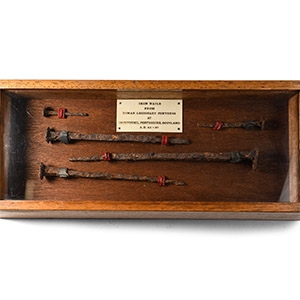
Romano-Scottish Legion XX Valeria Victrix 'Inchtuthil Fort' Boxed Educational Iron Nail Hoard Set
Circa 83-87 A.D.Sold for (Inc. bp): £520
Group of five iron clout-nails permanently mounted in a wooden display case with sloping sides and sliding glazed lid; with information panel 'Iron Nails / From / Roman Legionary Fortress / at / Inchtuthil, Perthshire, Scotland / A.D.83-87'; supplied with a printout on the subject of the Inchtuthil fortress. 713 grams total, 36 x 15.8 cm
From excavations started by Richmond in Perthshire, Scotland, from the 1950s, and discovered in the summer of 1960. Selected and boxed by David Colville & Sons by 1963. Property of a Norwich, Norfolk, UK, gentleman.
The fortress at Inchtuthil was a fortified headquarters and forward supply depot for the forces led by the Roman governor, Gnaeus Julius Agricola, when he undertook a lengthy campaign against the Caledonian tribes in the north of Britain. The campaign is mentioned in the biographical work written by his son-in-law, the historian Tacitus, which has been studied in order to understand the Roman plan for the subjugation of the island. The troops chosen for the campaign were drawn from the 20th Legion (Legio XX Valeria Victrix). While the construction of Inchtuthil and other strongholds took place, the troops lived in temporary encampments which were also fortified and formed a chain of defensive sites from which domination of the surrounding territory could be achieved. Subsequently once the site was abandoned late in the 1st century A.D., (around 86 A.D.) no further building took place there or in the area. Excavation in the 20th century by Sir Ian Richmond (begun in 1952) revealed a pristine site with its complete plan recoverable - unique in the Roman Empire. The defences were a broad ditch and turf wall with stone facing, with watchtowers and gatehouses. The site was thought to have been abandoned due to relocation of troops to counter an invasion from eastern Europe into the province of Dacia, although this is no longer certain. A huge quantity of iron nails (more than 875,000) was recovered from a pit in the fort as well as other ironware; the goods had been buried in order not to let them fall into the hands of the Caledonians. The excavated nails and other items were sorted and sold in small parcels, which was completed by 1963.The nails range in size from small nails between thirty-eight and seventy millimetres long, up to the massive spikes three hundred and seventy-two millimetres long. These kind of long nails were also used for crucifixions. -
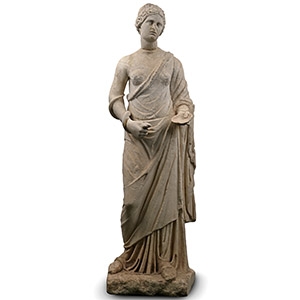
Roman Statue of the Goddess Hygeia with Later Restorations
2nd-3rd century A.D. and laterSold for (Inc. bp): £13,000
Carved in the round, standing on a rectangular base, wearing a floor-length tiered robe with exposed right shoulder and arm; separate left hand extended, holding a patera; right hand gripping the head of a snake wound around the arm; separate head with finely modelled hair bound in a chignon; repaired and restored. 95 kg total, 115.5 cm high
Believed to have been in the collection of George Adolphus Gray (c.1850), captain of a merchant vessel and avid collector. Acquired by the present owner circa 15 years ago, reportedly recovered from a skip. This lot has been checked against the Interpol Database of stolen works of art and is accompanied by search certificate number no.12967-244537.
Asclepius, son of Apollo and Coronis, was the Graeco-Roman god of medicine, healing and prophecy. He had two daughters with Epione, the goddess of soothing - Hygeia (goddess of health) and Panacea (goddess of healing). -
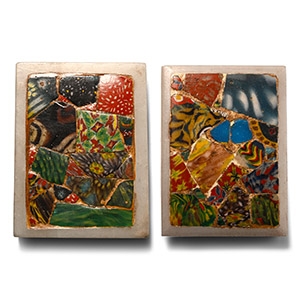
Roman Mosaic Glass Paperweight Pair
2nd century B.C.-1st century A.D. and laterSold for (Inc. bp): £1,404
A collection of ancient Roman polychrome mosaic glass fragments, set in the 18th-19th century into two rectangular marble bases. 630 grams total, 10.5 x 7.6 - 10.7 x 8.1 cm
Private collection, UK. -
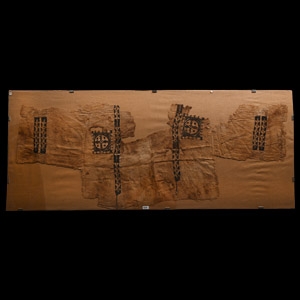
Large Mounted Roman Linen Tunic
Circa 4th-5th century A.D.Sold for (Inc. bp): £5,200
Comprising half of the upper part of a tunica manicata in light fabric, S-twist tapestry, ornamented with dark purple clavi with orbiculi and tablia, wool over linen; mounted in fabric backing and perspex display frame. 7.7 kg total, mount: 1.64 m
Acquired 1970s-1996. Property of a North American collector. London collection, 2016.
The tunic is decorated in purple with opus phrygium embroidery. The archaeological evidence from the dry desert cemeteries of Egypt offers striking confirmation of pictorial sources about late Roman clothing around the empire. -
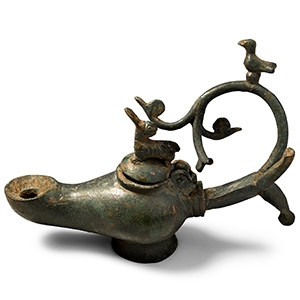
Byzantine Bronze Oil Lamp
5th-7th century A.D.Sold for (Inc. bp): £624
Comprising: a squat body, large circular nozzle with shallow socket, hinged domed lid with regardant hare, the handle formed from his pricked ears, two long tendril handles with perching bird detailing, splayed foot; square-section socket to base for mounting on a lamp stand. 693 grams, 19 cm
UK private collection before 2000. Acquired on the UK art market. Private collection, London, UK. -
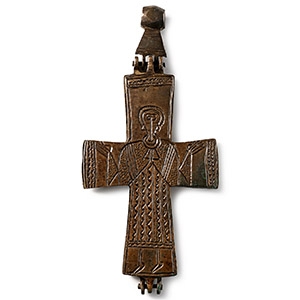
Large Byzantine Bronze Reliquary Pendant Cross
10th-12th century A.D.Sold for (Inc. bp): £715
Enkolpion with hinged barrel-shaped loop; incised nimbate figure to each face in orans pose within a decorative border. 109 grams, 12.5 cm
Ex DRG Coins and Antiquities, Bishops Stortford, Essex, UK. From the private collection of a West London, UK, gentleman, formed since the early 2000s. Accompanied by a handwritten dealer's ticket. -
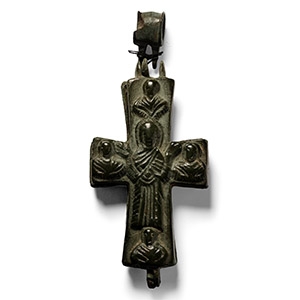
Large Byzantine Bronze Reliquary Cross Pendant
Circa 900-1200 A.D.Sold for (Inc. bp): £416
Enkolpion with hinged suspension bar, each face with nimbate robed figure in orans pose with four busts surrounding. 49 grams, 94 mm
Ex DRG Coins and Antiquities, Bishops Stortford, Essex, UK. From the private collection of a West London, UK, gentleman, formed since the early 2000s. Accompanied by a handwritten ticket. -
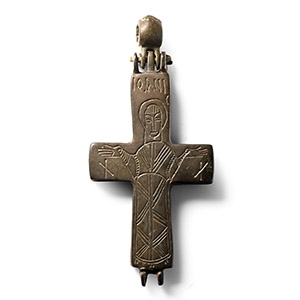
Byzantine Bronze Reliquary Cross Pendant
Circa 9th century A.D.Sold for (Inc. bp): £468
Enkolpion with hinge and large suspension loop; obverse with nimbate robed figure in orans pose with cross beneath each wrist, inscription 'IOANIC' ('John'); reverse with similar nimbate robed figure in orans pose with inscription 'MPXC' (Mary mother of Christ). 25.2 grams, 76 mm
Ex C.J. Martin, UK. From the private collection of a West London, UK, gentleman, formed since the early 2000s. Accompanied by a handwritten ticket.

