-
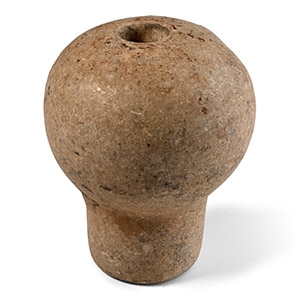
Mesopotamian Mottled Cream Stone Macehead
3rd-2nd millennium B.C.Sold for (Inc. bp): £117
With plain globular body, wide tubular shaft. 416 grams, 81 mm
Ex 1990s collection and with a central London gallery. -
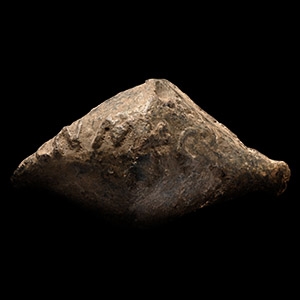
Roman Lead Cnaeus Pompey Battle of Munda Slingshot
1st century B.C.Sold for (Inc. bp): £247
A facetted lentoid-section sling shot (glans) with inscription in Latin letters 'CN' (Cneius) 'MAG' (Magnus) on one side, and 'IMP' for 'IMPERATOR' (victorious general) to the other side, i.e Gnaeus Pompeius Magnus Imperator (Pompey the Great the victorious general). 79.57 grams, 44 mm
From a private Tyneside collection, formed since the early 2000s.
The shot (Völling type 1C) is marked with the abbreviated name of Gnaeus Pompey; it was used in quantity at the Battle of Monda (or Munda) against Julius Caesar, 17th March 45 BC. The projectiles could be of different material: in lead (glandes) or in pottery or stone (lapides missiles). Sometimes they were signed with the name of the general, as is our specimen. -
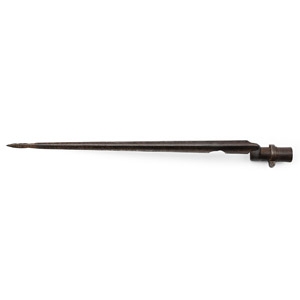
US Confederate Bayonet
19th century A.D.Sold for (Inc. bp): £78
Comprising a tubular socket for fixing to a muzzle of a weapon, with a separate collar, long tapering triangular blade with a raised rib on the underside and 'US' stamp at the base. 320 grams, 52.5 cm
From the private collection of author and historian Dr DeWitt Bailey, one of the global authorities on the confederate army in the US civil war; thence by descent to his grandson. -
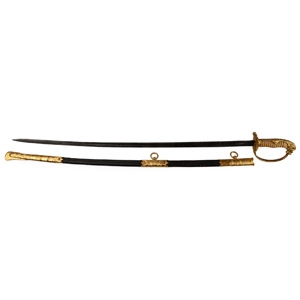
Kriegsmarine WWI German Naval Officer's Sword and Scabbard
Early 20th century A.D.Sold for (Inc. bp): £286
Comprising a slender single-edged blade with etched designs; the hilt composed of a wire-bound ribbed bone handle, a lion-head pommel with inset eyes, and an ornate guard with folding edges, one side with a socket for securing the scabbard; accompanied a leather scabbard with ornate metal fittings. 778 grams total, 91 cm
From the private collection of author and historian Dr DeWitt Bailey, one of the global authorities on the confederate army in the US civil war; thence by descent to his grandson. -
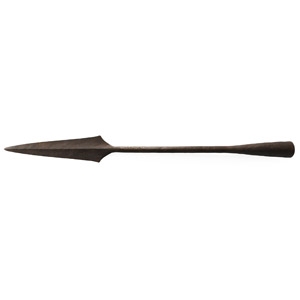
Germanic Iron Socketted Javelin Head
Circa 5th-6th century A.D.Sold for (Inc. bp): £247
Long shaft tapering towards a triangular blade with strong mid-rib and squared shoulders; professionally cleaned, conserved, and restored. 210 grams, 40.7 cm
Cleaned, conserved and restored.
From the family collection of a South East London collector; formerly acquired in the late 1950s.
The total length of these javelins, including iron heads, shanks and wooden shafts, was probably about 210cm. The design was, obviously, intended to kill or cripple efficiently. The length of the shaft suggest that these javelins, including the infamous angon, were used also in hand to hand combat, where there was a danger of the head being lopped off. -
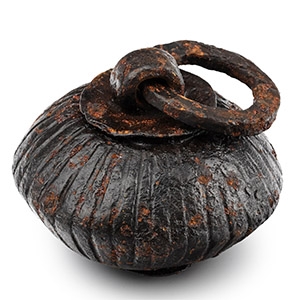
Medieval Iron Flail Head
14th-15th century A.D.Sold for (Inc. bp): £195
Biconvex in profile with loop and ring, segmented surface. 277 grams, 50 mm
From the family collection of a London gentleman; formed in the late 1940s-1950s; thence by descent. From the property of a late Lincolnshire, UK, gentleman. -
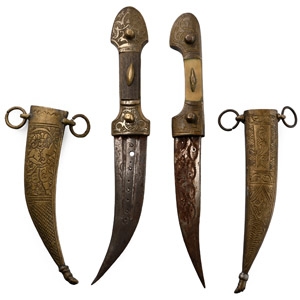
Western Asiatic Style Dagger Group
20th century A.D.Sold for (Inc. bp): £208
Each a curved steel blade with two fullers, stamped ornament; waisted bronze grip with applied bone panels, tendril ornament; cast scabbard with suspension rings, advancing warrior with scimitar to each face. 425 grams total, 23.2-23.7 cm
Acquired during the 1960s. From an old North London oriental and ethnographical collection. From the property of a late Lincolnshire, UK, gentleman. -
.jpg)
Greek Lead Slingshot
3rd-1st century B.C.Sold for (Inc. bp): £195
Biconical in profile with casting seam and reserved legend 'ΑΛ[EXANΔΡΟ]Υ.', the club of Herakles on the other side. 29.4 grams, 30 mm
Acquired on the German art market before 2000. Private collection, Munich, Germany.
The presence of the club of Hercules connects the slingshot with ruling dynasty of Macedonia. Similar slingshots were found in Miletos. -
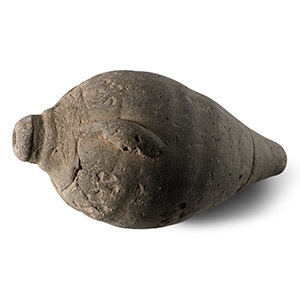
Byzantine 'Greek Fire' Ceramic Fire Bomb or Hand Grenade
9th-11th century A.D.Sold for (Inc. bp): £117
A piriform missile with domed filler-hole, and lugs to the shoulder; intended to be filled with explosive liquid and a wick, and used as a hand grenade. 445 grams, 15 cm
From an important specialist collection, London, UK, 1990s onwards. Accompanied by an academic paper by military specialist Dr Raffaele D'Amato, dated 15 July 2019 and titled 'Eastern Roman Empire - Greek Fire Bomb or Hand Grenade (μεσαίον kακάβιον) 9th-11th century AD'.
Apart from the use of siphons or manual flame-throwers called cheirosiphona, special corps of Roman soldiers employed terracotta grenades, in the form of small jars, abundantly evidenced in archaeological excavations. They were called μεσαία kακαβιά or κυτροκακάβια where the former had a bulbous shape and the latter a more cylindrical form. -
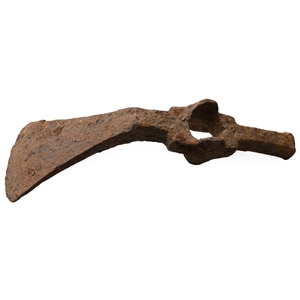
Late Roman Military Iron 'Dolabra' Trenching Tool
7th century A.D.Sold for (Inc. bp): £221
Pickaxe with two narrow, opposite and perpendicular cutting edges, central hole for the wooden handle flanked by two oval protrusions. 757 grams, 25.5 cm
Ex German art market, 2000s. Acquired from an EU collector living in London. From the collection of a Surrey, UK, gentleman.
This tool was used by Eastern Roman soldiers for trenching work, and it was also suitable for clearing stones, clearing rough terrain, and mining. If necessary, it could also be used as a weapon. -
.jpg)
Byzantine Decorated Bronze Archer's Thumb Ring
5th-7th century A.D.Sold for (Inc. bp): £46
Circular in section with triangular flange to one edge, incised ring-and-dot markings. 3.72 grams, 24.34 mm overall, 16.19 x 13.95 mm internal diameter (approximate size British F 1/2, USA 3, Europe 4.3, Japan 4)
From a private Tyneside collection, formed since the early 2000s. -
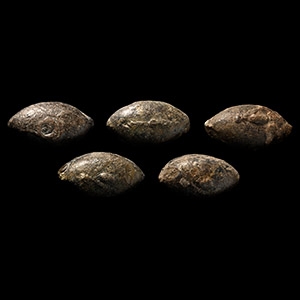
Roman Lead Slingshot Group
1st century B.C.Sold for (Inc. bp): £247
A mixed group of four lentoid-section biconical lead slingshot, three fitted with iconic winged thunderbolts on one side, and one with the Tanit goddess symbol, possibly alluding to a Balearic-Punic origin. 155 grams total, 28-30 mm
From the collection of a Surrey, UK, gentleman; acquired in the 1990s.
The slingshots are belonging to the type IIb of the Völling classification. The practice of inscribing slingshots developed early, in 4th century BC Greece. Most inscriptions are names (in full or abbreviated) of generals or commanders of units of slingers. Some are slogans of the contesting sides. Individual letters occasionally appear, sometimes in conjunction with a name or motif or numbers.

