-
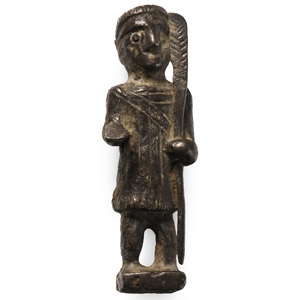
Roman Silver Statuette
2nd-1st century A.D.Sold for (Inc. bp): £312
Modelled in the round standing on a square base, wearing a knee-length chiton; right hand held out flat, left hand supporting a frond; short hair and exaggerated nose. 19.97 grams, 44 mm
From a private Tyneside collection, formed since the early 2000s. -
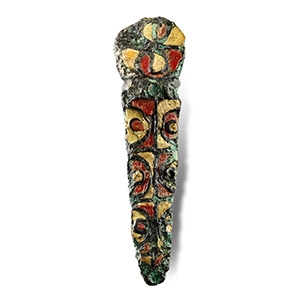
'The Thorpe Audlin' Romano-British Enamelled Bow Brooch
Circa 2nd century A.D.Sold for (Inc. bp): £468
Comprising: discoid head with raised rectangular neck, tongue-shaped bow with tapered end; the head decorated extensively with a raised triskele style pattern, with retained enamel in alternate yellow and red colours; the body with a raised longitudinal running linear border bisected by four latitudinal borders; within each sub-rectangular cell, a crescent border with central raised pellet; within each cell created by the raised borders, retained enamel in alternating red and yellow; the reverse undecorated with lug and chord, catchplate to lower end. 13.7 grams, 57 mm
Found by Mr Wayne Colbeck whilst searching with a metal detector in Thorpe Audlin, Wakefield, Yorkshire, UK, in 2014. Accompanied by a copy of the British Museum's Portable Antiquities Scheme (PAS) report no.YORYM-D5BBD5. Accompanied by the finder's original copy of the York Archaeological Trust's object entry form dated 31 October 2014 with reference no.E001019.
Sally Worrell, National Finds Advisor has been unable to locate any comparable examples of this form of brooch. It has been designated by the British Museum as a 'Find of Note' and of 'Regional Importance'. -
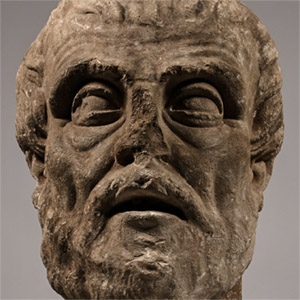
Monumental Roman Marble Head of a Greek Philosopher, Probably Diogenes
1st century B.C.-1st century A.D.Sold for (Inc. bp): £46,800
Carved in the round bust of a cynical, mature philosopher with short tousled hair and thick beard, exaggerated protruding eyes and gaunt facial features, the mouth modelled slightly open as if the subject is in pain; mounted on a custom-made stand. 47.6 kg total, 60 cm including stand
Private collection, Paris, 1980s. European private collection. Accompanied by a copy of French passport no.237041. Accompanied by an academic report by Professor Neritan Ceka. This lot has been checked against the Interpol Database of stolen works of art and is accompanied by a search certificate number no.12610-234690. This lot has been cleared against the Art Loss Register database, and is accompanied by an illustrated lot declaration signed by the Head of the Antiquities Department, Dr Raffaele D'Amato.
The portrait head was initially meant to be assembled on a statue. Chisel marks at the neck level indicate a relatively late separation of the head from the body, which must have been twice its natural size. The working of the back of the head suggests that the sculpture was exposed only to the front. The search for realistic traits brings this head close to the Hellenistic portraits of the 3rd and 2nd centuries BC, representing socially disadvantaged people of different ages and situations, such as fishermen and peasants, in the so-called genre sculptures. This presentation would be in contrast to the supernatural proportions of the portrait, which should have represented an elderly, publicly known person, poet, or philosopher, exhibited in his city of origin. In this respect, it would be more suited to the representation of a Cynical philosopher, in the model of Diogenes of Villa Albani. The almond-shaped eyes without drilled pupils, engraved eyes, and the absence of a deep drilling technique on hair date the portrait between the 1st century BC and the 1st century AD. -
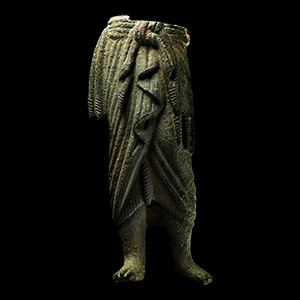
Roman Bronze Lower Section of Adonis-Tammuz Statue
2nd-3rd century A.D.Sold for (Inc. bp): £416
Modelled in the round as a belted torso and legs with tiered tasselled robes and bare feet. 128 grams, 10 cm
UK art market, 1981. Private collection, London, UK.
Adonis was the offspring of an incestuous union between Smyrna and Cinyras. As an infant, he was given by Venus (Aphrodite) to Persephone for protection, but later became an object of desire for both, resulting in a decision by Zeus that he would spend four months with Persephone, four months with Venus and four months with whomever he wished. According to mythological traditions, Adonis was killed by a wild boar during a hunt - either sent by Artemis, or Ares in disguise. Aphrodite pleaded for Adonis' life with Zeus, who allowed the youth to spend half of each year with her and half in the underworld. -
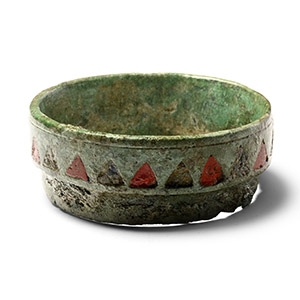
'The Kniveton' Romano-British Enamelled Bronze Drinking Horn Rim
2nd century A.D.Sold for (Inc. bp): £494
A sub-circular rim, emulating the natural shape of a cow-horn aperture, with alternating triangular inlaid cells of red and blue enamel, the lower internal socket with the remains of three fixing rivets. 52 grams, 53 mm
Found whilst searching with a metal detector in Kniveton, Derbyshire Dales, East Midlands, UK. Accompanied by a copy of the British Museum's Portable Antiquities Scheme (PAS) report no.WWID-7C901E.
The British Museum's Portable Antiquities Scheme (PAS) states: 'This is a find of note and has been designated: County / local importance'. -
.jpg)
Large Romano-British Bronze Dolphin Mount
2nd-3rd century A.D.Sold for (Inc. bp): £715
Modelled in the round, with dentilled fin and tail, hollow to the underside, scale detailing. 126 grams, 12.3 cm
Found Lincolshire, UK.
The dolphin was believed to ferry the souls of the dead to the afterlife. This type of bronze figure was probably intended to form a doorknob. -
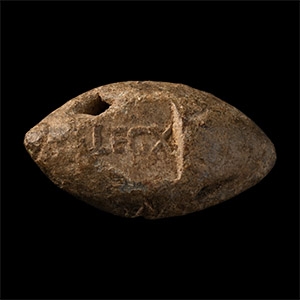
Roman Lead 'LEG X' Slingshot
1st century A.D.Sold for (Inc. bp): £1,235
Lentoid in form with impressed legend 'LEGX' and casting seam. 29.4 grams, 30 mm
Ex German art market, 2000s. Acquired from an EU collector living in London. From the collection of a Surrey, UK, gentleman. -
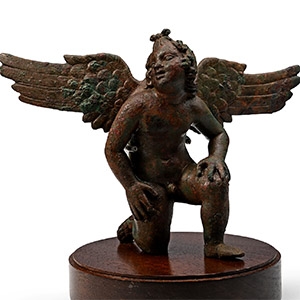
Roman Bronze Winged Eros
1st century A.D.Sold for (Inc. bp): £13,000
Modelled in the round in kneeling pose, nude, with the fingers of his left hand spread across his bent knee, head turned to the right and slightly tilted upwards; two large dorsal wings spread; the face fleshy with small eyes and nose, the hair with a wreath of curls framing the face; attachment panel behind the shoulders; mounted on a custom-made display stand. 1.38 kg total, 19 cm wide
Ex F. Philips, Netherlands, before 1980s. with Jan Roelofs Antiquaries, Netherlands. Acquired on the European art market, 2023. Private collection, London. Accompanied by an academic report by Prof. Neritan Ceka. This lot has been checked against the Interpol Database of stolen works of art and is accompanied by search certificate number no.12930-245218.
The image of the winged Eros held a special significance in Roman culture, embodying not only the god of love but also the elegance, refinement, and sophistication of the Classical tradition. His wings symbolised the fleeting nature of passion, while his youthful form carried connotations of vitality and beauty. To incorporate Eros into the decoration of luxury objects was to invoke divine favour and to align oneself with the cultivated ideals of the Graeco-Roman world. Bronzes of the 1st century A.D. represent the height of Roman metalworking, when elite households and sanctuaries commissioned works of remarkable artistry. Fittings such as this, finely cast and intended for a prestigious vessel, were both functional and symbolic: practical elements elevated to expressions of status and taste. Surviving examples are a testament to the technical mastery of Roman workshops and the desire of their patrons to surround themselves with imagery of the gods in even the smallest details of daily life. -
.jpg)
Monumental Roman Bronze Left Hand
Circa 2nd-3rd century A.D.Sold for (Inc. bp): £40,300
A truly exceptional and imposing fragment, rendered with remarkable naturalism, the forefinger extended and gently bent, the thumb positioned for grip, and the remaining fingers elegantly curled inward, possibly from a life-sized statue of an emperor, magistrate or a general; presented on a custom-made display stand, the thumb and forefinger sympathetically restored. 4.75 kg total, 45 cm including stand
Ex Frits Phillips, Eindhoven, Netherlands, before 1980. Private European collection, 1980s. Private collection, London. Accompanied by an academic report by Dr Raffaele D’Amato. This lot has been checked against the Interpol Database of stolen works of art and is accompanied by a search certificate number no.12907-242493.
During the height of the Roman Empire, monumental bronze statues were not simply works of art; they were instruments of authority and prestige. By the 2nd and 3rd centuries A.D., Rome possessed the wealth and technical mastery to produce over life-sized figures in hollow bronze, a medium that required immense skill and resources. These statues were intended to impress and endure, often commemorating emperors, generals, and gods in a scale that placed them beyond the ordinary realm of mortals. Such bronzes were used to dominate public spaces and convey imperial power. In forums, baths, and temples, the towering images of rulers reminded citizens of Rome’s strength and the divine favour said to rest upon its leaders. The famous equestrian statue of Marcus Aurelius in Rome is perhaps the best surviving example of this tradition; its imposing scale and lifelike rendering conveyed both the emperor’s authority and his humanity. Another renowned piece, the fragments of the colossal bronze statue of Constantine the Great, once stood in the heart of the capital and would have dwarfed viewers, embodying the emperor’s near-divine status. Even earlier examples, like the Bronze of Germanicus or the over life-sized bronzes of emperors found at sites such as Herculaneum, illustrate how these works were strategically placed to broadcast messages of victory and control. Bronze was the perfect medium for such statements. Its ability to hold fine details gave these figures a vivid presence, while the sheer scale was designed to inspire awe. These statues were not simply commemorative; they were a visual language of power, cast in metal to endure beyond the individual and the age in which they were created. -
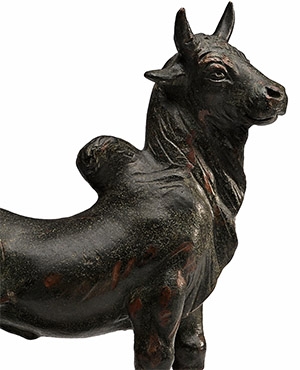
Bronze Figure of a Zebu Bull
Roman Imperial Period, 2nd-3rd century A.D.Sold for (Inc. bp): £11,700
Modelled in the round in alert pose with head raised and slightly turned; hair texture to the forehead, neck and shoulders; mounted on a custom-made stand. 2.3 kg total, 20 cm including stand
Art market, Bavaria, 1990s. with Christie's, New York, 7 December 2011, no.188. Accompanied by copies of the relevant Christie's catalogue pages. Accompanied by a copy of an Art Loss Register certificate, no.S00122050. This lot has been checked against the Interpol Database of stolen works of art and is accompanied by search certificate number no.12962-245248.
After the Roman annexation of Egypt, Egyptian cults such as that of the Apis bull were syncretised, becoming part of a distinctively Egyptian form of Roman polytheism. Representations of prancing Apis bulls, turned either left or right, have been found throughout the Roman Empire. However, it is also possible that this beautiful statuette is connected with the cult of Jupiter Dolichenus, where the armed god is usually standing upon a bull. -
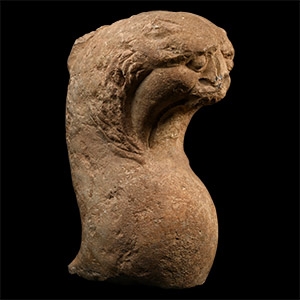
Roman Marble Gryphon Trapezophoros Section
Circa 1st-2nd century A.D.Sold for (Inc. bp): £845
Carved in the round, S-curved in profile with scale detailing and grimacing gryphon's face; ledge to rear of head to support a tabletop. 19.56 kg, 35 cm
Acquired from Robert Evans, who in turn acquired from Sir Arthur Evans of the Ashmolean Museum. From the private collection of a Somerset gentleman. -
.jpg)
Late Roman Imperial Porphyry Fragment
4th-6th century A.D.Sold for (Inc. bp): £3,120
Formed as an irregular block with three possibly later polished sides, with the other three sides presenting a descending wall and two hollows carved in the upper and lower part; probably from an Imperial sarcophagus or monument; mounted on a custom-made stand. 10.55 kg, 31 cm including stand
Acquired from the private collection of a Somerset gentleman who was related to Sir Arthur Evans. From the private collection of a UK gentleman since before 2005.
For the Romans, porphyry was the Imperial marble par excellence, and from Constantine the Great until the end of the 5th century, but probably also later, it was used to create sarcophagi for the emperors and members of the Imperial families. This particular stone was connected with the Imperial family because of its red colour, recalling the violet and red shades of the purple (porphyra), the precious colour assigned only to emperors and their relatives. In Constantinople, a room of the Imperial palace was called Porphýra, located on one of the palace terraces overlooking the Sea of Marmara and the Bosphorus. It was perfectly square in shape with a pyramidal ceiling and was entirely covered in purple porphyry speckled with white dots: this was the room where the empresses gave birth to the heir of the Roman Empire, called Porphyrogénnētos, meaning ‘born in the purple room’. Porphyry was widely used for building churches in the Christian Empire, and Justinian exhausted the supplies from Egypt by building the Great Church of Hagia Sophia, where still today a great amount of this material can be seen. The impressive Imperial sarcophagi were kept in the Church of the Holy Apostles, as well as the great porphyry sarcophagus of Constantine the Great, of which only a small fragment survives today in the Archaeological Museum of Istanbul.

