-
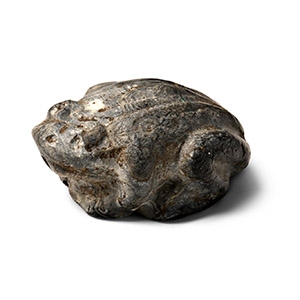
Mesopotamian Stone Frog Amulet
2nd-1st millennium B.C.Sold for (Inc. bp): £234
Modelled as a crouching frog with anatomical detailing, pierced longitudinally. 5.56 grams, 26 mm
From the collection of a gentleman, acquired on the London art market in the 1990s.
Frog amulets in ancient Egypt symbolised fertility, rebirth, and regeneration. Associated with the goddess Heqet, who was linked to childbirth and life-giving forces, these amulets were particularly popular in contexts related to fertility and protection during pregnancy and childbirth. Their connection to the annual Nile flood, which brought new life to the land, further emphasised their symbolism of renewal and abundance. -
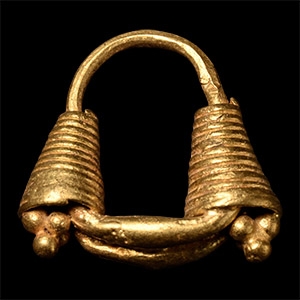
Assyrian Gold Earring with Double Twisted Wires
1st millennium B.C.Sold for (Inc. bp): £221
Comprising a wire hoop with filigree cones and granule clusters. 1.50 grams, 13 mm
From the collection of a late Japanese gentleman, 1970s onwards. -
.jpg)
Western Asiatic Banded Agate Bead Necklace String
1st millennium B.C. and laterSold for (Inc. bp): £208
Restrung on a cotton thread, composed mainly of cylindrical, biconical and tabular beads. 62.9 grams, 36 cm
From the family collection of a Hampstead gentleman; formerly acquired in the 1980s. -
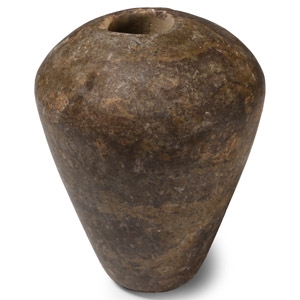
Western Asiatic Stone Macehead
3rd-2nd millennium B.C.Sold for (Inc. bp): £117
Piriform with vertical socket expanding towards the narrower end. 385 grams, 84 mm
From a West London, UK, collection, 1980-1990s. This lot has been cleared against the Art Loss Register database, and is accompanied by an illustrated lot declaration signed by the Head of the Antiquities Department, Dr Raffaele D'Amato. -
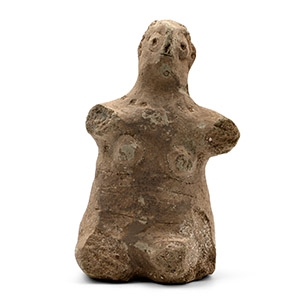
Mesopotamian Clay Fertility Figure
4th-3rd millennium B.C.Sold for (Inc. bp): £156
Stylised detailing to her face and hair, beaded necklace around her neck and small breasts; remains of outstretched arms; shallow U-shaped channel to reverse delineating her buttocks and spine. 225 grams, 11.5 cm high
Fine condition.
Acquired 1980-2015. Ex Abelita family collection. From the private collection of John Meredith, acquired since the 1990s; thence by descent. -
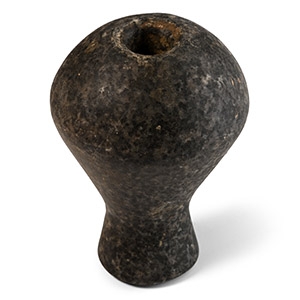
Mesopotamian Black and Grey Mottled Stone Macehead
3rd-2nd millennium B.C.Sold for (Inc. bp): £117
Piriform in profile with flared tubular socket and flat rim, carination to the bulb. 481 grams, 96 mm
Ex 1990s collection and with a central London gallery. -
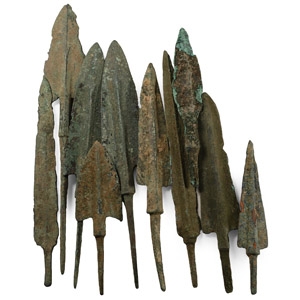
Luristan Bronze Arrowhead Collection
13th-7th century B.C.Sold for (Inc. bp): £143
Comprising triangular types with thick midrib, heater-shaped, leaf-shaped, and other types. 263 grams, 10 - 18 cm
Ex London art market, 1980-1990s. This lot has been cleared against the Art Loss Register database, and is accompanied by an illustrated lot declaration signed by the Head of the Antiquities Department, Dr Raffaele D'Amato.
One category of the represented arrowheads has a sharp, flat blade, the ends of which extend to form wings or barbs, and a prominent midrib extending into a long tang that often has a stop; the blade shape varies from deltoid to more triangular. Another form has no barbs, but it has a prominent midrib extending to the tang, and a narrow leaf-shaped blade. -
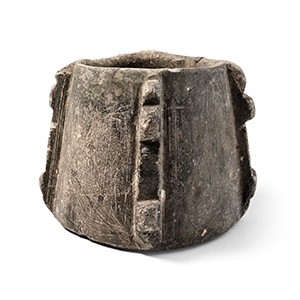
Mesopotamian Stone Vessel
1st millennium B.C.Sold for (Inc. bp): £117
Squat in profile with tapering sidewall, four radiating vertical straps with lobes. 250 grams, 83 mm
Ex Mayfair, London, UK, gallery, 2000s. -
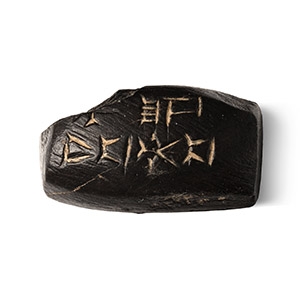
Babylonian Black Stone Inscribed Duck Weight
1st millennium B.C. or laterSold for (Inc. bp): £111
Rectangular in section with cuneiform inscription to the upper face. 3.92 grams, 20 mm
with Archaeologia, Switzerland, before 1983. Ex private North American collection. London private collection, 2016. -
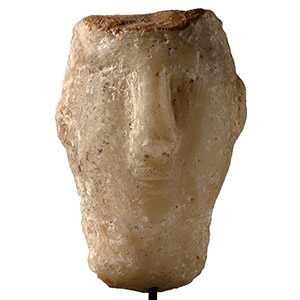
South Arabian Alabaster Head of a Woman
3rd-1st century B.C.Sold for (Inc. bp): £585
Modelled with an angular nose with straight ridge, small mouth with raised lips, rounded cheeks and chin, shallow eyes with grooved outlines, shallow ears, short neck, the back and the top of the head left roughly tooled; mounted on a custom-made display stand. 3.3 kg total, 24.3 cm high including stand
UK collection, 1990s. Acquired on the UK art market, before 2000. Private collection, Mr M.V., a London-based businessman.
This finely carved calcite-alabaster head was probably unfinished, as can be seen from the absence of the holes for the inlay of the eyes and the unfinished ears. In the Arabian funerary sculptures of the period, the tops of the heads are usually cut off flat just above the hair line and left roughly tooled. The cut was due to the necessity of fitting them into niches of 'house shrines'. Large stelae with niches containing such heads were found in the Timna Cemetery. -
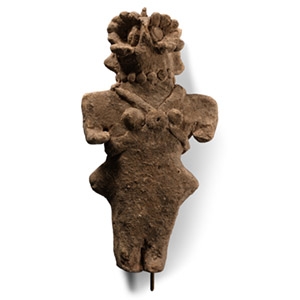
Amorite Terracotta Idol of a Standing Woman
3rd-2nd millennium B.C.Sold for (Inc. bp): £572
Modelled in the round female figure standing with stub arms, applied breasts and pectoral cross-straps with central disc; applied collar of discs and mask with segmented detailing to eyes and reverse; mounted on a custom-made stand. 153 grams, 13.8 cm
Acquired in 1993. Private collection, Switzerland, thence by descent. Private collection, since the late 1990s. Accompanied by a copy of an Art Loss register certificate, no.S00027857. -
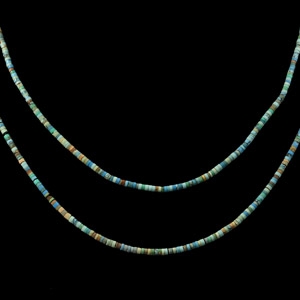
Western Asiatic Mixed Stone Bead Necklace String Group
1st millennium B.C. and laterSold for (Inc. bp): £91
Two restrung groups of annular types in various shades of green. 9.14 grams total, 36 cm each
London, UK, collection, 2000s.

