-
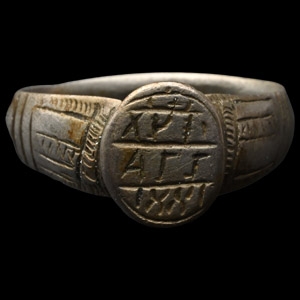
Byzantine Inscribed Silver Ring
Circa 6th-8th century A.D.Sold for (Inc. bp): £130
A D-section hoop with slightly flared shoulders and trumpet-shaped discoid bezel; hatched bands to the shoulders, four lines of enigmatic Greek text [ΧΥΙ ΑΓΓ ΙΧXΙ] to the bezel. 7.53 grams, 27.13 mm overall, 21.06 mm internal diameter (approximate size British V, USA 10 1/2, Europe 23.77, Japan 22)
Property of a private collector; acquired before 1975. -
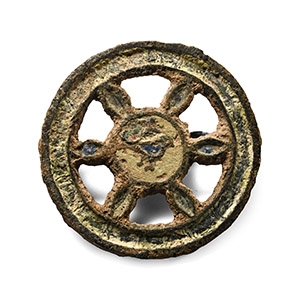
Byzantine Enamelled Brooch with Bird
9th century A.D.Sold for (Inc. bp): £65
The outer ring linked by six radiating ellipsoid spokes to a central hub, pin-lug, pin and catch to the reverse; the outer ring with median band of enamel, similar to each of the spokes; the hub with enamel-filled bird motif on a plain, enamelled field. 9.73 grams, 35 mm
Acquired before 1978. Private collection, UK. -
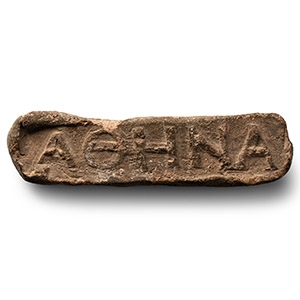
Byzantine Terracotta Token with Inscription
Circa 6th-8th century A.D.Sold for (Inc. bp): £130
D-shaped in section with impressed legend to the flat face 'AΘHNA' (Athens). 20 grams, 74 mm
Ex important Christian collection, 1970s. -
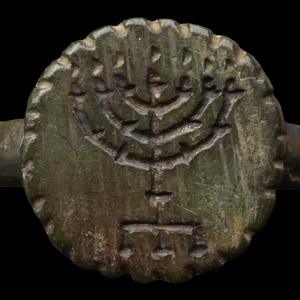
Judaic Bronze Ring with Menorah
Circa 3rd-4th century A.D.Sold for (Inc. bp): £325
With D-section hoop supporting a discoid bezel with decoratively notched circumference; possibly later engraved with a menorah. 2.34 grams, 18.62 mm overall, 17.24 x 15.16 mm internal diameter (approximate size British J 1/2, USA 5, Europe 9.32, Japan 9)
North American collection, 1990s-2000s. Ex property of a Surrey gentleman. -
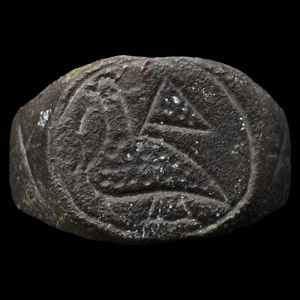
Byzantine Bronze Ring with Dove of Peace
12th-15th century A.D.Sold for (Inc. bp): £46
Wide hoop with X-motis on the shoulders, oval bezel with stylised dove holding a sprig in its beak. 4.90 grams, 21.74 mm overall, 19.61 mm internal diameter (approximate size British T, USA 9 1/2, Europe 21.26, Japan 20)
Ex German art market, 2000s. Acquired from an EU collector living in London. From the collection of a Surrey, UK, gentleman. -
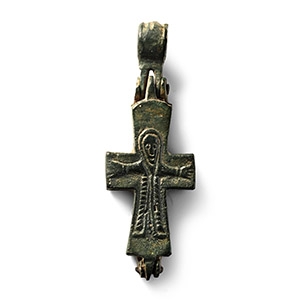
Byzantine Bronze Reliquary Cross Pendant
9th-12th century A.D.Sold for (Inc. bp): £176
Enkolpion reliquary cross with hinge and loop, suspension ring above; one face with low-relief Corpus Christi in stavrosis position, the other with robed figure in orans pose. 14.38 grams, 58 mm
Ex Den of Antiquity, Cambridge, UK. From the private collection of a West London, UK, gentleman, formed since the early 2000s. Accompanied by a typed dealer's ticket. -
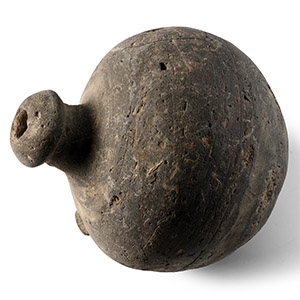
Byzantine 'Greek Fire' Ceramic Fire Bomb or Hand Grenade
9th-11th century A.D.Sold for (Inc. bp): £117
Bulbous body with short neck and biconvex filler-hole; intended to be filled with explosive liquid and a wick, and used as a hand grenade. 454 grams, 10.4 cm
From an important specialist collection, London, UK, 1990s onwards. Accompanied by an academic paper by military specialist Dr Raffaele D'Amato, dated 15 July 2019 and titled 'Eastern Roman Empire - Greek Fire Bomb or Hand Grenade (μεσαίον kακάβιον) 9th-11th century AD'.
Apart from the use of siphons or manual flame-throwers called cheirosiphona, special corps of Roman soldiers employed terracotta grenades, in the form of small jars, abundantly evidenced in archaeological excavations. They were called μεσαία kακαβιά or κυτροκακάβια where the former had a bulbous shape and the latter a more cylindrical form. -
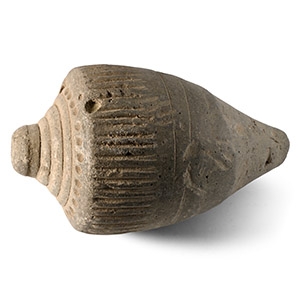
Byzantine 'Greek Fire' Ceramic Fire Bomb or Hand Grenade
9th-11th century A.D.Sold for (Inc. bp): £117
Piriform in profile with domed mouth, impressed vertical line decoration on the upper body; intended to be filled with explosive liquid and a wick, and used as a hand grenade. 725 grams, 15.5 cm
From an important specialist collection, London, UK, 1990s onwards. Accompanied by an academic paper by military specialist Dr Raffaele D'Amato, dated 15 July 2019 and titled 'Eastern Roman Empire - Greek Fire Bomb or Hand Grenade (μεσαίον kακάβιον) 9th-11th century AD'.
Apart from the use of siphons or manual flame-throwers called cheirosiphona, special corps of Roman soldiers employed terracotta grenades, in the form of small jars, abundantly evidenced in archaeological excavations. They were called μεσαία kακαβιά or κυτροκακάβια where the former had a bulbous shape and the latter a more cylindrical form. -
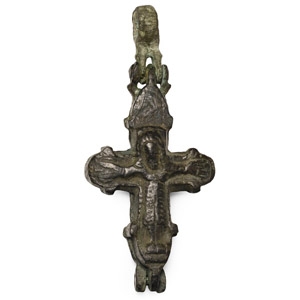
Byzantine Bronze Reliquary Cross Pendant
11th-12th century A.D.Sold for (Inc. bp): £195
Enkolpion with low-relief Corpus Christi figure to obverse, hinge loops above and below; incised and inlaid cross to reverse. 14.8 grams, 57 mm
Ex European collection, 1990s. Ex Cambridgeshire, UK, collection. -
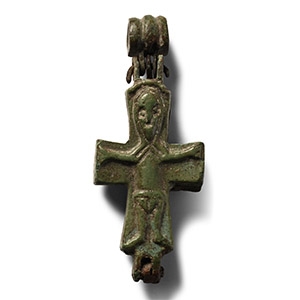
Byzantine Bronze Reliquary Cross Pendant
Circa 9th-12th century A.D.Sold for (Inc. bp): £169
Enkolpion with hinged and ribbed loop; low-relief nimbate figure wearing a loincloth to obverse; robed figure to reverse. 21.9 grams, 55 mm
Ex Den of Antiquity, Cambridge, UK. From the private collection of a West London, UK, gentleman, formed since the early 2000s. Accompanied by a typed dealer's identification ticket. -
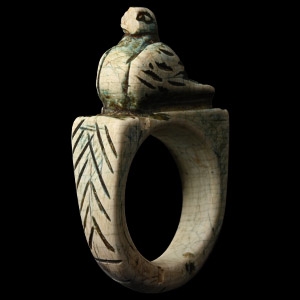
Byzantine Bone Ring with Dove
Circa 5th-6th century A.D. or laterSold for (Inc. bp): £111
Christian image of a dove resting modelled in the round on rectangular bezel, hoop and the dove's body both decorated with hatching. 9.08 grams, 40.97 mm overall, 19.28 x 18.50 mm internal diameter (approximate size British R 1/2, USA 8 3/4, Europe 19.38, Japan 18)
Family collection formed in the 1970s. Ex property of a London lady. Northern Ireland collection. -
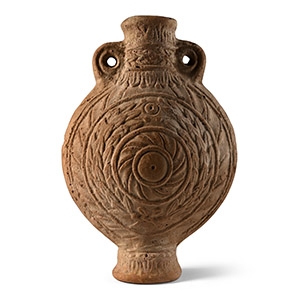
Byzantine Ceramic Pilgrim's Flask with Wreath
Circa 6th-8th century A.D.Sold for (Inc. bp): £247
Biconvex in section with flared base and mouth, lateral pierced lugs at the shoulders, low-relief wreath detailing to the body. 166 grams, 14.1 cm
Ex Mayfair, London, UK, gallery, 2000s.

