-
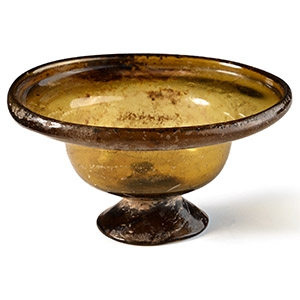
Roman Footed Amber Glass Cup
2nd-3rd century A.D.Sold for (Inc. bp): £715
Comprising a deep body with a wide, upturned rim; applied conical foot. 100 grams, 11.3 cm wide
Previously from a German private collection. Acquired Sotheby's, London, 13 & 14 July 1981, no.482 (illus). From a private Wiltshire, UK, collection. Accompanied by a copy of the relevant Sotheby's catalogue pages. -
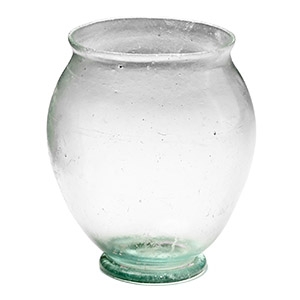
Roman Pale Green Glass Jar
2nd-3rd century A.D.Sold for (Inc. bp): £546
With applied disc base, flared neck and rounded rim. 62.53 grams, 98 mm
Acquired Christie's, London, Antiquities, Works of Art and Important Renaissance Bronzes, Plaquettes and Limoges Enamels, 8 July 1981, no.12 (part). From a private Wiltshire, UK, collection. Accompanied by a copy of the relevant Christie's catalogue pages. -
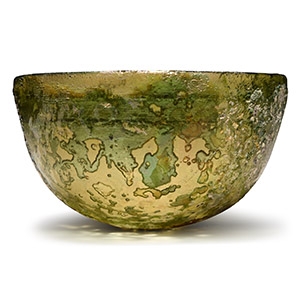
Roman Moulded Iridescent Glass Cup
1st century A.D.Sold for (Inc. bp): £468
With rounded base and rounded rim; parallel ribs to the upper body below the rim; partly restored. 185 grams, 12.4 cm wide
Ex London, UK, gentleman, 1990s. -
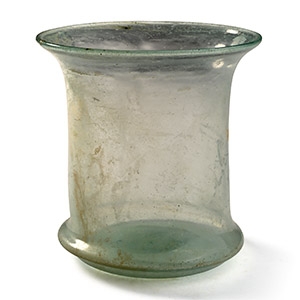
Roman Pale Green Glass Cup
Circa 3rd century A.D.Sold for (Inc. bp): £390
With slightly dimpled base, carinated flange to foot and tubular body, flared rim. 54 grams, 85 mm
From an important collection of glass, London, UK, 1990s. -
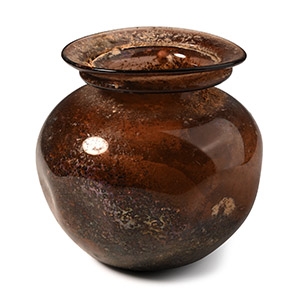
Roman Mould Blown Aubergine Glass Jar
Circa 3rd century A.D.Sold for (Inc. bp): £624
Of squat profile with dimples to the equator, gussetted neck, broad mouth with rolled and everted rim; dimple to the underside. 72 grams, 77 mm
From an important collection of glass, London, UK, 1990s. -
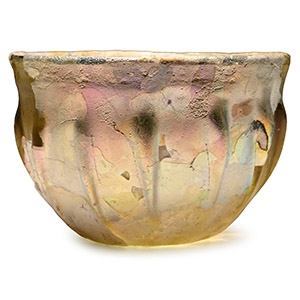
Roman Pillar-Moulded Honey-Coloured Glass Bowl with Fine Iridescence
3rd-4th century A.D.Sold for (Inc. bp): £390
With iridescent surface, narrow base and vertical ribbed segmentation to the sidewall, gently flared rim. 164 grams, 11.1 cm wide
Ex London, UK, gentleman, 1990s. -
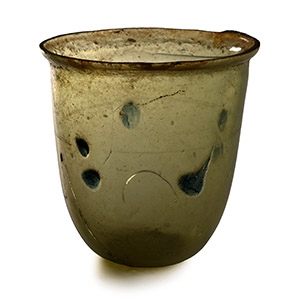
Roman Olive Green Glass Vessel with Blue Spot Decoration
1st-2nd century A.D.Sold for (Inc. bp): £442
With tapering sidewall and flared rim, applied blue glass splashes. 37.8 grams, 68 mm
Acquired Christie's, London, Antiquities, Works of Art and Important Renaissance Bronzes, Plaquettes and Limoges Enamels, 8 July 1981, no.6 (part). From a private Wiltshire, UK, collection. Accompanied by a copy of the relevant Christie's catalogue pages. -
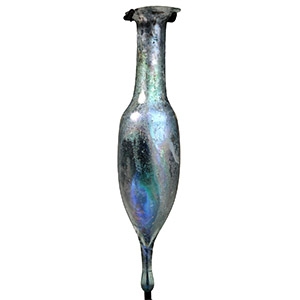
Roman Iridescent Blue Glass Flask
2nd-3rd century A.D.Sold for (Inc. bp): £845
Of fusiform type with a rolled lip and thick rounded bottom; iridescent surface. 198 grams total, 16.2 cm including stand
From an important collection of glass, London, UK, 1990s. -
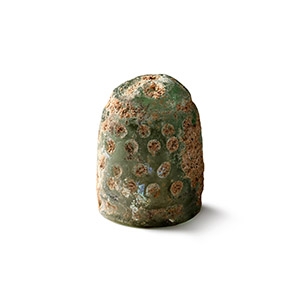
Roman Glass Thimble
1st-4th century A.D.Sold for (Inc. bp): £390
Narrow tubular type with domed end and impressed dimples. 6.47 grams, 23 mm
From an important collection of a London gentleman, UK, 1990s. -
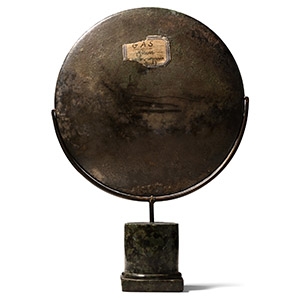
Roman Silver Mirror
1st-3rd century A.D.Sold for (Inc. bp): £1,755
Discoid with raised, rounded rim; a 19th-century collection label bearing a handwritten inscription: ‘GAS, Miroir, Gallo Romain’ indicating the findspot; mounted on a custom-made display stand with serpentine column base. 239 grams, 13.8 cm (426 grams total, 20.1 cm including stand)
19th century collection label inscribed in ink ‘GAS, Miroir, Gallo-Romain’, indicating that the mirror was discovered at Gas, Eure-et-Loir, northern France. Private collection, UK.
The British Museum houses several notable ancient Roman silver hand mirrors, including: 1. Bursa Treasure Mirror – Part of the Bursa Treasure, a 1st-century AD Roman silver hoard discovered near Bursa, Turkey. This collection includes a large silver mirror, reflecting the luxurious personal items used by elite Roman women. 2. Chaourse Treasure Mirror – found in 1883 near Chaourse, France, this 2nd–3rd century AD hoard contains various silver objects, including a silvered bronze mirror, offering insights into the affluent lifestyles of Roman society. These mirrors exemplify the exquisite craftsmanship and refined artistry of Roman silverwork, providing a glimpse into the daily grooming practices and material culture of the Roman elite. -
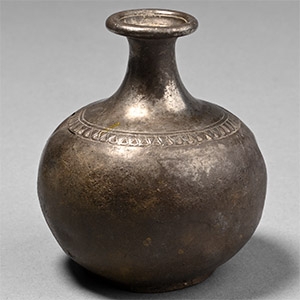
Roman or Gandharan Decorated Silver Aryballos
Circa late 1st century B.C.-early 1st century A.D.Sold for (Inc. bp): £1,170
Globular in profile with basal ring, punched band of teardrops to the shoulder, trumpet-shaped neck with everted and rolled rim. 46 grams, 66 mm
Acquired from a private UK collection prior to 1979. Ex Julian Sherrier collection, a leading figure in Gandharan art. with Christie's, New York, sale 2337, 14th September 2010, no.40 (part). Accompanied by the original Christie's lot ticket. -
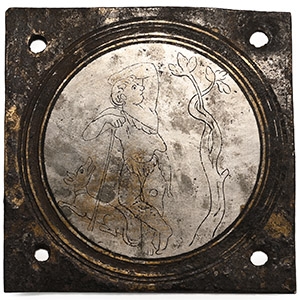
Roman Silver Military Belt Plaque
Circa 4th century A.D.Sold for (Inc. bp): £520
Square plaque from a baldric or military belt, with an engraved circle in the centre depicting a shepherd resting under a tree with two crossed branches, leaning on his staff with a greyhound beside him. 48.7 grams, 66 mm
From a UK collection since before 1990.
The plaque is related to a series of late Antique bronze plates destined to decorate the military baldrics or belts. Some of them were found in a late Roman tomb in Totanés (Toledo), ornamented with busts, and a plaque from Merida (Badajoz) was decorated with the personification of Rome. The plaque is related to similar ones from Italian and Syrian-Palestinian workshops, whose ornamentation seems sometimes to be connected to imperial authority. Parallels are linked to similar pieces of different iconographic types, but which were equally popular in the late Roman Empire, such as hunting or bucolic motifs.

