-
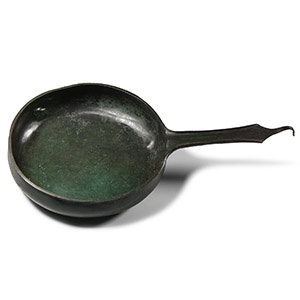
Roman Bronze Patera with Handle
1st century B.C.-1st century A.D.Sold for (Inc. bp): £715
The bowl with a wide flat bottom and convex sides; the inside with incised concentric circles; flat handle with raised edges and hooked finial for suspension. 483 grams, 39.5 cm
German private collection, Mr O., collecting in the 1950s-1960s; thence by descent. with Bonhams, London, 7 July 2016, lot 191 (£3,000-5,000). Accompanied by an academic report by Dr Raffaele D’Amato. Accompanied by copies of the relevant Bonhams printed catalogue pages (full page). This lot has been checked against the Interpol Database of stolen works of art and is accompanied by search certificate number no.11735-201189.
This vessel was part of Roman and provincial bronze instrumentum domesticum, i.e. culinary or domestic utility ware. Such cooking vessels are rare: some are found in central and northern Italy, in Pannonia, Germany and in Britain. The Aylesford Pan, today in the British Museum (inventory no.1886.1112.1), is one of the most important finds. This specimen (Eggers type 130), probably pre-Caesarian or Caesarian, was found in a grave together with a Celtic bucket and a jug. -
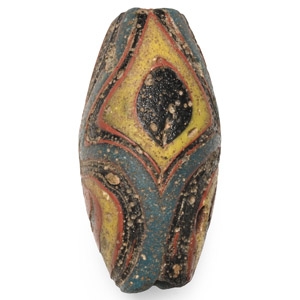
Roman or Later Mosaic Glass Bead
1st-4th century A.D.Sold for (Inc. bp): £46
Fusiform type with folded design in contrasting colours. 4.8 grams, 26 mm
Acquired in London or Japan, early 1980s. Property of a London, UK, gentleman. -
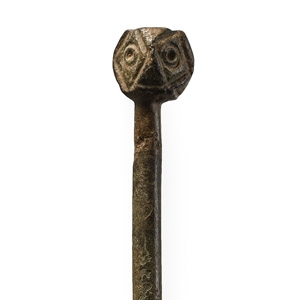
Late Roman Bronze Dress Pin
4th-5th century A.D.Sold for (Inc. bp): £65
With polyhedral head bearing impressed lozenge ornament, hipped shank. 11.37 grams, 10.1 cm
From a private Tyneside collection, formed since the early 2000s. -
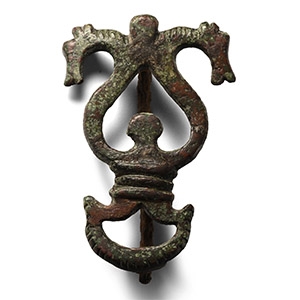
Roman Bronze Double Horse-Headed Brooch
2nd century A.D.Sold for (Inc. bp): £143
Skeuomorphic type with openwork crescent to the foot, transverse ribbed panel and two swept arms developing to addorsed horse-heads; ferrous pin and catch to the reverse. 6.95 grams, 42 mm
Ex DRG Coins and Antiquities, Bishops Stortford, Essex, UK. From the private collection of a West London, UK, gentleman, formed since the early 2000s. Accompanied by a handwritten dealer's ticket. -
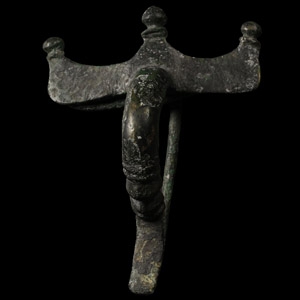
Roman Bronze Bow Brooch
2nd century A.D.Sold for (Inc. bp): £98
P-shaped bow brooch with three onion-shaped knops to the upper edge of the headplate, chord and pin to reverse, deep bow with ribbed section above junction with the rectangular foot; catch to reverse. 38.4 grams, 69 mm
Ex important German collection, 1990s. This lot is accompanied by an illustrated lot declaration signed by the Head of the Antiquities Department, Dr Raffaele D’Amato.
This type of fibula falls within the P-shaped bow brooch typology, a provincial form found in Britain, Pannonia, and the Balkan Peninsula. It is usually associated with men's costume. -
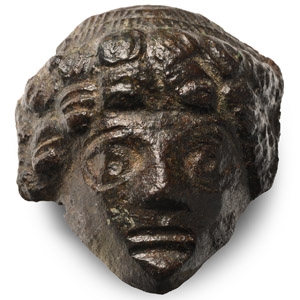
Roman Bronze Head Mount
2nd-4th century A.D.Sold for (Inc. bp): £59
Modelled in the half-round mask with copious hair and a circlet; exaggerated eyes, perhaps intended to have a silver overlay; modern mounting stud to the reverse. 24.5 grams, 30 mm
Ex P. Chapman collection, 1980s-1990s. -
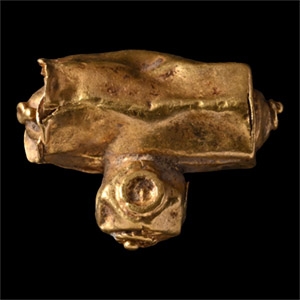
Roman Gold Amulet Case
5th-6th century A.D.Sold for (Inc. bp): £124
Cylindrical body with domed finials with applied pellets, cornerless cube-shaped suspension loop with applied pellet and filigree annulets. 0.78 grams, 14 mm
Ex property of a late Japanese collector, 1970-2000s. This lot is accompanied by an illustrated lot declaration signed by the Head of the Antiquities Department, Dr Raffaele D'Amato.
Assessing the typology and chronology of such amulet capsules is very difficult, and precise dating is usually impossible, especially since the context of the find is often unknown, as in this case. According to Schienerl, prismatic, usually hexagonal amulet capsules only appear in the 2nd or 3rd century, while the use of amulets in the Eastern Roman Empire ceased after the 7th century. -
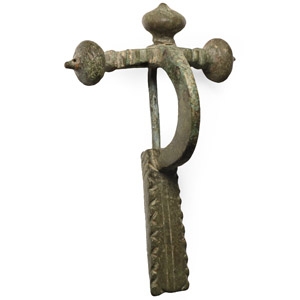
Roman Bronze Crossbow Brooch
Circa 4th century A.D.Sold for (Inc. bp): £104
With three onion-shaped knops to the crossbar and pierced moulding to the upper face, deep bow, trapezoidal foot with notched edges and longitudinal lines; integral catch; hinged pin to reverse; Keller Type 4. 37.8 grams, 73 mm
From a private Tyneside collection, formed since the early 2000s. -
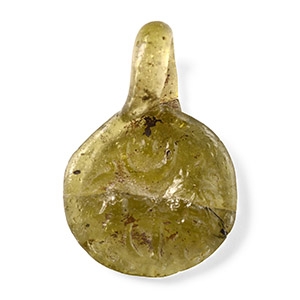
Late Roman Glass Pendant
5th-7th century A.D.Sold for (Inc. bp): £117
Discoid with impressed motif of a lion surmounted by a crescent and pellet. 1.23 grams, 24 mm
From the private collection of the late Mr S.M., 1969-1999. -
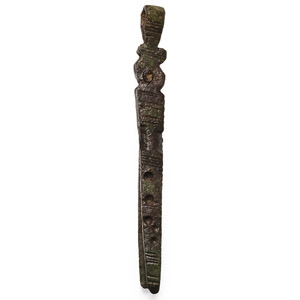
Late Roman Bronze Tweezers
4th-6th century A.D.Sold for (Inc. bp): £65
Formed as two narrow flat-section arms with transverse ribbing, chamfered edges and impressed point ornament. 7.68 grams, 70 mm
From a private Tyneside collection, formed since the early 2000s. -
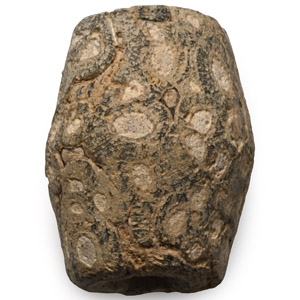
Roman Mosaic Glass Bead
1st-4th century A.D.Sold for (Inc. bp): £33
Barrel-shaped type with weathered surface. 11.9 grams, 26 mm
Acquired in London or Japan, early 1980s. Property of a London, UK, gentleman. -
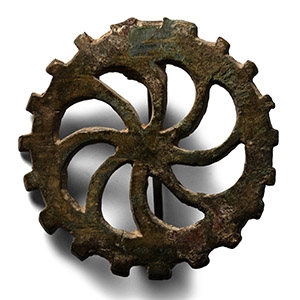
Roman Bronze Sun Wheel Plate Brooch
2nd century A.D.Sold for (Inc. bp): £78
With flat rim, openwork radiating curved arms and hub to centre, teeth to rim; pin, pin-lugs, and catch to the reverse. 12.5 grams, 39 mm
Ex DRG Coins and Antiquities, Bishops Stortford, Essex, UK. From the private collection of a West London, UK, gentleman, formed since the early 2000s. Accompanied by a hand written dealer's ticket.

