-
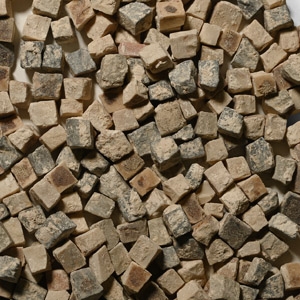
Roman Mosaic Stone Tesserae Group
1st-4th century A.D.Sold for (Inc. bp): £195
A mixed group of two hundred and fifty single tesserae of various colours and sizes, mostly cuboid. 350 grams total, 7-14 mm
From a collection acquired on the UK art market from various auction houses and collections mostly before 2000. From an important Cambridgeshire estate; thence by descent.
Roman mosaics were made from small cubes of natural stone and terracotta possibly cut from tile or brick. Each of these small cubes was called a tessera (plural tesserae) from the Latin word for dice. -
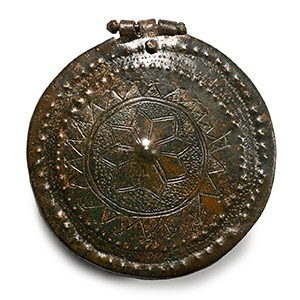
Late Roman Hinged Lidded Pyxis
4th-5th century A.D.Sold for (Inc. bp): £468
Sheet-bronze two-part pyxis with carinated sidewall to the base, lid with reserved octofoil on a pounced field, concentric pointillé rings; working hinge mechanism. 64 grams, 86 mm
Acquired in the 1990s. Ex Abelita family collection. This lot is accompanied by an illustrated lot declaration signed by the Head of the Antiquities Department, Dr Raffaele D'Amato.
Although pyxides were originally made of wood, as their name suggests, the term soon came to refer, in the Graeco-Roman world, to round containers used for both medicinal and domestic purposes. From the time of the Achaeans to the end of the Roman Empire, we find pyxides made of horn, ivory, bronze, silver, and gold. Women used them to store their ointments, makeup, and toiletries. A pyxis used for medical purposes was called a loculus, while the name pyxidicula designated a container for eye drops, and a tripuxium was a pyxis containing extracts from three different containers. -
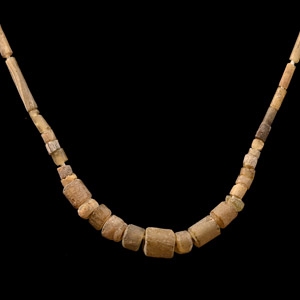
Roman Yellow Glass Bead Necklace String
1st-4th century A.D. and laterSold for (Inc. bp): £26
Restrung group of tubular and other types. 9.2 grams, 46 cm
London, UK, collection, 2000s. -
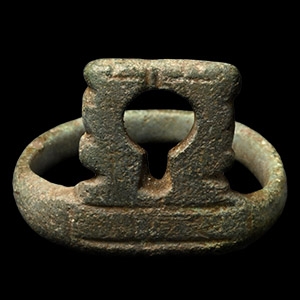
Roman Bronze Key Ring
1st-2nd century A.D.Sold for (Inc. bp): £52
Comprising a narrow hoop, rectangular bezel with dentilled outer edge, keyhole-shaped void. 6.36 grams, 21.44 mm overall, 19.9x17.4 mm internal diameter (approximate size British P 1/2, USA 7 3/4, Europe 16.86, Japan 16)
Found Gloucestershire, UK. Acquired from the early 1980s. From the private collection of a late Gloucestershire, UK, gentleman; thence by descent. -
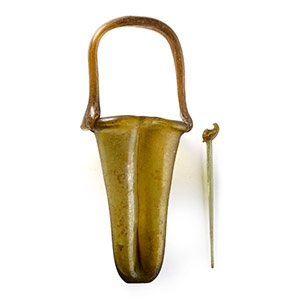
Roman Amber Glass Double Unguentarium with Dolphin-Headed Pin
Circa 4th century A.D.Sold for (Inc. bp): £169
With rolled rim and a large loop handle above; accompanied by a tapering glass pin with applied dolphin finial. 75 grams, 16.5 cm
Previously from a German private collection. Acquired Sotheby's, London, 13 & 14 July 1981, no.425 (illus). From a private Wiltshire, UK, collection. Accompanied by a copy of the relevant Sotheby's catalogue pages. -
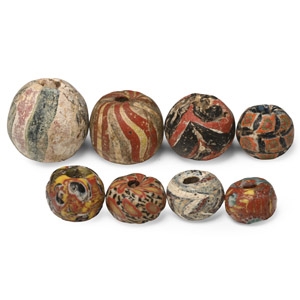
Roman and Later Mosaic Glass Bead Group
1st-4th century A.D. and laterSold for (Inc. bp): £104
Barrel-shaped and other types. 24.8 grams total, 11-18 mm
Acquired in London or Japan, early 1980s. Property of a London, UK, gentleman. -
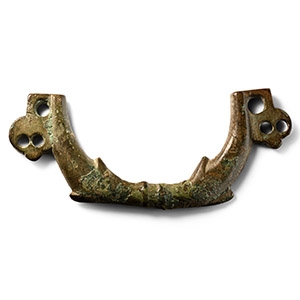
Large Roman Bronze Vessel Handle with Conjoined Dolphins
2nd century A.D.Sold for (Inc. bp): £27
Comprising a crescentic band with ribbed detailing of two opposed dolphins, each with a pierced P-shaped lug to the lower end; 55 grams, 11.3 cm
Found Gloucestershire, UK. -
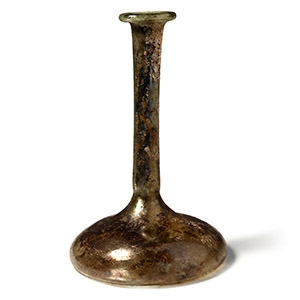
Roman Blue-Green Glass Ampulla
1st-2nd century A.D.Sold for (Inc. bp): £234
Tall and slender vessel with wide base and flared rim. 90 grams, 15.5 cm
From an important collection of glass, London, UK, 1990s. -
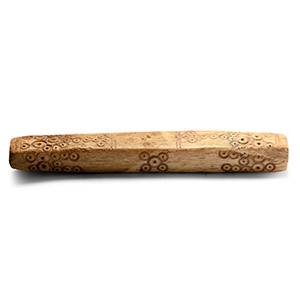
Roman Bone Gaming Piece Bar
1st-4th century A.D.Sold for (Inc. bp): £169
Rectangular in plan and square in section with groups of ring-and-dot markings distributed across the flat faces. 22 grams, 93 mm
From a collection of gaming items, formed 1980-1990s. -
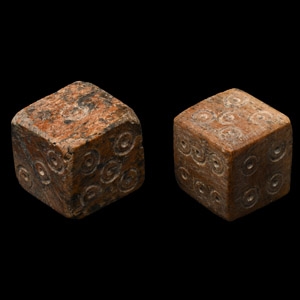
Roman Bone Gaming Dice Pair
1st-4th century A.D.Sold for (Inc. bp): £234
A pair of cuboid dice with ring-and-dot markings disposed 1;6, 2:5, 3:4. 5.35 grams total, 11 mm each
Ex German art market, 2000s. Acquired from an EU collector living in London. From the collection of a Surrey, UK, gentleman. -
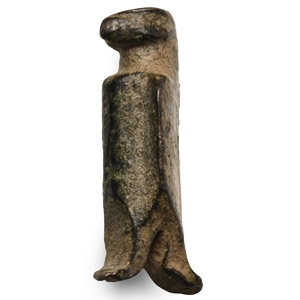
Roman Silver Eagle Statuette
Circa 1st-2nd century A.D.Sold for (Inc. bp): £39
Stylised standing eagle with elongated body and curving tail. 3.82 grams, 20 mm
From a private Tyneside collection, formed since the early 2000s. -
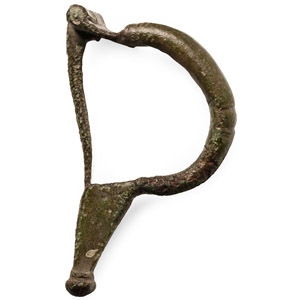
Romano-British Bronze Brooch with Maker’s Name ACUTI
Late 1st-early 2nd century A.D.Sold for (Inc. bp): £98
P-shaped or Aucissa variant, deeply arched bow with two incisions; maker’s name 'ACUTI' at the front of the bow. 10.9 grams, 51 mm
Found East Anglia, UK. From a Kent collection formed in the 1990s.

