-
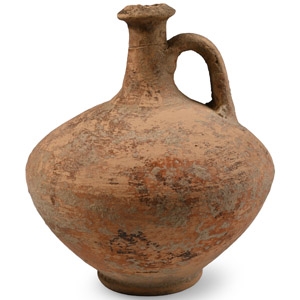
Roman Terracotta Wine Flagon
3rd-4th century A.D.Sold for (Inc. bp): £104
With narrow foot and broad shoulder, biconvex mouth and strap handle. 360 grams, 14 cm
Ex German art market, 2000s. Acquired from an EU collector living in London. From the collection of a Surrey, UK, gentleman. -
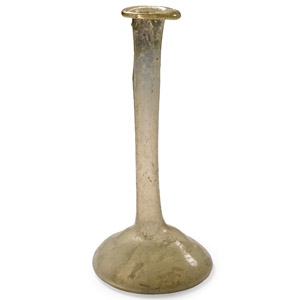
Roman Glass Candlestick Unguentarium
1st-3rd century A.D.Sold for (Inc. bp): £195
Comprising a low conical body and slightly convex wall, dimple base; tall cylindrical neck flaring to mouth with inward-folded rim; slightly iridescent surface. 58 grams, 17.5 cm
From an important London collection of glass, 1990s. This lot is accompanied by an illustrated lot declaration signed by the Head of the Antiquities Department, Dr Raffaele D'Amato.
This kind of toilet bottle was called ‘candlestick unguentarium’ by the academics due to the shape of its neck. They are especially found in Roman Egypt (Karanis class XIII.A.I.). -
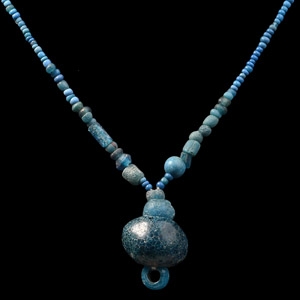
Roman Deep Blue Glass Bead Necklace String
1st-4th century A.D. and laterSold for (Inc. bp): £78
A restrung group of oblate and other types with an irregular pendant centrepiece, with some 'Indo-Pacific' beads. 12.62 grams, 37 cm
London, UK, collection, 2000s. -
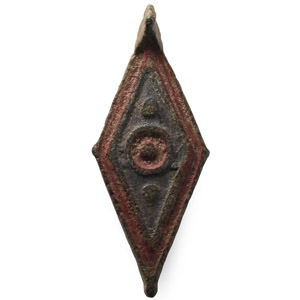
Romano-British Enamelled Bronze Lozenge-Shaped Seal Lid
2nd century A.D.Sold for (Inc. bp): £26
Composed of a lozenge-shaped plate with blue and red enamel decoration, remains of hinge at one end with a terminal knop at the opposite end. 5.25 grams, 48 mm
Found Norfolk, UK. From a Kent collection formed in the 1990s. -
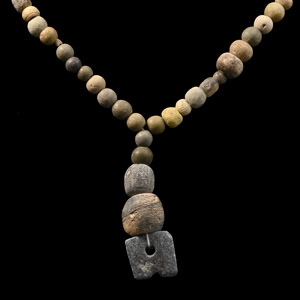
Roman Glass Bead Necklace String
1st-4th century A.D. and laterSold for (Inc. bp): £33
Restrung group of mostly spherical beads with a rectangular pendant centrepiece. 25.4 grams, 30.5 cm
London, UK, collection, 2000s. -
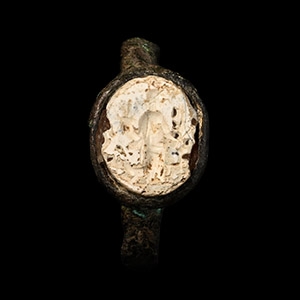
Roman Bronze Ring with Seated Fortuna Gemstone
2nd-3rd century A.D.Sold for (Inc. bp): £33
D-section hoop and ellipsoid bezel with inset gemstone, intaglio motif of a seated goddess holding a sword blade-uppermost. 2.03 grams, 21.6 mm overall, 15.7 mm internal diameter (approximate size British J 1/2, USA 5, Europe 9.32, Japan 9)
with Archaeologia, Switzerland, before 1983. Ex private North American collection. London private collection, 2016. -
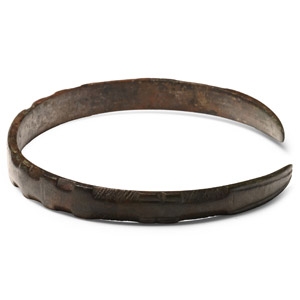
Late Roman Bronze Bracelet
4th-6th century A.D.Sold for (Inc. bp): £78
Penannular rectangular-section body with notched edges and tapering finials. 20.3 grams, 63 mm
Ex German art market, 2000s. Acquired from an EU collector living in London. From the collection of a Surrey, UK, gentleman. -
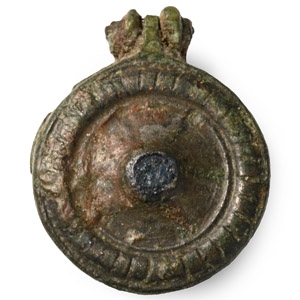
Romano-British Enamelled Bronze Seal Box
2nd century A.D.Sold for (Inc. bp): £46
Circular box with hinged lid decorated with blue enamel in the centre, surrounded by traces of red enamel; base perforated with four holes for affixing to the wrapping and a small notch on each side for the security cord for the bag. 9.39 grams, 25 mm
Found Norfolk, UK. From a Kent collection formed in the 1990s. -
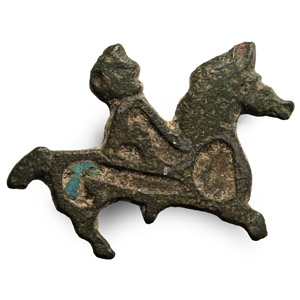
Romano-British Enamelled Bronze Horse and Rider Brooch
2nd century A.D.Sold for (Inc. bp): £91
With panels to the cloak and horse's body for enamel fill with traces of blue and renamel, notched outline to the hair and mane; remains of pin-lugs and catchplate to verso. 3.21 grams, 29 mm
Found Norfolk, UK. From a Kent collection formed in the 1990s. -
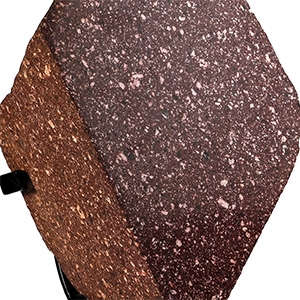
Late Roman Imperial Porphyry Fragment
4th-6th century A.D.Sold for (Inc. bp): £3,640
Formed as a parallelepiped with round corner having a possibly later polished side and the other three sides straight and round, with signs of carving; probably from an Imperial sarcophagus or monument; mounted on a custom-made stand. 9.85 kg total, 36.5 cm including stand
Acquired from the private collection of a Somerset gentleman who was related to Sir Arthur Evans. From the private collection of a UK gentleman since before 2005.
For the Romans, porphyry was the Imperial marble par excellence, and from Constantine the Great until the end of the 5th century, but probably also later, it was used to create sarcophagi for the emperors and members of the Imperial families. This particular stone was connected with the Imperial family because of its red colour, recalling the violet and red shades of the purple (porphyra), the precious colour assigned only to emperors and their relatives. In Constantinople, a room of the Imperial palace was called Porphýra, located on one of the palace terraces overlooking the Sea of Marmara and the Bosphorus. It was perfectly square in shape with a pyramidal ceiling and was entirely covered in purple porphyry speckled with white dots: this was the room where the empresses gave birth to the heir of the Roman Empire, called Porphyrogénnētos, meaning ‘born in the purple room’. Porphyry was widely used for building churches in the Christian Empire, and Justinian exhausted the supplies from Egypt by building the Great Church of Hagia Sophia, where still today a great amount of this material can be seen. The impressive Imperial sarcophagi were kept in the Church of the Holy Apostles, as well as the great porphyry sarcophagus of Constantine the Great, of which only a small fragment survives today in the Archaeological Museum of Istanbul. -
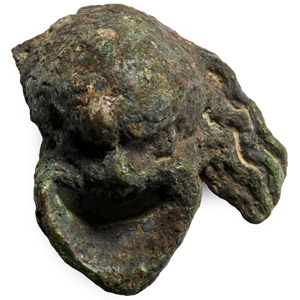
Roman Bronze Comic Actor's Mask Mount
2nd century A.D.Sold for (Inc. bp): £59
With a braided wig, exaggerated scooped mouth and grotesque features, hollow to the reverse. 24.9 grams, 33 mm
From the collection of a gentleman, acquired on the London art market in the 1990s. -
.jpg)
Roman Gemstone and Glass Pendant Collection
2nd-3rd century A.D.Sold for (Inc. bp): £208
Comprising: a fragment of a glass pendant with impressed image of an advancing lion, crescent moon above; a conical agate intaglio with a profile of theatre mask; an oval carnelian intaglio with a dove holding an olive branch; a jasper intaglio with standing Asclepius holding a snake-staff. 4.35 grams total, 10-17 mm
Norfolk family collection, 1940s-1960s; thence by descent.

