-
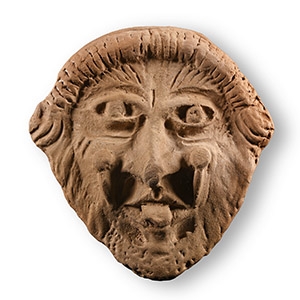
Greek Terracotta Face of a Gorgoneion
6th-5th century B.C.Sold for (Inc. bp): £1,040
With large eyes and applied pupils, accentuated nose and open mouth with protruding tongue, hair indicated with regularly disposed lines; repaired, western Greek workmanship; mounted on a custom-made display stand. 142 grams total, 15.5 cm including stand
Ex Mr M.Q.F, Horgen, Switzerland, 1971. with Galerie Rhéa, Zurich, Switzerland.
A Gorgoneion was a protective symbol in ancient Greek art that depicts the head of the Gorgon, a mythical creature with snakes for hair and a terrifying gaze that could turn people to stone. The Gorgoneion was believed to have the power to ward off evil and protect the person who wore it or displayed it. The image of the Gorgoneion was often used as an apotropaic symbol to ward off evil or bad luck. It was often depicted on shields, armour, or even as an architectural feature on buildings. The symbol was also sometimes used in jewellery, such as amulets or pendants, and was believed to bring good luck and protection to the wearer. The most famous depiction of the Gorgoneion is probably the one on the aegis of the goddess Athena. -
.jpg)
Greek Gold Diadem with Glass Gem
1st millennium B.C.Sold for (Inc. bp): £1,235
Sheet-gold with tapering finials, central raised cell set with a two-tone glass insert imitating banded agate; mounted on perspex backing. 76.87 grams total, 30 cm (36 cm including stand)
with Galerie Rhéa, Zurich, Switzerland. -
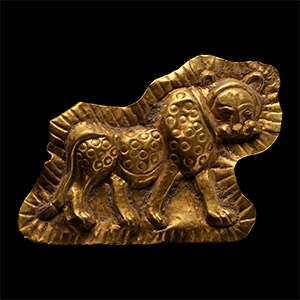
Scythian Gold Applique
4th-3rd century B.C.Sold for (Inc. bp): £975
Sheet-gold panel with repoussé advancing leopard motif surrounded by a hatched border. 1.94 grams, 44 mm
Ex Mayfair gallery, London, UK, pre 1999. -
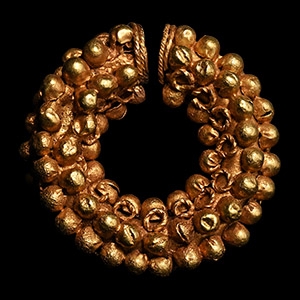
Etruscan Gold Leech Earring
3rd century B.C.Sold for (Inc. bp): £936
Formed with a hollow c-shaped body adorned with five rows of hollow spheres and a double filigree ropework band, two rows of filigree hoops to the inner face. 7.61 grams, 30 mm
From the collection of a North American gentleman, formed in the 1990s. -
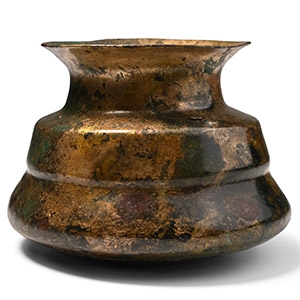
Greek Bronze Jar
Late 1st millennium B.C.Sold for (Inc. bp): £468
Bell-shaped in profile with stepped sidewall, carinated shoulder and flared rim; domed and tiered underside with basal disc. 263 grams, 11.6 cm wide
Ex property of a London, UK, gentleman, Mayfair gallery, 1990s. -
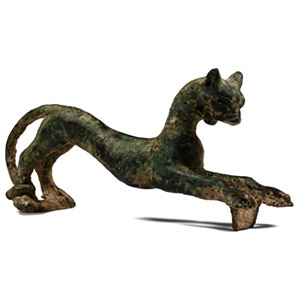
Bronze Handle of a Leaping Panther
2nd-4th century A.D.Sold for (Inc. bp): £2,340
Roman or Parthian handle modelled in the round in leaping stance with forepaws extended, tail curled between the legs, mouth gaping in a roar; tab and sprue between the forelegs, bar between the hind feet; furniture fitting. 180 grams, 14 cm
Acquired in the 1980s. Private collection, Switzerland, thence by descent. Private collection, since the late 1990s. This lot has been checked against the Interpol Database of stolen works of art and is accompanied by a search certificate number no.12744-234682. -
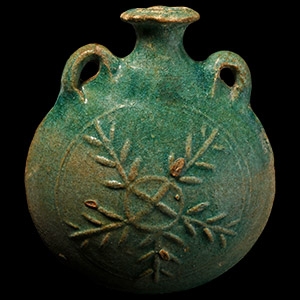
Parthian Blue-Glazed Water Vessel
2nd century B.C.Sold for (Inc. bp): £650
Discoid in plan and biconvex in section with trumpet-shaped spout and loop to each shoulder; radiating fronds to tondo on each face. 278 grams, 14.1 cm
Ex London, UK gallery, 1971-early 2000s. Private collection, London, UK. -
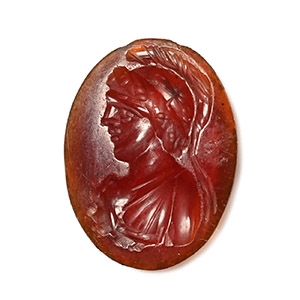
Roman Carnelian Gemstone of Athena
1st-2nd century A.D.Sold for (Inc. bp): £975
Ellipsoid in plan with incuse profile bust of Athena wearing a Corinthian style helmet; supplied with a museum-quality impression. 0.87 grams, 17 mm
Acquired in the mid 1980s-1990s. Private collection, Switzerland, thence by descent. Private collection, since the late 1990s. -
.jpg)
Roman Carnelian Gemstone with Vulcan
1st century B.C.-1st century A.D.Sold for (Inc. bp): £338
Depicting a nude blacksmith seated on a stool before a forge, hammer in his right hand, holding an object he is hammering with the other hand. 0.25 grams, 10 mm
Private collection, North Germany. with Gorny & Mosch, 14 December 2005, no.238. Accompanied by a copy of an Art Loss Register certificate no.S00075379.
Probably a Roman copy of a Hellenistic subject. Some Roman ring intaglios were dedicated to Vulcan (Greek Hephaestus), god of the blacksmiths, artisans, and carpenters. Usually, the god is represented standing or working in his forge, wearing a wide-brimmed hat and a one-shouldered tunic, identifying him as a craftsman. In his right hand, he holds a hammer over an anvil, and in his left a pair of long metalworking tongs. Sometimes he is naked, seated and working. -
.jpg)
Roman Leda and the Swan Carnelian Gemstone
2nd-3rd century A.D.Sold for (Inc. bp): £520
An oval intaglio with an engraved image of Leda on a low couch copulating with Zeus in swan-form, set in a fragmentary silver ring. 4.37 grams, 23.66 mm
Ex German art market, 2000s. Acquired from an EU collector living in London. From the collection of a Surrey, UK, gentleman. -
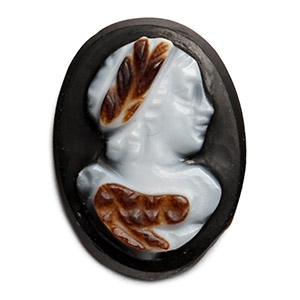
Roman Banded Agate Cameo with Bust of Cupid
2nd century A.D.Sold for (Inc. bp): £1,170
With a bust of Cupid, the god of love, facing right; supplied with a museum-quality impression. 0.41 grams, 13 mm
Private English collection, formed between the late 1970s and early 1990s. Private collection, London, UK. -
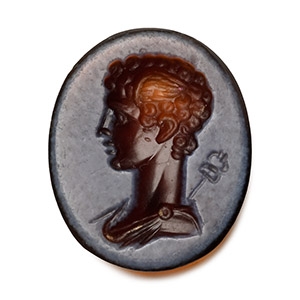
Roman Nicolo Gemstone of Hermes
Late 1st century B.C.Sold for (Inc. bp): £3,380
With an intaglio bust of the god Hermes facing left; supplied with a museum-quality impression. 0.34 grams, 12 mm
Private English collection, formed between the late 1970s and early 1990s. Private collection, London, UK.

