-
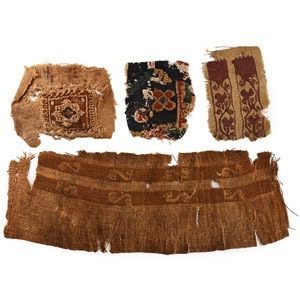
Egyptian Coptic Textile Fragment Group
Circa 4th-5th century A.D.Sold for (Inc. bp): £260
Comprising: a fragment of a double segmenta from the sleeve of a tunic in purple wool on linen, embroidered with vegetal motifs; the fragment of a double segmenta from the hem of a cloak in brown wool on linen, embroidered with S pattern; a tablion with central geometric motif and border embroidered with meanders; a fragment of tapestry in yellow, green and red wool, S torsion, embroidered with floral patterns. 59 grams total including package, 7-24.5 cm
Acquired 1970s-1996. Property of a North American collector. London collection, 2016.
The fragments are decorative parts of tunics and cloaks. These are fabrics of great decorative finesse, with some elements displaying an unusual and extremely well-preserved color palette. The plant designs recall Iranian motifs. -
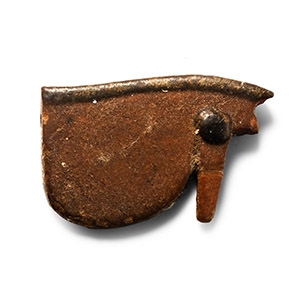
Egyptian Brown Glazed Eye of Horus Amulet
Late Period, 664-332 B.C.Sold for (Inc. bp): £39
Wedjat amuletic bead in dark brown faience with applied black detailing to the pupil and brow. 8.63 grams, 44 mm
with Archaeologia, Switzerland, before 1983. Ex private North American collection. London private collection, 2016. -
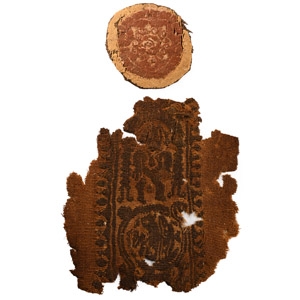
Egyptian Coptic Textile Fragment Group
Circa 5th-6th century A.D.Sold for (Inc. bp): £91
Comprising a fragment of a large segmentum in linen and wool, embroidered with a dancer, followed by a tondo with a Nereid riding a dolphin, borders with geometric decorations; an orbiculus decorated with vegetal patterns. 37 grams total including package, 6.7-14 cm
Acquired 1970s-1996. Property of a North American collector. London collection, 2016.
The segmentum was probably part of the vertical clavus of a tunic; it is highly probable that the embroidery refers to the Dionysian cycle with dancers, animals and probably, in the missing parts, hunters. -
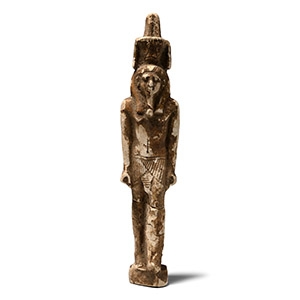
Egyptian Faience Nefertem Statuette with Hieroglyphs
Late-Ptolemaic Period, circa 664-30 B.C.Sold for (Inc. bp): £468
Presented in a striding pose with his left leg forward and his arms at his sides; wearing his emblem, the lotus-flower headdress from which two plumes emerge, and a menat on each side; dorsal pillar with hieroglyphs, beginning with the incantation: "Words spoken by Nefertum, son of Sekhmet...." 42.8 grams, 11.6 cm
From the collection of a gentleman, acquired on the London art market in the 1990s.
Nefertum is usually depicted as a young man wearing a headdress with a lotus flower or a crown featuring the flower. The god is often linked to beauty, healing, and the lotus flower, with his cult connected to the royal family and the cycle of rebirth. Nefertum’s imagery and symbolism associate him with themes of creation, renewal, and the sun; he symbolises the first sunlight and the pleasant scent of the Egyptian blue lotus flower, emerging from the primal waters within an Egyptian blue water lily. -
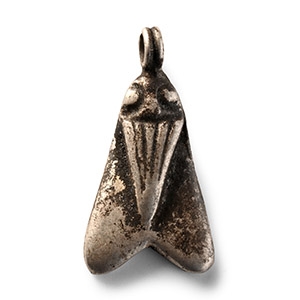
Egyptian Silver Fly Amulet
Late Period, 664-332 B.C.Sold for (Inc. bp): £195
With textured detailing to wings and body, loop for suspension. 1.33 grams, 20 mm
From a gentleman's family collection, 2000s. -
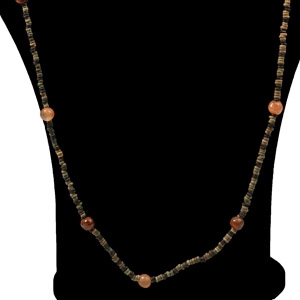
Egyptian Faience Mummy Bead Necklace with Carnelian Feature Beads
Late-Ptolemaic Period, 664-30 B.C.Sold for (Inc. bp): £59
A long, restrung designer necklace of annular beads with spherical, tubular and other types. 2.2.28 grams, 96 cm
From an old deceased estate. Property of an East London lady collector, acquired at auction before 1995. -
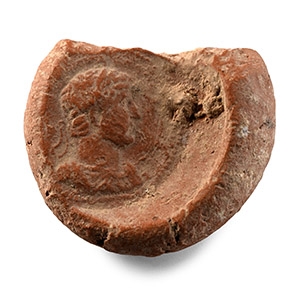
Egyptian Clay Papyrus Document Sealing with Bust of Hadrian
Roman Period, 117-135 A.D.Sold for (Inc. bp): £247
Discoid in plan with impressed seal, profile bust of Hadrian placed to one side. 4.89 grams, 24 mm
Acquired on the UK art market before 2000. Property of an Essex, UK, gentleman. -
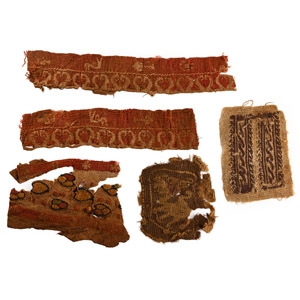
Egyptian Coptic Textile Fragment Group
Circa 4th-6th century A.D.Sold for (Inc. bp): £260
Comprising: fragment of a segmentum in red and coarse linen, S torsion, embroidered with geometric motifs; fragment of another segmentum in red, yellow, blue and green wool, with representations of buds within a red frame; a small tabula in purple wool over linen background, embroidered with a stylised image of Pegasus; a double segmenta, in purple over linen, embroidered with wave motif. 66 grams total including package, 7.8-20.5 cm
Acquired 1970s-1996. Property of a North American collector. London collection, 2016.
These are pieces of extraordinary finesse in both material and design. They all probably were once applied as a decoration of various garments, such as tunics, cloaks, and shawls. -
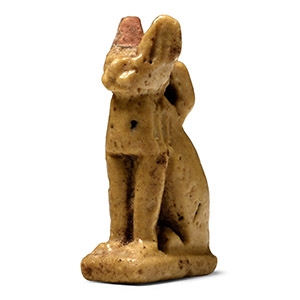
Egyptian Yellow Faience Bastet Cat Amulet
New Kingdom, circa 1550-1070 B.C.Sold for (Inc. bp): £715
Figure of Bastet as a cat with pointed ears, seated on a rectangular base with a rounded end; suspension loop on the back, ear repaired. 2.51 grams, 26 mm
Ex London gallery and Belinda Elliston, a member of the Egyptian Exploration Society, 1940s onwards.
In ancient Egypt, the cat was venerated as the sacred animal of the goddess Bastet, whose principal cult centre was Bubastis in the Nile Delta. Although cats were once part of folk practice, their veneration as part of formal cults spread across Egypt during the Late Period. Bastet was closely linked to lion-headed goddesses like Sekhmet, Tefnut, and Pakhet, and the cat itself became associated with solar imagery: the Book of the Dead portrays the sun god as a Great Cat vanquishing Apophis beneath the sacred Ished Tree. The cat could also embody the Eye of the Sun or, more often in Bastet’s case, the Eye of the Moon. Mummified cats were frequently dedicated as votive offerings, and some of their feline-shaped coffins were adorned with finely crafted bronze heads to enhance their divine likeness. -
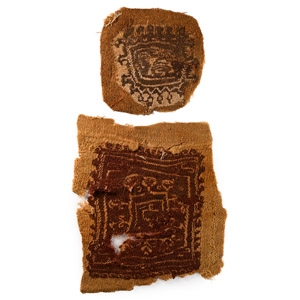
Egyptian Coptic Textile Fragment Group
Circa 4th century A.D.Sold for (Inc. bp): £143
Comprising: an orbiculus in purple wool and coarse linen, on brown linen background, S torsion, embroidered with two stylised lions, the borders crenellated; a tabula in purple wool and coarse linen, on brown linen background, S torsion, embroidered with a central cross, the borders decorated with meanders. 36 grams total including package, 8.7-13 cm
Acquired 1970s-1996. Property of a North American collector. London collection, 2016.
The tabula, or tablion, was a squared embroidery decorating tunics or mantles. The Christian elements, like the cross at the centre of our tabula, began to decorate the garments from the 4th century onwards. -
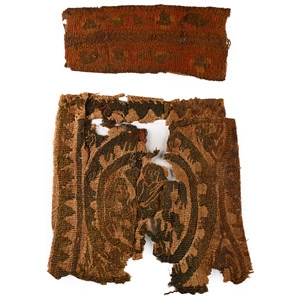
Egyptian Coptic Textile Fragment Group
Circa 4th-6th century A.D.Sold for (Inc. bp): £130
Comprising: remains of a segmentum in yellow, green and brown wool over a red linen background, S torsion, embroidered with a central band and coloured buds; a near complete tablion with representation of a dancer, inside a rondo, with four hares running on the four corners, triangular border on the external edge. 33 grams total including package, 10.7-12.2 cm
Acquired 1970s-1996. Property of a North American collector. London collection, 2016.
The central dancing figure, with her attributes and attitude, can only be interpreted as a Maenad, isolated from the Bacchic procession and abandoned to sacred trances. -
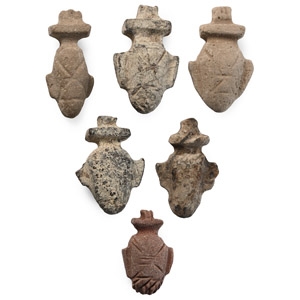
Egyptian Amulet Collection
Late Period, 664-332 B.C.Sold for (Inc. bp): £117
Mainly heart-type amulets in various materials. 14.85 grams total, 20-26 mm
with Archaeologia, Switzerland, before 1983. Ex private North American collection. London private collection, 2016.

