-
.jpg)
Egyptian Black Stone Amulet with Cartouche
Late Period, 664-332 B.C.Sold for (Inc. bp): £416
Carved in low relief with hieroglyphs to the sub-rectangular plaque, with two feathers above; integral pierced lug to reverse. 3.15 grams, 29.8 mm
with Archaeologia, Switzerland, before 1983. Ex private North American collection. London private collection, 2016. -
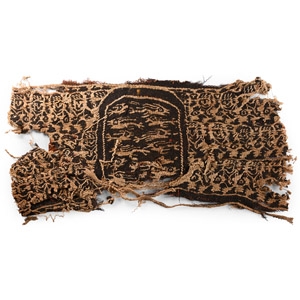
Egyptian Coptic Textile Fragment
Circa 4th-8th century A.D.Sold for (Inc. bp): £130
Fragment of a tapestry or a fabric, white linen and brown wool, S twist, depicting three rows of black slingers, shields in right or left hands, marching in opposing positions towards a roundel decorated with images of marine animals. 40 grams total including package, 22.5 cm
Acquired 1970s-1996. Property of a North American collector. London collection, 2016.
This embroidery was typical of tunics and garments characterised by full-length clavi, decorated with either intricate geometric patterns or with a multitude of small figures and animals, often edged with geometric borders and finished with thick, weft-loop fringes or cords. -
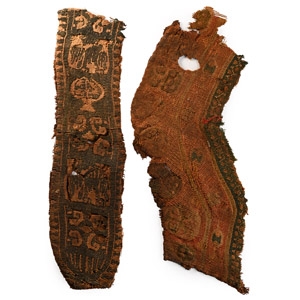
Egyptian Coptic Textile Fragment Group
Circa 6th-7th century A.D.Sold for (Inc. bp): £117
Comprising the terminal part of a clavus in white and purple linen and wool, S torsion, borders embroidered with pilasters, the central scene representing eagles alternating with geometric elements; a large fragment of another clavus, ornamented with geometric patterns in red, green and yellow wool. 49 grams total including package, 22 cm each
Acquired 1970s-1996. Property of a North American collector. London collection, 2016.
The clavi are realised in tapestry technique, and the one with prominent figures has a rounded end. They were part of the decoration of a tunic, and the presence of the Imperial eagle, not a common pattern, could refer to a military tunic. -
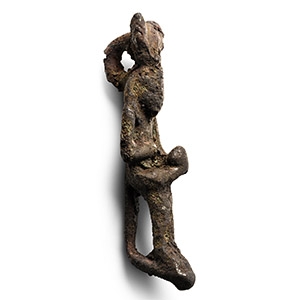
Egyptian Bronze Isis and Horus Pendant
Late-Ptolemaic Period, circa 664-30 B.C.Sold for (Inc. bp): £59
Isis modelled seated and suckling infant Horus on her lap, suspension loop behind the head. 5.04 grams, 39 mm
From the collection of a gentleman, acquired on the London art market in the 1990s.
In ancient Egyptian mythology, Isis was the sister-wife of Osiris and the mother of the sky god Horus. She is associated with fertility and motherhood and is often depicted in artworks seated in a nursing pose with her son, Horus, on her lap, as here. -
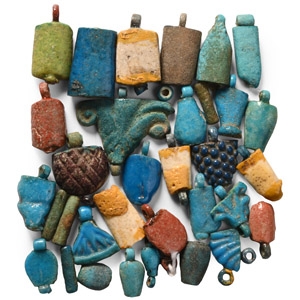
Egyptian Glazed Faience Bead and Amulet Collection
New Kingdom, 1550-1070 B.C.Sold for (Inc. bp): £143
Comprising various glazed amulets and beads, including grape bunch, lotus flower, and other types. 8.3 grams total, 2-19 mm
Ex Norri collection, Milton Keynes, UK, 1980s-1990s. -
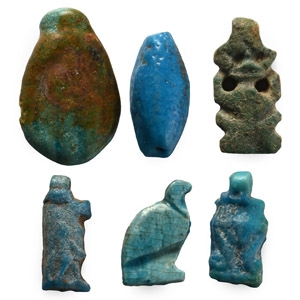
Egyptian Amulet Bead Collection
Late Period, 664-332 B.C.Sold for (Inc. bp): £65
Group of amuletic beads and pendants, including Bes with a feathered headdress, the goddess Taweret, a Hathor head with characteristic curled wig, a vulture, and others. 3 grams total, 12.5-19.6 mm
with Archaeologia, Switzerland, before 1983. Ex private North American collection. London private collection, 2016. -
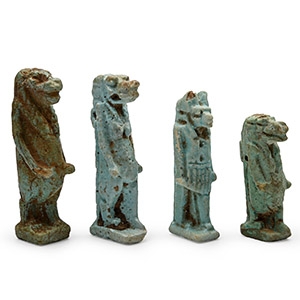
Egyptian Blue Glazed Amulet Collection
Late Period, 664-332 B.C.Sold for (Inc. bp): £234
Group of four amuletic figural pendants, each standing with dorsal pillar: three examples of Taweret with hippopotamus-head and one of Anubis with jackal-head. 20 grams total, 31-43.6 mm
with Archaeologia, Switzerland, before 1983. Ex private North American collection. London private collection, 2016. -
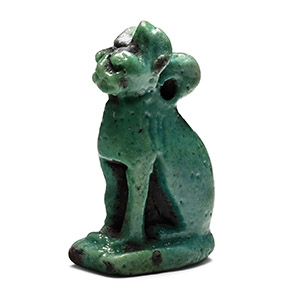
Egyptian Blue Faience Bastet Cat Amulet
New Kingdom, circa 1550-1070 B.C.Sold for (Inc. bp): £715
Modelled seated on a tongue-shaped base, with simple facial detailing and suspension loop to the back. 3.25 grams, 28 mm
Ex London gallery and Belinda Elliston, a member of the Egyptian Exploration Society, 1940s onwards.
In ancient Egypt, the cat was venerated as the sacred animal of the goddess Bastet, whose principal cult centre was Bubastis in the Nile Delta. Although cats were once part of folk practice, their veneration as part of formal cults spread across Egypt during the Late Period. Bastet was closely linked to lion-headed goddesses like Sekhmet, Tefnut, and Pakhet, and the cat itself became associated with solar imagery: the Book of the Dead portrays the sun god as a Great Cat vanquishing Apophis beneath the sacred Ished Tree. The cat could also embody the Eye of the Sun or, more often in Bastet’s case, the Eye of the Moon. Mummified cats were frequently dedicated as votive offerings, and some of their feline-shaped coffins were adorned with finely crafted bronze heads to enhance their divine likeness. -
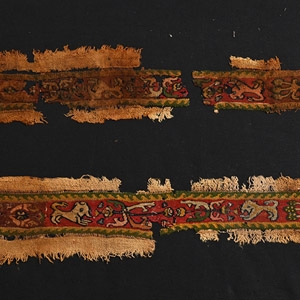
Large Mounted Egyptian Coptic Textile Pair with Animals
Mid 6th century A.D.Sold for (Inc. bp): £1,560
Pair of decorative tunic strips (clavi) ending with circular decorations (orbiculi), red, green and yellow wool, S-twist tapestry, decorated with two rows of lions alternating with vegetal elements running in a contrasting manner. 434 grams total, mount: 1.21 m
Acquired 1970s-1996. Property of a North American collector. London collection, 2016.
Among the many fragments of wool tunics are several long strips that match to form nearly full-length central pectoral clavi. They are patterned with a profusion of small figures or interlaced abstract designs, birds, plants and animals with a contrasting border filled with geometric motifs. -
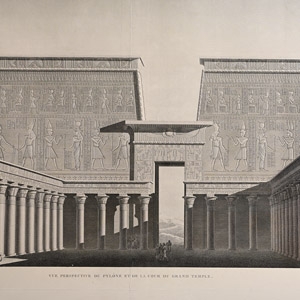
Very Large Egyptian Expedition Lithograph of the Temple of Edfu
Early 19th century A.D.Sold for (Inc. bp): £117
Proof etching on laid paper of plate 61 from Jomard Description de l'Égypte: ou, Recueil des observations et des recherches qui ont été faites en Égypte pendant l'expédition de l'armée française with title Edfou (Apollinopolis Magna). Vue perspective du pylône et de la cour du Grand Temple. 235 grams, 106 x 69.3 cm
From the collection of a North American priest. Acquired between 1981-1996. Property of a North American collector.
Produced between February 1802 and 1830 on the orders of Napoleon Bonaparte; published between 1809 and 1828. Just 1,000 copies were distributed to various institutions, printed on laid paper with an 'Égypte ancienne et moderne' watermark. The book is subtitled Recueil des observations et des recherches qui ont été faites en Égypte pendant l’expédition de l’Armée française, publié par les ordres de Sa Majesté l’Empereur Napoléon le Grand (Gathering of observations and discoveries which were made in Egypt during the expedition of the French army, published on the orders of His Majesty the Emperor Napoleon the Great). It was the world's first encyclopedia devoted exclusively to the remains of ancient Egypt. The plates of this book are the first to present the archaeological sites of Thebes (Luxor). The Temple of Horus at Edfu is among the best-preserved temples in Egypt. -
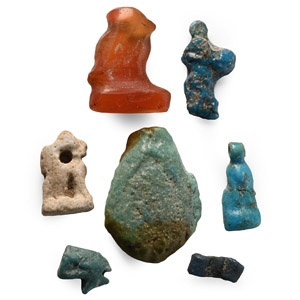
Egyptian Amulet Bead Collection
Late Period, 664-332 B.C.Sold for (Inc. bp): £104
Group of amuletic beads and pendants including a wedjat-eye, Horus in falcon form, a seated Bastet, Bes playing a tambourine, and other types. 3.3 grams total, 8-19.5 mm
with Archaeologia, Switzerland, before 1983. Ex private North American collection. London private collection, 2016. -
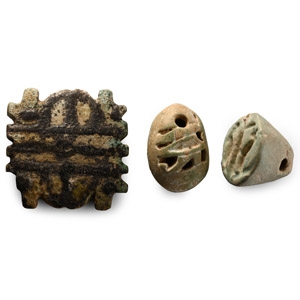
Egyptian Blue Glazed Amulet Collection
Late Period, 664-332 B.C.Sold for (Inc. bp): £46
Including a glazed composition plaque formed from four conjoined wedjat motifs, a pendant with pierced-work wedjat-eye, and a pendant with a double uraei motif. 14 grams total, 17.2-32 mm
with Archaeologia, Switzerland, before 1983. Ex private North American collection. London private collection, 2016.

