-
.jpg)
Egyptian Glass Eyes
Late-Ptolemaic Period, circa 664-30 B.C.Sold for (Inc. bp): £260
Comprising two blue-rimmed eyes with black pupil and cream sclera, and a blue eyebrow. 2.82 grams total, 23-24 mm
From the collection of a gentleman, acquired on the London art market in the 1990s. -
.jpg)
Egyptian Stone Scaraboid with Cartouche of Thutmose IV
New Kingdom, 18th Dynasty, circa 1415 B.C.Sold for (Inc. bp): £234
Keeled body pierced longitudinally, underside with cartouche for Thutmose IV (Men-kheperru-re) and other hieroglyphs. 5.79 grams, 34 mm
From the collection of a gentleman, acquired on the London art market in the 1990s. -
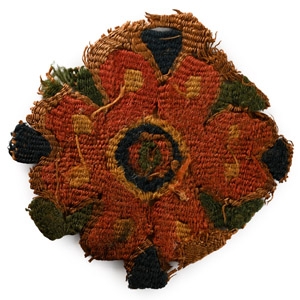
Egyptian Coptic Textile Fragment
Circa 5th-6th century A.D.Sold for (Inc. bp): £195
Central part of an orbiculus representing a six-petalled flower, S torsion, in red, yellow, olive green and blue wool. 11 grams total including package, 74 mm
Acquired 1970s-1996. Property of a North American collector. London collection, 2016.
Similar figures are widely presented in Coptic textiles, repeating a pattern in which flowers are usually paired with bird figures. This decoration is typical of tunics, but it was also used in large-scale textiles intended for domestic or funerary furnishings. -
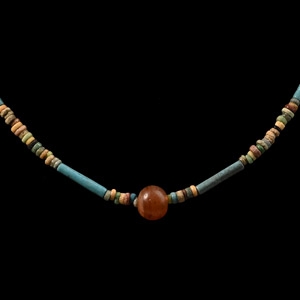
Egyptian Mummy Bead Necklace with Carnelian Feature Bead
Late Period, 664-332 B.C.Sold for (Inc. bp): £111
Restrung group of tubular and annular glazed composition beads with oblate centrepiece. 8.41 grams, 51 cm long
Previously with Astarte Gallery, London W1, UK, 1983. From the private collection of T.R. Elley, West Sussex, UK, 1980s. Accompanied by an invoice copy dated 18 October 1983. -
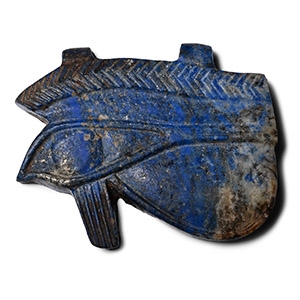
Egyptian Lapis Lazuli Wedjat Eye
Third Intermediate Period-Late Period, 1069-332 B.C.Sold for (Inc. bp): £2,210
Sizeable and finely detailed Eye of Horus, wedjat, with both falcon and human elements, visible gold flecks in places (characteristic of this stone), and two suspension loops on the top. 18.8 grams, 46 mm
From the collection of a gentleman, acquired on the London art market in the 1990s. This lot is accompanied by an illustrated lot declaration signed by the Head of the Antiquities Department, Dr Raffaele D'Amato.
This finely carved wedjat-eye amulet is a representation of the healed eye of the god Horus, featuring both human and falcon elements. The name wedjat in ancient Egyptian means ‘the one that is sound.’ According to Egyptian mythology, Horus' eye was wounded or taken by the god Seth and restored by Thoth. The wedjat-eye amulet was thought to protect its wearer and bestow the power of recovery and regeneration onto them. It was very popular and used by both the living and the dead. -
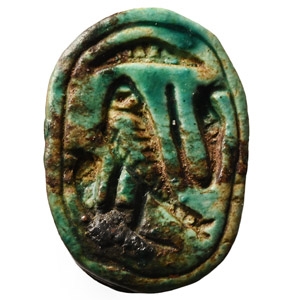
Egyptian Steatite Scarab with Horus and Uraeus
Late Period, 664-332 B.C.Sold for (Inc. bp): £104
Detailed carapace and head, underside with a rearing cobra and Horus in falcon form. 3.42 grams, 19 mm
Mrs Allinson to Mrs Foster, 1867 and thence by descent to the current owner, Stanley Crescent, London, UK. -
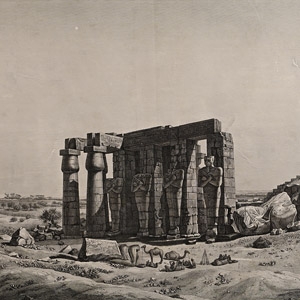
Very Large Egyptian Expedition Lithograph of the Memnonium at Thebes
Early 19th century A.D.Sold for (Inc. bp): £117
Proof etching on laid paper of plate 25 from Vol.II of Description de l'Égypte : ou, Recueil des observations et des recherches qui ont été faites en Égypte pendant l'expédition de l'armée française. entitled Thèbes. Memnonium. Vue du péristyle du tombeau et des débris de la statue colossale d'Osymandyas, prise de l'ouest. 211 grams, 105 x 69 cm
From the collection of a North American priest. Acquired between 1981-1996. Property of a North American collector.
Produced between February 1802 and 1830 on the orders of Napoleon Bonaparte; published between 1809 and 1828. Just 1,000 copies were distributed to various institutions, printed on laid paper with an 'Égypte ancienne et moderne' watermark. The book is subtitled Recueil des observations et des recherches qui ont été faites en Égypte pendant l’expédition de l’Armée française, publié par les ordres de Sa Majesté l’Empereur Napoléon le Grand (Gathering of observations and discoveries which were made in Egypt during the expedition of the French army, published on the orders of His Majesty the Emperor Napoleon the Great). It was the world's first encyclopedia devoted exclusively to the remains of ancient Egypt. The plates of this book are the first to present the archaeological sites of Thebes (Luxor). The "Memnonium" is the Greek name for the mortuary temple of Ramesses II, now known as the Ramesseum. -
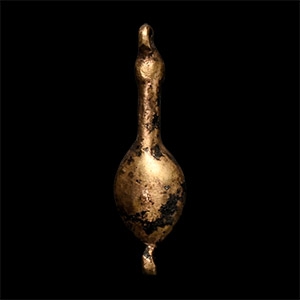
Egyptian Gold Poppy Amulet
Circa 5th-3rd century B.C.Sold for (Inc. bp): £234
Bulbous poppy-head with loop at the apex. 0.21 grams, 12 mm
Ex French collection, early 20th century. From the collection of a late Japanese gentleman, 1970s onwards. -
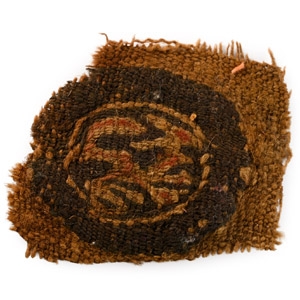
Egyptian Coptic Textile Fragment
Circa 4th century A.D.Sold for (Inc. bp): £78
An orbiculus in yellow, green and red wool and coarse linen, on brown linen background, S torsion, embroidered with a stylised hare within a green circle. 11 grams total including package, 71 mm
Acquired 1970s-1996. Property of a North American collector. London collection, 2016.
In early Christian iconography, the hare was a symbol representing primarily the Church hiding in Christ (the ‘rock’ of Psalm 103:18) from a sinful world. This interpretation drew from the Old Testament's description of the hare as a weak creature that makes its lair in the rock, signifying the Church's reliance on Christ for safety. It was also linked to resurrection and fertility. -
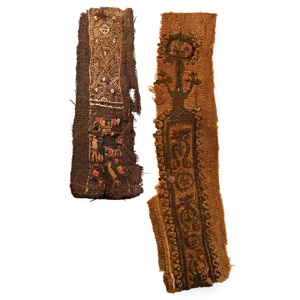
Egyptian Coptic Textile Fragment Group
Circa 5th-6th century A.D.Sold for (Inc. bp): £130
Comprising: a decorative tunic stripe (clavus) in purple wool over coarse linen, S-twist tapestry, embroidered with floral medallions and stylised plants, borders decorated with meanders; fragment of a segmentum, in yellow, red green and brown wool, S-twist tapestry, divided in two sections, embroidered with a stylised human figure and geometric interlacing. 41 grams total including package, 15.5-22 cm
Acquired 1970s-1996. Property of a North American collector. London collection, 2016. -
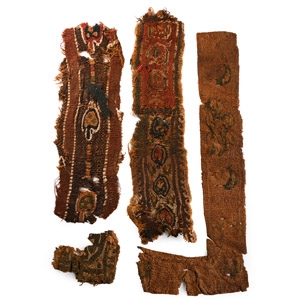
Egyptian Coptic Textile Fragment Group
Circa 7th-8th century A.D.Sold for (Inc. bp): £208
Comprising: a fragment of a segmentum in linen and red, brown, yellow and blue wool, S torsion, embroidered with a series of heads alternating with a flying putto holding a melograne; a fragment of another segmentum in linen and red, brown, yellow and blue wool, S torsion, embroidered with vegetal patterns, borders decorated with meanders; a fragment of a segmentum in linen and red, brown, white, yellow and blue wool, S torsion, embroidered with floral buds; a small fragment of a tablion with geometric decoration, purple wool on linen. 44 grams total including package, 4.3-20.5 cm
Acquired 1970s-1996. Property of a North American collector. London collection, 2016.
Some of these pieces are fragments from a tunic decoration, usually belonging to bands on red background, decorated with a series of motifs related to the Dionysian cult: usually these depict cherubs, fish, heads, palmettes, vegetal and floral ornaments, as well as figures of dancing puttoes within the orbiculi. The decorative motifs on these tunics were usually arranged vertically and horizontally. -
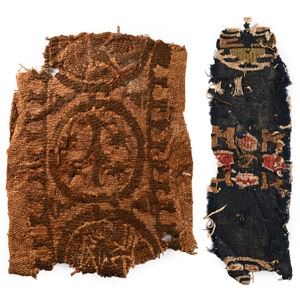
Egyptian Coptic Textile Fragment Group
Circa 4th-5th century A.D.Sold for (Inc. bp): £91
Comprising: a fragment of a clavus of tunic in purple wool on linen, embroidered with vegetal motifs patterned inside orbiculi, framed by straight borders with external crenellation; a fragment of segmentum in yellow, green and red wool, S torsion, embroidered with floral and geometric patterns. 46 grams total including package, 15-16 cm
Acquired 1970s-1996. Property of a North American collector. London collection, 2016.
The fragments are decorative parts of tunics. These are fabrics of great decorative finesse, with some elements displaying an unusual and extremely well-preserved color palette. The plant designs recall Iranian motifs.

