-
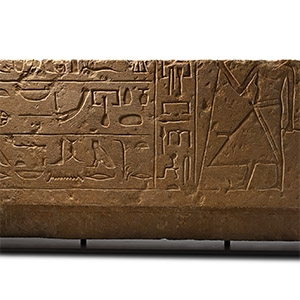
Egyptian Limestone Relief of Shepset
Old Kingdom, 5th-6th Dynasty, circa 2513-2200 B.C.Sold for (Inc. bp): £9,360
Rectangular relief featuring three horizontal bands of hieroglyphic text, which preserve part of an offering formula and two titles: Overseer of all fruit trees (ı͗my-rꜢ ḫt nb(t) bnrt) and Overseer of the King’s repast (ı͗my-rꜢ Ꜥbw-rꜢ nswt); a vertical panel displays two more titles: Courtier of the (royal) house (smr pr), Director of the Dining Hall of the Great House (ḫrp sḥ pr-ꜤꜢ), and the deceased's name Shepset (šps.t); to the right, there is a standing figure of the deceased dressed in a long kilt and holding a staff of office; mounted on a custom-made display stand. 27.3 kg total, 70 cm wide including stand
Acquired 1970s-1996. Private collection, Switzerland. with a North American collector. London collection, 2016. Accompanied by an academic report by Egyptologist Paul Whelan. This lot has been checked against the Interpol Database of stolen works of art and is accompanied by search certificate number no.12944-244463.
The deceased's name is somewhat unusual. The name ends with a bread loaf sign, suggesting it belongs to a female, which is clearly not the case here. Even if one reads the seated figure as a determinative, which would render the name as Set (st), this too would belong to a female. It could simply be an error by the layout scribe and/or sculptor, or the name may be incomplete. The lower border was a decorative feature used both horizontally and vertically to define distinct zones, or registers, in tomb reliefs. The original position of the present fragment may be suggested by a similarly arranged text-and-figure composition decorating the lintel of the doorway leading to the funerary chapel in a tomb at Giza belonging to a man named Ankhaf. Although oriented in the opposite direction, the staff-holding, standing figure of Ankhaf is depicted before a vertical column of inscription, with three longer horizontal bands of text to the right. The first two horizontal lines contain an offering formula invoking Anubis and Osiris, while the third line lists his titles. These are partly repeated in the vertical column, followed by Ankhaf’s name. The decorative border beneath the inscriptions on the present example would not seem out of place in such a setting. Another plausible location for the original placement of the present fragment would be the architrave of a tomb’s false door – the symbolic portal through which the deceased could re-enter the world of the living and partake in food offerings made by priests or relatives. In either location, the composition identifies the tomb owner by image and name, states his official credentials, and designates him as the sole recipient of the offerings listed in the accompanying formula. -
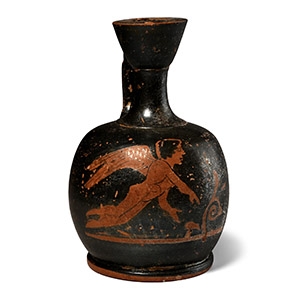
Greek Red-Figure Lekythos with Eros
Attic, circa 4th century B.C.Sold for (Inc. bp): £975
With flared foot, waisted neck and everted rim, strap handle to the rear; painted with a scene of winged Eros in flight above a baseline, with frond. 106 grams, 10.9 cm
Property of a private Rutland, UK, collector, formed from at least from the 1990s. -
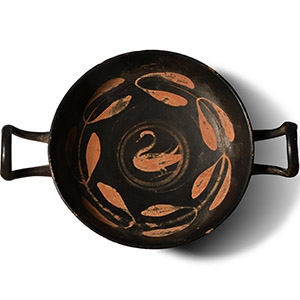
Greek Apulian Xenon Stemless Kylix Attributed to the Red Swan Group
South Italic, circa 4th century B.C.Sold for (Inc. bp): £715
Shallow with arched loop handles below the rim, low stepped foot; tondo with painted wreath of laurel leaves surrounding a standing swan in profile; to the outer face two horizontal sprigs of laurel leaves. 159 grams, 19.6 cm
Ex David Miller, Hemel Hempstead, London, UK. From the private collection of a West London, UK, gentleman, formed since the early 2000s. -
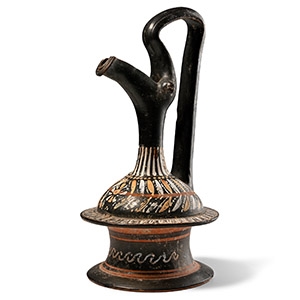
Greek Apulian Blackware Epichysis with Floral Design
Magna Gracia, circa 4th century B.C.Sold for (Inc. bp): £715
Blackware with spool base, domed upper face, tall neck with spout and strap handle to the rear; the spool with laurel-leaf band in white, the upper face with tendrils in cream and ochre. 217 grams, 18.5 cm
Property of a private Rutland, UK, collector, formed from at least from the 1990s. -
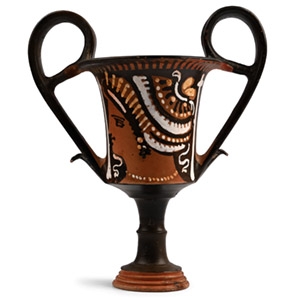
Greek Apulian Black-Glazed Kantharos with Ladies of Fashion
South Italic, circa 325-300 B.C.Sold for (Inc. bp): £1,170
High-handled with carinated lower body, socle base; profile 'ladies of fashion' busts with white and cream detailing to the hair, diadem and earrings. 436 grams, 21 cm high
From the private collection of a Canadian gentleman living in Essex, UK, formed since the 1920s-circa 1990. Property of an Essex lady until the the late 1990s; thence by descent. From the private collection of an Essex gentleman since the late 1990s. Accompanied by an original thermoluminescence analysis report no.N125k90 by Oxford Authentication. -
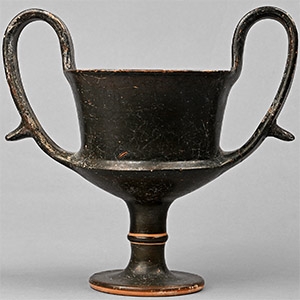
Boeotian Black-Glazed Terracotta Kantharos
Circa 5th century B.C.Sold for (Inc. bp): £1,040
The high-handled drinking cup with carinated lower body and a tall offset foot with a collar. 310 grams, 19 cm wide
Ex Galleria Serodine, Arte Antichità, Fritz Huchelmann-Tieche, Ascona 13 November 1987. Private collection, Bern, Switzerland. -
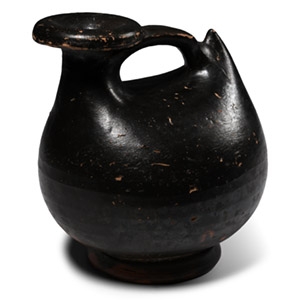
Greek Black-Glazed Terracotta Askos
4th century B.C.Sold for (Inc. bp): £416
A pouring vessel with bulbous body and funicular spout, central strap handle. 160 grams, 97 mm high
Ex C.R., Ticino, before 1970. with Galerie Rhéa, Zurich, Switzerland. -
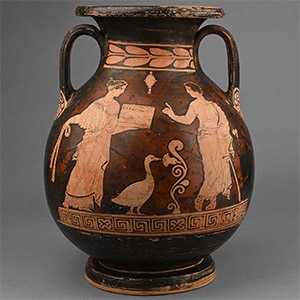
Large Apulian Red-Figure Pelike
Early 4th century B.C.Sold for (Inc. bp): £7,150
Of Plain Style, comprising a broad mouth and neck with torus rim, vertical handles with central rib, bulbous body, stepped disc foot; laurel wreath on the neck and a meander pattern to the lower body; Side a) a youth wearing a himation and shoes, before him a woman carrying a basket and a fillet, wearing a sleeveless chiton, himation, and a sphendone (a fillet decorated by black dots), between the two figures a standing goose before a large flower, a suspended mirror above the figures; Side b) a draped young boy holding a ball and a strigil, the slightly taller youth dressed in a himation and leaning on a staff, a haunch of meat hanging between the figures. 2.49 kg, 33.5 cm
with Bonhams, London, 13 April 2000, no.167. Private collection, Suffolk. This lot has been checked against the Interpol Database of stolen works of art and is accompanied by search certificate number no.12903-242647.
The haunch of meat (note the hoof), was a type of 'love gift' seen in Attic vase-painting. It could also refer to honorary shares of sacrificial meat: animal sacrifice had been a central part of Greek religious life since the Prehistoric era. -
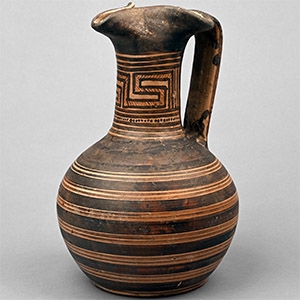
Attic Terracotta Geometric Jug with Handle
8th century B.C.Sold for (Inc. bp): £2,106
With a bulbous body and low basal ring, tubular neck with pinched trefoil spout and a wide strap handle to the rear; the body decorated with densely arranged circumferential bands, a panel of Greek key motifs on the neck, the handle with horizontal stripes and a central X-motif. 735 grams, 23.7 cm
Swiss private collection, 1980-1990s. Private collection, Bern, Switzerland. This lot has been checked against the Interpol Database of stolen works of art and is accompanied by a search certificate number no.12654-236373.
These kinds of geometric oinochoai almost always had spherical bodies, cylindrical necks with trefoil mouths and strap handles from rim to shoulder. They are typical of Attic workshops of the Middle Geometric period (800-750 B.C.). -
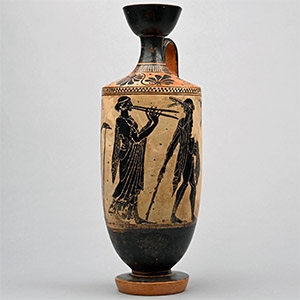
Greek Attic Terracotta Black-Figure Lekythos Attributed to the Athena Painter
Circa 490 B.C.Sold for (Inc. bp): £9,100
Nearly cylindrical body with a slightly sloping shoulder with five palmettes and eight dots in between; main image showing a Dionysian procession with two advancing nude satyrs facing a young male playing a double pipe, each of the satyrs leaning on a walking stick and having a long garment draped over their shoulders and wearing a fillet and a large wreath on their heads. 649 grams, 29.2 cm
Münzen und Medaillen A.G., H. Cahn, Basel, 24 April 1989. Private collection, Bern, Switzerland. Accompanied by an original thermoluminescence analysis report no.N125q44 by Oxford Authentication. This lot has been checked against the Interpol Database of stolen works of art and is accompanied by a search certificate number no.12641-236375.
The Athena Painter is known as the painter who designed several Greek black-figure pottery works using the 5th-century BC white-ground technique. He specialised in lekythoi and refers to Athena as his main subject in his works. Together with the Theseus Painter, they continued the tradition of painting large lekythoi. His black figures are of high quality, and in addition to lekythoi, he decorated other potteries such as oenochoai. Some archaeologists say that he may have been the same person as the Bowdoin Painter of red-figure pottery, although they may have just worked in the same workshop. -
.jpg)
Large Etruscan Terracotta Caeretan Cylinder-Stamped Brazier
7th-6th century B.C.Sold for (Inc. bp): £3,120
Comprising a wide and shallow body with everted rim; the internal wall and the upper face of the rim decorated with a procession of nude men in knielauf position, some holding a lituus in their left hand with their right hand raised up towards the sky, the other figures with both of their hands raised up, the figures alternating with figures of lions and antelopes; rosette to the centre. 9.4 kg, 44.5 cm wide
Acquired on the European art market in the early 2000s. with Galerie Rhéa, Zurich, Switzerland. Accompanied by an academic report by Dr Raffaele D’Amato. This lot has been checked against the Interpol Database of stolen works of art and is accompanied by search certificate number no.12776-237862.
As can be discerned from the identifying marks under the vessels, Caeretan craftsmen used the potting wheel to produce the braziers, a technique introduced in Etruria in the 8th century B.C. They were usually decorated with one or more stamped friezes rolled onto the clay with a large cylindrical matrix before firing. The subjects of these friezes were adapted by the Etruscans from Near Eastern and Greek prototypes. Today, these braziers are found in chamber graves, but they were used in the daily life of Etruscans in domestic and sacred contexts, and employed as portable hearths. A famous example came from the Tomba Maroi III in the Banditaccia Necropolis at Cerveteri, now in the Museo of Villa Giulia, Rome (Pieraccini, 2003, fig.10). It was found perched on a stone seat, and within the burned brazier were burned remains, several eggs and three drinking cups. -
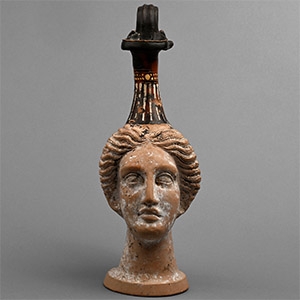
Gnathian Plastic Vase in the Shape of a Woman
4th-3rd century B.C.Sold for (Inc. bp): £7,540
Hollow-formed with broad chamfered base, body modelled as the head of a woman supporting the neck in the form of a trefoil oinochoe with a high, curving handle to the rear; moulded head with detailed swept hair wrapped in a cloth (sakkos), and stern facial features; circumferential painted band beneath the rim and vertical strokes; supplied with a custom-made stand. 1.34 kg total, 31 cm high excluding stand
Acquired from Galerie Simone de Monbrison, Rue Bonaparte, Paris, France, 1980. Accompanied by a thermoluminescence analysis report no.N125e36 from Oxford Authentication. Accompanied by a copy of French passport no.150924, dated 19 December 2013. This lot has been checked against the Interpol Database of stolen works of art and is accompanied by a search certificate number no.12666-234641.

