-
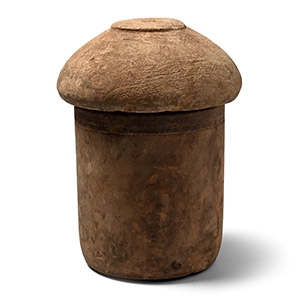
Coptic Wooden Jar with Lid
4th-6th century A.D.Sold for (Inc. bp): £98
Columnar in profile, turned wooden vessel with stepped rim and dark-red painted band below the lip; domed lid with inner locating ring to underside; flat panel to the apex. 147 grams total, 11.5 cm high
London, UK, art market, 1990s. From the collection of G.M.R.H., London, UK. -
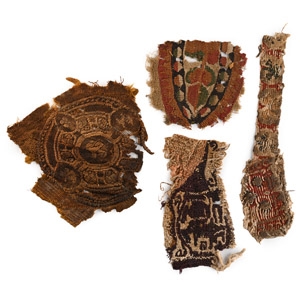
Egyptian Coptic Textile Fragment Group
Circa 4th-5th century A.D.Sold for (Inc. bp): £104
Comprising: a fragment of a clavus in coarse linen and dark brown wool, tapestry, with remains of a medallion embroidered with a lion running right; fragment of an orbiculus in linen and yellow and blue wool, S torsion, embroidered with vegetal and geometric patterns; two terminal fragments of a clavi, in red, green, dark blue and white wool. 58 grams total including package, 8.6-19.5 cm
Acquired 1970s-1996. Property of a North American collector. London collection, 2016.
These are decorative parts of tunics. The lion orbiculus in particular stands out for its delicate design and hunting theme. Dionysus and his entourage were often depicted on these tunics, despite the fact that these fabrics were produced in a by then heavily Christianised empire. -
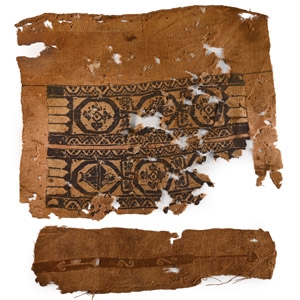
Egyptian Coptic Textile Fragment Group
Circa 7th century A.D.Sold for (Inc. bp): £286
Comprising: a large fragment of a tunic with double segmenta in dark purple wool over linen, S torsion, formed by two parallel stripes, embroidered with kantharos and floral patterns, inscribed in tondos within bands with crenellated borders; a thin clavus connected to an orbiculus ending in an arrow shape, red purple and brown wool over linen, S torsion, embroidered with S shaped and lanceolate patterns. 207 grams total including package, 31-33.5 cm
Acquired 1970s-1996. Property of a North American collector. London collection, 2016.
This type of embroideries were typical of tunics and garments characterised by full-length clavi, and segmenta, decorated with either intricate geometric patterns or floral and vegetal motifs. In Christian symbology, the kantharos was an ancient Greek wine cup that symbolised resurrection and eternal life through Christ. -
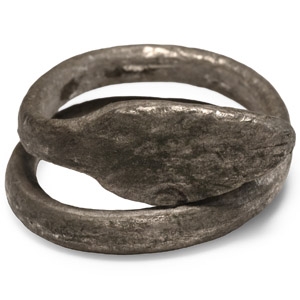
Romano-Egyptian Silver Snake Ring
Roman Period, 30 B.C.-323 A.DSold for (Inc. bp): £156
Comprising a coiled D-section body and a snake-head finial. 4.02 grams, 20.64 mm overall, 14.29 mm internal diameter (approximate size British G 1/2, USA 3 1/2, Europe 5.55, Japan 5)
Ex German art market, 2000s. Acquired from an EU collector living in London. From the collection of a Surrey, UK, gentleman. -
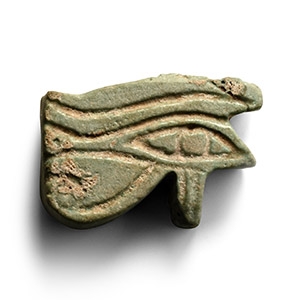
Egyptian Eye of Horus Amulet
Late Period, 664-332 B.C.Sold for (Inc. bp): £286
Large wedjat-eye amulet with incised human and falcon elements. 7.64 grams, 33.6 mm
with Archaeologia, Switzerland, before 1983. Ex private North American collection. London private collection, 2016. This lot has been checked against the Interpol Database of stolen works of art and is accompanied by search certificate number no.13162-242767. -
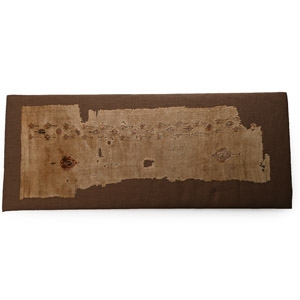
Large Mounted Egyptian Coptic Textile
Circa 5th-7th century A.D.Sold for (Inc. bp): £1,430
Possibly a fragment of a cloak, wool on linen, S-twist tapestry, decorated with a band of lanceolate leaves and two bigger opposed leaves in red, green and yellow colour. 345 grams total, mount: 86.5 cm
Acquired 1970s-1996. Property of a North American collector. London collection, 2016.
A. Gayet, who excavated the Necropolis of Antinoe, showed that the cloaks of Coptic-era nobles could be ornate, with decoration applied or woven into the fabric. Realised in dark blue, red, orange, yellow, green, brown and off-white linen and wool, the leaves are usually positioned inside a central medallion, also lanceolate, divided by a small leaf surmounted by a flower. -
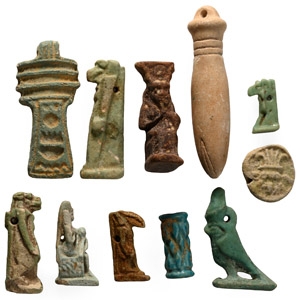
Egyptian Faience Amulet Group
Late-Ptolemaic Period, circa 664-30 B.C.Sold for (Inc. bp): £650
Comprising: two amulets of Isis suckling infant Horus; Horus in falcon form; a papyrus column; a djed pillar; two amulets of Thoth depicted as an ibis-headed man; a circular plaque with head of Bes, and others. 29 grams total, 16-52 mm
From the collection of a gentleman, acquired on the London art market in the 1990s. -
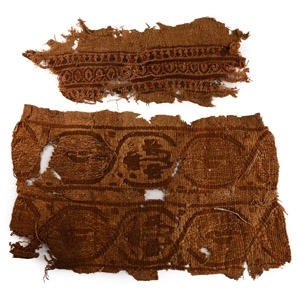
Egyptian Coptic Textile Fragment Group
Circa 4th century A.D.Sold for (Inc. bp): £234
Comprising: fragment from a wide tunic segmentum in red granate and coarse linen, S torsion, embroidered with stylised birds and plants inscribed in tondos; fragment of another segmentum in red, blue and green wool, with representations of buds. 63 grams total including package, 19.5-25 cm
Acquired 1970s-1996. Property of a North American collector. London collection, 2016.
Similar figures are widely present in Coptic textiles, repeating a pattern in which flowers are usually paired with bird figures. This decoration is typical of tunics, but it was also used in large-scale textiles intended for domestic or funerary furnishings. -
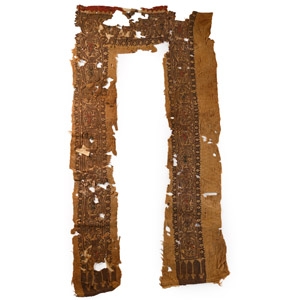
Large Egyptian Coptic Textile Fragment
Circa 7th century A.D.Sold for (Inc. bp): £546
Fragment from a tunic in coarse linen and purple violet wool, preserving the ornamentation of neck and chest, decorated with alternating medallions, with figures enclosed within the orbiculi of the vertical braids (clavi), representing nude or lightly dressed dancers; the upper part of the fragment featuring a decoration of red triangles descending downwards. 224 grams, 62 cm
Acquired 1970s-1996. Property of a North American collector. London collection, 2016.
This iconographic theme, originating from the pagan repertoire of Greek origin, was common on late Roman tunics: it evoked the joyful processions of Dionysus' servants. -
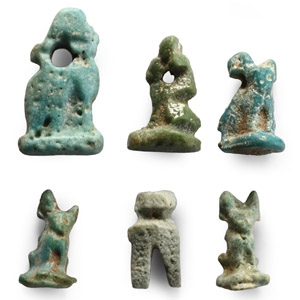
Egyptian Amulet Pendant Collection
Late Period, 664-332 B.C.Sold for (Inc. bp): £98
Including jackal, feline, and other types. 1.66 grams total, 10-15 mm
with Archaeologia, Switzerland, before 1983. Ex private North American collection. London private collection, 2016. -
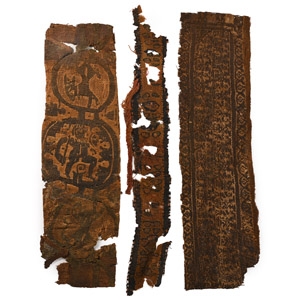
Egyptian Coptic Textile Fragment Group
Circa 5th-7th century A.D.Sold for (Inc. bp): £260
Comprising a large fragment of a segmentum in linen and wool, decorated with orbiculi, a warrior to the centre flanked by hares; a large fragment of a segmentum in purple embroidery, comprising a central row with Nubian figures and borders with geometric decoration; a third segmentum in red, green and yellow wool with central vegetal ornaments. 126 grams total including package, 28-31.2 cm
Acquired 1970s-1996. Property of a North American collector. London collection, 2016.
The theme of rabbits or hares, in association with other characters and animals of the Dionysian thiasos in a hunting setting, has notable parallels. The warrior in the center of the medallion holds a spear and shield and raises his left leg forward. Such representations are linked to narratives of the Dionysian cycle. -
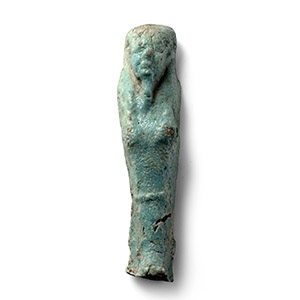
Egyptian Faience Shabti
Ptolemaic Period, 332-30 B.C.Sold for (Inc. bp): £104
D-shaped in section with tripartite wig and false beard. 7.95 grams, 61 mm
Ex London, UK, collection, 1990s.

