-
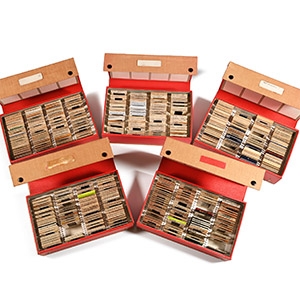
Historic Collection of 601 Slides of Archaeological Objects From Egypt
1960s-1980s A.D.Sold for (Inc. bp): £546
Housed in five linen-covered boxes, covering mummies, masks, scarabs, cylinders, shabtis, titulary, tablets, statuary, Saite artefacts, and Pre Dynastic pottery, stone vases etc. 3.9 kg total, 26.5 x 17 x 6.5 cm each box
Property of archaeologist Stephanie Gee, N.W. London, UK, 1960s-1980s.
Stephanie Gee was a prominent archaeologist who took part in several expeditions in Egypt. She was a trusted assistant to the British-Australian archaeologist Veronica Seton-Williams, who excavated in Egypt, Britain, and the Near East. Stephanie also took part in the Tell El-Farâ'în expeditions of 1965-1968, and assisted Seton-Williams with preparing the 1966 expedition report. Their collaboration continued and Stephanie helped with the manuscript of Seton-Williams’ book ‘The Road to El-Aguzein’, a narrative account of her life that was first published in 1988. -
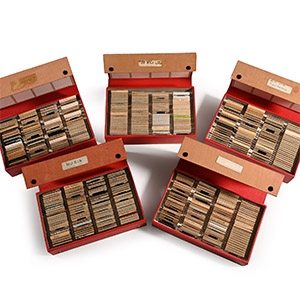
Historic Collection of 861 Slides of Archaeological Sites in Egypt
1960s-1980s A.D.Sold for (Inc. bp): £910
Housed in five linen-covered boxes, covering Edfu, Kom Ombo, Nubia, Middle Kingdom Tombs, Semmebtisi, Thebes, Abu Simbel, Bersha, Gebravi, Rifa, Upper Egypt, El Kab, Esna, Medamud etc. 4.21 kg total, 26.5 x 16.5 x 6.5 cm each box
Property of archaeologist Stephanie Gee, N.W. London, UK, 1960s-1980s.
Stephanie Gee was a prominent archaeologist who took part in several expeditions in Egypt. She was a trusted assistant to the British-Australian archaeologist Veronica Seton-Williams, who excavated in Egypt, Britain, and the Near East. Stephanie also took part in the Tell El-Farâ'în expeditions of 1965-1968, and assisted Seton-Williams with preparing the 1966 expedition report. Their collaboration continued and Stephanie helped with the manuscript of Seton-Williams’ book ‘The Road to El-Aguzein’, a narrative account of her life that was first published in 1988. -
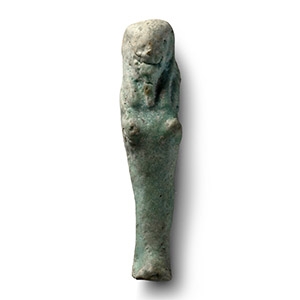
Egyptian Faience Shabti
Ptolemaic Period, 332-30 B.C.Sold for (Inc. bp): £59
D-shaped in section with tripartite wig and arms crossed at the chest. 6.6 grams, 60 mm
Ex London, UK, collection, 1990s. -
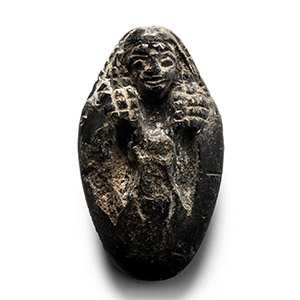
Egyptian Black Stone Heart Amulet
New Kingdom, circa 1500-1200 B.C.Sold for (Inc. bp): £312
Carved in the half-round, lentoid in plan, with a human head wearing a hatched wig, remains of a scarab beetle in the centre, pierced to reverse for suspension. 13.3 grams, 41.6 mm
with Archaeologia, Switzerland, before 1983. Ex private North American collection. London private collection, 2016. -
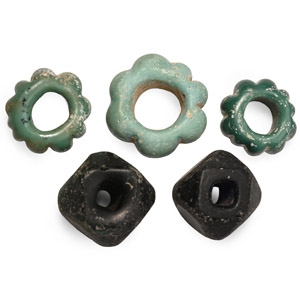
Phoenician Glass Bead Group
Circa 600-400 B.C.Sold for (Inc. bp): £85
Comprising: three ring-shaped with grooves and two irregular cube-shapes. 46 grams total, 18-25 mm
Prince collection, 1990s-2014. Ex private collection 1970s-1990s. -
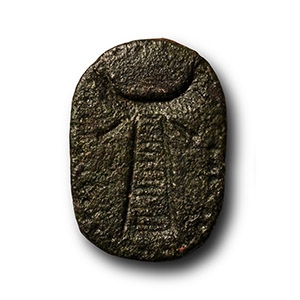
Phoenicio-Egyptian Dark Green Stone Scarab
Circa 9th-8th century B.C.Sold for (Inc. bp): £195
With textured carapace, bull-horned column to the reverse, possibly a symbol of Tanit. 3.94 grams, 15 mm
From the property of the late Mr SM, London, UK, 1969-1999. This lot is accompanied by an illustrated lot declaration signed by the Head of the Antiquities Department, Dr Raffaele D'Amato.
The widespread adoption of the scarab, both as a symbol linked to the concept of rebirth, and in its function as a seal, exemplifies the extent of Egyptian influence on Phoenician culture, from its origins in the Levant to its spread across the Mediterranean. -
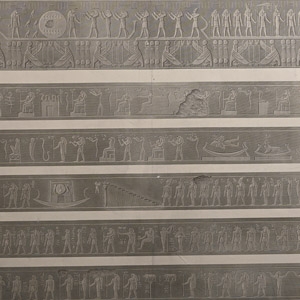
Very Large Egyptian Expedition Lithograph of Reliefs at the Grand Temple of Edfu
Early 19th century A.D.Sold for (Inc. bp): £156
Proof etching on laid paper of plate 58 from Vol .I of Description de l'Égypte : ou, Recueil des observations et des recherches qui ont été faites en Égypte pendant l'expédition de l'armée française. entitled Edfou (Apollinopolis magna) Frises sculptées dans l'intérieur du portique du grand Temple, Autres sculptures du portique. 258 grams, 105.5 x 68.5 cm
From the collection of a North American priest. Acquired between 1981-1996. Property of a North American collector.
Produced between February 1802 and 1830 on the orders of Napoleon Bonaparte; published between 1809 and 1828. Just 1,000 copies were distributed to various institutions, printed on laid paper with an 'Égypte ancienne et moderne' watermark. The book is subtitled Recueil des observations et des recherches qui ont été faites en Égypte pendant l’expédition de l’Armée française, publié par les ordres de Sa Majesté l’Empereur Napoléon le Grand (Gathering of observations and discoveries which were made in Egypt during the expedition of the French army, published on the orders of His Majesty the Emperor Napoleon the Great). It was the world's first encyclopedia devoted exclusively to the remains of ancient Egypt. The plates of this book are the first to present the archaeological sites of Thebes (Luxor). The Temple of Horus at Edfu in Upper Egypt is one of the best preserved in the country, and its walls feature significant religious and mythological scenes. -
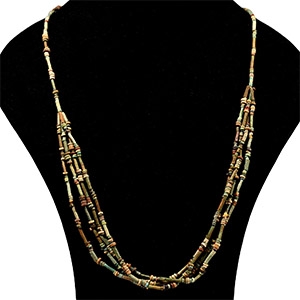
Egyptian Multi-Stranded Mummy Bead Necklace
Late Period, 664-332 B.C.Sold for (Inc. bp): £111
A four-strand designer necklace composed of polychrome beads of mainly annular and tubular types. 22.9 grams, 82 cm
Acquired before 1979. From the private collection of Mr F.A., South Kensington, London, UK; thence by descent 2014.
For thousands of years, artisans in Egypt created vibrant ceramics to echo the beauty of rare jewels. These ornaments were created with almost every material, colour, and texture imaginable and they come from across Egypt and beyond: vibrant blue lapis lazuli from Afghanistan, glossy black obsidian from Turkey, and aqua-green turquoise from the Sinai. They were worn in life and, after death, they served as precious ornamentation for mummies. -
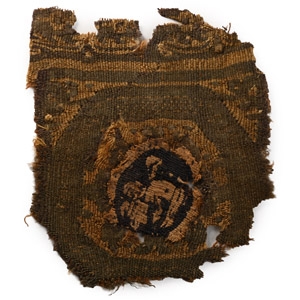
Egyptian Coptic Textile Fragment
Circa 4th-5th century A.D.Sold for (Inc. bp): £59
An orbiculus in coarse linen and green wool, S torsion, embroidered with the image of putto with holding a box and looking left, surrounded by tondos ornamented with vegetal embroidery, borders decorated with floral elements. 11 grams total including package, 88 mm
Acquired 1970s-1996. Property of a North American collector. London collection, 2016.
The iconography of this fragment is called "Nilotic," as it depicts plant and human elements linked to life on the Nile River. These images are very recurrent on Coptic textiles. Weavers created patterns that allowed them to reproduce these motifs on any type of fabric (curtains, tassels, clothing). -
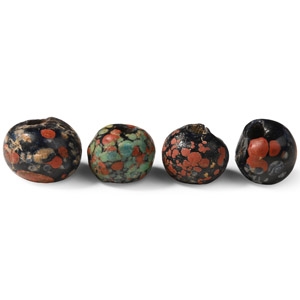
Phoenician Glass Bead Collection
Circa 600-400 B.C. or laterSold for (Inc. bp): £65
Four beads with a core of dark blue glass embedded with dispersed canes fused into the matrix, creating varied patterns in red, blue, white, and green, possibly Hebron. 19.6 grams total, 14-19 mm
Prince collection, 1990s-2014. Ex private collection 1970s-1990s. -
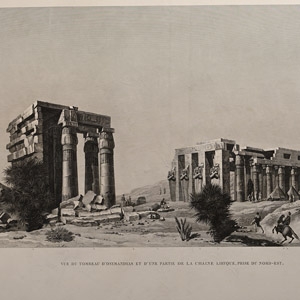
Very Large Egyptian Expedition Lithograph of the Memnonium at Thebes and Tomb of Ozymandias
Early 19th century A.D.Sold for (Inc. bp): £117
Proof etching on laid paper of plate 26 from Vol .II of Description de l'Égypte : ou, Recueil des observations et des recherches qui ont été faites en Égypte pendant l'expédition de l'armée française. entitled Thèbes. Memnonium. Vue du tombeau d'Osymandyas et d'une partie de la chaîne Libyque, prise du nord-est. 227 grams, 104 x 69.5 cm
From the collection of a North American priest. Acquired between 1981-1996. Property of a North American collector.
Produced between February 1802 and 1830 on the orders of Napoleon Bonaparte; published between 1809 and 1828. Just 1,000 copies were distributed to various institutions, printed on laid paper with an 'Égypte ancienne et moderne' watermark. The book is subtitled Recueil des observations et des recherches qui ont été faites en Égypte pendant l’expédition de l’Armée française, publié par les ordres de Sa Majesté l’Empereur Napoléon le Grand (Gathering of observations and discoveries which were made in Egypt during the expedition of the French army, published on the orders of His Majesty the Emperor Napoleon the Great). It was the world's first encyclopedia devoted exclusively to the remains of ancient Egypt. The plates of this book are the first to present the archaeological sites of Thebes (Luxor). The "Memnonium" was the Greek name for the mortuary temple of Ramesses II, known today as the Ramesseum. -
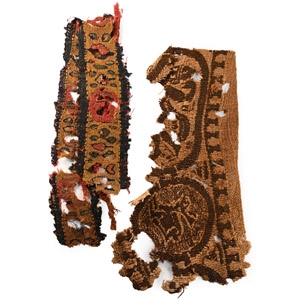
Egyptian Coptic Textile Fragment Group
Circa 5th-6th century A.D.Sold for (Inc. bp): £98
Comprising a large segmentum in linen and wool, with a hare and nereid, wool purple on linen, S torsion, borders with dentellid decoration; two other segmenta in wool and linen, part of clavi, with floral and vegetal embroidery. 41 grams total including package, 19-33 cm
Acquired 1970s-1996. Property of a North American collector. London collection, 2016.
The theme of rabbits or hares, in association with other characters and animals of the Dionysian thiasos (here a nereid), has notable parallels. Such representations are linked to narratives of the Dionysian cycle.

