-
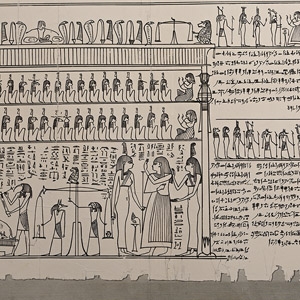
Very Large Egyptian Expedition Lithograph of the Hypogees Papyrus Manuscript from Thebes
Early 19th century A.D.Sold for (Inc. bp): £130
Proof etching on laid paper of plate 60 from Vol.II of Description de l'Égypte : ou, Recueil des observations et des recherches qui ont été faites en Égypte pendant l'expédition de l'armée française. entitled Thèbes. Hypogées. Manuscrit sur papyrus. 226 grams, 103.5 x 70 cm
From the collection of a North American priest. Acquired between 1981-1996. Property of a North American collector.
Produced between February 1802 and 1830 on the orders of Napoleon Bonaparte; published between 1809 and 1828. Just 1,000 copies were distributed to various institutions, printed on laid paper with an 'Égypte ancienne et moderne' watermark. The book is subtitled Recueil des observations et des recherches qui ont été faites en Égypte pendant l’expédition de l’Armée française, publié par les ordres de Sa Majesté l’Empereur Napoléon le Grand (Gathering of observations and discoveries which were made in Egypt during the expedition of the French army, published on the orders of His Majesty the Emperor Napoleon the Great). It was the world's first encyclopedia devoted exclusively to the remains of ancient Egypt. The plates of this book are the first to present the archaeological sites of Thebes (Luxor). The papyrus manuscript was recovered from an underground tomb chamber (hypogeum). The text is written in hieratic, a cursive form of hieroglyphic script often used for religious papyrus documents. The main scene shows the judgment of the dead before a tribunal led by the god Osiris. The scales compare the deceased's heart against the feather of Maat. If they balance, the deceased gains entry into the eternal afterlife; if not, the fearsome Ammut creature devours the heart, and the deceased ceases to exist. -
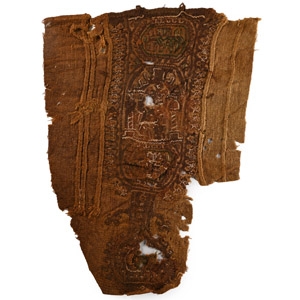
Large Egyptian Coptic Textile Fragment
Circa 4th-8th century A.D.Sold for (Inc. bp): £169
Very large tunic fragment with a clavus connected by a thin band to the orbiculus, in red purple, brown and red granate wool over linen, S torsion, embroidered with three tondos decorated with stylised images of dancers with raised heads and curly hair; crenellated borders. 108 grams total including package, 30 cm
Acquired 1970s-1996. Property of a North American collector. London collection, 2016.
This type of embroidery was typical of tunics and garments characterised by full-length clavi, decorated with either intricate geometric patterns or with a multitude of small figures and animals, often edged with geometric borders and finished with thick, weft-loop fringes or cords. -
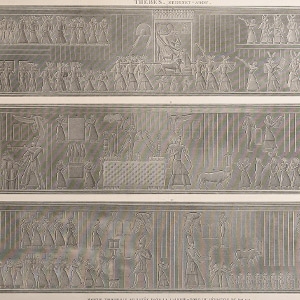
Very Large Egyptian Expedition Lithograph of the Temple of Medynet-Abou at Thebes
Early 19th century A.D.Sold for (Inc. bp): £117
Proof etching on laid paper of plate 11 from Phillipeaux Thèbes - Medynet-Abou with Plan et Coupe Longitudinale du Temple et de ses Propylées 2.3 Plan et Coupe Longitudinale du Palais - Plan du pavillon. 240 grams, 105.5 x 70 cm
From the collection of a North American priest. Acquired between 1981-1996. Property of a North American collector.
Produced between February 1802 and 1830 on the orders of Napoleon Bonaparte; published between 1809 and 1828. Just 1,000 copies were distributed to various institutions, printed on laid paper with an 'Égypte ancienne et moderne' watermark. The book is subtitled Recueil des observations et des recherches qui ont été faites en Égypte pendant l’expédition de l’Armée française, publié par les ordres de Sa Majesté l’Empereur Napoléon le Grand (Gathering of observations and discoveries which were made in Egypt during the expedition of the French army, published on the orders of His Majesty the Emperor Napoleon the Great). It was the world's first encyclopedia devoted exclusively to the remains of ancient Egypt. The plates of this book are the first to present the archaeological sites of Thebes (Luxor). Medinet Habu is the name given to the impressive mortuary temple built for Ramesses III. The walls are covered with scenes of religious and royal ceremonies, as well as battle scenes. An earlier temple and later tomb complexes are found within its impressive enclosure walls. -
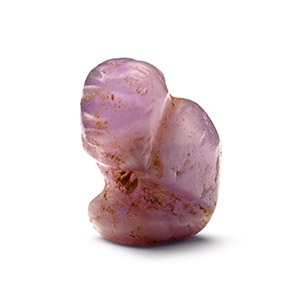
Egyptian Amethyst Ba-Bird Amulet
Late Period, 664-332 B.C.Sold for (Inc. bp): £124
Crouched figure of a human-headed Ba-bird on a rectangular base, carved in the round. 0.62 grams, 9.8 mm
with Archaeologia, Switzerland, before 1983. Ex private North American collection. London private collection, 2016. -
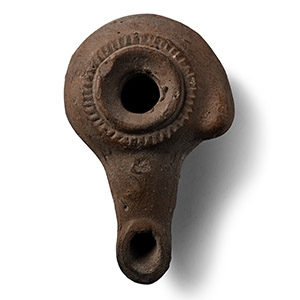
Egyptian Terracotta Oil Lamp
Ptolemaic Period, circa 200-50 B.C.Sold for (Inc. bp): £72
Rounded body with large filler hole and pointed lug on the shoulder, the rim with a low-relief ovolo decoration, elongated nozzle with scooped nozzle; low basal ring. 63 grams, 88 mm
From a private Wiltshire, UK, collector, acquired before 1980. -
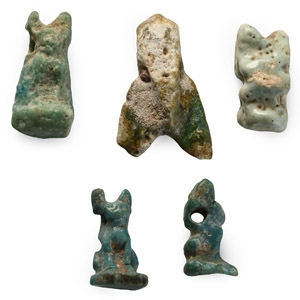
Egyptian Amulet Collection
Late Period, 664-332 B.C.Sold for (Inc. bp): £111
Comprising two crouching Bastet cat figures, a hare, a fly, and a simplified Anubis. 1.56 grams total, 10-15 mm
with Archaeologia, Switzerland, before 1983. Ex private North American collection. London private collection, 2016. -
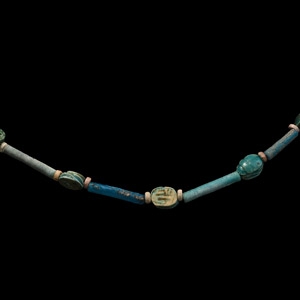
Egyptian Faience Mummy Bead Necklace with Reproduction Scarabs
Late Period, 664-332 B.C. and laterSold for (Inc. bp): £72
Restrung group of tubular and annular beads with interstitial later scarabs. 9.9 grams, 62 cm long
From a private Tyneside collection, formed since the early 2000s. -
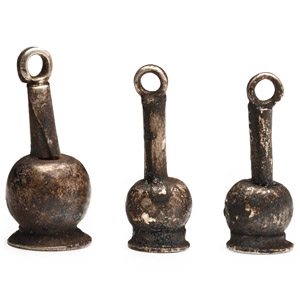
Egyptian Poppy Amulet Group
Late Period, 664-332 B.C.Sold for (Inc. bp): £78
Three pendants each with poppy-head and loop at the apex. 3.55 grams total, 17-19 mm
From a gentleman's family collection, 2000s. -
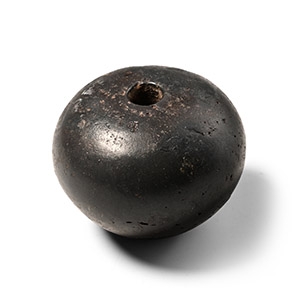
Egyptian Hematite Macehead
3rd millennium B.C.Sold for (Inc. bp): £325
Piriform with narrow socket tapering to the socket's mouth. 323 grams, 54 mm
Acquired 1970s-1996. Property of a North American collector. London collection, 2016. -
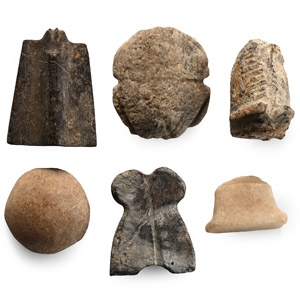
Egyptian Stone Amulet Collection
Late Period, 664-332 B.C.Sold for (Inc. bp): £78
Including scarab, pedestal-base and other types. 18 grams total, 14-21 mm
with Archaeologia, Switzerland, before 1983. Ex private North American collection. London private collection, 2016. -
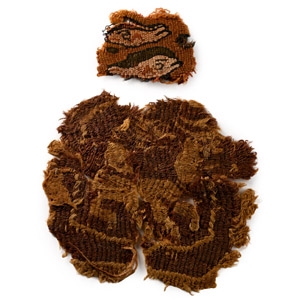
Egyptian Coptic Textile Fragment Group
Circa 5th century A.D.Sold for (Inc. bp): £52
Comprising: fragment of an orbiculus in brown and yellow coarse linen and wool, S torsion, embroidered with a running animal (lion?); fragment of a tablion with representations of fishes, white and green wool on linen. 10 grams total including package, 34-71 mm
Acquired 1970s-1996. Property of a North American collector. London collection, 2016.
Particularly interesting is the presence of fish, which are part of depictions of marine life, in keeping with the classical Graeco-Roman tradition. Stylistically, Hellenistic naturalism is evident in these compositions in the rounded shapes of fish and marine animals, which create an effect of movement. -
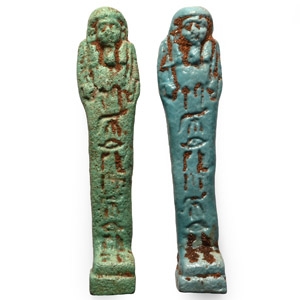
Egyptian Faience Shabti Group for Ha-bener-Re
Late-Ptolemaic Period, 664-30 B.C.Sold for (Inc. bp): £234
Two mummiform shabtis from the same mould, wearing a lappet wig and false beard, and holding a pick, hoe, and miniscule seed bag; inscribed with a column of hieroglyphic text on the front repeating the opening dedication "The illuminated one, the Osiris" ( sḥḏ wsỉr), and another on the dorsal pillar giving the name of the deceased, possibly to be read as Ha-bener-Re (ḥꜢ-bnr-rꜤ), a Ka-priest (ḥm-kꜢ). 16.4 grams total, 72 mm each
From the collection of a gentleman, acquired on the London art market in the 1990s.

