-
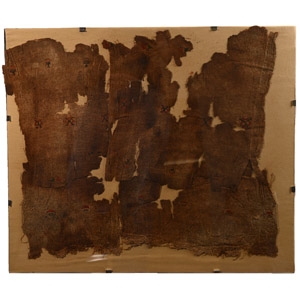
Large Mounted Egyptian Coptic Textile
Circa 6th-7th century A.D.Sold for (Inc. bp): £234
Possible fragment of tapestry or a cloak, light fabric, S-twist tapestry, ornamented with wool and linen flowers in red, green and yellow colour. 1.8 kg total, mount: 78 x 70 cm
Acquired 1970s-1996. Property of a North American collector. London collection, 2016.
Most of the linen or wool garments found by A. Gayet in the Antinoe necropolis were woven in a specific pattern, in a single piece, on a horizontal warp. Another relatively common pattern for linen garments consisted of assembling three pieces woven on a single warp and forming the upper part of the garment, with the collar and sleeves. -
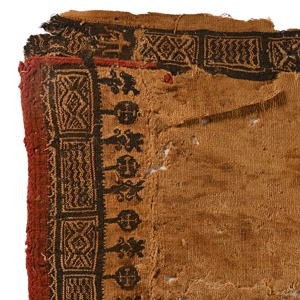
Large Egyptian Coptic Textile Fragment
Circa 5th-9th century A.D.Sold for (Inc. bp): £494
A very large tunic fragment from the upper part of the garment, in purple and red wool over linen, S torsion, a horizontal band with geometric patterns alternating with zig-zag lines, and descending on the breast with two clavi, patterned in similar way; red border with cords in the upper part, dentilled border with floral and vegetal ornaments (plants, flowers and buds with cross) in the lower part. 103 grams total including package, 36 cm
Acquired 1970s-1996. Property of a North American collector. London collection, 2016.
These decorative bands had a ground weave in purple wool, with natural linen and red forming the inlaid design of formal sprigs and zig-zag patterns. The double woven selvedge of the tunic’s neck has been preserved in the upper part. -
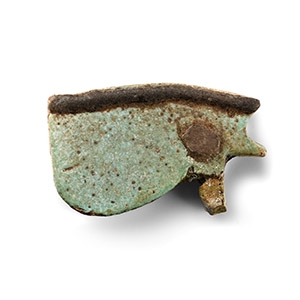
Egyptian Eye of Horus Amulet
Late Period, 664-332 B.C.Sold for (Inc. bp): £78
Wedjat amuletic bead with applied black detailing to the pupil and brow. 4 grams, 30.8 mm
with Archaeologia, Switzerland, before 1983. Ex private North American collection. London private collection, 2016. -
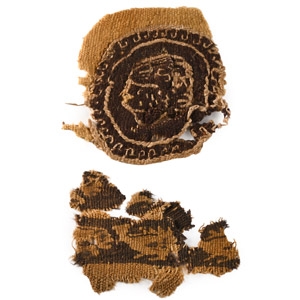
Egyptian Coptic Textile Fragment Group
Circa 4th-5th century A.D.Sold for (Inc. bp): £65
Comprising: an orbiculus in coarse linen and brown wool, S torsion, embroidered with the image of a stylised bird, surrounded by tondos ornamented with geometric embroidery, borders meander decorated; a similar fragment of double segmenta, embroidered with hares alternated to fishes. 9 grams total including package, 60-64 mm
Acquired 1970s-1996. Property of a North American collector. London collection, 2016.
The iconography of this fragment is called "Nilotic," as it depicts plant and human elements linked to life on the Nile River. These images are very recurrent on Coptic textiles. Weavers created patterns that allowed them to reproduce these motifs on any type of fabric (curtains, tassels, clothing). -
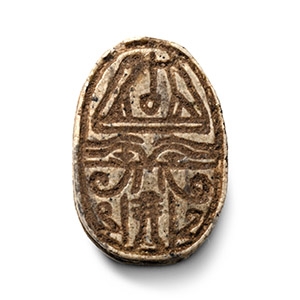
Egyptian Faience Hieroglyphic Scarab
Late-Ptolemaic Period, circa 664-30 B.C.Sold for (Inc. bp): £176
Detailed carapace and legs, underside with hieroglyphs including opposing wedjat and djed pillar; pierced longitudinally. 6.64 grams, 24 mm
From the collection of a gentleman, acquired on the London art market in the 1990s. -
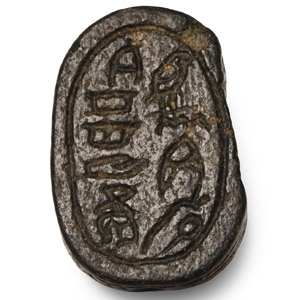
Egyptian Stone Scarab with Hieroglyphs
Late Period, 664-332 B.C.Sold for (Inc. bp): £98
Incised detailing for the head and legs, hieroglyphs on the underside. 2.58 grams, 16 mm
Ex Simmons gallery, 1990s. -
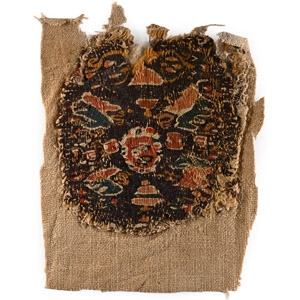
Egyptian Coptic Textile Fragment
Circa 4th-5th century A.D.Sold for (Inc. bp): £143
Orbiculus with a dark blue background, a stylised cup on the vertical axis, rendered in yellow, red and green wool, flanked by stylised plants or animals, while the lower part of the circle features branches flanked by leaves in pink, white, green and yellow; made of polychrome wool, with coarse linen and red, yellow, green and blue wool weft, tapestry woven. 38 grams total including package, 15.2 cm
Acquired 1970s-1996. Property of a North American collector. London collection, 2016.
The embroidery belonged to a tunic. These fabrics were of great decorative finesse, displaying an unusual and extremely well-preserved color palette. The plant designs recall Iranian motifs. -
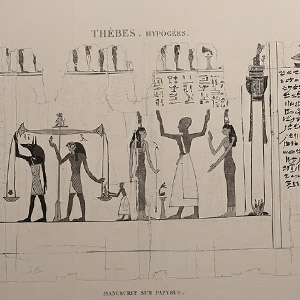
Very Large Egyptian Expedition Lithograph of the Hypogees Papyrus Manuscript from Thebes
Early 19th century A.D.Sold for (Inc. bp): £117
Proof etching on laid paper of plate 67 from Vol.II of Description de l'Égypte : ou, Recueil des observations et des recherches qui ont été faites en Égypte pendant l'expédition de l'armée française. entitled Thèbes. Hypogées. Manuscrit sur papyrus. 233 grams, 110 x 67 cm
From the collection of a North American priest. Acquired between 1981-1996. Property of a North American collector.
Produced between February 1802 and 1830 on the orders of Napoleon Bonaparte; published between 1809 and 1828. Just 1,000 copies were distributed to various institutions, printed on laid paper with an 'Égypte ancienne et moderne' watermark. The book is subtitled Recueil des observations et des recherches qui ont été faites en Égypte pendant l’expédition de l’Armée française, publié par les ordres de Sa Majesté l’Empereur Napoléon le Grand (Gathering of observations and discoveries which were made in Egypt during the expedition of the French army, published on the orders of His Majesty the Emperor Napoleon the Great). It was the world's first encyclopedia devoted exclusively to the remains of ancient Egypt. The plates of this book are the first to present the archaeological sites of Thebes (Luxor). The papyrus manuscript was recovered from an underground tomb chamber (hypogeum). The vignette in this scene depicts the weighing of the deceased's heart on scales before Osiris's tribunal. If the heart (on the left) did not balance with Maat (on the right), it would be devoured by Ammut, the fearsome creature seated on a shrine before Osiris. -
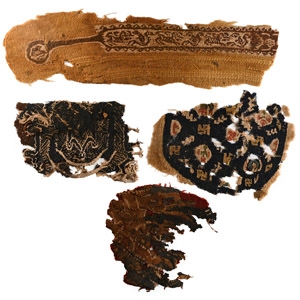
Egyptian Coptic Textile Fragment Group
Circa 4th-6th century A.D.Sold for (Inc. bp): £169
Comprising: a fragment of a segmentum in white linen and blue wool, D torsion, with remains of a medallion embroidered with architectonical ornaments; fragment of an orbiculus in linen and red, brown, yellow and blue wool, S torsion, embroidered with vegetal patterns and the central images of an animal; a further fragment of an orbiculus in white linen and red, white, black wool, S torsion, embroidered with floral buds, a tetragamma and animals; a beautiful fragment of clavus, purple wool on linen, embroidered with lions catching birds. 67 grams total including package, 10.7-26.6 cm
Acquired 1970s-1996. Property of a North American collector. London collection, 2016.
Scenes featuring personified animals first appeared during the early Pharaonic period and continued through to the Coptic era. These animals are often featured in scenes of music and dance, or processions linked with Dionysiac iconography. -
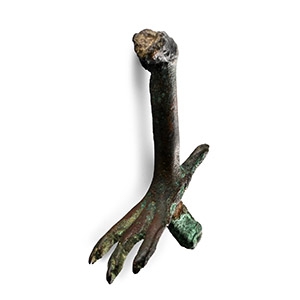
Egyptian Bronze Ibis Statue Foot
Late Period, 664-332 B.C.Sold for (Inc. bp): £78
Modelled in the round with three spreading claws and spur to rear, attachment lug to underside. 35 grams, 62 mm
From the collection of a Buckinghamshire, UK, collector established from the earlier 1960s. -
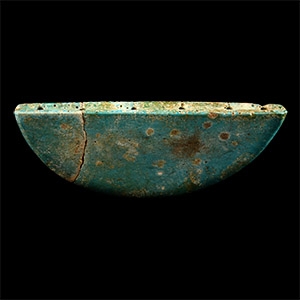
Large Egyptian Blue Glazed Solar Bead
1st millennium B.C.Sold for (Inc. bp): £52
Flat and crescent-shaped with transverse piercings to the reverse; an end spacer for a multi-strand necklace. 24 grams, 82 mm wide
with Archaeologia, Switzerland, before 1983. Ex private North American collection. London private collection, 2016. -
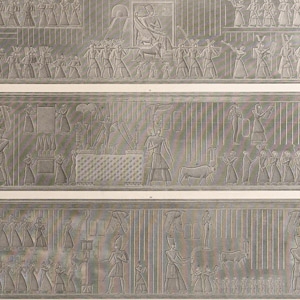
Very Large Egyptian Expedition Lithograph of the Reliefs of the Temple of Medynet-Abou at Thebes
Early 19th century A.D.Sold for (Inc. bp): £117
Proof etching on laid paper of plate 11 from Phillipeaux Thèbes - Medynet-Abou Marche Triomphale sculptée dans la Galerie-Nord du Péristyle du Palais with military procession in three registers. 231 grams, 104 x 70 cm
From the collection of a North American priest. Acquired between 1981-1996. Property of a North American collector.
Produced between February 1802 and 1830 on the orders of Napoleon Bonaparte; published between 1809 and 1828. Just 1,000 copies were distributed to various institutions, printed on laid paper with an 'Égypte ancienne et moderne' watermark. The book is subtitled Recueil des observations et des recherches qui ont été faites en Égypte pendant l’expédition de l’Armée française, publié par les ordres de Sa Majesté l’Empereur Napoléon le Grand (Gathering of observations and discoveries which were made in Egypt during the expedition of the French army, published on the orders of His Majesty the Emperor Napoleon the Great). It was the world's first encyclopedia devoted exclusively to the remains of ancient Egypt. The plates of this book are the first to present the archaeological sites of Thebes (Luxor). Medinet Habu is the name given to the impressive mortuary temple built for Ramesses III. The walls are covered with scenes of religious and royal ceremonies, as well as battle scenes. An earlier temple and later tomb complexes are found within its impressive enclosure walls.

