-
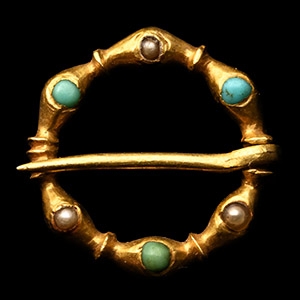
Medieval Gold Brooch with Turquoise and Pearls
13th-14th century A.D.Sold for (Inc. bp): £644
A delicate annular brooch set with three turquoise cabochons and three seed pearls, the space between the cells separated with a slender collar. 1.29 grams, 14 mm
Private collection, UK.
An annular brooch is a type of brooch that is circular in shape, forming a complete ring, they were worn by both men and women of all social classes. The word 'annular' comes from the Latin word 'annulus' meaning ring. These brooches were popular in medieval Europe, particularly from the 13th to 15th centuries, and were used to fasten clothing such as tunics and cloaks. -
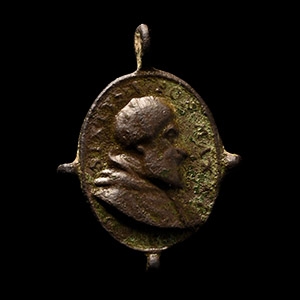
Pope Sixtus V Bronze Pendant
Dated 1585 A.D.Sold for (Inc. bp): £390
Ellipsoid bronze bifacial pendant with three radiating lugs and pierced lug above; reverse with kneeling nimbate figure (St. Jerome) in ankle-length robe, one hand extended and open book below, lion's head to his rear; obverse with profile bust in cassock and camauro (papal cap), legend above 'SIXTVS V PONS MAX A I'. 4.7 grams, 30 mm
Found Tuesday 1st April 2025 in Claydon, Suffolk, UK. Accompanied by a copy of the British Museum's Portable Antiquities Scheme (PAS) report no.SF-92A7E3.
This item is a rare example of a Catholic papal emblem made and used during Elizabeth I's reign, when the Protestant cause was dominant. This is only the second known example to be found in England. -
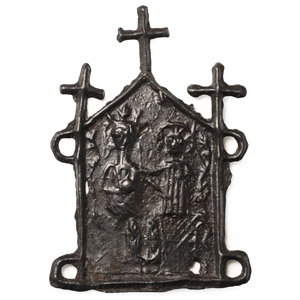
Medieval Pewter Pilgrim's Badge with Crosses
13th century A.D.Sold for (Inc. bp): £546
Styled as a church building surmounted by three crosses, raised hatching to one face, and a scene depicting the Virgin and Child beneath a starry sky to the other; four attachment loops remaining. 5.06 grams, 43 mm
Ex European collection, 1990s. Ex Cambridgeshire, UK, collection. -
.jpg)
Medieval Lead Gregory X Papal Bulla
1271-1276 A.D.Sold for (Inc. bp): £338
The obverse depicting the busts of St Peter and St Paul each within a compartment defined by pellets; cross pattee supported on a staff between the busts; at the top of the bulla in the centre, legend 'SPASPE' (abbreviations for St Paul and St Peter); reverse inscribed in Lombardic script in three lines 'GRE/GORIVS./PP. X', with an omega above the letters 'PP' and curlicue after 'X'; both obverse and reverse faces with a pelletted perimeter. 34.4 grams, 37 mm
Found Norfolk, UK. Accompanied by an illustrated report from Andy Flowers KLMD dated November 2013.
Pope Gregory IX, born Ugolino di Conti, was the 178th Pope of the Catholic Church, reigning from 1227 to 1241. He is known for his strong defence of papal authority, his role in the Crusades, and his establishment of the Papal Inquisition. -
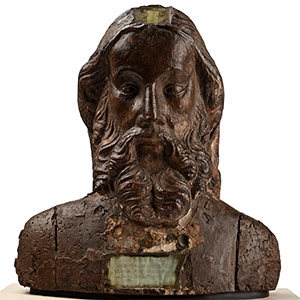
Medieval Reliquary Bust of Saint John the Baptist
15th century A.D.Sold for (Inc. bp): £4,420
Reliquary bust of Saint John the Baptist carved in walnut wood with applied pigments and gilding; inset glass panels to brow and chest with ink on vellum; the inscriptions (i) in the chest; ‘En cette teste a des cheveux nostre du [anet?] [chef?] lame Jehan baptiste …Et ces reliques… [dente?] saincte [agnes? agneau?]’ (in this head are some hairs from [...] John the Baptist ... and these holy relics'; (ii) In the head; ‘ap…e sancti joha(n)nis bap… (...of Saint John the Baptist)’; separate shoulders partly detached; mounted on a custom-made stand. 2.8 kg total, 33 cm including stand
Private collection, France, 2013. Accompanied by a previous cataloguing document. This lot has been checked against the Interpol Database of stolen works of art and is accompanied by search certificate number no.12991-246401.
According to the Gospels of Matthew (14:6–12) and Mark (6:21–29), Saint John was arrested for criticising the incestuous marriage of King Herod and Herodias, the wife of his slain half-brother Philip. Herodias’s daughter, Salome, danced for Herod during his birthday banquet, and as a reward, she was offered whatever she wished. In an act of revenge against John, Herodias had her daughter ask for his head on a platter. Though reluctant, Herod was bound by his promise, and he ordered the saint’s execution by beheading. Early accounts suggest that the saint’s remains were being venerated as early as the fourth century, having been purportedly rediscovered in a grave located some thirty miles north of Jerusalem. They remained in the Holy Land until 1206, when Saint John’s skull was stolen by crusaders returning to France after the Sack of Constantinople. It was taken by one of the crusaders, Walo of Sarton, to Amiens, where it remains to this day in the cathedral built to house it. The saint came to be invoked by sufferers of headaches and was thought to guard against insanity. The latter belief may even have informed the prominent inclusion of the saint as a young boy on the Goldenes Rössl, which was given to the continually insane King Charles VI by his wife in 1405 as a reminder of his royal duties. By the end of the Middle Ages, the saint’s relics had such famous, reputed healing powers that it led to his widespread devotion, and images of the saint (and especially those focusing on his head and the associated significance of his surviving skull) were produced in large numbers right across Europe. Few, however, contain actual relics, and fewer still have intact and undisturbed compartments incorporating original inscribed parchment labels. This marvellous bust is an anomaly and almost unique in having its relics well preserved. The stylistic treatment of our figure is extremely close to that of a bearded head on a capital with two figures formerly in the collection of the North Carolina Museum of Art at Raleigh (inv. G.57.14.16, now deaccessioned). Dated to the late fourteenth century, it was clearly carved in the same artistic orbit as our bust. -
.jpg)
Illuminated Medieval Book of Hours Manuscript Page
Flemish, circa 15th century A.D.Sold for (Inc. bp): £995
Mounted in a bifacial frame to display recto and verso; band of detailed floral ornament to the outer edge with central figure in a short pea-jacket; fifteen-line block of bastarda-script text with Latin text (e.g. Pinguescent speciosa deserti: et exultatione colles accingentur from Psalm 64:13); coloured versals and decorative panels. 142 grams total, 26.6 x 20 including mount, window: 14.5 x 8.8 cm
Ex Hedwig collection, Brussels, thence by descent, 2000s. Accompanied by a Belgian cultural export licence. -
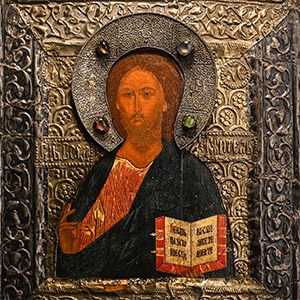
Painted Wooden Icon with Christ Pantocrator with Silver Basma
Russia, 16th-17th century A.D.Sold for (Inc. bp): £5,720
With raised right hand, the left hand holding the Gospel, dressed in red tunic and dark-green garment (himation); covered with an elaborate silver oklad with repoussé and chased decoration, mounting bar to reverse, silver-coloured metal with reserved epigraphic panels and circular void to reveal painted icon beneath; separate two-piece gilt revetment, the upper nimbus with pierced edge and reserved capitals, set with four stones; the background panel bearing reserved tendril ornament; incised Cyrillic inscription 'Г[оспо]дь Вседержит[ель]' (= Lord Almighty) on the sides of Jesus; the Gospel with Cyrillic inscription, red foil embroidered in gold; incised three letters in Cyrillic capitals on the gilt nimbus 'ТѠ Ο И' (The only living One). 983 grams, 29 x 25 cm
Acquired on the UK art market. Private collection, London, UK. Accompanied by an academic report by Dr Raffaele D'Amato. This lot has been checked against the Interpol Database of stolen works of art and is accompanied by a search certificate number no.12926-246332. -
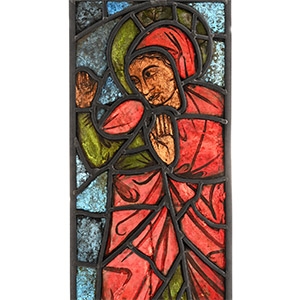
Medieval Stained Glass Panel of the Annunciate Virgin
Western France, 1250-1275 A.D.Sold for (Inc. bp): £5,460
Depicting Mary clad in red and green, with a green halo outlining her head, raising her hands in exclamation. 1.92 kg, 53 x 23.5 cm
Eglise Saint-Malo, Dinan, France, by repute. Acquired from the above by Mr and Mrs Junius P. Morgan, Princeton, New Jersey, USA. The Dalva Brothers collection. Accompanied by a previous cataloguing document. This lot has been checked against the Interpol Database of stolen works of art and is accompanied by search certificate number no.12994-246433.
Although her garments are uncharacteristic of figures of the Virgin, she nevertheless almost certainly represents Mary as she appeared in a scene of the Annunciation. Both in terms of the choice of colours, and in the style and treatment of her features and drapery folds, she can be compared very closely with window panels from the third quarter of the thirteenth century removed from the Church of Saint Radegonde in Poitiers, including a window now in the Glencairn Museum in Bryn Athyn which shows in its lowermost vignette an identically dressed Virgin riding side saddle on a donkey during her flight into Egypt (fig. 1a-b). -
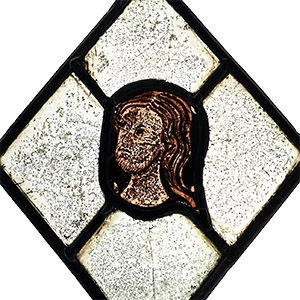
Medieval Stained Glass Panel of a Man
13th century A.D.Sold for (Inc. bp): £1,300
Lozenge panel with four rectangular elements and central irregular panel with painted bearded male bust. 370 grams, 30.5 cm high
The Monastery Stained Glass, 2003. -
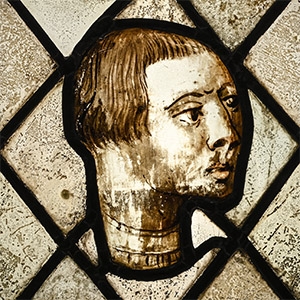
Medieval Stained Glass Head of a Man
Netherlands, Brabant, 1500-1520 A.D.Sold for (Inc. bp): £1,170
Square composite panel with brown-hued vitreous enamel and pink pigment, irregular profile bust set into the diamond quarries. 838 grams, 30.3 x 27 cm
Ancient Arms and Armour, Stained Glass, Coffrets and Furniture. Property from a New York Collection, American Art Association, New York, 23 November 1923, no.110 (as Flemish XV-XVI). The Monastery Stained Glass, 2004. Accompanied by a previous cataloguing document.
The loose, fluid brushwork and fine touches of pink sanguine pigment on this male head place him firmly in the first decades of the sixteenth century, a dating supported further by the visible hemline of the fashionable pleated shirt covering his neck. These are all characteristic features of Southern Netherlandish stained glass from this period, and parallels offered by programs such as the early sixteenth-century windows in Antwerp Cathedral, the c. 1500 glazing scheme at Sint Gummarus church in Lier just outside Antwerp, as well as at sites such as Notre Dame du Sablon in Brussels, suggest an artist working in Brabant in the early years of the century. -
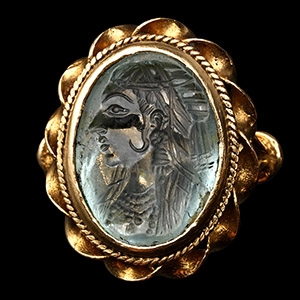
Aquamarine Gemstone with Mughal Princess in Gold Ring
Circa 17th century A.D. and laterSold for (Inc. bp): £2,860
Ellipsoid in plan intaglio showing a profile female bust with elaborate tiered headdress and collars; set in a later gold ring. 8.26 grams, 25.37 mm overall, 17.74 mm internal diameter (approximate size British O 1/2, USA 7 1/4, Europe 15.61, Japan 15)
From the private collection of Rev. Nathaniel Evans, Worthing, Sussex, UK, thence by descent. This lot has been checked against the Interpol Database of stolen works of art and is accompanied by search certificate number no.12934-245934.
These portraits, realised on objects of minor art like glyptics, give a glimpse of the type of jewels and gems realised during the Mughal era. They illustrated the gem connoisseurship of the Mughal Era at its pinnacle. -
.jpg)
Renaissance Gold and Enamel Ring with Ruby
Western Europe, late 16th century A.D.Sold for (Inc. bp): £5,850
Comprising a slender round-section hoop, expanding shoulders with scrolled tendrils, a quatrefoil bezel with D-shaped ornamented panels, set with a table cut ruby; retaining traces of white enamel. 5.48 grams, 23.29 mm overall, 17.28 mm internal diameter (approximate size British M, USA 6, Europe 12.46, Japan 12)
Private collection, UK. This lot has been checked against the Interpol Database of stolen works of art and is accompanied by search certificate number no.12995-246010.

