-
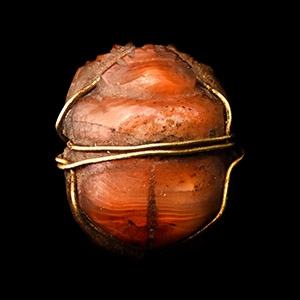
Egyptian Hardstone Scarab with Later Gold Pendant Mount
Late Period, 664-332 B.C.Sold for (Inc. bp): £572
Carved scarab with detailed carapace and mouth parts; later gold wire mount for suspension. 2.88 grams, 16.54 mm
Early 20th century UK, collection. -
.jpg)
Egyptian Alabaster Mirror Handle
New Kingdom, 18th-20th Dynasty, 1550-1070 B.C.Sold for (Inc. bp): £3,900
In the form of a papyrus column, the upper platform pierced through for insertion of a bronze mirror, incised with lotus petals at the top of the shaft and at the base; mounted on a custom-made display stand. 482 grams total, 14.5 cm including stand
with Nicholas Wright, London, UK, 1969. Christie's, London, 14 April 2011, no.128. Accompanied by copies of the relevant Christie's catalogue pages. This lot has been checked against the Interpol Database of stolen works of art and is accompanied by search certificate number no.12941-243535.
The papyrus stalk was used in the hieroglyphic script for the word 'wadj', meaning 'fresh', making it an appropriate talisman for the preservation of the body. -
.jpg)
Egyptian Green Stone Frog Amulet
Late Period, 664-332 B.C.Sold for (Inc. bp): £351
Modelled seated on an oval base; pierced for suspension. 1.47 grams, 13 mm
Mrs Allinson to Mrs Foster, 1867 and thence by descent to the current owner, Stanley Crescent, London, UK.
Frog amulets in ancient Egypt symbolised fertility, rebirth, and renewal. Associated with the goddess Heket, who was connected to childbirth and life-giving forces, these amulets were especially popular in contexts related to fertility and protection during pregnancy and labour. Their association with the annual Nile flood, which brought new life to the land, further underscored their symbolism of revival and abundance. -
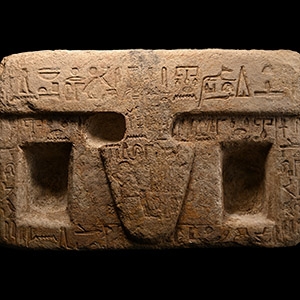
Egyptian Limestone Offering Table for Iny
Late Old Kingdom-First Intermediate Period, circa 2400-2040 B.C.Sold for (Inc. bp): £11,700
Rectangular table with the upper part carved in high relief in the shape of a bread loaf on a mat representing the hieroglyphic sign for "offering" (ḥtp), with two rectangular recesses for libations, and extensive hieroglyphic inscriptions displaying offering formulae along with the titles and name of the deceased: "an offering that the king gives and Anubis, the one upon his mountain, a voice offering of bread and beer for the sole companion, god’s sealer, the revered one before the god, lord of the sky/heaven, In[y]". 14.75 kg, 45.5 cm
Acquired 1970s-1996. Private collection, Switzerland. with a North American collector. London collection, 2016. Accompanied by an academic report by Egyptologist Paul Whelan. This lot has been checked against the Interpol Database of stolen works of art and is accompanied by search certificate number no.13001-244462.
Offering tables played a significant role in ritualistic activity within tombs. Their origins may be traced back to the simple act of placing a loaf of bread on a reed mat during Predynastic burials, which gradually evolved into a more formalised and durable expression in stone. The distinctive form also became a hieroglyph, used in words meaning “to be satisfied,” “to be satiated,” and similar expressions, reflecting appropriate sentiments for food and drink offerings. -
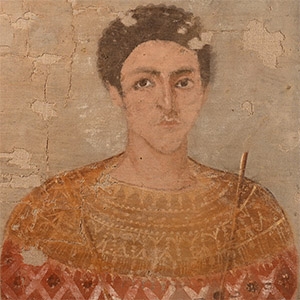
Romano-Egyptian Painted Portrait on Linen
1st-2nd century A.D.Sold for (Inc. bp): £26,000
Encaustic painting on thin linen fabric, upper part of the funeral shroud with half-length representation of the deceased, representing the bust of a young man in the guise of mummiform Osiris holding implements of his divinity, black hair, wearing a gilt broad collar (maniakion) and netting, pink dress ornamented with rosettes, traces of halo in white pigment; set in a glazed frame. 4.3 kg, 58 x 63 cm including frame
Collection of the estate of Patti Cadby Birch (1923-2007), New York, USA. with Sotheby’s, New York, Antiquities, 5 June 2008, sale no.8452, no.105. European private collection, acquired thereafter. Accompanied by a copy of an Art Loss Register certificate, no.S00014603. Accompanied by an academic report by Dr Raffaele D'Amato. This lot has been checked against the Interpol Database of stolen works of art and is accompanied by a search certificate number no.12612-234638. This lot has been cleared against the Art Loss Register database, and is accompanied by an illustrated lot declaration signed by the Head of the Antiquities Department, Dr Raffaele D'Amato.
Fayum portraits, painted on wood or linen, applied to the mummies of the Graeco-Roman period, are one of the most wonderful legacies that the koiné of the Graeco-Roman world has left us. Due to the favourable climate enhancing the state of preservation, these encaustic paintings have left us an almost photographic testimony of the faces of the inhabitants of Roman Egypt. The realistic portrait shows here the idea of the deceased as Osiris. This idea, already existing in the Ptolemaic Period regardless of the gender of the person represented, continued to exist in the Graeco-Roman period. The deceased is undoubtedly a young man, beardless, with black and slightly frizzy hair. A similar male portrait with the same type of clothing, the attributes: nimbus and the identifying elements of Osiris can be found in a portrait now in Paris (Parlasca, 2003, no.771, pl.172,3). Patti Cadby Birch (1923-2007) was a prominent American philanthropist and collector, known for her significant contributions to the arts. A patron of institutions such as The Metropolitan Museum of Art and the Museum of Modern Art in New York, she supported numerous exhibitions and acquisitions, particularly in the fields of antiquities and Islamic art. Works from her esteemed collection have been widely exhibited and are held in several major museum collections. -
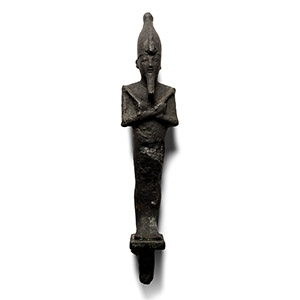
Egyptian Bronze Osiris Statuette
Late-Ptolemaic Period, circa 664-30 B.C.Sold for (Inc. bp): £1,300
Modelled in the round as a characteristically mummiform standing figure with arms crossed and holding the crook and flail regalia, wearing the hedjet crown and uraeus. 136 grams, 13.5 cm
From the collection of a gentleman, acquired on the London art market in the 1990s.
Osiris is a deity associated with death and fertility, widely acknowledged as the supreme god of rebirth. Although he was once a mortal ruler, as a deity, his domain was the Underworld. Abydos served as the primary cult site of Osiris’s worship, where a renowned annual celebration in his honour took place. -
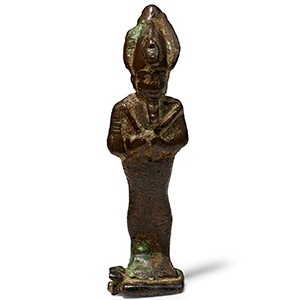
Egyptian Bronze Statuette of Osiris
Late Period, 664-332 B.C.Sold for (Inc. bp): £390
A slender standing figure of Osiris in iconic mummiform appearance, wearing the tall conical Atef crown with its flanking ostrich plumes, and central uraeus, holding the crook (heka) and flail (nekhakha) regalia; suspension loop on the reverse. 47.3 grams, 76 mm
Acquired on the UK art market in the 1970s. Private collection, UK. -
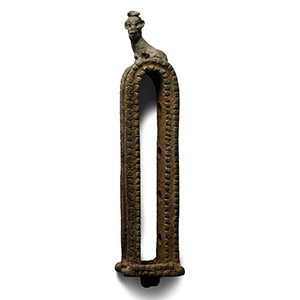
Romano-Egyptian Bronze Sistrum Fragment with Goat
2nd-3rd century A.D.Sold for (Inc. bp): £117
Comprising a slender U-shaped body with beaded border, the sides with four pairs of piercings to accept separate crossbars, an applied goat resting atop the body. 73.7 grams, 10.8 cm
Ex Paul Munro-Walker, Bournemouth, Hampshire, UK, 1980s. From a UK collection since before 1990.
When the sistrum was shaken, copper or bronze discs on its crossbars would rattle against each other, creating a clashing sound. The ancient Egyptian name for the sistrum, sesheshet, is onomatopoeic and mimics this sound. -
.jpg)
Egyptian Bronze Head of a Cat
Late-Ptolemaic Period, 664-30 B.C.Sold for (Inc. bp): £1,820
The head of goddess Bastet modelled in the round with alert ears and eyes, ears pierced; hollow-formed. 40.4 grams, 33.6 mm high
Acquired in the mid 1990s. Private collection, Switzerland, thence by descent. Private collection, since the late 1990s.
The feline's pierced ears likely once held earrings or other ornaments. It was probably attached to a statuette of a cat, whose body may have been crafted from wood. The cat was sacred to Bastet, a protective mother goddess and the daughter of the sun god Re. Amulets provided the wearer with the goddess's protection. Her name means ‘she of the bast [ointment jar],’ which may have contained a substance favoured by or exclusive to royalty. Originally, Bastet was depicted as a woman with the head of a lioness, but by the late New Kingdom, she was typically shown with a cat's head. She is sometimes portrayed with kittens, emphasising her maternal role as a fierce protector of her offspring. -
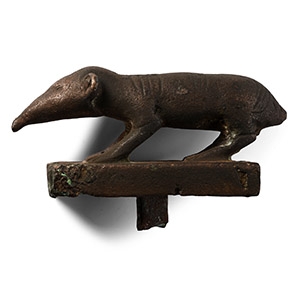
Egyptian Bronze Figure of a Shrew
Late-Ptolemaic Period, 664-30 B.C.Sold for (Inc. bp): £715
Modelled in the round in a crouching pose on a rectangular base with an attachment peg. 145 grams, 73 mm
From the collection of a gentleman, acquired on the London art market in the 1990s.
This figure most likely comes from a shrew coffin or votive statuette. The dwarf shrew (Crocidura nana) and Flower’s shrew (Crocidura floweri) were among many animal species buried in dedicated cemeteries across various parts of Egypt. Ironically, these tiny creatures symbolised Horus in his raptor-headed form — a figure who, in reality, would have preyed upon them. Shrews were associated with Khenty-irty, the “seeing-and-blind god,” due to their ability to navigate darkness. It may be possible to read the shrew’s symbolism as that of seeking light in darkness, representing the Egyptian belief in the deceased’s journey through the hours of the night before rebirth at dawn. Radiographic analysis of a bundle containing about twenty-one shrews shows that they were dried whole, with no evisceration, preserved by being ‘pickled’ in natron. -
.jpg)
Egyptian Limestone Relief with Pharaoh Making Offerings
Ptolemaic-Roman Period, circa 332 B.C.-300 A.D.Sold for (Inc. bp): £4,680
Rectangular relief showing the pharaoh wearing the pschent crown of Upper and Lower Egypt and presenting the hieroglyphic sign of a field (sḫt) in his outstretched palms towards the now barely discernible figure of a standing deity holding a long sceptre; an empty cartouche above and a column of worn hieroglyphic text below; mounted on a custom-made display stand. 18.4 kg total, 45.5 cm including stand
Acquired 1970s-1996. Private collection, Switzerland. with a North American collector. London collection, 2016. This lot has been checked against the Interpol Database of stolen works of art and is accompanied by search certificate number no.12943-244661.
Scenes showing the pharaoh offering various items, including fields, to one or more deities are found in temples across Egypt. The empty cartouche is a feature most often seen in inscriptions from Ptolemaic and Roman-period temples, reflecting uncertainty over the holder of power in the country. -
.jpg)
Egyptian Limestone Relief Fragment with Female Figure
New Kingdom, 18th Dynasty, circa 1295 B.C.Sold for (Inc. bp): £4,550
Showing a female figure as part of a procession, carrying a loaf of bread, a second offerant behind her; mounted on a custom-made display stand. 3.12 kg total, 42 cm high including stand
From the estate of the late Professor Dr E. Bernardo Streiff, Geneva; a distinguished collection of antiquities formed during the 1950s-1970s. with Galerie Rhéa, Zurich, Switzerland. This lot has been checked against the Interpol Database of stolen works of art and is accompanied by a search certificate number no.12625-236383.
Professor Dr E. Bernardo Streiff (1911-2001) was a prominent Swiss physician and academic based in Geneva, best known for his contributions to medical science as well as his deep passion for ancient art and antiquities. Over the course of several decades, particularly between the 1950s and 1970s, Professor Streiff assembled a highly regarded private collection of antiquities, reflecting both scholarly discernment and aesthetic sensitivity. His interests focused on the art and material culture of the ancient Mediterranean, with a particular emphasis on Greek, Etruscan, and Roman objects. A connoisseur guided by academic rigour, Dr Streiff maintained close ties with museums, galleries, and archaeological experts of his time. Many pieces from his collection were acquired from leading European dealers and fairs, and are notable for their quality, provenance, and condition. Following his passing, objects from the Streiff collection have appeared in respected sales and exhibitions, recognised for their integrity and the refined eye of the collector behind them.

