-
.jpg)
Large Scandinavian Viking Bronze Shield Pendant
8th-10th century A.D.Sold for (Inc. bp): £247
A broad sheet-bronze disc horse harness pendant with band of repoussé bosses to the edge, applied cross-bands to the obverse and central boss; applied attachment loop with tremolier detailing. 60 grams, 12.1 cm
From the private collection of a London gentleman, from his grandfather's collection formed before the early 1970s. -
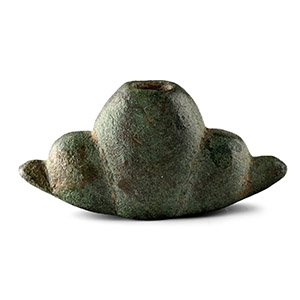
Anglo-Scandinavian Viking Bronze Five-Lobed Pommel
10th-11th century A.D.Sold for (Inc. bp): £338
Of Petersen's Type S (Wheeler Type III) with five graduated lobes; hollow, the lower face a swept arc; pierced through the tallest lobe to accept the tang of the sword's blade. 48.7 grams, 50 mm
Found Norfolk, UK. -
.jpg)
Viking Age Bronze Sword Scabbard Chape Collection
10th-12th century A.D.Sold for (Inc. bp): £780
Comprising: a small and narrow type (Paulsen's Gruppe I 2, Untergruppe d) with an openwork panel to each face filled by a cross-shaped motif with curved cross-bar, and a dentilled upper edge to the mouth; a tongue-shaped type (Paulsen's Gruppe I 1) with an openwork centre and Ringerike style bird formed with looped bands, pellets to the pinions, a triangular in plan head joined to the inner faces of the ropework border forming the upper edge of the chape, with a wolf's head at the apex and stepped knop finial (apex and lower end of the chape damaged); two of the same type (Gruppe I 1) with a pair of scrolls in the central void and a 'knot' to the apex', one with ropework detailing and a wolf's head; a broad D-shaped plaque with a plain reverse plate riveted in place, guilloche band to the outer edge and interlaced vines to the centre. 118 grams total, 46-75 mm
From the collection of a North American gentleman, formed in the 1990s.
The chape with the dentilled upper edge bears a cross motif on which only the curvature of the cross-piece indicates its origin in the raven/eagle figure found more commonly on this type; as its ornament has developed a long way from its original form, it should be dated to the 11 or 12th century. The D-shaped plaque with the plain reverse is not in Paulsen's typology but appears to be derived from the smaller types in his Gruppe VII. -
.jpg)
Very Large Anglo-Scandinavian Viking Bronze Horse Harness Link
11th century A.D.Sold for (Inc. bp): £3,380
Lozengiform in plan with pierced bulb to opposed angles, one with ring in situ; obverse with reserved rim, beast in profile with bent forelegs and gaping jaws, tail curled above the back, attacking a serpentine creature with segmented body and three-toed claws. 81 grams, 10.8 cm
Found Lincolshire, UK. This lot has been checked against the Interpol Database of stolen works of art and is accompanied by search certificate number no.12988-242245.
Openwork rhombic mounts were found in various Scandinavian places. One was found, for example, in a sunken hut at Sebbersund in Northern Jutland, and dated to the passage of 10th-11th century A.D. An openwork mount depicting a four-legged animal from Lund was excavated from a pit in a cultural deposit with dendro-chronological dates between 1060-1070. -
.jpg)
Medieval Gold Ring Brooch with Sapphires
France, 14th century A.D. or laterSold for (Inc. bp): £1,950
An annular brooch set with six cabochon sapphires, the spaces in between engraved with annulets, diamonds and a fleur-de-lis at the centre, a flower motif on each side of the pin. 6.11 grams, 20 mm
Private English collection, formed between the late 1970s and early 1990s. Private collection, UK.
In medieval jewellery, sapphires were revered not only for their beauty but for their rich symbolic and spiritual meaning. Associated with the heavens, they embodied divine wisdom, purity, and truth, often worn by clergy and royalty as signs of piety and authority. Believed to protect against envy, poison, and deceit, sapphires were also thought to reveal dishonesty by losing their brilliance, making them symbols of fidelity and integrity. Frequently gifted as tokens of loyal love, they were valued for their supposed healing properties, particularly for ailments of the eyes and mind. In 14th-century jewellery, the fleur-de-lis symbolised a blend of royal allegiance, religious devotion, and noble identity. As the emblem of the French monarchy, it signified loyalty to the crown and noble lineage, while its association with the Virgin Mary evoked purity and spiritual grace. Common in courtly and devotional contexts, it also reflected chivalric ideals such as honour, fidelity, and moral virtue. -
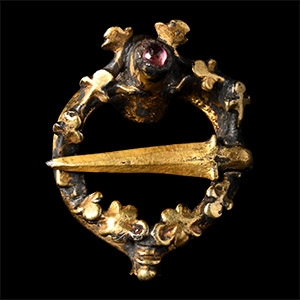
Medieval Gold Ring Brooch with Garnets
13th-14th century A.D.Sold for (Inc. bp): £390
An annular brooch set with decorative oak leaves, tall collet at the top set with a garnet cabochon, dagger-shaped pin. 1.74 grams, 18 mm
Private collection, UK.
In medieval jewellery, garnets were highly prized for their deep red hue and believed mystical properties. Associated with protection, vitality, and divine love, garnets were thought to ward off illness, protect against injury, and illuminate the darkness—both literal and spiritual. Their rich colour made them a symbol of Christ’s sacrifice, and they frequently appeared in religious and funerary jewellery. Garnets were also connected to concepts of faithfulness and truth, making them a popular choice in personal adornment and ecclesiastical pieces throughout the Middle Ages. Oak trees were widely regarded as symbols of strength, stability, and endurance, owing to their longevity and robust nature. In jewellery, oak leaves could represent resilience, fortitude, and the ability to withstand adversity—virtues admired in both secular and religious life. Within Christian art and ornamentation, the oak also carried spiritual significance, evoking the Tree of Life and the strength of faith. It was often interpreted as a symbol of God’s protection, particularly in devotional objects or pieces with sacred motifs. -
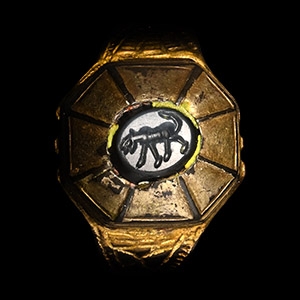
Large Medieval Silver-Gilt Ring with Lion Intaglio
14th-16th century A.D.Sold for (Inc. bp): £468
With a broad hoop, each shoulder decorated with a pointillé geometric motif, octagonal-section domed bezel with segmented upper and corrugated sidewall; inset nicolo with advancing lion motif. 9.96 grams, 31.53 mm overall, 19.51x23.08 mm internal diameter (approximate size British V 1/2, USA 10 3/4, Europe 24.40, Japan 23)
with Archaeologia, Switzerland, before 1983. Ex private North American collection. London private collection, 2016. -
.jpg)
'The Somersham' Medieval Inscribed Silver-Gilt Scroll Mount or Badge
13th-15th century A.D.Sold for (Inc. bp): £338
Scroll-shaped mount with canted ends, mounting lugs to reverse; obverse with two incuse panels, each with a line of reserved text: '+MTN V/EIRT R' – not obviously meaningful, though 'VEIRT' is an acceptable Anglo-Norman spelling for mod.Fr. verité, ‘truth’. 3.69 grams, 32 mm
Found Somersham, Suffolk, UK, declared as treasure under the Treasure Act with reference no.2022T849 and subsequently disclaimed by the Crown. Accompanied by a copy of the British Museum's Portable Antiquities Scheme (PAS) report no.SF-B47EF7. Accompanied by a copy of the Department for Digital, Culture, Media & Sport Treasure Act receipt dated 9 September 2022. Accompanied by a copy of a letter from the British Museum explaining that the Crown's interest in the object has been disclaimed. -
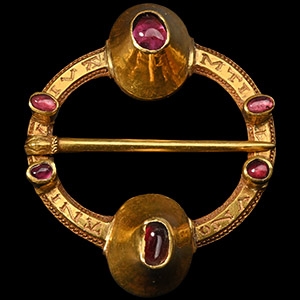
Medieval Gold Ring Brooch with Garnets and 'Let us Live as One Soul’ Posy Inscription
13th-14th century A.D.Sold for (Inc. bp): £7,020
An annular brooch with pelletted edges, six garnet cabochons adorning the brooch, each in a tall closed setting; inscribed on the front 'VIVAMTINVNOANI', the reverse inscribed with 'AMORIVNTVANVNTVI' divided between two palmettes. 8.76 grams, 38 mm
Private English collection, formed between the late 1970s and early 1990s. Private collection, UK. This lot has been checked against the Interpol Database of stolen works of art and is accompanied by search certificate number no.12989-245987.
Both inscriptions can be interpreted differently according to the order of their reading; the front can be read ‘IN JUNO ANI VIVAM TI’, which roughly translates as ‘May I live for you in the fastening’, alternatively ‘VIVAM[vs] IN VNO ANI[mo]’ which roughly translates as ‘Let us live as one soul’. The back reads: 'AMORIVNTVANVNTVI' ‘AMOR[is] IVN[c]T[i] ANVNTIV[s]’ which roughly translates as ‘a message of joint love’. The inscriptions on the brooch serve as metaphors, linking its function of fastening materials to the binding of lovers in medieval romance. Gift-giving was central to courtly love, and the brooch symbolised both affection and protection, reminding the wearer of the giver’s love while also warding off unwanted advances. -
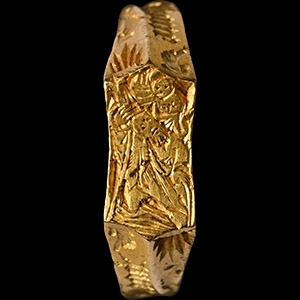
'The Otterington Hall' Medieval Inscribed Iconographic Gold Ring with Saint Christopher
1450-1550 A.D.Sold for (Inc. bp): £7,150
With a flat rectangular bezel engraved with an image of Saint Christopher carrying the Christ child on his back, the hoop extending on either side of the bezel and having a twisted design creating facetted shoulders with transverse ridges extending from each side of the bezel; each smaller shoulder facet engraved with six projecting rays, each larger side with engraved blackletter texts 'pur' and 'bone' meaning 'for good (fortune)’/ ‘for the best'; a foliate design present between the bezel and text, and each word followed by an engraved flower, the remainder of the hoop with a twisted ropework design; heavily worn by its original owner creating a desirable natural finger shape connecting the wearer with the original owner. 3.26 grams, 18.91 mm overall, 16.51 mm internal diameter (approximate size British I 1/2, USA 4 1/2, Europe 8.07, Japan 7)
Found whilst searching with a metal detector in South Otterington, Hambleton, North Yorkshire, UK, on 28 November 2024, by James Sweeney; declared as a Treasure under the Treasure Act with reference no.2024 T1402, and subsequently disclaimed by the Crown. Accompanied by a copy of the British Museum's Portable Antiquities Scheme (PAS) report no.YORYM-AED39E. Accompanied by a copy of a letter from the Office of the Senior Coroner for North Yorkshire and York, explaining that the Crown's interest in this find has been disclaimed. This lot has been checked against the Interpol Database of stolen works of art and is accompanied by search certificate number no.12990-244092.
Saint Christopher, the patron of travellers, was one of the most popular saints in the Middle Ages. As a supposed early Christian martyr, he was thought to give protection against death from the plague. -
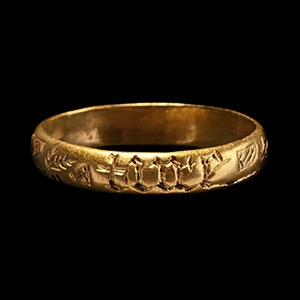
Medieval Gold Posy Ring Inscribed 'With Luck'
14th century A.D.Sold for (Inc. bp): £1,690
D-shaped in section with blackletter legend '+ala ven ture' (a l'aventure, meaning with luck/ perhaps/ if possible) and fronds between. 1.74 grams, 21.27 mm overall, 18.81 mm internal diameter (approximate size British Q, USA 8, Europe 17.49, Japan 16)
Acquired on the UK art market in the 1980s. From an East Anglian private collection. -
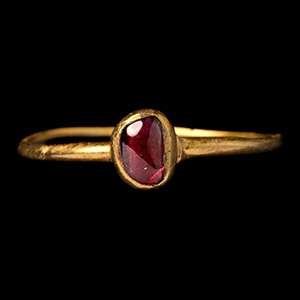
'The Harrietsham' Medieval Gold and Gem Set Ring
Southern England, 1300-1400 A.D.Sold for (Inc. bp): £1,105
Comprising a narrow shank and cup bezel with inset garnet cabochon; straightened. 1.37 grams, 22.77 mm overall, 17.26 mm internal diameter (approximate size British N, USA 6 1/2, Europe 13.72, Japan 13)
Found whilst searching with a metal detector near Harrietsham, Maidstone, Kent, UK, on 5th April 2024; declared as Treasure and susiquently disclaimed with Treasure Reference no.2024 T639. Accompanied by a copy of the British Museum's Portable Antiquities Scheme (PAS) report no.SUSS-EDF83D. Accompanied by a copy of the Department for Digital, Culture, Media & Sport's Treasure receipt dated 4th June 2024. Accompanied by a receipt, and disclaim letter, both from Mid Kent and Medway Coroner's Service.
The Portable Antiquities Scheme states: 'This is a find of note and has been designated: Include in MedArch.'

