-
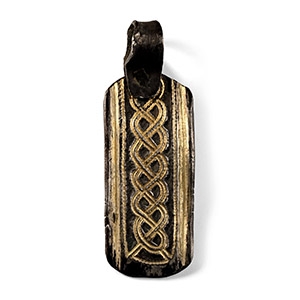
Saxon Silver-Gilt Pendant with Entwined Beasts
5th-6th century A.D.Sold for (Inc. bp): £416
Flat in section with reeded gilt borders, central knotwork motif; probably a portion of an ornamental mount, with a later applied loop for suspension. 3.96 grams, 42 mm
From the private collection of a London gentleman, from his grandfather's collection formed before the early 1970s. -
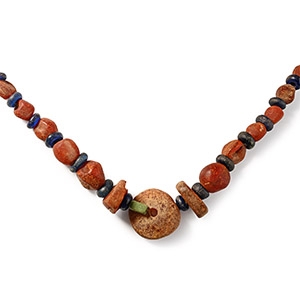
Anglo-Saxon Glass and Amber Bead Necklace String
Late 5th-6th century A.D.Sold for (Inc. bp): £715
Including annular, tubular, and other types, a large amber tabular bead to the centre. 32 grams, 26 cm
Found Seaham, Co Durham, UK. Property of a Durham private collector. -
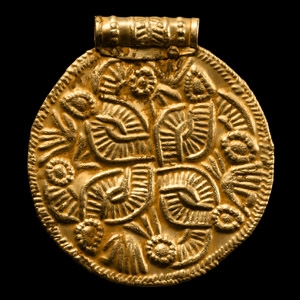
Large Pre-Viking Gold Bracteate Medallion with Interlaced Snakes
5th-6th century A.D.Sold for (Inc. bp): £5,720
Executed using the repoussé technique, depicting interlaced snakes or possibly Jörmungandr, the world serpent; applied suspension loop with repoussé chevrons and pellets, faux ropework border around the whole. 13.04 grams, 61 mm
From the collection of a North American gentleman, formed in the 1990s. Accompanied by an academic report by Dr Raffaele D’Amato. This lot has been checked against the Interpol Database of stolen works of art and is accompanied by search certificate number no.11729-200423.
The bracteate belongs to the main type D, showing an image of tetramorphic monsters. Probably here the representation refers to Jörmungandr, the serpent of Midgard, son of Loki and killer of Thor, protagonist of Ragnarok - the downfall of the gods. The art of the bracteate medallions is one of the few contemporary sources for the pre-Christian religion of the Nordic countries. It demonstrates that ancient Germanic mythology, although known from later texts, was built on a tradition dating back to at least the 5th-6th centuries A.D. The function of these medallions was linked to the social position of the wearer in Germanic society. -
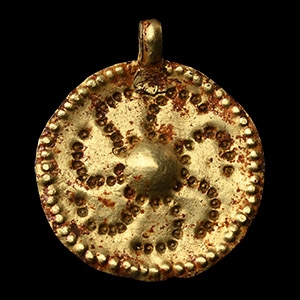
Viking Gold Sun-Whorl Bracteate Pendant
8th-10th century A.D.Sold for (Inc. bp): £910
Scalloped circumference and repoussé central 'kolovrat' design, mounting loop above. 2.54 grams, 27 mm
From the private collection of a London gentleman, from his grandfather's collection formed before the early 1970s. -
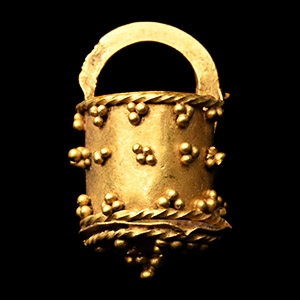
Pre-Viking Gold Filigree Aroma Bucket Pendant
Circa 4th-7th century A.D.Sold for (Inc. bp): £338
Miniature drum-shaped vessel with strap handle, the body decorated with granule clusters. 1.49 grams, 15 mm
Private collection formed in Europe in the 1980s. Westminster collection, central London, UK.
Pendants in the form of miniature buckets have been found in a number of pagan Anglo-Saxon and Viking contexts and are generally made of bronze or iron, with gold examples being rare; three gold examples were found with the hoard from Hoen, Norway. Bronze bucket amulets have been found at Driffield in Yorkshire, and Vimose bog in Denmark, among other places. In form they represent wooden buckets bound with bronze or iron bands which have been found in Anglo-Saxon and Viking graves and are believed to have held mead or ale and were used to replenish the cups from which warriors drank. As amulets they probably represent the ecstatic power of alcoholic drink and the role of women as the dispensers of these precious beverages. -
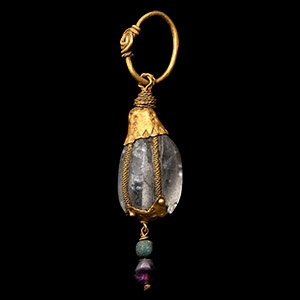
Viking Period Gold and Crystal Pendant with Bead Drop
Circa 10th-12th century A.D.Sold for (Inc. bp): £2,600
Irregular barrel-shaped crystal with lozengiform gold base, braided strip from each arm extending to the bell-shaped cap with punched pellet and triangle motifs; braided filigree collar and loop, thick gold rod suspension loop; underside with short dangle, amethyst and glass beads. 21.69 grams, 79 mm
Private collection formed in Europe in the 1980s. Westminster collection, central London, UK. This lot has been checked against the Interpol Database of stolen works of art and is accompanied by search certificate number no.12932-245386.
In Birka grave 1148B, a similar piece was found in a warrior cremation grave. It was a fragment of a grey slate whetstone, with a rivetted, groove-decorated bronze fitting, which ends in a bronze carrying ring. These items were worn as pendants. -
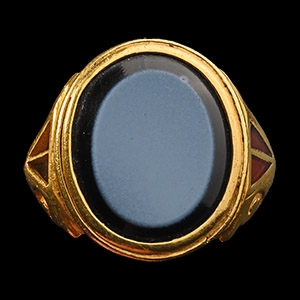
Large Migration Period Gold Ring with Gemstones
Eastern Europe, 4th-5th century A.D.Sold for (Inc. bp): £10,530
Wide hoop with volute decoration on the shoulders, two triangular settings on both shoulders, one side with garnet cloisonnés separated by a narrow bar, an applied strip of sheet-gold to the inside of the ring behind the setting; large oval bezel set with nicolo. 22.03 grams, 29.00 mm overall, 21.65 mm internal diameter (approximate size British U, USA 10, Europe 22.52, Japan 21)
with Fran Sternberg AG, Zurich, Sale XXVI, 16 November 1992, no.689. Private collection, UK. This lot has been checked against the Interpol Database of stolen works of art and is accompanied by search certificate number no.12984-245991. -
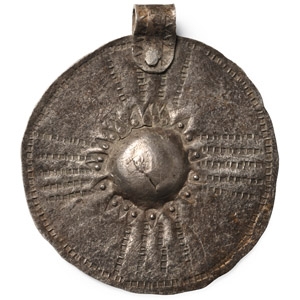
Viking Silver Stamped Shield Pendant
8th-10th century A.D.Sold for (Inc. bp): £468
A horse harness pendant executed in repoussé technique, a dome to the centre with punched annulets and other details; applied loop. 6.38 grams, 46 mm
From the private collection of a London gentleman, from his grandfather's collection formed before the early 1970s. -
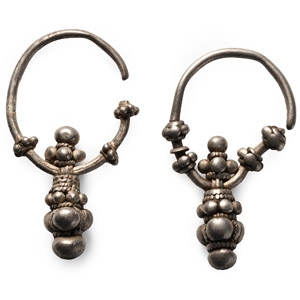
Viking Period Silver Temple Ring Pair
Circa 10th-12th century A.D.Sold for (Inc. bp): £182
Matching pair with crescentic hoops and granule decoration. 19.6 grams total, 45-47 mm
Private collection formed in Europe in the 1980s. Westminster collection, central London, UK. -
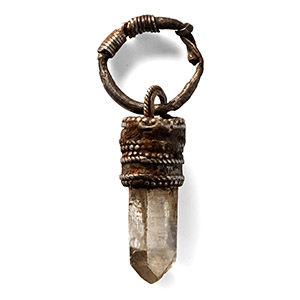
Viking Silver Pendant with Rock Crystal
8th-10th century A.D.Sold for (Inc. bp): £624
With hexagonal-section crystal bead modified for use as a pendant with the addition of a silver collar bearing filigree ropework; thick wire suspension loop with ends twisted around the shank. 7.55 grams, 51 mm
From the private collection of a London gentleman, from his grandfather's collection formed before the early 1970s. -
.jpg)
Viking Silver Elfshot Pendant with Stone Arrowhead
9th-11th century A.D. and earlierSold for (Inc. bp): £572
An amulet with a silver cap securing an arrow-shaped flint insert. 2.43 grams, 34 mm
From the private collection of a London gentleman, from his grandfather's collection formed before the early 1970s.
This amulet was believed to offer protection against 'Elfshot'. The attack of elves was believed responsible for mysterious suffering in men and livestock: sudden shooting pains localised to a particular area of the body, such as in rheumatism, arthritis, or muscle stitches or cramps. Elves were thought to shoot darts or arrows where such pains had no obvious external cause. Belief in elfshot persisted into the 20th century in rural areas, and as proof, country folk would sometimes find small arrowheads (the remains of Neolithic or Mesolithic flints, or naturally-occurring spear-shaped stones) that were believed to be the magical weapons that caused the afflictions. Belief in elfshot began in the Pagan Germanic period. -
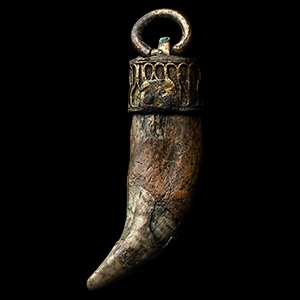
Large Viking Period Bear's Tooth Pendant
9th-12th century A.D.Sold for (Inc. bp): £1,235
A large bear's tooth set into a copper-alloy pendant setting, decorated with corded wire and a circumferential frieze of filigree loops, sturdy suspension loop to the cap. 42.5 grams, 94 mm
Acquired 1971-1972. From the collection of the vendor's father. London, UK, collector. with TimeLine Auctions, Essex, 6 September 2022, no.394. Private collection, London, UK.

