-
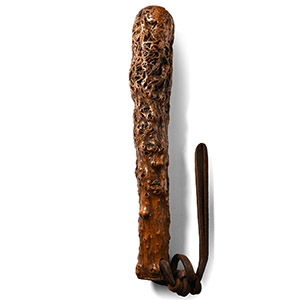
Vunikau War Throwing Club
Fiji, 19th century A.D.Sold for (Inc. bp): £260
A natural root club with a good patina of age and wear; hide thong for suspension. 391 grams, 34.2 cm
From Fiji, South Pacific. From an old Northern Ireland collection. From the property of a late Lincolnshire, UK, gentleman.
“The club was the Fijian warrior's favourite weapon. He had his spears, from ten to fifteen feet long and often richly carved, efficient bows and arrows, and slings for throwing stones; but, although these had each its special use, none approached the club in popularity.” R. A. Derrick, “Notes on Fijian Clubs, (With a System of Classification)”. -
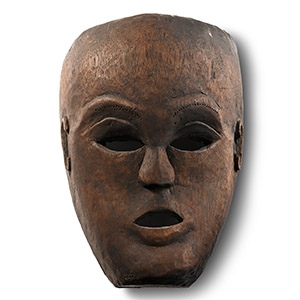
African Wooden Ceremonial Face Mask
Chokwe Tribe, late 20th century A.D.Sold for (Inc. bp): £46
A performance mask: a heavy carved wooden mask with natural features, ears to the sides and drilled holes to the eyebrows and chin. 1.32 kg, 26.2 cm
From Democratic Republic of the Congo, Central Africa. From the collection of the late Professor R M Hicks, OBE. From the property of a late Lincolnshire, UK, gentleman.
Itinerant actors wearing these masks travel from village to village, living on gifts received at performances. Most masks are carved of wood. The most popular and best-known entertainment masks are chihongo, spirit of wealth, and pwo, his consort. -
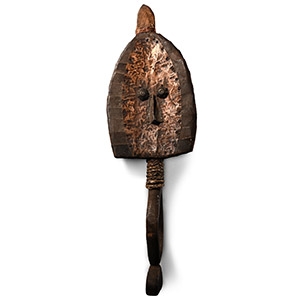
African Wooden Ceremonial Face Mask
Ashanti Tribe, 20th century A.D.Sold for (Inc. bp): £26
A carved tribal mask with copper to the face and back of the head, a single horn to the top of the head and stylised legs. 484 grams, 47.5 cm
From Ghana, West Africa. From an old Surrey, UK, oriental and ethnographical collection; acquired during 1950s. From the property of a late Lincolnshire, UK, gentleman. -
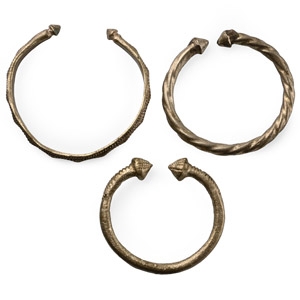
Tuareg Manilla Bronze Slave Bracelet Group
Okombo Tribe, late 19th-early 20th century A.D.Sold for (Inc. bp): £8
Each penannular in form with opposed conical finials, one with radial twist to the shank. 53 grams total, 47-55 mm
From Nigeria, West Africa. From an old Derby, UK, specialist collection. From the property of a late Lincolnshire, UK, gentleman. -
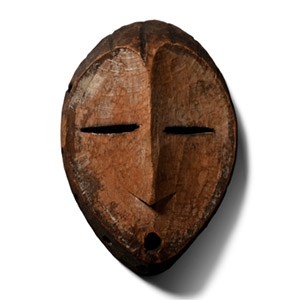
African Wooden Ceremonial Face Mask
Lega Warega Tribe, early 20th century A.D.Sold for (Inc. bp): £208
Teardrop-shaped in plan with two scooped facets, slit eyes; pierced around the edge for attachment. 57 grams, 14.7 cm
From Democratic Republic of the Congo, Central Africa. From the Estate of Dr J Bynon; acquired 22 February 1914. From the property of a late Lincolnshire, UK, gentleman.
Most of Lega masks are sculptures of a human face that are rarely worn over the face and never for purposes of true transformation. The Lega masks can be assigned different uses and meanings depending on the context of the performance. In Bwami ceremonies, masks are attached to different parts of the body, fixed to hat, piled in stacks, hung on fences, held in the hand, dragged on the ground, and occasionally worn on the forehead with the beard draping over the face of the wearer or arranged on a miniature palisade. Participants in most rites display their masks as a group in conjunction with particular dance movements and aphorisms, which vary depending on the context in which they are used. Lega masks differ from those used in many other African masquerades in that while women do not own them, both men and women handle and present them in very similar performances. Masks are among the initiation objects displayed on the grave before being passed to new owners. They are usually passed from an uncle to a nephew. -
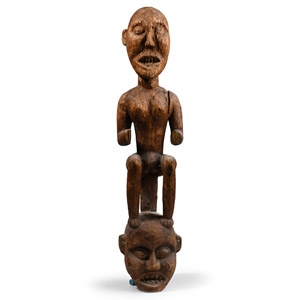
African Wooden Fertility Figure
Bamileke Tribe, early-mid 20th century A.D.Sold for (Inc. bp): £52
Carved in the round naked female with knees flexed standing on a grotesque male head. 1.43 kg, 65 cm
From Cameroon, Central Africa. From the estate of Dr J Bynon. From the property of a late Lincolnshire, UK, gentleman.
This is a carved wooden tribal figure, part of the door frame of the Chief's house, from the Bamileke tribe. A large number of prestigious items of paraphernalia were produced within the Grassland area, including large house-posts, door and window frames carved with human and animal figures, thrones, stools and tables decorated with small heads and figures, large bowls, carved horns for royal feasts, anthropomorphic terracotta and bronze pipes. -
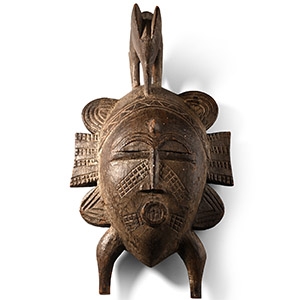
African Wooden Ceremonial Face Mask
Senufo Tribe, 20th century A.D.Sold for (Inc. bp): £59
Carved with an oval face, pointed chin, a flat nose, slit eyes, an open mouth; animal figure presented on top and some scarification. 715 grams, 36 cm
From Burkina Faso, West Africa. From the estate of a West Sussex, UK, collector. From the property of a late Lincolnshire, UK, gentleman.
Several types of masks are used depending upon the occasion. The Kpelie, a human face with projections all around, is said to remind initiates of human imperfection. -
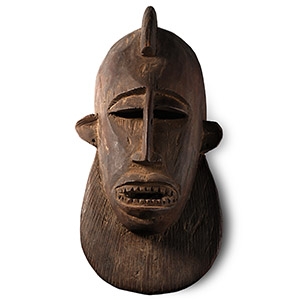
African Wooden Ceremonial Face Mask
Baule Tribe, early-mid 20th century A.D.Sold for (Inc. bp): £39
A wooden tribal oval mask with wide open mouth displaying teeth, a large narrow nose, hatched crest. 1.63 kg, 36 cm
From Côte d'Ivoire, West Africa. From a Glasgow ethnographical collection; formed 1940s-1950s. From the property of a late Lincolnshire, UK, gentleman. -
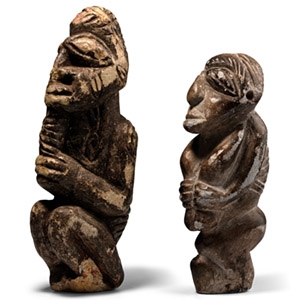
West African Squatting Stone Figure Pair
Kissi Tribe, early 20th century A.D.Sold for (Inc. bp): £7
Carved stone statues (twins) from Sierra Leone; two steatite anthropomorphic carvings, one male and one female, both with hands wrapped around the knees. 2.55 kg total, 20-23.5 cm
From Sierra Lione, West Africa. From an old Norwich, UK, collection. From the property of a late Lincolnshire, UK, gentleman.
The Kissi as early as the 15th century, revered soapstone (steatite) anthropomorphic carvings, which are found in fields and rivers in the area centered around Sewa and Mano rivers. The Kissi people call them Pomdo (Pombo), which mean "the deceased". Some of their carvings are extremely old. These statues were the abodes of the spirits of their ancestors. In order to find out which ancestor a statue represented; a man’s dreams were analyzed with the help of the diviner. At festivities the statue was wrapped in cotton upon which sacrificial blood had been poured. The owner (the guardian of the statue) placed it on the family altar; hence it was thought to be the family’s protector against sickness. It was also consulted before a new undertaking was planned. The statues were believed to have supernatural power and were used in rice cultivation. Remarkably, the descendants of the Kissi people still keep up the tradition of stone carving. -
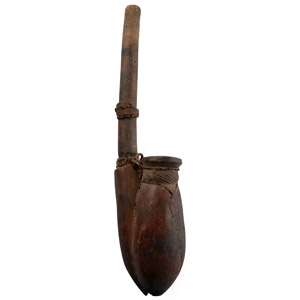
Central African Clay Smoking Pipe
Tikar Tribe, late 19th-early 20th century A.D.Sold for (Inc. bp): £7
With decoration to the top of the bowl and an embedded wooden stem with leather binding, secured by twine; repair to the stem. 152 grams, 23.6 cm
From Cameroon, Central Africa. From an old Dorset, UK, specialist collection. From the property of a late Lincolnshire, UK, gentleman.
From the Cameroon -
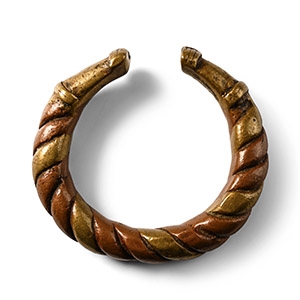
African Bi-Metal Slave Bracelet
19th century A.D.Sold for (Inc. bp): £20
Penannular in form and D-shaped in section formed from bronze and brass coils, with clubbed beast-head finials. 182 grams, 76 mm
Private collection, London, UK. -
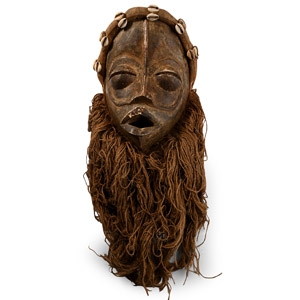
African Wooden Ceremonial Face Mask
Dan Tribe, early-mid 20th century A.D.Sold for (Inc. bp): £52
Carved in an exaggerated face with slits in the protrusive eyes, open lips, vertical crest from nose to brow; with a rolled leather headband, decorated with cowrie shells and lengths of fibre. 808 grams, 28 cm
From Côte d'Ivoire and Liberia, West Africa. From the late Brian Morley collection, 1950s. From the property of a late Lincolnshire, UK, gentleman.

