-
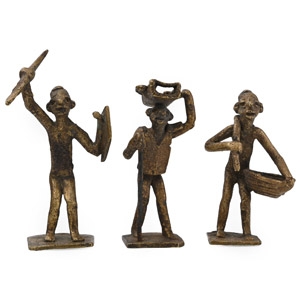
Ashanti Bronze Gold Figural Weight Collection
Akan Tribe, 19th-20th century A.D.Sold for (Inc. bp): £59
Comprising two figures carrying baskets and a warrior with spear and shield. 122 grams total, 60-77 mm
From an old Oxford, UK, collection. From the property of a late Lincolnshire, UK, gentleman. -
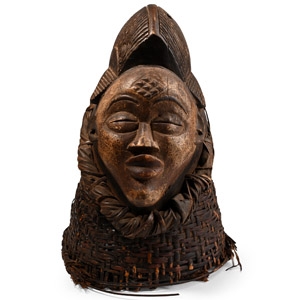
African Wooden Ceremonial 'Maiden Spirit' Mask
Punu Tribe, early-mid 20th century A.D.Sold for (Inc. bp): £39
A wooden mask with traces of white facial pigment and a raffia collar. 851 grams, 36.5 cm
From Gabon, West Africa. From an old Norwich, UK, collection. From the property of a late Lincolnshire, UK, gentleman.
Punu masks represent idealised female ancestors' faces. The white colour of the mask is genderless and a symbol for peace, deities, spirits of the dead, and the afterlife. It is the predominating colour in funeral celebrations and memorials. The masks were worn during funerals. They appeared also in the magical rites whose function was to unmask sorcerers. The masks have realistic, mostly white but sometimes black faces with protruding pursed lips, globular protruding eyes incised with a curve, high-domed foreheads, and characteristic rigid high coiffures reflecting the Punu women's hair styles. The masks often have an oriental expression, but no such influence has been established. Many Punu masks can be recognized by raised diamond-shape scarification marks on the foreheads and temples. -
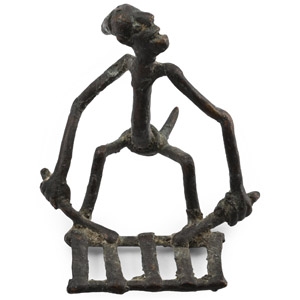
West African Bronze Figure of a Musician
19th-20th century A.D.Sold for (Inc. bp): £13
Figure of a musician playing a type of xylophone with a beater in each hand. 89 grams, 93 mm
From an old Oxford, UK, collection. From the property of a late Lincolnshire, UK, gentleman. -
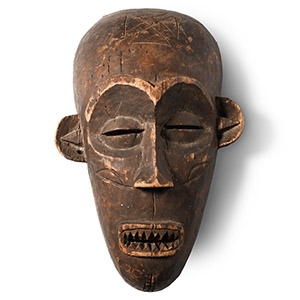
African Wooden Ceremonial Face Mask
Senufo Tribe, early-mid 20th century A.D.Sold for (Inc. bp): £13
Carved with a narrow face, protruding flat nose, slit eyes, an open mouth displaying teeth, protruding ears and scarification; hollow to the reverse. 382 grams, 32 cm
From Bukina Faso, West Africa. From a Glasgow ethnographical collection; formed 1940s-1950s. From the property of a late Lincolnshire, UK, gentleman. -
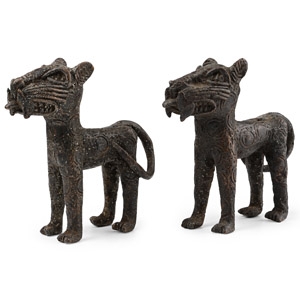
African Bronze Leopard Figure Pair
Edo Tribe, 20th century A.D.Sold for (Inc. bp): £46
Two lost wax bronze cast decorated standing leopards. 943 grams total, 13.4-13.5 cm wide
From Benin. From the late Brian Morley collection, 1950s. From the property of a late Lincolnshire, UK, gentleman.
The leopard is a motif that occurs throughout many of the Benin Bronzes as it is the animal who symbolises both the Oba (king) and justice. -
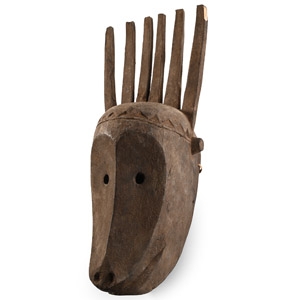
African Wooden Ceremonial Face Mask
Bambara tribe, early-mid 20th century A.D.Sold for (Inc. bp): £221
Carved wooden elongated mask representing an animal head with wide open snout, round ears, small round holes for the eyes and six horns above the brow. 1.47 kg, 49.5 cm
From Mali, West Africa. From a Glasgow ethnographical collection; formed 1940s-1950s. From the property of a late Lincolnshire, UK, gentleman.
The number of horns make reference to specific characteristics of males (three, six, or 9 horns) or females (four or eight horns) and the androgynous (two, five or seven), making this a male mask of six horns. -
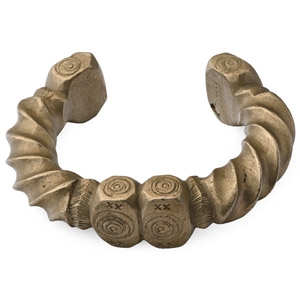
African Brass Manilla Slave Bracelet
Okombo Tribe, late 19th-early 20th century A.D.Sold for (Inc. bp): £52
Penannular in form, comprising rectangular polyhedral blocks with ring-and-dot ornament, spiral form to the arms. 244 grams, 87 mm
From Nigeria, West Africa. From an old Derby, UK, specialist collection. From the property of a late Lincolnshire, UK, gentleman.
Once a form of currency for West African peoples, manillas became one of the main currencies of choice during the slave trade to the Americas. Their usage during this time in history was of such prevalence that they were often referred to as “slave trade money.” Provenance: Private Derby Oriental Collection. The Manilla is in very good condition and measures 105mm wide and weighs about 250gms. Manillas are typically horseshoe-shaped with flared ends and often decorated with balls on each end. Africans from each region had names for each variety of manilla and were very particular about the types they would accept. They valued the Manillas by the sound they made when struck and used them as the dominant form of currency for many things including everyday market purchases, bride price and burials. The main purpose of the manilla – the trading and purchase of slaves- fostered a system where the incoming voyage of Europeans took manillas to West Africa to obtain slaves, who were then taken to the Americas. The price of a slave valued in manillas varied depending on the time, place and type being offered. -
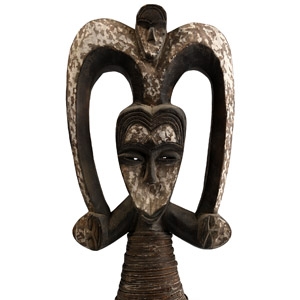
African Wooden Ceremonial 'Forest Spirit' Face Mask
Kwele Tribe, early-mid 20th century A.D.Sold for (Inc. bp): £78
Carved wooden 'Four Faces Forest Spirit Mask' from Gabon, displaying flat surfaces with whitened heart-shaped faces each with a triangular nose, coffee-bean eyes and small or non-existent mouth; the two large carved horns represent the antelope. 1.2 kg, 50 cm
From Gabon, West Africa. From the property of a late Lincolnshire, UK, gentleman.
The faces are usually painted in white kaolin earth, a pigment associated by the Kwele with light and clarity, the two essential factors in the fight against evil. The Kwele occupy a great forest region on the borders of Gabon, Cameroon and the Republic of Congo. -
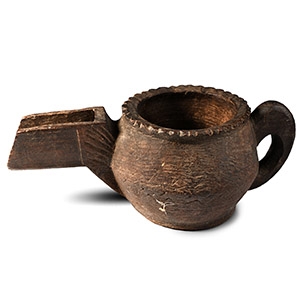
African Wooden Water Jug
Early-mid 20th century A.D.Sold for (Inc. bp): £26
With geometric carved decoration, large spout, strap handle and a serrated rim; West African type. 511 grams, 28.5 cm
From West Africa. From an old Surrey, UK, oriental and ethnographical collection; acquired during 1950s. From the property of a late Lincolnshire, UK, gentleman. -
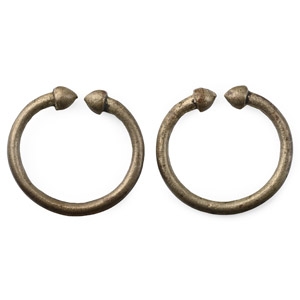
African Brass Kano Bracelet Pair
Okombo Tribe, late 19th-early 20th century A.D.Sold for (Inc. bp): £7
Penannular in form with plain white brass body and cone-shaped finials. 92 grams total, 63 mm each
From Nigeria, West Africa. From an old Derby, UK, specialist collection. From the property of a late Lincolnshire, UK, gentleman.
The bracelet is the most common money form in Africa. It served the important monetary functions of portability and wealth display. Variants of this form were accepted virtually everywhere in Africa. -
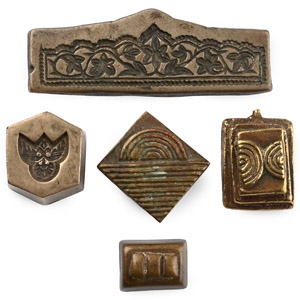
Ashanti Bronze Gold Weight Collection
Akan, 19th-20th century A.D.Sold for (Inc. bp): £59
Including a hexagonal-section block with stamped motif, rectangular bars and other types. 211 grams total, 19-68 mm
From an old Oxford, UK, collection. From the property of a late Lincolnshire, UK, gentleman. -
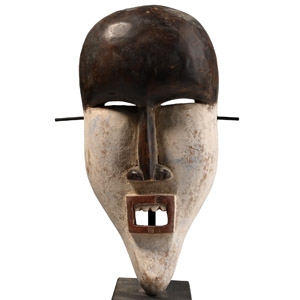
African Wooden Ceremonial Face Mask
Salampasu Tribe, early to mid 20th century A.D.Sold for (Inc. bp): £286
Piriform and hollow to the reverse, with white-painted lower face, long nose, a square red-painted mouth with carved teeth; mounted on a custom-made stand. 855 grams total, 39 cm including stand
From the frontier between the Democratic Republic of the Congo and Angola, Central Africa. From a private London, UK, ethnographic collection. From the property of a late Lincolnshire, UK, gentleman.
Salampasu masks were integral part of the warriors’ society whose primary task was to protect this small enclave against invasions by outside kingdoms.

