-
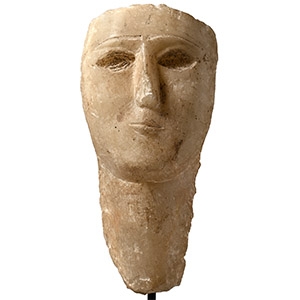
South Arabian Alabaster Head of a Woman
6th-4th century B.C.Sold for (Inc. bp): £1,105
Large female head with angular nose with straight ridge, rounded cheeks and chin, large sockets for inlaid eyes with rounded depressions in the centre of the eyes, grooved eyebrows and outlines of the eyes, the tapering neck long and cylindrical, the back left roughly tooled; mounted on a custom-made display stand. 3.66 kg total, 31.4 cm including stand
UK collection, 1990s. Acquired on the UK art market, before 2000. Private collection, Mr M.V., a London-based businessman.
This finely carved calcite-alabaster head was originally set within a stela and inscribed with the name of the deceased. Six hundred of these funerary stelae were discovered in localities like Mārib, and other examples were later found during the excavations of the Awwam temple cemetery. -
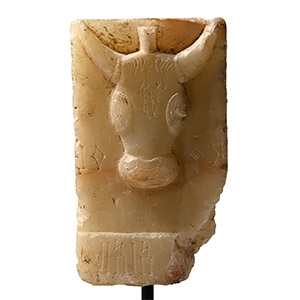
South Arabian Alabaster Plaque with Bull's Head
3rd-1st century B.C.Sold for (Inc. bp): £910
Comprising a square panel with a bull's head in low-relief, striated eyes and flaring nostrils, a thick tuft of hair arranged between the eyes, shallow acanthus leaf between curved horns, inscription on the rectangular space at the bottom of the panel; mounted on a custom-made display stand. 2.09 kg total, 19.8 cm including stand
UK collection, 1990s. Acquired on the UK art market, before 2000. Private collection, Mr M.V., a London-based businessman.
The presence of these representations in South Arabian cemeteries attests to the importance of the bull in the religious iconography of pre-Islamic Arabia. -
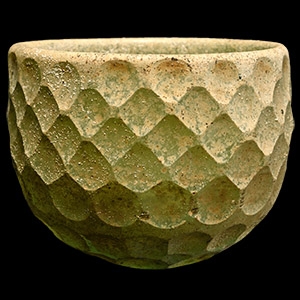
Sasanian Cut Glass Bowl
5th century A.D.Sold for (Inc. bp): £2,340
Rounded in profile and decorated with a dense frieze of wheel-cut facets. 187 grams, 96 mm
London art market, 1989. Private collection, London, UK. This lot has been checked against the Interpol Database of stolen works of art and is accompanied by a search certificate number no.12896-241337. -
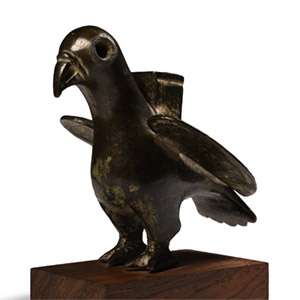
Western Asiatic Bronze Incense Burner in the Shape of an Eagle
9th-11th century A.D.Sold for (Inc. bp): £5,980
With outstretched wings and erect body, open beak and eyes hollowed to accept inserts, five-feather spread tail and a rectangular socket to the back; mounted on a custom-made display stand. 430 grams total, 11 cm including stand
Béla Hein collection, Paris, France, before 1931. Accompanied by an academic report by Dr Raffaele D’Amato. This lot has been checked against the Interpol Database of stolen works of art and is accompanied by a search certificate number no.12569-232077.
Béla Hein (1883-1931) was a prominent dealer and collector of African art in early 20th century Paris. In the early 1920s, he founded a gallery specialising in African art, contemporary sculpture, and a variety of curiosities, including antiquities. Hein's influence extended across the art world, and his collection reflected a keen eye for both historical and aesthetic significance. -
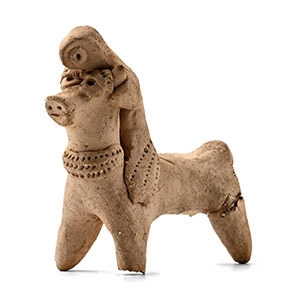
Syro-Hittite Terracotta Man Riding Bull
12th-7th century B.C.Sold for (Inc. bp): £98
Standing bull with a rider on its back holding onto the horns, leaning forwards, staring the bull in the eyes and applying what is possibly a bridle decorated with a series of impressed 'dots'; the rider seated forward on the shoulders, applied eyes with central impressed 'dot', a series of dots impressed in an X-pattern between shoulders and hips at the rear and three bands of impressed dots to the legs; bull's tail held firmly between his back legs, applied eyes, shallow dots and incised line representing muzzle and mouth, applied collar at the neck decorated with three lines of impressed 'dots'. 41.5 grams, 64 mm
Fair condition, repaired.
Ex important Mayfair, London, UK, collection, before 2000. From the private collection of John Meredith, acquired since the 1990s; thence by descent. -
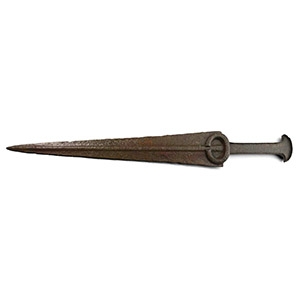
Luristan Bronze Short Sword
2nd-1st millennium B.C.Sold for (Inc. bp): £780
A short sword or dirk with slender triangular blade, low round midrib with flat upper face, annular guard and remains of scooped shoulders, columnar grip with open sides to receive bone or wooden hilt, crescent pommel. 303 grams, 40.5 cm
Ex Abelita family collection, 1990s.
These bronze daggers or dirks, typical of Marlik culture, were cast in a one piece mould according to Negahban, although in some specimens the penannular guard was cast later into the blade. The separate sets of encircling ribs on the grips are again typical of swords from the Marlik area. -
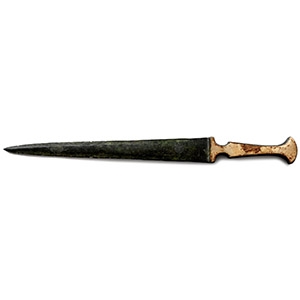
Luristan Bronze Short Sword with Inlaid Handle
1000 B.C.Sold for (Inc. bp): £1,430
With triangular tapering blade, flanged hilt to accept inlays, bone on the handle, two angular indentations on each side of the guard. 515 grams, 50 cm
with Bonhams, London, 4 July 1996, no.324. Private collection, Suffolk.
This dirk is of Medvedskaya type I, a common weapon among dirks and daggers produced in Luristan. According to Moorey, such kind of daggers were produced in Western Persia at least since the 13th century B.C. and remained in use at least until the 9th century B.C. The two practically identical examples published by Khorasani are preserved in the National Museum of Teheran. -
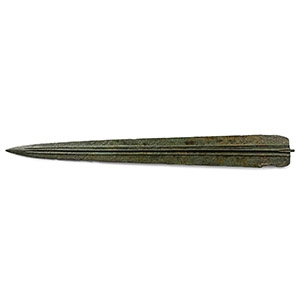
Luristan Bronze Short Sword with Blood Channels
1st millennium B.C.Sold for (Inc. bp): £286
Broad two-edged blade, leaf-shaped with short rectangular tang, corrugated midrib extending almost to the tip; rounded shoulders. 558 grams, 53 cm
with Archaeologia, Switzerland, before 1983. Ex private North American collection. London private collection, 2016. -
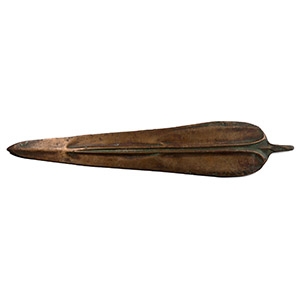
Western Asiatic Bronze Sword Blade
Mid 1st millennium B.C.Sold for (Inc. bp): £234
Two-edged leaf-shaped blade with short rectangular tang, corrugated midrib extending almost to the tip and flared at the shoulders. 384 grams, 38.7 cm
From a London collection, early 2000s. -
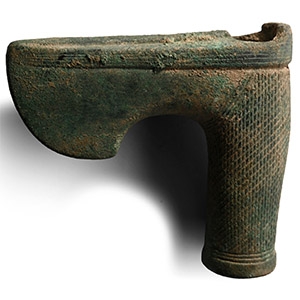
Elamite Decorated Bronze Axehead
2nd-1st millennium B.C.Sold for (Inc. bp): £1,430
With a short socketted shaft with hatched panel, triangular-section blade with reeded upper edge, broadening towards the cutting edge. 390 grams, 96 mm
French collection, 1980s. Acquired on the London art market. Private collection, London, UK. -
.jpg)
Elamite Decorated Bronze Axehead
2nd-1st millennium B.C.Sold for (Inc. bp): £572
With a crescentic blade, ornamental curved edging to the upper shaft hole, a collar to the lower shaft hole, raised band around the edge of the blade. 330 grams, 11.6 cm
French collection, 1980s. Acquired on the London art market. Private collection, London, UK. -
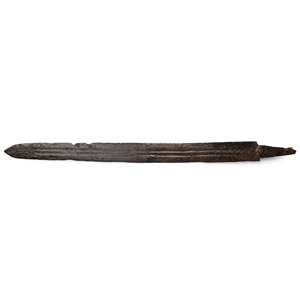
Roman Iron Spatha Sword
2nd-4th century A.D.Sold for (Inc. bp): £2,340
A double-edged blade of Lauriacum Hromówka typology with blood channels running down most of its length on both sides, parallel cutting edges tapering towards the triangular point, massive tapering tang with a bronze nail for the fastening of the pommel, and an ancient repair at the base of the tang with a flattened domed rivet. 468 grams, 70.1 cm
From the private collection of a London gentleman, from his grandfather's collection formed before the early 1970s. Accompanied by an academic report by Dr Raffaele D’Amato. This lot has been checked against the Interpol Database of stolen works of art and is accompanied by a search certificate number no.12917-245171.
Although in Latin literature the late Roman sword was often still conventionally called gladius (Ammianus Marcellinus, Historiae, XIX, 6; Passio SS. Rogatiani et Donatiani, 1859, p.323), the main kind of blade of the 3rd and 4th century Roman soldier belongs to the type so-called spatha (Scriptores Historia Augusta, Divus Claudius, XXV,7,5; 8,5) which directly derived from the long cutting Celtic sword of the La Tène III period, already used by the cavalrymen and auxilia of the previous ages. The great spatha (spathì) of the Roman heavy infantryman was considered by Julius Africanus (Fragm., I, 1, 53) as the main weapon of the armoured legionary of Alexander Severus. The frequent clashes with Germanic warriors armed with long swords and the increased recruitment of them in the Roman army quickened a more intensive use of the spathae by the milites legionarii. These longer swords slowly replaced the shorter gladius, the double-edged sword of the imperial infantry, for all types of troops.

