-
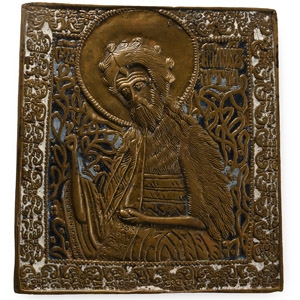
Russian Orthodox Enamelled Bronze Travel Icon with Saint John the Baptist
19th century A.D.Sold for (Inc. bp): £169
With blue champlevé enamel, depicting Saint John the Baptist, portrayed as an elderly man, wearing a camel-skin robe; his left hand holding a scroll with the prophecy of Isaiah, while the right hand is raised in blessing gesture; at the top, Old Slavic Inscription ‘Saint John the Precursor’ (Иоа́нн Предте́ча); pseudo-vegetal background with abstract decorations. 190 grams, 11.8 cm
Acquired from Chris Martin-Zakheim, Iconastas, 5 Piccadilly Arcade, London SW1. From the private collection of a West London, UK, gentleman, formed since the early 2000s.
John the Baptist is called ‘the Precursor’ because his evangelical mission was to prepare the way for Jesus Christ, announcing his imminent arrival and calling people to repentance and welcome the Messiah. His role as a ‘forerunner prophet’ makes him the link between the Old and New Testaments, as he prophesied the coming of Christ and baptised him in the Jordan River. He was considered the highest among the prophets in the hierarchy of saints of the Orthodox Church. -
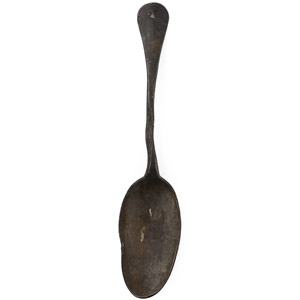
Georgian Pewter Spoon
18th century A.D.Sold for (Inc. bp): £7
With long ovoid bowl, square-section shank and broad scooped finial; usage wear. 75 grams, 20.2 cm
Acquired in the 1980s. From an old Cheshire, UK, archaeological collection. From the property of a late Lincolnshire, UK, gentleman. -
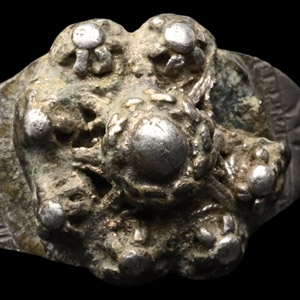
Post Medieval Silver Ring with Rosette
Circa 17th-18th century A.D.Sold for (Inc. bp): £33
Expanding hoop with linear decoration on each side of the bezel, bezel formed of small floral motifs forming a large rosette. 5.44 grams, 25.52 mm overall, 18.69 x 17.53 mm internal diameter (approximate size British O, USA 7, Europe 14.98, Japan 14)
Ex German art market, 2000s. Acquired from an EU collector living in London. From the collection of a Surrey, UK, gentleman. -
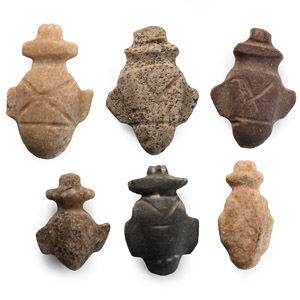
Egyptian Style Stone Heart Amulet Collection
20th century A.D.Sold for (Inc. bp): £46
Mainly heart-type in various materials. 16.8 grams total, 19-27 mm
with Archaeologia, Switzerland, before 1983. Ex private North American collection. London private collection, 2016.
According to ancient Egyptian beliefs, the heart (ib) was regarded as the centre of intelligence, emotions, and behaviour. It was also believed to store a person's memories. During the Weighing of the Heart ceremony in the afterlife, the heart could speak on behalf of the deceased and account for their lifetime of actions before Osiris. For this reason, heart amulets were placed on the mummy to protect the organ and ensure a favourable outcome during judgment. -
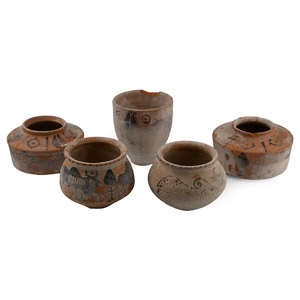
Indus Valley Style Terracotta Vessel Group
20th century A.D.Sold for (Inc. bp): £46
Mixed group of jars and a cup with painted details. 1.05 kg, 8.2-11 cm wide
Very fine condition.
From the private collection of John Meredith, acquired since the 1990s; thence by descent. -
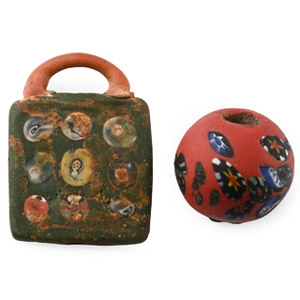
Post Medieval Glass Item Group
India, 20th century A.D.Sold for (Inc. bp): £13
Comprising a large spherical mosaic glass bead and a handbag-shaped mosaic glass pendant. 75.6 grams total, 33-55 mm
Private collection, UK. -
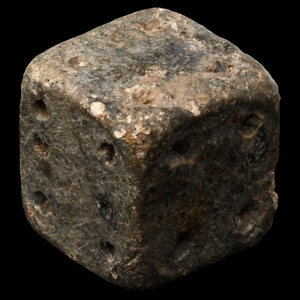
Lead Gaming Dice
17th-18th century A.D.Sold for (Inc. bp): £52
Cuboid with punched pellet markings disposed 1:6, 2:4, 3:5. 24.9 grams, 14 mm
From the private collection of Colin Narbeth, UK, 1990s, with collection reference no.128. -
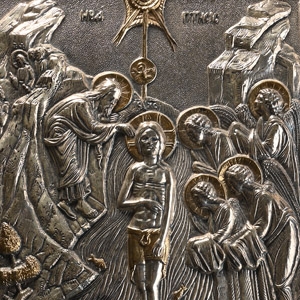
Reproduction Silver-Gilt Byzantine Icon of Christ's Baptism
20th century A.D.Sold for (Inc. bp): £72
Representing the Epiphany (the Manifestation) of Jesus Christ; Jesus standing in the river, wearing a small loincloth made from a knotted tallit, recognisable by its striped edge; the rocky landscape of the Jordan valley temporarily breaking open and river becoming a vast whirlpool; from the left bank John reaching towards Jesus and blessing his cousin; four angels look on holding towels; above, the dove of the Holy Spirit with three rays of light; above the inscription Η ΒΑΠΤHCΙC (the Baptism). 110 grams, 26 x 20 cm
925 silver
Ex David Miller, Hemel Hempstead, London, UK. From the private collection of a West London, UK, gentleman, formed since the early 2000s.
The Gospel of Mark describes the voice of God announcing: ‘Thou art my beloved Son, with thee I am well pleased’ (Mark 1: 11). This is the theoretical moment after which Jesus becomes known as Christ and John becomes known as the Baptist. -
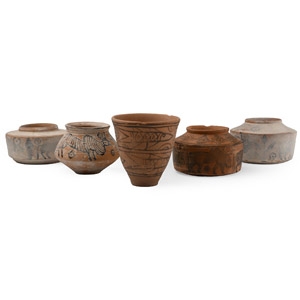
Indus Valley Style Terracotta Vessel Group
20th century A.D.Sold for (Inc. bp): £39
Mixed group of jars and a cup with painted details. 990 grams, 10-10.5 cm wide
Very fine condition.
From the private collection of John Meredith, acquired since the 1990s; thence by descent. -
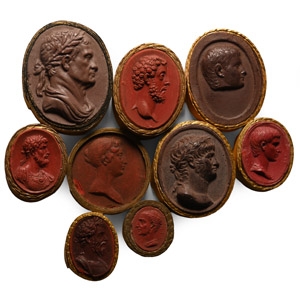
Roman Portraits Plaster Cast Collection
Late 19th-early 20th century A.D.Sold for (Inc. bp): £416
Comprising eight male portraits and one female portrait; each held in a cardboard frame. 61 grams total, 19-40 mm
From a private Tyneside collection, formed since the early 2000s. -
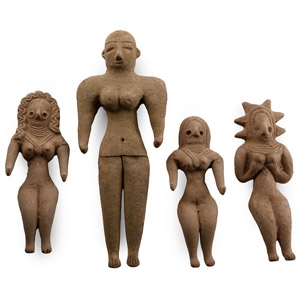
Indus Valley Style Terracotta Idol Group
20th century A.D.Sold for (Inc. bp): £39
Mixed group of figures with anatomical details. 352 grams, 11.5-17.5 cm
Very fine condition.
Property of a retired English university professor; acquired on the UK art market. From the private collection of John Meredith, acquired since the 1990s; thence by descent. -
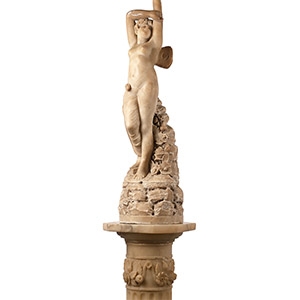
Large Marble Standing Nymph on a Stand
20th century A.D.Sold for (Inc. bp): £124
Showing a standing nude nymph with her arms elegantly raised and head tilted back exposing her neck, content expression on her relaxed face and mouth held slightly open showing her top teeth; a see-through garment wrapped around her waist; standing atop a fluted pillar with a floral wreath to the top. 81 kg total, 193 cm
Private collection, London.

