-
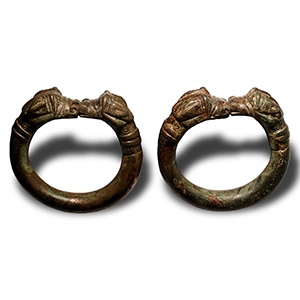
Monumental Luristan Bronze Armband Pair with Dragon Heads
Late 1st millennium B.C.Sold for (Inc. bp): £845
A matching pair of penannular armbands, each with a round-section body and dragon-head terminals, one terminal on each band separately made; the dragons with ring-and-dot eyes and linear decoration, slit mouths and flaring nostrils. 1.19 kg total, 13-13.1 cm
Ex London, UK gallery, 1971-early 2000s. Private collection, London.
Bronze armbands of this scale and quality are characteristic of Luristan, an important centre of metal production in western Iran during the early 1st millennium B.C. The region is renowned for its distinctive cast bronzes, including weapons, horse trappings, and items of personal adornment, often decorated with powerful animal imagery. The dragon, with its elongated body and open jaws, was a common motif in Luristan art, symbolising strength, protection, and the supernatural. Armbands with dragon-head terminals likely carried an apotropaic function, serving both as impressive ornaments and as protective charms for the wearer. Monumental examples such as this pair are rare survivals, attesting to the high status of their original owner and the extraordinary skill of Luristan bronze workers. -
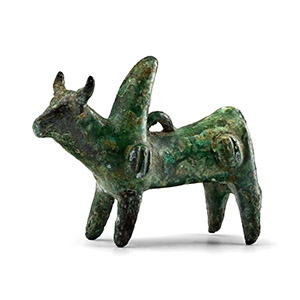
Bactrian Bronze Zebu Statuette
2nd-1st century B.C.Sold for (Inc. bp): £351
Modelled in the round and hollow to the underside with loop behind the hump. 138 grams, 80 mm
UK collection, 1990s. Acquired on the UK art market, before 2000. Private collection, Mr M.V., a London-based businessman. -
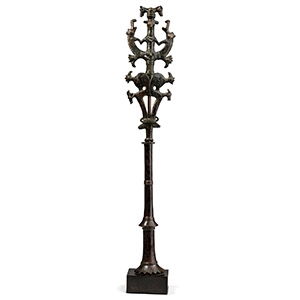
Large Luristan Bronze 'Master of Animals' Bronze Finial
8th-7th century B.C.Sold for (Inc. bp): £2,340
Formed as a Master of Animals atop a collared tubular stem with flared foot; the finial composed of two goats with heads returned and a looped band at the rump, above these two birds standing looking up towards two quadrupeds each with a bird's head on the rump; each in the grip of the Master standing crowned between them; the Master with tubular body, animal-like ears, prominent nose above a small mouth and wearing collars, neck rings and tiered headdress with addorsed bovine heads; waisted socket below and flared dentilled rim; mounted on a display stand. 916 grams total, 43 cm including stand
Acquired in Iran, 1967. Private collection, UK. Accompanied by an academic report by Dr Raffaele D'Amato. This lot has been checked against the Interpol Database of stolen works of art and is accompanied by a search certificate number no.12824-241323.
The “Master of Animals” is a long-lived Near Eastern motif showing a central figure—human, heroic or divine—grasping two confronting beasts, usually by their necks or forelegs. First seen in late 4th–3rd millennium BC Mesopotamian seals, it spread across Iran, Anatolia and the Levant and remained current into the 1st millennium BC. Its meaning is straightforward and powerful: control over the wild, the protection of order, and the sanction of royal or divine authority. The image appears on seals, plaques and weapons, and in the round on bronze fittings and finials (notably in Luristan), where it likely marked status and carried an apotropaic force. For collectors, the type is prized for its clear silhouette and economy of form, the instant legibility of a hero mastering chaos, a theme as old as the first cities and as compelling today. -
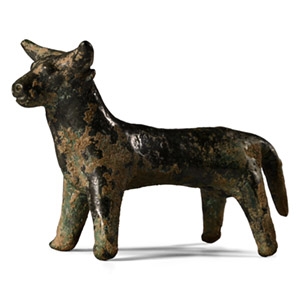
Large Western Asiatic Bronze Figure of a Bull
Circa 10th century B.C.Sold for (Inc. bp): £10,296
A heavy example modelled in the round with slender, elongated trunk, thick neck and prominent horns, vestigial ears below; Anatolian workmanship. 1.32 kg, 19.2 cm
with Christie's, New York, 8 June 2001, no.363. Private collection, Europe. Accompanied by copies of the relevant Christie's catalogue pages. Accompanied by an academic report by Dr Raffaele D’Amato. This lot has been checked against the Interpol Database of stolen works of art and is accompanied by a search certificate number no.12414-226675.
Bulls with raised horns have been found in central Anatolian royal burials. Among the sacred animals found in the royal graves of Alacahöyük, the bull and the deer are always present. This simplified figure of a young and spritely standing bull recalls the Baltimore bull and the other two examples in the Cleveland Museum of Art. Images of bulls were mounted on standards, used in battlefields or in religious processions, or as in the royal graves of Alacahöyük, they were used to decorate cult furniture or shrines. -
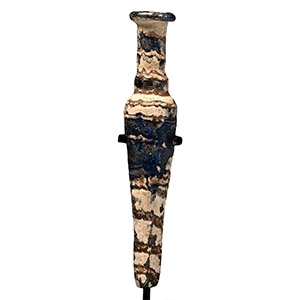
Achaemenid Glass Flask
Circa 5th century B.C.Sold for (Inc. bp): £468
Comprising a tapering square-section body, square base and rounded shoulders; dragged trail ornament to each face narrow neck and everted rolled rim; mounted on a custom-made stand. 76 grams total, 14.6 cm including stand
From an important collection of glass, London, UK, 1990s. -
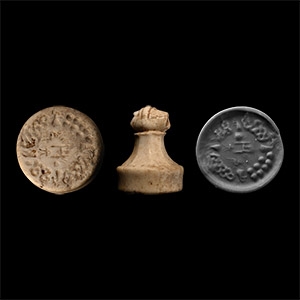
Anatolian White Marble Stamp Seal with Owner's Name
2nd millennium B.C.Sold for (Inc. bp): £1,820
Comprising a thick discoid body with a tapering handle above, accompanied by a copy of an old scholarly note, typed and signed by W.G. Lambert, late Professor of Assyriology, University of Birmingham, 1970-1993, which states: 'Stamp Seal of White Marble, 28 x 25 mm. The base of the stamp is round, with a flat bottom and slightly outcurving sides. The handle rises from the base with decreasing diameter, and eight sides, to the knob, which is roughly oval and pierced from side to side, with a raised band over the top. This shape is a typical Hittite stamp seal shape. The design consists of a band of design around the edge surrounding hieroglyphs in the middle. The band consists of four sections of pattern: three kinds of guilloche and one section of dots, interspersed with two opposite animal heads, and two opposite unidentified items. The hieroglyphs are no doubt the owner's name. This seal comes from Anatolia, and dates to the 17/16th century B.C. It is in good state of preservation.' 26.7 grams, 35 mm
UK private collection, acquired 1990-1993. Accompanied by a copy of a scholarly note, typed and signed by Professor Wilfrid George Lambert in 1991.
Seals were the working signatures of the ancient Near East. Pressed or rolled into wet clay, they secured jars, bags, doors and tablets, and left a distinct impression that identified the owner, authorised a transaction, and showed whether a container had been opened. Stamp seals (pressed once to leave a single emblem) appear from the 7th–4th millennia BC and continue throughout later periods; cylinder seals (rolled to create a repeating frieze) developed in Mesopotamia in the late 4th millennium BC and are used into the 1st millennium BC. Beyond administration, seals were miniature artworks and amulets. Their images—gods and worshippers, royal hunts, banquets, heroes and mythic beasts—broadcast rank, piety and profession, and were believed to protect the owner. Materials range from soft stones to hard chalcedonies, haematite and lapis, worked with drills and abrasives to achieve crisp intaglio cutting. Many were worn on cords or rings and followed their owners through life, sometimes into the grave. Seals matter because they underpin the earliest systems of record-keeping and trade. Impressions on tablets and bullae are primary documents for ancient law, economy and religion; the seals themselves preserve that imagery in the round. For collectors, well-cut examples with sharp impressions, good polish and honest ancient wear are especially desirable, and pieces with early collection histories are keenly sought. -
.jpg)
Seljuk Gold Bracelet with Fluted Body
11th-13th century A.D.Sold for (Inc. bp): £3,900
Triangular in section, the shank formed as continuous loops of gold rod tapering to the shoulders, closure formed as a domed disc with a granulated top and collar, granulated triangular plaque to each shoulder. 46.8 grams, 70 mm
Acquired in the 1980s. Private collection, Switzerland, thence by descent. Private collection, since the late 1990s. This lot has been checked against the Interpol Database of stolen works of art and is accompanied by a search certificate number no.12707-234683. -
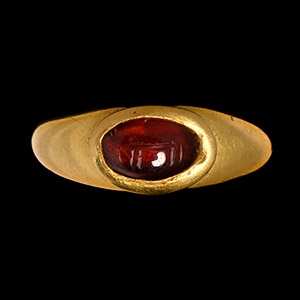
Western Asiatic Gold Ring with Calligraphic Gemstone
12th-15th century A.D.Sold for (Inc. bp): £936
Ellipsoid bezel with inset garnet cabochon, incised Kufic inscription. 7.00 grams, 22.05 mm overall, 16.29 mm internal diameter (approximate size British J 1/2, USA 5, Europe 9.32, Japan 9)
with Archaeologia, Switzerland, before 1983. Ex private North American collection. London private collection, 2016. -
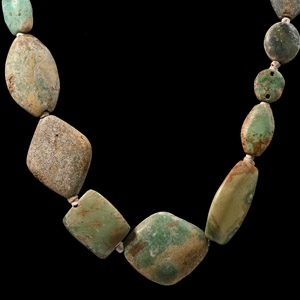
Western Asiatic Turquoise-Coloured Stone Bead Necklace
1st millennium B.C. and laterSold for (Inc. bp): £520
Restrung designer group of flat-diamond, lentoid-section tabular, and other types. 99 grams, 66 cm
From the collection of a late Japanese gentleman, 1970s onwards. -
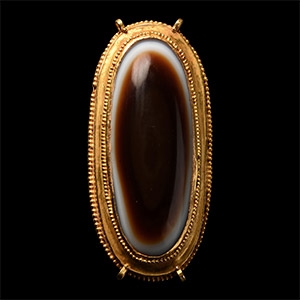
Bactrian Gold Pendant with Agate Bead
4th-2nd century B.C.Sold for (Inc. bp): £3,640
Stepped frame with bands of granulation and four small suspension loops, inset oval banded agate cabochon. 14.6 grams, 50 mm
Yvette Raoux, Paris, 1960s-1980s. Acquired by the current owner in 1989. with Christie's, Ancient Jewelry, New York, 6 December 2007, no.466. This lot has been checked against the Interpol Database of stolen works of art and is accompanied by search certificate number no.12977-243176. -
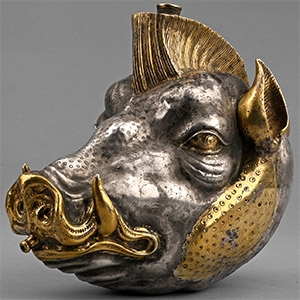
Large Sogdian Silver-Gilt Wild Boar Rhyton
5th-6th century A.D.Sold for (Inc. bp): £65,000
A Sogdian or Sasanian head of a wild boar with detailed facial features including large snout, curled tusks, alert eyes with heavy eyelids, erect ears, the animal's mane framing the head and back; a series of small circles decorating the cheeks; an oval vessel mouth emerging from the mane and the spout formed as a pierced stud at the centre of the boar's chest. 1.3 kg, 21.5 cm long
with a New York gallery, 1970s. Private collection, London. Accompanied by three black-and-white photographs taken prior to cleaning, believed to date from the 1970s. Accompanied by an academic report by Dr Raffaele D’Amato. This lot has been checked against the Interpol Database of stolen works of art and is accompanied by search certificate number no.12979-246395.
The production of silver vessels and dinner objects for the court was highly centralised within the Sasanian Empire. In the 5th and 6th century AD, the production of silver vessels expanded, creating new shapes, such as pitchers, elliptical bowls and high-footed bowls. If the iconography included both Dionysian and Christian imagery, the subjects linked with royal power were the favourites, and among them, the boar. The boar was, in fact, the animal associated with the Zoroastrian Izad Vahram, the epitome of victory. It was not a coincidence that one of the usurpers of the Persian throne, the general Farrukhān, took the title of Shahrbaraz (reigning in 630 AD), whose name means ‘The Boar of the Empire’, attesting to his dexterity in military command and warlike personality. Shahrwarāz derived in fact from the middle-Persian word shahr (country) and warāz (boar). -
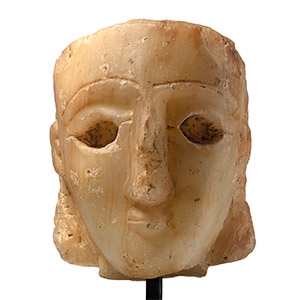
South Arabian Alabaster Head of a Female
3rd-1st century B.C.Sold for (Inc. bp): £1,170
Sculptured female head, angular nose with straight ridge, slightly rounded cheeks and triangular chin, large sockets for inlaid eyes, grooved eyebrows and high ears, long locks of hair visible below the ears; mounted on a custom-made display stand. 1.96 kg total, 18.5 cm including stand
UK collection, 1990s. Acquired on the UK art market, before 2000. Private collection, Mr M.V., a London-based businessman.
In the Arabian funerary sculptures of the period, the tops of the heads are usually cut off flat just above the hair line and left roughly tooled. The cut was due to the necessity of fitting them into niches of 'house shrines'. Large stelae with niches containing such heads were found in the Timna Cemetery.

