-
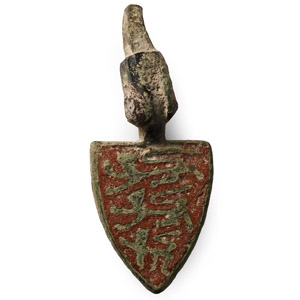
Medieval Knight's Bronze Heraldic Horse Harness Pendant with the Royal Arms of England
Circa 14th century A.D.Sold for (Inc. bp): £234
Heater-shaped with red enamel field and reversed three lions passant gardant, with hinged hanger above. 6.73 grams, 40 mm
Found West Sussex, UK. -
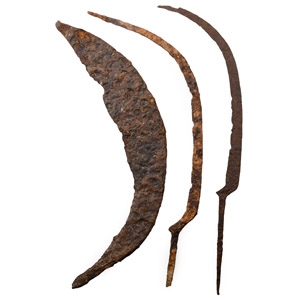
Medieval Iron Scythe Group
13th-14th century A.D.Sold for (Inc. bp): £33
Each with attachment spike and curved blade sharpened on the inner edge. 373 grams total, 31.2-35.5 cm
From the property of a late Lincolnshire, UK, gentleman. -
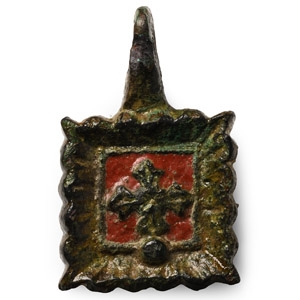
Medieval Knight's Bronze Heraldic Horse Harness Pendant
14th-15th century A.D.Sold for (Inc. bp): £169
Square with integral pierced lug above; dentilled rim with petal detailing, central square field with red enamel finish and reserved cross moline motif. 13.6 grams, 38 mm
Ex Graham Slater collection, Cambridge, 1980s-1990s. -
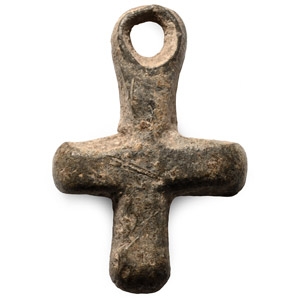
Medieval Lead Cross Pendant
Circa 14th-16th century A.D.Sold for (Inc. bp): £14
Each arm trapezoidal in section; integral loop. 7.84 grams, 29 mm
Ex P Chapman collection, 1980s-1990s. -
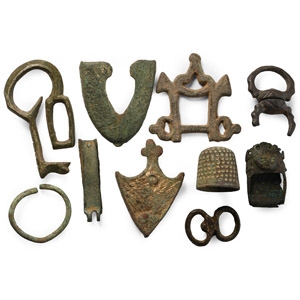
Medieval Bronze Artefact Collection
12th-15th century A.D.Sold for (Inc. bp): £20
Including a thimble, scabbard chape, buckle loop and other items. 90 grams total, 19.5-54 mm
Found Gloucestershire, UK. Acquired from the early 1980s. From the private collection of a late Gloucestershire, UK, gentleman; thence by descent. -
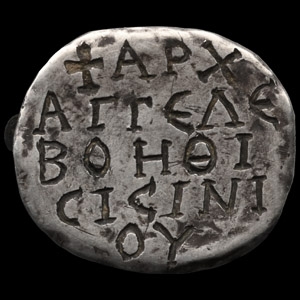
Medieval Bronze and Silver Ring with Greek Inscription
Circa 15th-16th century A.D.Sold for (Inc. bp): £140
Comprising a D-section bronze hoop and large silver bezel with Greek inscription in five lines reading '+ APX / AITEΛE / BOHΘI / CICINI / OY'. 8.80 grams, 24.12 mm overall, 19.44 mm internal diameter (approximate size British T, USA 9 1/2, Europe 21.26, Japan 20)
Ex German art market, 2000s. Acquired from an EU collector living in London. From the collection of a Surrey, UK, gentleman. -
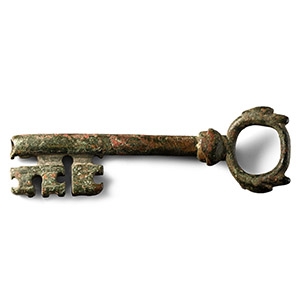
Large Medieval Bronze Door Key with Animal Heads on Handle
11th-12th century A.D.Sold for (Inc. bp): £260
Comprising a tubular-section shank, circular bow with lateral beast-heads, large rectangular bit with clefts and grooved wards. 61.9 grams, 10.3 cm
Found Gloucestershire, UK. -
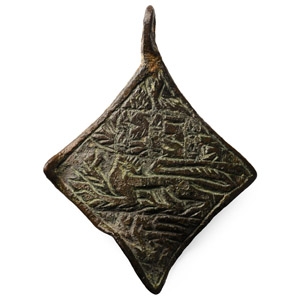
Medieval Knight's Bronze Heraldic Horse Harness Pendant
14th-15th century A.D.Sold for (Inc. bp): £85
Lozengiform with reserved border and integral loop, three lions passant gardant in low relief. 9.22 grams, 51 mm
Ex Graham Slater collection, Cambridge, 1980s-1990s. -
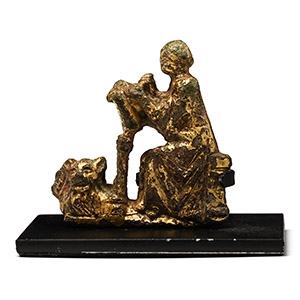
Medieval Gilt Bronze Mount of Saint Mark with Lion
French, 13th-14th century A.D.Sold for (Inc. bp): £247
Showing the robed saint seated on a low chair with a lion, his emblem, at his feet, originally an element from a processional cross; accompanied by a custom-made display stand. 21.37 grams, 36 mm high
Private collection, UK. -
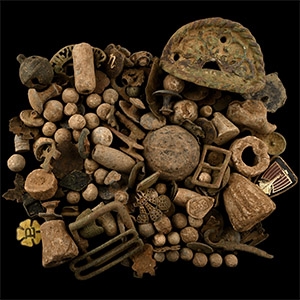
Medieval and Later Artefact Group
14th-20th century AD.Sold for (Inc. bp): £13
Including buttons, pendants, badges, musket and pistol balls, buckles, and other items. 2.23 kg total, 7-87 mm
Found Suffolk, UK. (Uk buyers only, not for export) -
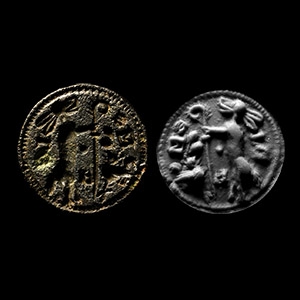
Medieval Bronze Chess Piece Personal Seal Matrix with Fox-Bishop
14th century A.D.Sold for (Inc. bp): £143
With a beaded border, a long-eared fox with a bishop’s crozier preaches to a congregation of birds; this hugely popular satirical motif in which the pastor becomes the predator, preying on his flock, was originally directed against the mendicant friars but soon came to criticise the regular clergy too; the two pairs of letters, either side of the ‘preacher’, appear to read 'IE ME', perhaps Anglo-Norman for ‘I love’. 7.09 grams, 18.65 mm high
Found Gloucestershire, UK. Acquired from the early 1980s. From the private collection of a late Gloucestershire, UK, gentleman; thence by descent. -
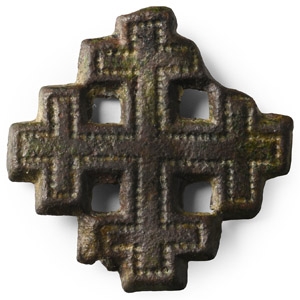
Medieval Bronze Knight's Holy Sepulchre Badge
Circa 13th-14th century A.D.Sold for (Inc. bp): £143
Formed as a cross-crosslet, the symbol of the Knights of the Holy Sepulchre, with punched-point border. 0.99 grams, 22 mm
Ex Graham Slater collection, Cambridge, 1980s-1990s.
The 'Equestrian Order of the Holy Sepulchre of Jerusalem' was an order of knighthood under the protection of the Pope, formed around 1099 AD by Duke Godfrey of Bouillon, the leader of the First Crusade. It was established for the protection of pilgrims travelling to the Holy Land and was recognised by a Papal Bull in about 1113 AD.

