-
.jpg)
Mesopotamian Banded Agate Cylinder Seal
1st millennium B.C.Sold for (Inc. bp): £520
With incuse rearing ibex and altar; supplied with a museum-quality impression. 2.35 grams, 22.5 mm
From the 'S' collection, acquired 1970-1990s. The collection was seen and studied by W.G. Lambert, late Professor of Assyriology at the University of Birmingham, 1970-1993. -
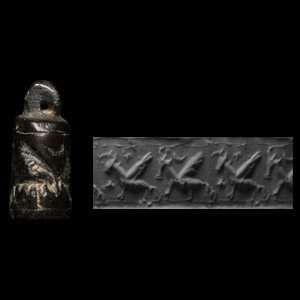
Urartu Black Stone Stamp-Cylinder Seal with Winged Quadruped
Circa 900-700 B.C.Sold for (Inc. bp): £910
With two winged monsters, accompanied by museum quality impressions and a copy of an old scholarly note, typed and signed by W.G. Lambert, late Professor of Assyriology, University of Birmingham, 1970-1993, which states: 'Description of Stamp-Cylinder Seal of black stone, 31 x 14 mm. Sides: two winged monsters of slightly differing type; lunar crescent and other fillers, the design between rules. Base: winged quadruped. The stamp-cylinder is from the ancient Urartu, the area around lake Van, and dates c. 900-700 B.C. It has a pierced lug at the top which allows the base to be used as a stamp seal. Such monsters as are depicted are typical of Urartian art, not only of their seals. Condition very good.' 7.88 grams, 30 mm
UK private collection, acquired 1990-1993. Accompanied by a copy of a scholarly note, typed and signed by Professor Wilfrid George Lambert in 1987. -
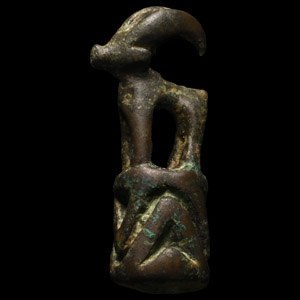
Anatolian Bronze Cylinder Seal Surmounted by Horned Animal
Late 3rd millennium B.C.Sold for (Inc. bp): £1,105
Cylindrical body topped with a standing quadruped, likely a mouflon, accompanied by a copy of an old scholarly note, typed and signed by W.G. Lambert, late Professor of Assyriology, University of Birmingham, 1970-1993, which states: 'Cylinder Seal of Bronze, surmounted by a Horned Animal Maximum height 42mm., Diameter of seal: 15mm. The animal has big, back-curving horns, and was probably meant as a mouflon sheep. It is decorative, makes an imposing piece of a simple seal shape. The design of the seal is a wavey line creating triangular spaces, which are filed with triangles of a smaller size or arrow-heads. In one case the latter and a v-shaped extra wavey line are used. The date of these ornamented seals has been disputed. Some scholars have put them in the third millennium B.C., some in the first millennium. The seal design is well known for the latter half of the third millennium and the beginning of the second millennium B.C., and the animal gives the impression of being related to such creatures in bronze from third millennium Anatolia. Thus this is a late-third-millennium seal, and is to be placed somewhere in the area from Anatolia to Kurdistan. Its condition is fine, and the metal sculpture is well done.' 25.7 grams, 41 mm
UK private collection, acquired 1990-1993. Accompanied by a copy of a scholarly note, typed and signed by Professor Wilfrid George Lambert in 1990.
Seals were the working signatures of the ancient Near East. Pressed or rolled into wet clay, they secured jars, bags, doors and tablets, and left a distinct impression that identified the owner, authorised a transaction, and showed whether a container had been opened. Stamp seals (pressed once to leave a single emblem) appear from the 7th–4th millennia BC and continue throughout later periods; cylinder seals (rolled to create a repeating frieze) develop in Mesopotamia in the late 4th millennium BC and are used into the 1st millennium BC. Beyond administration, seals were miniature artworks and amulets. Their images—gods and worshippers, royal hunts, banquets, heroes and mythic beasts—broadcast rank, piety and profession, and were believed to protect the owner. Materials range from soft stones to hard chalcedonies, haematite and lapis, worked with drills and abrasives to achieve crisp intaglio cutting. Many were worn on cords or rings and followed their owners through life, sometimes into the grave. Seals matter because they underpin the earliest systems of record-keeping and trade. Impressions on tablets and bullae are primary documents for ancient law, economy and religion; the seals themselves preserve that imagery in the round. -
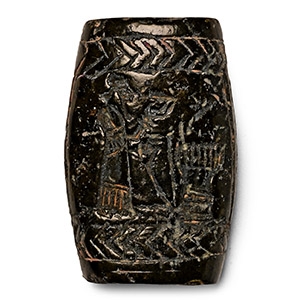
Assyrian Green Serpentine Amulet with Worshippers
Circa 900-600 B.C.Sold for (Inc. bp): £780
Bifacial amulet with chevron borders and worshippers, accompanied by a copy of an old scholarly note, typed and signed by W.G. Lambert, late Professor of Assyriology, University of Birmingham, 1970-1993, which states: 'Amulet of Green Serpentine, 31mm. high. There is a band of chevrons at both top and bottom of this amulet, going in opposite directions. Between them on the one side is a standing worshipper holding up a cup in one hand and a bow in the other, in front of him an altar. On the other side is a sacred tree under a winged solar disc, and to the other side of the tree is a minute worshipper with hands extended. [...] from any part of the [...].' 11.9 grams, 31 mm
with Bonhams, Fine Antiquities, 20th May, 1992, no.76. Accompanied by a copy of a scholarly note, typed and signed by Professor Wilfrid George Lambert in 1990. -
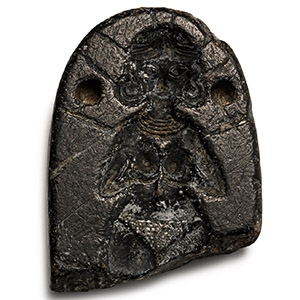
Western Asiatic Black Stone Mould for Female Figure
2000-1700 B.C.Sold for (Inc. bp): £390
Tongue-shaped mould fragment with a recessed female figure on the upper face, accompanied by a copy of an old scholarly note, typed and signed by W.G. Lambert, late Professor of Assyriology, University of Birmingham, 1970-1993, which states: 'Upper Portion of Mould in Black Stone, 39 x 29 x 10 mm. This mould served to make metal figurines of a nude female figure. It is preserved from the thighs up, and is in very good state of preservation. The figure is worked in much detail: the hair is carefully arranged on the head, she has large earrings, five strings of beads around the neck; she holds her hands under her breasts, and the pubic hair is carefully marked. The fine quality, detailed work of this piece is most unusual. It dates to c. 1200 - 1700 B.C and comes from Iraq or an adjacent area.' 23.43 grams, 38 mm
UK private collection, acquired 1990-1993. Accompanied by a copy of a scholarly note, typed and signed by Professor Wilfrid George Lambert in 1991. -
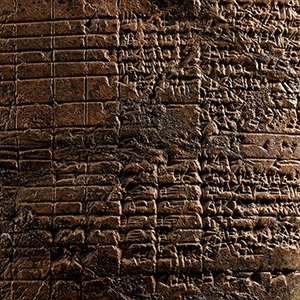
Very Large Sumerian Terracotta Cuneiform Tablet Recording Commodities for Various Named individuals
3rd millennium B.C.Sold for (Inc. bp): £3,380
Rectangular in plan with rounded edges, obverse with incised grid and dense cuneiform text across about half the available surface; one corner chipped. 931 grams, 17.2 cm
with Archaeologia, Switzerland, before 1983. Ex private North American collection. London private collection, 2016. -
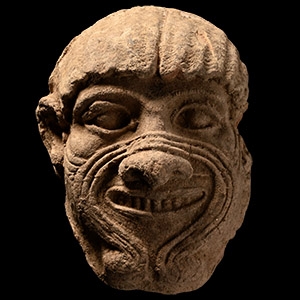
Babylonian Head of Humbaba
900-700 B.C.Sold for (Inc. bp): £3,380
Modelled in the half-round with hollow reverse; thick band of hair above the brow, small deep-set eyes, broad nose and mouth with three raised bands extending to a short beard; mounted on a custom-made stand. 128 grams total, 11.5 cm including stand
London art market, 1995. Private collection, Switzerland. Private collection, London. Accompanied by an academic report by Dr Raffaele D’Amato. This lot has been checked against the Interpol Database of stolen works of art and is accompanied by search certificate number no.12971-245208.
Humbaba (or Huwawa) was a demon of Mesopotamian legend, most famously described in the Epic of Gilgamesh. He was appointed by the god Enlil as the terrifying guardian of the Cedar Forest, a place of the gods. His grotesque features, with glaring eyes and monstrous expressions, were said to strike fear into anyone who saw him. Babylonian representations of Humbaba often emphasise this fierce appearance, with distorted facial traits designed to ward off evil. Such images could serve an apotropaic purpose, protecting people and places from harm, while also evoking one of the most memorable figures of Babylonian mythology. -
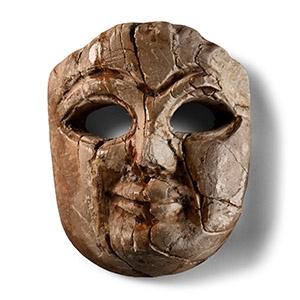
Sumerian Bone Face Mask
Circa 3000 B.C.Sold for (Inc. bp): £936
D-shaped in plan and plano-convex in section with large ellipsoid voids for the eyes, high-relief facial features. 50 grams, 59 mm
Acquired between 1981-1996. Property of a North American collector. -
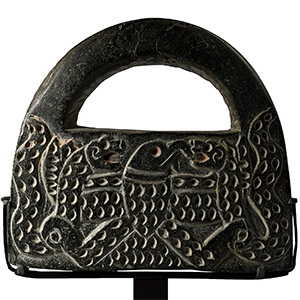
Bactrian Black Chlorite 'Hand Bag' Ceremonial Weight
3rd millennium B.C.Sold for (Inc. bp): £9,750
D-shaped in profile with void below the curved edge, obverse with reserved serpent and lion opposed, the lion's claw grasping the serpent; reverse with spread eagle flanked by rearing serpents; all bodies with sockets to accept coloured inserts; mounted on a custom-made stand. 2.95 kg total,18.5 cm (22.5 cm including stand)
with Gallery Rosen Ancient Art, Tel Aviv, 1960s. Ex London, UK, gallery, 1971-early 2000s. London, UK, collection. This lot has been checked against the Interpol Database of stolen works of art and is accompanied by a search certificate no.12774-237878.
The object could have been carried or swung in ceremonies or processions. On one side is a bird of prey, with its claws surrounded by the writhing bodies of two serpents, whose heads flank the bird's head. This symmetrical scheme probably renders a version of the enmity of eagle and serpent, which must have been an important theme of ancient Iranian art; the motif was later diffused throughout the world. -
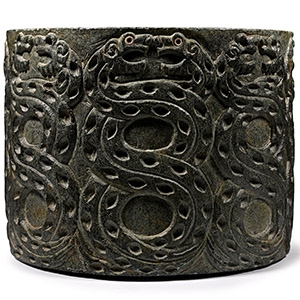
Large Bactrian Black Chlorite Vessel with Opposing Pairs of Serpents
3rd millennium B.C.Sold for (Inc. bp): £8,775
Drum-shaped vessel with reserved frieze to the outer face: pairs of opposed snakes with bodies entwined; shallow socket to each of the eyes to accept an inlay panel. 2 kg, 18 cm wide
with Gallery Rosen Ancient Art, Tel Aviv, 1960s. Ex London, UK, gallery, 1971-early 2000s. London, UK, collection. This lot has been checked against the Interpol Database of stolen works of art and is accompanied by a search certificate no.12772-237880.
The chlorite stone vessels of early Bactria were kidney-shaped vessels with simple geometric decoration or cylindrical like our specimen. Small cylindrical vases were used as cosmetic containers, together with chlorite cosmetic flasks. -
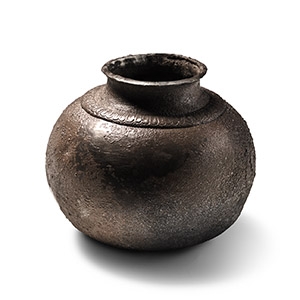
Achaemenid Silver Jar with Lotus Flower
Circa 500 B.C.Sold for (Inc. bp): £910
Squat in profile with basal disc, raised panel to the shoulder with lotus flower detailing, low neck and everted rim. 117 grams, 78 mm
London art market, 1980s-2000s. Private collection, London, UK. -
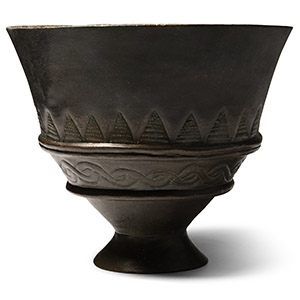
Urartu Decorated Bronze Chalice
Early 1st millennium B.C.Sold for (Inc. bp): £3,120
With pedestal foot and rib above, bowl with repoussé collar to the equator, guilloche below; mouth with hatched vandykes at the shoulder. 255 grams, 14.6 cm wide
Ex property of a London, UK, gentleman, Mayfair gallery, 1990s.

