-
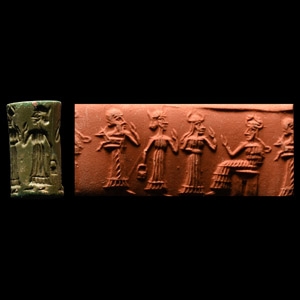
Akkadian Green Jasper Cylinder Seal with Presentation Scene
Circa 2300-2200 B.C.Sold for (Inc. bp): £650
Showing two goddesses with two other figures; accompanied by a museum quality impression and a copy of an old scholarly note by W.G. Lambert, late Professor of Assyriology, University of Birmingham, 1970-1993, which states: 'Cylinder seal of green jasper 19 x 11 mm. Presentation scene: seated goddess to right, before her one goddess, a woman holding a bucket and a man holding a kid are standing. Akkadian, c. 2300-2200 B.C., fine engraving in very good condition.' 3.96 grams, 19 mm
From the private collection of a North American lady, formed 1970s-early 1990s, with collection reference no.P108. Accompanied by a copy of a scholarly note, handwritten and signed by Professor Wilfrid George Lambert and an old photograph. -
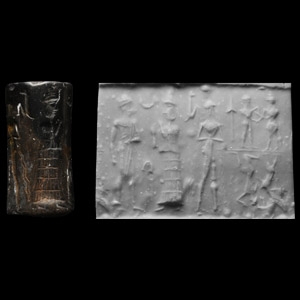
Old Babylonian Cylinder Seal with God Holding Mace
1900-1600 B.C.Sold for (Inc. bp): £975
Depicting two sets of figures; accompanied by a museum quality impression and a copy of an old scholarly note, typed and signed by W.G. Lambert, late Professor of Assyriology, University of Birmingham, 1970-1993, which states: 'Cylinder Seal of Hematite, 29.5 x 15 mm. The engraving consists of two separate sets of figures, the first consisting of two standing facing figures. on the right is a Lamma, wearing a horned tiara and long flounced robe. She raises both hands in greeting to the figure on the left. he is the god with mace, wearing a hat with broad brim and garments which reach only to the knees. In his right hand he holds a sceptre at the waist. In the sky between the two figures is the lunar crescent, and between them near the ground is a shepherd's crook. This pair of figures, like the whole, is Old Babylonian, and dates c. 1900-1700 B.C. The remainder of the engraving was added later, but not after 1600 B.C. There is one isolated figure, standing, but with his head not reaching the top of the seal. He appears to be nude and holds a spouting jar in both hands at his waist, from which two streams of water flow. By his head is the 'mongoose' (or monkey), and the spade symbol fills the space opposite the 'mongoose'. The rest of the area is divided vertically by a line, and each half contains a pair of contestants, put tête bêche to each other. The upper pair are a grappling human-like figure and bull man, the lower pair are a human-like figure grappling with a winged monster. Not enough is known to be sure whether this seal comes from southern or northern Mesopotamia, but it is of considerable interest for the two separate groups of figures engraved by different craftsmen. There is some surface wear, but the whole of the design is well preserved.' 18.45 grams, 29 mm
UK private collection, acquired 1990-1993. Accompanied by a copy of a scholarly note, typed and signed by Professor Wilfrid George Lambert in 1990.
Seals were the working signatures of the ancient Near East. Pressed or rolled into wet clay, they secured jars, bags, doors and tablets, and left a distinct impression that identified the owner, authorised a transaction, and showed whether a container had been opened. Stamp seals (pressed once to leave a single emblem) appear from the 7th–4th millennia BC and continue throughout later periods; cylinder seals (rolled to create a repeating frieze) developed in Mesopotamia in the late 4th millennium BC and are used into the 1st millennium BC. Beyond administration, seals were miniature artworks and amulets. Their images—gods and worshippers, royal hunts, banquets, heroes and mythic beasts—broadcast rank, piety and profession, and were believed to protect the owner. Materials range from soft stones to hard chalcedonies, haematite and lapis, worked with drills and abrasives to achieve crisp intaglio cutting. Many were worn on cords or rings and followed their owners through life, sometimes into the grave. Seals matter because they underpin the earliest systems of record-keeping and trade. Impressions on tablets and bullae are primary documents for ancient law, economy and religion; the seals themselves preserve that imagery in the round. For collectors, well-cut examples with sharp impressions, good polish and honest ancient wear are especially desirable, and pieces with early collection histories are keenly sought. -
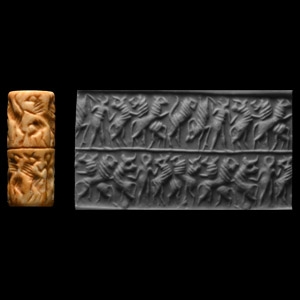
Sumerian Cream Stone Cylinder Seal with Contest Scene
Circa 2500 B.C.Sold for (Inc. bp): £624
Divided into two registers, both showing a contest scene with a horned hero grappling with horned beasts; accompanied by a museum quality impression and a copy of an old scholarly note, typed and signed by W.G. Lambert, late Professor of Assyriology, University of Birmingham, 1970-1993, which states: 'Cylinder Seal of Cream Stone, 28.5 x 12 mm. The engraved sides of this seal are divided into two registers by a single horizontal line. In both registers there is a contest scene. In the upper a standing hero with double belt around his waist succours a bovine on the right and an upended gpat on the left, both of which are being attacked by a lion. The body of the lion on the right crosses the body of a second bovine. In the lower register a standing nude hero succours two differentiated bovines, one of each side, which are being attacked each by a lion, but in this case each lion's body crosses that of a third and fourth bovine. This is a seal in the Sumerian tradition, c. 2500 B.C., from the Third Phrase [sic] of the Early Dynastic periods, and may come from Sumer itself, north Mesopotamia or south-east Iran. It is in good state of preservation and a nice example of its kind.' 8.83 grams, 28 mm
UK private collection, acquired 1990-1993.
Seals were the working signatures of the ancient Near East. Pressed or rolled into wet clay, they secured jars, bags, doors and tablets, and left a distinct impression that identified the owner, authorised a transaction, and showed whether a container had been opened. Stamp seals (pressed once to leave a single emblem) appear from the 7th–4th millennia BC and continue throughout later periods; cylinder seals (rolled to create a repeating frieze) developed in Mesopotamia in the late 4th millennium BC and are used into the 1st millennium BC. Beyond administration, seals were miniature artworks and amulets. Their images—gods and worshippers, royal hunts, banquets, heroes and mythic beasts—broadcast rank, piety and profession, and were believed to protect the owner. Materials range from soft stones to hard chalcedonies, haematite and lapis, worked with drills and abrasives to achieve crisp intaglio cutting. Many were worn on cords or rings and followed their owners through life, sometimes into the grave. Seals matter because they underpin the earliest systems of record-keeping and trade. Impressions on tablets and bullae are primary documents for ancient law, economy and religion; the seals themselves preserve that imagery in the round. For collectors, well-cut examples with sharp impressions, good polish and honest ancient wear are especially desirable, and pieces with early collection histories are keenly sought. -
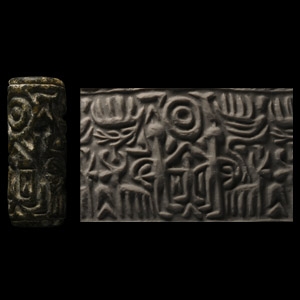
North-Syrian Green Stone Cylinder Seal with Standing Human-Like Figures
Circa 2800-2400 B.C.Sold for (Inc. bp): £598
With two standing figures; accompanied by a museum quality impression and a copy of an old scholarly note, typed and signed by W.G. Lambert, late Professor of Assyriology, University of Birmingham, 1970-1993, which states:Cylinder Seal of Dark Green Stone 55 x 22 mm. The engraved are divides into two main parts. In the major part two standing human-like figures are shown with one hand joining that of the other figure and the other held at the waist as if ready for action. Between them is a small similar figure with arms outstretched. Above are two concentric circles, and sundry shapes and linear motifs fill spaces. The minor part shows two pairs of horned animals tête bêche to eath(sic) other pair. The bottom two, with rising horns, face each other; the top two (one a stag, the other with different horns) are in a line. A snake and various shapes fill the spaces. Upper and lower rules enclose the design. This is a North-Syrian or Anatolian seal, c. 2800-2400 B.C. It is exceptionally large, in very good condition, and outstanding in every way.' 47 grams, 55 mm
with Sotheby's Antiquities, London, 10-11 December 1992, no.74. Accompanied by a copy of a scholarly note, typed and signed by Professor Wilfrid George Lambert in 1992.
Seals were the working signatures of the ancient Near East. Pressed or rolled into wet clay, they secured jars, bags, doors and tablets, and left a distinct impression that identified the owner, authorised a transaction, and showed whether a container had been opened. Stamp seals (pressed once to leave a single emblem) appear from the 7th–4th millennia BC and continue throughout later periods; cylinder seals (rolled to create a repeating frieze) developed in Mesopotamia in the late 4th millennium BC and are used into the 1st millennium BC. Beyond administration, seals were miniature artworks and amulets. Their images—gods and worshippers, royal hunts, banquets, heroes and mythic beasts—broadcast rank, piety and profession, and were believed to protect the owner. Materials range from soft stones to hard chalcedonies, haematite and lapis, worked with drills and abrasives to achieve crisp intaglio cutting. Many were worn on cords or rings and followed their owners through life, sometimes into the grave. Seals matter because they underpin the earliest systems of record-keeping and trade. Impressions on tablets and bullae are primary documents for ancient law, economy and religion; the seals themselves preserve that imagery in the round. For collectors, well-cut examples with sharp impressions, good polish and honest ancient wear are especially desirable, and pieces with early collection histories are keenly sought. -
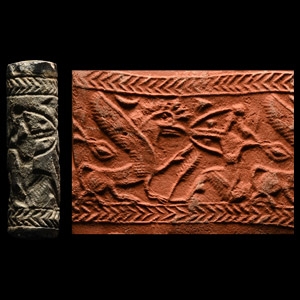
Neo-Assyrian Grey Stone Cylinder Seal with Kneeling God
Circa 900-800 B.C.Sold for (Inc. bp): £780
With a god shooting a sphinx; accompanied by a museum quality impression and a copy of an old scholarly note, typed and signed by W.G. Lambert, late Professor of Assyriology, University of Birmingham, 1970-1993, which states: 'Cylinder Seal of Grey Stone, 39 x 12. Top and bottom borders are filled with rows of chevrons going in opposite directions, and the design between a kneeling god shooting at a facing sphynx with a bird's head. As filling motifs there are: a small tree or plant, a lozenge, a triangle and a crescent. At each end the stone is stained by remains of original bronze caps, and the bronze bar which ran through the central hole is still present, though the rest of the metal, save for traces, has disappeared. This is a Neo-Assyrian cylinder, c. 900-800 B.C., from Assyria itself, or from neighbouring areas.' 8.7 grams, 39 mm
From the private collection of a North American lady, formed 1970s-early 1990s, with collection reference no.P16. Accompanied by a copy of a scholarly note, typed and signed by Professor Wilfrid George Lambert dated February 1992 and an old photograph. -
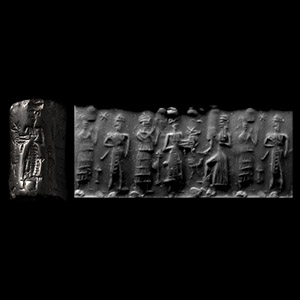
Western Asiatic Stone Cylinder Seal with Presentation Scene
2nd-1st millennium B.C.Sold for (Inc. bp): £520
With incuse frieze depicting a presentation scene, two profile figures in flounced robes flanking two standing figures in floor-length garments, one with leg bent and foot resting on a stool, receiving a gift of a small animal from his neighbour; fifth figure to the rear; supplied with a museum-quality impression. 12.53 grams, 23 mm
From the 'S' collection, acquired 1970-1990s. The collection was seen and studied by W.G. Lambert, late Professor of Assyriology at the University of Birmingham, 1970-1993. -
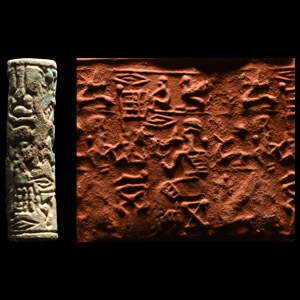
Middle Elamite Glazed Faience Cylinder Seal with Feasting Scene
Circa 1300-1200 B.C.Sold for (Inc. bp): £780
The scene divided into two registers with the main one with a seated figure and an attendant; accompanied by a museum quality impression and a copy of an old scholarly note, typed and signed by W.G. Lambert, late Professor of Assyriology, University of Birmingham, 1970-1993, which states: 'Cylinder Seal of Glazed Faience, 48 x 14 mm. The main scene consists of a seated figure, wearing a long robe, with hair done up in a bun at the back of the head, and drinking from a situla. Facing him is a standing attendant holding up a fan in both hands. Between them is a tablet with a leg of meat on it, also an unidentified object, a star and a lozenge-shape above the table. As a terminal there is a recumbent winged sphynx below a horned animal, also recumbent but with hear turned back. A top register contains: a winged sphynx, a monkey, a lozenge, a horned animal with head turned back and a tree as termina. This is a Middle Elamite cylinder, c. 1300-1200 B.C. such as have been found at Susa and Choga Zanbil. Only rarely are they seen on the market. One side of this one is better preserved than the other, and some of the original turquoise glaze still survives.' 10.67 grams, 47 mm
From the private collection of a North American lady, formed 1970s-early 1990s, with collection reference no.4656. Accompanied by a copy of a scholarly note, typed and signed by Professor Wilfrid George Lambert dated March 1992 and an old photograph. -
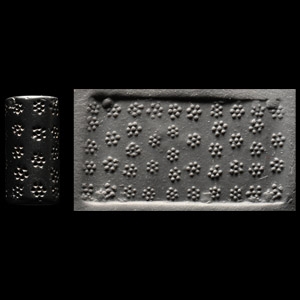
Syrian Haematite Cylinder Seal with Rosettes
Circa 1900-1600 B.C.Sold for (Inc. bp): £2,600
With rosettes arranged in rows; the design consists of rosettes, each composed of one central hole surrounded by six other holes, rosettes are arranged in alternate rows of four and five: four rows of four and four rows of five in total; accompanied by a museum quality impression and a copy of an old scholarly note, typed and signed by W.G. Lambert, late Professor of Assyriology, University of Birmingham, 1970-1993, which states: 'Cylinder Seal of Hematite, 22.5 x 11.5 mm. The condition is very good.' 9.03 grams, 22 mm
From the private collection of a North American lady, formed 1970s-early 1990s, with collection reference no.P44. Accompanied by a copy of a scholarly note, typed and signed by Professor Wilfrid George Lambert dated August 1990 and an old photograph. This lot has been checked against the Interpol Database of stolen works of art and is accompanied by search certificate number no.12933-246707. -
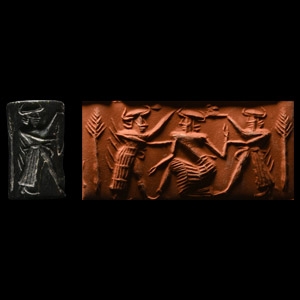
Akkadian Black Stone Cylinder Seal with Combat Scene
Circa 2300-2200 B.C.Sold for (Inc. bp): £749
Showing a combat of gods; accompanied by a museum quality impression and a copy of an old scholarly note, typed and signed by W.G. Lambert, late Professor of Assyriology, University of Birmingham, 1970-1993, which states: 'Cylinder Seal of Black Stone 27 x 16 mm. The design shows a combat of gods: all three wear horns on their heads as a mark of divinity. To each side of the scene is a god in long robe from waist to feet, open at the front with one leg projecting. They stand grappling with a god on one knee between them. He wears a robe of similar length, but not open at the front. Diagonal lines rise from the robes of the two attacking gods, probably marking them as fire gods. A stylised tree serves as a terminal. This is an Akkadian seal, c. 2500-2200 B.C. It is one of the rarer designs to see gods, and such fighting gods are not seen in other periods. But we have no written form of the myth to explain exactly what is happening. the seal is in very good condition and has an interesting design.' 12 grams, 27 mm
From the private collection of a North American lady, formed 1970s-early 1990s, with collection reference no.589/3. Accompanied by a copy of a scholarly note, typed and signed by Professor Wilfrid George Lambert and an old photograph. -
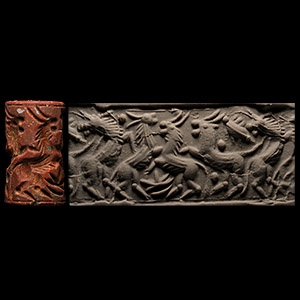
Large Western Asiatic Stone Cylinder Seal with Animals
2nd-1st millennium B.C.Sold for (Inc. bp): £520
Densely carved scene with two types of rearing horned animals in combat, depicted with long tails and with fur detailing on the bodies, pellets and other motifs on the field; accompanied by a museum quality impression. 52.5 grams, 44 mm
From the collection of a gentleman, acquired on the London art market in the 1990s. -
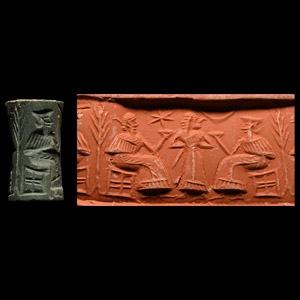
Akkadian Green Jasper Cylinder Seal with Seated Figures
Circa 2300-2200 B.C.Sold for (Inc. bp): £749
Showing a divine drinking scene; accompanied by a museum quality impression and a copy of an old scholarly note, typed and signed by W.G. Lambert, late Professor of Assyriology, University of Birmingham, 1970-1993, which states: 'Cylinder Seal of Green Jasper, 23 x 13 mm. Two seated figures face each other. On the right is a male, wearing a flat cap on his head, and a long robe to the feet with a deep fringe at the bottom. He is holding up a flat cup. The figure on the left is female, bare-headed, but wearing a similar long garment with fringe at the bottom, alos a fringe where the fabric overlaps from the waist down. Both figures hold up the same type of cup. Between them stands a servant, in a similar long robe and with bare head, holding a mace at the waist. In the sky there is a star and lunar crescent. A tall slender tree serves as a terminal. This is a Akkadian seal, c. 2300-2200 B.C., from Mesopotamia or a neighbouring region. In view of the flat cap on the male the figures are no doubt divine, and this is then a divine drinking scene. This seal is in excellent state of preservation.' 6.31 grams, 23 mm
From the private collection of a North American lady, formed 1970s-early 1990s, with collection reference no.P18. Accompanied by a copy of a scholarly note, typed and signed by Professor Wilfrid George Lambert in August 1992 and an old photograph. -
.jpg)
Mitanni Faience Cylinder Seal with Worship Scenes
Circa 1500-1200 B.C.Sold for (Inc. bp): £546
Accompanied by a copy of an old scholarly note, typed and signed by W.G. Lambert, late Professor of Assyriology, University of Birmingham, 1970-1993, which states: 'Cylinder Seal of Faience with Green Glaze 43 x 17 mm. The design, which is contained within a line above and another beneath, consists of two scenes of worship. The one shows a stylized sacred tree with a central trunk and five branches each side, all ending in buds, then a pendant hanging from each lowest branch on either side. On left and right and facing the tree are worshippers, both with hands raised. The other scene has two similar worshipers, facing each other with hands raised. Between them the area is divided in the middle by a guilloche. Above it is a stag falling onto its neck, below it is another kind of horned animal, but recumbent and turning its head. This seal is Mitanni, c. 1500-1200 B.C and from anywhere in the area between Syria and Western Kurdistan. It is a product of the Hurrian civilization and the stylized tree is a symbol of the Storm God, Hurrian Teshub, Babylonian Adad, Hebrew Hadad or Baal. The horned animals occur commonly on Mitanni seals, and this seal proves that they are symbolic of some god, but it is not known which one. The guilloche is a standard decorative filler of the period. Faience is a manufactures substance, comparable with the modern porcelain. In the ground it often deteriorates over the centuries and has a powdery surface. This one, however, is in good condition, the only mark of its age being that the glaze has lost something of its original colour, which was turquoise This is an unusually large seal and important since seals of this size and quality are extremely rare.'; supplied with a museum-quality impression. 11.3 grams, 42 mm
From the private collection of a North American lady, formed 1970s-early 1990s, with collection reference no.P31. Accompanied by a copy of a scholarly note, typed and signed by Professor Wilfrid George Lambert dated September 1990.

