-
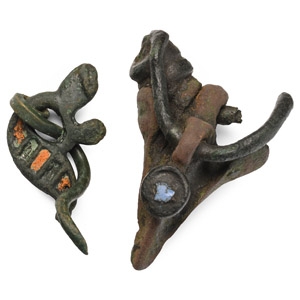
Romano-Celtic Enamelled Bronze Dragonesque Brooch Group
England, 2nd century A.D.Sold for (Inc. bp): £104
S-shaped brooch fragment with transverse bands of enamel, head with curving ear-terminal above and looped pin; accompanied by the remains of a large enamelled bronze bow brooch with enamelled discoid stud. 31.2 grams total, 40 mm each
Found Yorkshire, UK. -
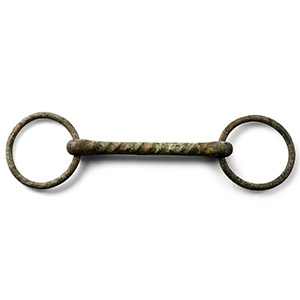
Celtic Bronze Horse Bridle Bit
Iron Age, circa 1st century B.C.-1st century A.D.Sold for (Inc. bp): £52
Comprising a round-section bit with lobe at each end pierced to accept a large hoop. 206 grams, 25 cm
From the collection of a Buckinghamshire, UK, collector established from the earlier 1960s. -
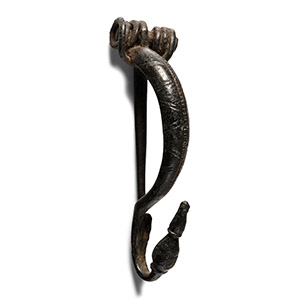
Celtic Bronze La Tene Brooch
Iron Age, 4th-3rd century B.C.Sold for (Inc. bp): £46
With an integral catchplate at the rear of the bow, a recurved knop finial below, an integral spring, and punched detailing to the forward face of the bow. 20 grams, 66 mm
Ex DRG Coins and Antiquities, Bishops Stortford, Essex, UK. From the private collection of a West London, UK, gentleman, formed since the early 2000s. Accompanied by a handwritten dealer's ticket. -
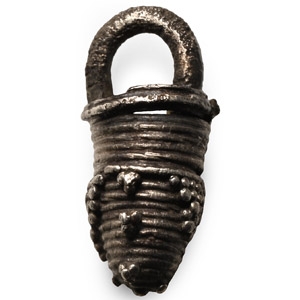
Pre-Viking Silver Filigree Bucket Pendant
4th-7th century A.D.Sold for (Inc. bp): £104
Formed as a bell-shaped container with granule detailing. 1.35 grams, 17 mm
From the private collection of a London gentleman, from his grandfather's collection formed before the early 1970s.
Pendants in the form of miniature buckets have been found in a number of pagan Anglo-Saxon and Viking contexts and are generally made of bronze or iron, with gold examples being rare; three gold examples were found with the hoard from Hoen, Norway. Bronze bucket amulets have been found at Driffield in Yorkshire and Vimose bog in Denmark, among other places. In form, they represent wooden buckets bound with bronze or iron bands, which have been found in Anglo-Saxon and Viking graves and are believed to have held mead or ale and were used to replenish the cups from which warriors drank. As amulet,s they probably represent the ecstatic power of alcoholic drink and the role of women as the dispensers of these precious beverages. -
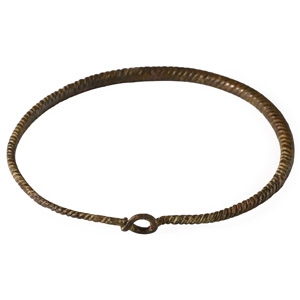
Viking Age Twisted Bronze Bracelet
Circa 9th-11th century A.D.Sold for (Inc. bp): £156
Penannular in form with hook-and-eye closure, twisted shank. 6 grams, 58 mm
Acquired on the UK art market in the late 20th century A.D. From the private collection of the late David King (1940-2024), Hoddesdon, Hertfordshire, UK. -
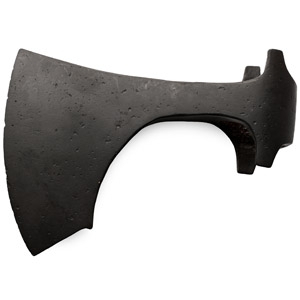
Viking Age Iron Socketted Bearded Axehead
Circa 10th-11th century A.D.Sold for (Inc. bp): £598
With slender ridged blade and chin to the lower edge, round socket with rectangular flanges, flattened rear edge; professionally cleaned, conserved, and restored. 788 grams, 17.5 cm
Cleaned, conserved and restored.
From the family collection of a South East London collector; formerly acquired in the late 1950s.
The type appears to be related to the Y-type of Viking axes. Slavic battle-axes also came into use in Scandinavia, especially in the eastern part of Gotland, Sweden and Denmark. The old Norse word Taparöx probably come from Topor, the Slavic word for axe. Eastern axes are also characterised by an almost completely round hole for the shaft. -
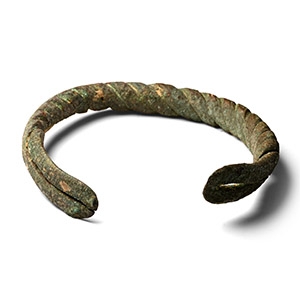
Viking Age Twisted Bronze Wire Bracelet
Circa 9th-11th century A.D.Sold for (Inc. bp): £143
Penannular in form made from a single wire strand looped at one end and butted at the other. 25.4 grams, 59 mm
Acquired on the UK art market before 2000. Property of an Essex, UK, gentleman. -
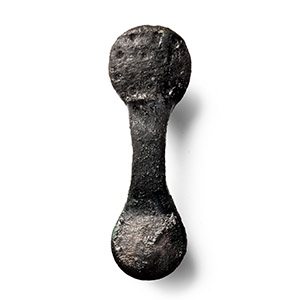
Anglo-Saxon Bronze Ansate Brooch
Circa 6th century A.D.Sold for (Inc. bp): £26
Comprising two discoid lobes joined by a narrow arch, pin-lugs and a catch to the reverse. 5.31 grams, 42 mm
From the collection of a Buckinghamshire, UK, collector established from the earlier 1960s. -
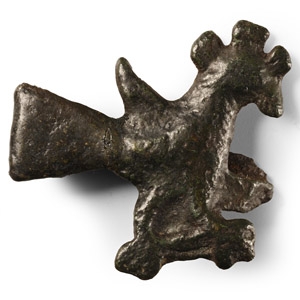
Viking Bronze Bird Brooch
10th-12th century A.D.Sold for (Inc. bp): £176
Modelled in profile with radiating tripartite crest, triangular stub wing, splayed feet, catch and pin-lugs to the reverse. 10.9 grams, 38 mm
From the collection of a North American gentleman, formed in the 1990s.
Bird brooches from the late Viking era have been found in Scandinavia as well in the English Danelaw, through to the early Norman era; such brooches can be dated to the 11th and even early 12th century. -
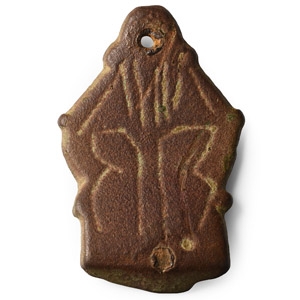
Anglo-Scandinavian Viking Bronze Stirrup Mount with Pseudo-Runes
11th century A.D.Sold for (Inc. bp): £72
Williams's Class A Type 1 with trapezoidal plaque and narrow ledge to the rear; incised geometric design following the outline of the mount with symmetrical panels; to the neck five vertical lines, perhaps pseudo-runes. 19.88 grams, 50 mm
Property of a gentleman; acquired in the 1970s.
The markings on the neck appear to conform to the shapes of four runes, being inverted chevrons to the edges (runic 'U'), a character of two verticals and a sloping cross-bar (runic 'H'), and a simple vertical stroke (runic 'I'). However, the outer chevrons are formed as the junction of the inner border with a vertical while the cross-bar appears to be a later abrasion. The form of 'H' with a single cross-bar is very early (2nd -5th century AD) and is almost unknown in England, while by the 8th century this form had been replaced in Scandinavia by a rune formed as a vertical with a small saltire to the centre (like an asterisk). It is nevertheless possible that these marks were intended as a form of pseudo-runic text. -
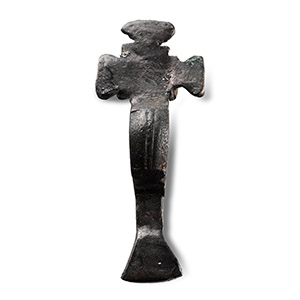
Anglo-Saxon Bronze Small-Long Brooch
Circa 6th century A.D.Sold for (Inc. bp): £26
Comprising a rectangular headplate with radiating arms, long bow with median punched ornament, triangular footplate with catch and pin-lugs to reverse. 11.3 grams, 61 mm
From the collection of a Buckinghamshire, UK, collector established from the earlier 1960s. -
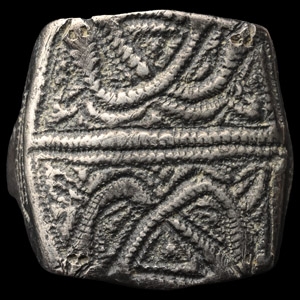
Viking Silver Ring with Snakes
10th-12th century A.D.Sold for (Inc. bp): £416
With large square plaque, low-relief design of serpents entwined on a pounced field. 2.75 grams, 20.01 mm overall, 17.73 mm internal diameter (approximate size British O, USA 7, Europe 14.98, Japan 14)
From the private collection of a London gentleman, from his grandfather's collection formed before the early 1970s.

