-
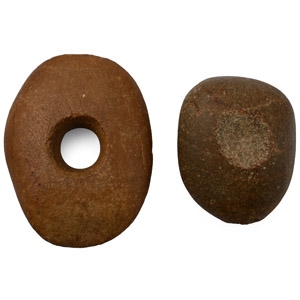
Stone Age Polished Macehead Group
Neolithic Period, 6th-4th millennium B.P.Sold for (Inc. bp): £130
Comprising: one ellipsoid in plan with usage wear to the string face; one oblate in form with ground depression to each face where the shaft-hole has been started. 502 grams total, 73-97 mm
Acquired on the UK art market in the 1980s. From an East Anglian private collection. -
.jpg)
Clactonian Knapped Homo Heidelbergensis Proto Handaxe
Lower Palaeolithic Period, circa 400,000-300,000 B.P.Sold for (Inc. bp): £117
Triangular core with two edges trimmed, one finely; with inked collection number: 'TWYDALL / 10. ss.1017.A'. 178 grams, 81 mm
Found Twydall, Kent, UK. Richard Jones collection, Welling, Kent, UK, 1912-1915. Ex Rochester Museum, Kent collections. Specialist collection of J Edwin Jarvis. Ex Martin Schoyen collection, London, UK. From the property of a late Lincolnshire, UK, gentleman.
These tools were part of the collection that was originally donated by a Mr Richard Jones of Welling in Kent to the Rochester Museum. During the period 1912-1915. Mr George Payne of the Kent Archaeological Society also collected along with a Mr George Baker. During 1902 'Sharpes Green Cement Works' was erected, then the smallest cement works on record, using second hand equipment and the last to use Static Chamber Kilns. The processing site was situated on the south shore of the river Medway near Gillingham, Kent, on an island known locally as "Horrid Hill" just off the shore. Horrid Hill was so named because French prisoners of the Napoleonic war who attempted to escape the 'Hulks' moored on the river were hanged here for their efforts. The raw material for the manufacture of cement was extracted from a local quarry in orchard grounds belonging to a Mr Walter Stunt of Lorenden, Faversham, Kent at a place called Twydall between Chatham and Upchurch. During the removal of the chalk an infilled cavity was broken into on the eastern face of the quarry, which contained very rich lower Palaeolithic material. To facilitate the removal of the extracted chalk from the quarry to the works on the river a trackway was constructed to allow a small horse drawn railway to carry wagon loads of chalk for processing. To transport the loads over the tidal saltmarsh from river bank to the island a causeway was built above the upper tidal limit to the works. The material used was the gravel extracted at the quarry which was useless for the manufacture of cement and which contained the implements. The subsequent erosion caused by the tidal flow of the river exposed the Palaeolithic implements along the stretch of the causeway and, during the period of 1912 to 1915, were collected from the surface. The majority of the material is made up of flakes and cores typical of the 'Clactonian' style with also some Acheulian axes. The implements are well retouched and worked on thick, heavy flakes with high angle platforms, typical of the 'Clactonian' industry. The tools are made from the same marbled north Kent flint which was used at the Swanscombe Palaeolithic site from the ancient lower gravels of the Thames valley. This flint is typically a brown and yellow banded variety derived from the dark green skinned nodules of the "Bull Head" bed which underlies the Thanet sands. -
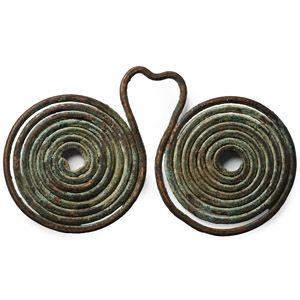
Bronze Age Coiled Spectacle Pendant
16th-10th century B.C.Sold for (Inc. bp): £52
Comprising two coiled wire circles joined by a heart-shaped loop. 8.37 grams, 54 mm
Early 1990s London collection. Acquired on the UK art market. From a private collection, Lancashire, UK. -
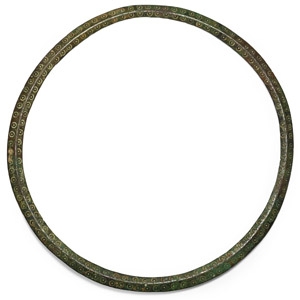
Bronze Age Decorated Neck Torc
Central Europe, circa 1000 B.C.Sold for (Inc. bp): £72
Lozenge-section annular body with punched ring-and-dot decoration on the upper face. 181 grams, 21.2 cm
From a private Tyneside collection, formed since the early 2000s. -
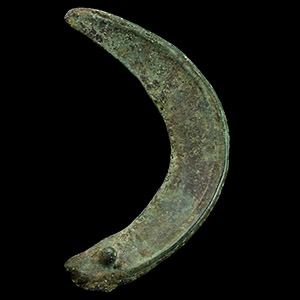
Bronze Age Curved Sickle Blade
Circa 14th-13th century B.C.Sold for (Inc. bp): £182
Of crescentic form with parallel raised ribs to the outer edge and vertical spur to neck. 72 grams, 11 cm
From the collection of a Buckinghamshire, UK, collector established from the earlier 1960s. -
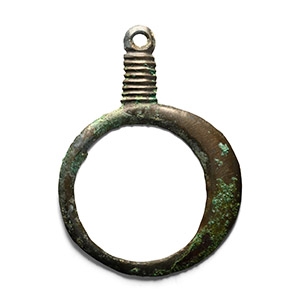
Bronze Age Lunar Pendant
Central Europe, 2nd-early 1st millennium B.C.Sold for (Inc. bp): £117
Formed as a flat disc with offset circular void, ribbed shank and loop above. 9.13 grams, 75 mm
Ex London, UK, collection, early 2000s. -
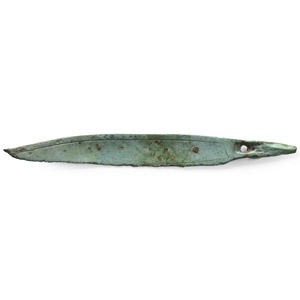
Bronze Age Knife
1st millennium B.C.Sold for (Inc. bp): £39
With single-edge blade with scooped tip, incised line below the rear edge, tapering tang with hole for attaching an organic griip. 20 grams, 13.5 cm
Ex Garcia collection, France, 1990s. -
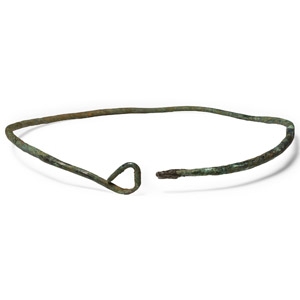
Bronze Age Neck Torc
Central Europe, circa 1000 B.C.Sold for (Inc. bp): £78
Comprising a round-section body twisted at one end with a single looped terminal. 87 grams, 19.5 cm
From a private Tyneside collection, formed since the early 2000s. -
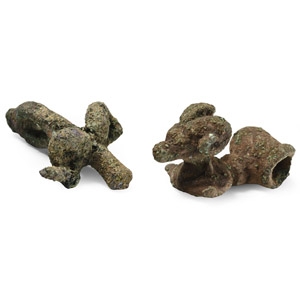
Bronze Age Ram Head Pendant Pair
1st millennium B.C.Sold for (Inc. bp): £27
Comprising a slender loop with applied curled horn detailing; forepart of a ram modelled in the round with broad integral loop to the rear. 13.8 grams total, 27-30 mm
Acquired on the UK art market before 2000. Property of an Essex, UK, gentleman. -
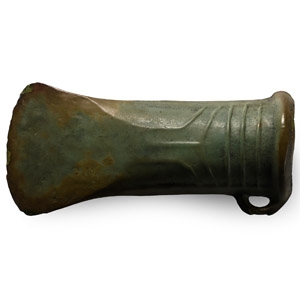
Bronze Age Decorated Looped and Socketted Axehead
Central Europe, 2nd-1st millennium B.C.Sold for (Inc. bp): £156
With ellipsoid-section shank and splayed blade with curved cutting edge; raised ribs beneath the carinated mouth, small loop below the rim. 255 grams, 10.9 cm
Ex David Miller, Hemel Hempstead, London, UK. From the private collection of a West London, UK, gentleman, formed since the early 2000s. -
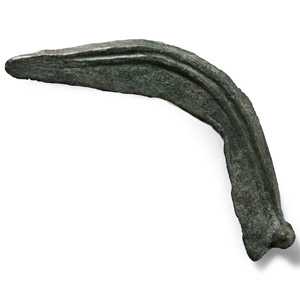
Bronze Age Sickle Blade
Central Europe, 2nd-1st millennium B.C.Sold for (Inc. bp): £39
Of crescentic form with parallel raised ribs to the outer edge and a vertical spur to the neck. 43 grams, 13 cm
Ex German collection, 1990s. This lot is accompanied by an illustrated lot declaration signed by the Head of the Antiquities Department, Dr Raffaele D’Amato. -
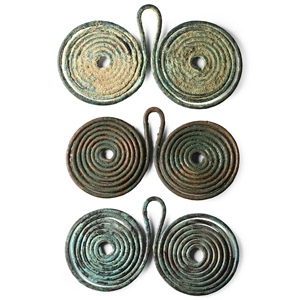
Bronze Age Coiled Spectacle Pendant Group
16th-10th century B.C.Sold for (Inc. bp): £247
A group of three spectacle pendants, each composed of two coiled wire circles joined by a loop. 26 grams total, 53-57 mm
Early 1990s London collection. Acquired on the UK art market. From a private collection, Lancashire, UK.

