-
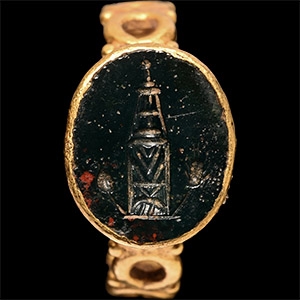
Byzantine Turreted Gold Ring with Architectural Jasper Gemstone
Circa 6th-8th century A.D.Sold for (Inc. bp): £2,860
Comprising a flat-section body composed of intersecting rings and pellets, turreted bezel with carinated body set with a polished jasper cabochon, incuse image of a tower with flanking palm trees. 6.43 grams, 28.80 mm overall, 17.80 mm internal diameter (approximate size British O, USA 7 1/2, Europe 17.5, Japan 14).
Ex K collection, London, 1990s. This lot has been checked against the Interpol Database of stolen works of art and is accompanied by search certificate number no.12969-246373. -
.jpg)
Large Byzantine Gold Ring Of Mary and Eutropius
6th-9th century A.D.Sold for (Inc. bp): £5,980
Comprising a D-section hoop with flat sides bearing wave-pattern ornament and legend 'MAPIAC / EYTPOΠIOY' (belonging to Mary and Eutropius); tiered bezel with incised key-pattern and undulating line to the edges; shoulders with palmette motif; discoid plaque with incuse wreath surrounding a bird with star above and lizard; with platinum inclusions. 23.66 grams, 31.00 mm overall, 19.87 mm internal diameter (approximate size British R 1/2, USA 8 3/4, Europe 19.38, Japan 18)
Private English collection, formed between the late 1970s and early 1990s. Private collection, UK. This lot has been checked against the Interpol Database of stolen works of art and is accompanied by search certificate number no.12970-246013. -
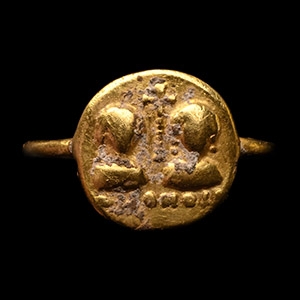
Byzantine Gold Marriage Ring
6th-7th century A.D.Sold for (Inc. bp): £546
Comprising a slender round-section hoop with an applied discoid bezel, two facing busts flanking a cross and an inscription below. 3.76 grams, 20.90 mm overall, 18.29 mm internal diameter (approximate size British P, USA 7 1/2, Europe 16.23, Japan 15)
From a UK collection since before 1990. -
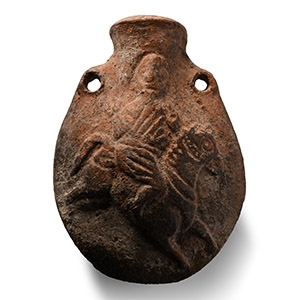
Byzantine Ceramic Pilgrim's Flask with Christ and Donkey
Circa 6th-8th century A.D.Sold for (Inc. bp): £338
Lentoid in section and teardrop-shaped in profile with flared mouth and pierced shoulders, low-relief image of a nimbate man riding a donkey to each face. 30.3 grams, 71 mm
Ex Mayfair, London, UK, gallery, 2000s. -
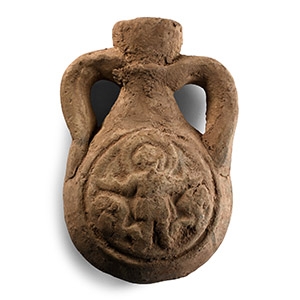
Byzantine Ceramic Pilgrim's Flask with St Menas and Inscription
Circa 6th-8th century A.D.Sold for (Inc. bp): £234
Hollow body discoid in profile and lentoid in section with thick loop handles to the shoulders, low-relief scene of a nimbate man between beasts to obverse, Greek text to reverse 'AΓΙΟΥ / MHNA/EYΛO[ΓΙ]A' (the blessing of Saint Menas). 101 grams, 89 mm
Ex Mayfair, London, UK, gallery, 2000s. -
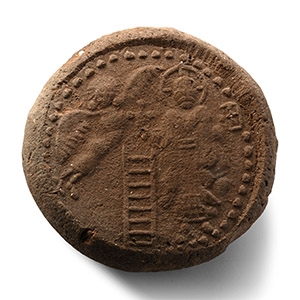
Christian 'Jacobs Ladder' Terracotta Pilgrim's Token
Circa 6th-8th century A.D.Sold for (Inc. bp): £468
Plano-convex in section with impressed design of a nimbate figure standing beside a ladder with a levitating winged angel at the side, all within a pelletted border. 13.4 grams, 33 mm
Ex important Christian collection, 1970s. -
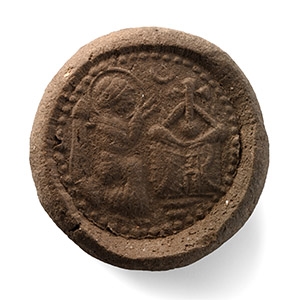
Christian 'Angel of the Sepulchre' Terracotta Pilgrim's Token
Circa 6th-8th century A.D.Sold for (Inc. bp): £598
Plano-convex in section with impressed design of a nimbate figure kneeling before a container surmounted by a cross and crescent moon, all within a pelletted border. 6.93 grams, 26 mm
Ex important Christian collection, 1970s. -
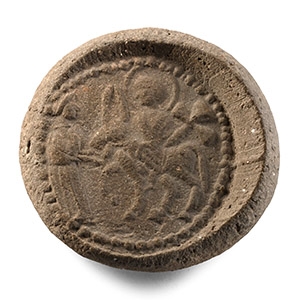
Christian 'First Passion, Entry into Jerusalem' Terracotta Pilgrim's Token
Circa 6th-8th century A.D.Sold for (Inc. bp): £338
Plano-convex in section with impressed design of a nimbate figure riding a donkey led by a facing robed figure, cross to the rear, all within a pelletted border. 6.09 grams, 25 mm
Ex important Christian collection, 1970s. -
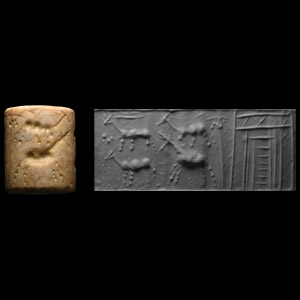
Jemdet Nasr White Marble Cylinder Seal with Temple
3000-2800 B.C.Sold for (Inc. bp): £1,430
Showing a decorated temple with animals, accompanied by a museum quality impression and a copy of an old scholarly note, typed and signed by W.G. Lambert, late Professor of Assyriology, University of Birmingham, 1970-1993, which states: Cylinder Seal of White Marble, 41 x 35 mm. The engraving shows a decorated temple facade and beside it four horned animals, a standard on a pole and a motif of four dots. This is a Jemdet Nasr seal, c. 3000-2800 B.C., from southern Mesopotamia, and is in very good state of preservation. It illustrates the Sumerian city state of the time. the temple was the largest building, and it owned flocks and herds, being a big economic organization as well as a religious institution. For the climate and terrain sheep and goats were the normal domestic animals, and ordinary people might own these. The larger domestic animals, which included cattle and other horned animals such as gazelles which eventually proved unsuccessful as domestic animals, were owned only by the temple. Seals of this size and quality are rare.' 98.8 grams, 41 mm
with Armand Trampitsch, Glyptique Archéologie, Paris, Hôtel Drouot, Sale No.2, 13-14 May 1992, no.216. Accompanied by a copy of a scholarly note, typed and signed by Professor Wilfrid George Lambert in 1992.
Seals were the working signatures of the ancient Near East. Pressed or rolled into wet clay, they secured jars, bags, doors and tablets, and left a distinct impression that identified the owner, authorised a transaction, and showed whether a container had been opened. Stamp seals (pressed once to leave a single emblem) appear from the 7th–4th millennia BC and continue throughout later periods; cylinder seals (rolled to create a repeating frieze) develop in Mesopotamia in the late 4th millennium BC and are used into the 1st millennium BC. Beyond administration, seals were miniature artworks and amulets. Their images—gods and worshippers, royal hunts, banquets, heroes and mythic beasts—broadcast rank, piety and profession, and were believed to protect the owner. Materials range from soft stones to hard chalcedonies, haematite and lapis, worked with drills and abrasives to achieve crisp intaglio cutting. Many were worn on cords or rings and followed their owners through life, sometimes into the grave. Seals matter because they underpin the earliest systems of record-keeping and trade. Impressions on tablets and bullae are primary documents for ancient law, economy and religion; the seals themselves preserve that imagery in the round. For collectors, well-cut examples with sharp impressions, good polish and honest ancient wear are especially desirable, and pieces with early collection histories are keenly sought. -
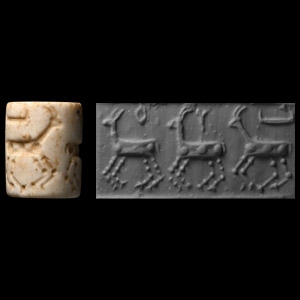
Jemdet Nasr Cylinder Seal with Horned Quadrupeds
Circa 3000 B.C.Sold for (Inc. bp): £3,120
With three horned quadrupeds; accompanied by a museum quality impression and a copy of an old scholarly note, typed and signed by W.G. Lambert, late Professor of Assyriology, University of Birmingham, 1970-1993, which states: 'Cylinder Seal of Alabaster, 27 x 16 mm. The design consists of three prancing horned quadrupeds. All are cut largely with the drill, save for some hand work on the bodies, necks, heads and tails. Above each animal's back is a device, apparently a symbol. [...] The animals were from temple herds, and the prized possessions of the communities, since sheep and goats were the normal domestic animals of the time.' 63.5 grams, 36 mm
with Bonhams, Fine Antiquities 20th May, 1992, no.68. Accompanied by a copy of a scholarly note, typed and signed by Professor Wilfrid George Lambert in 1992.
Seals were the working signatures of the ancient Near East. Pressed or rolled into wet clay, they secured jars, bags, doors and tablets, and left a distinct impression that identified the owner, authorised a transaction, and showed whether a container had been opened. Stamp seals (pressed once to leave a single emblem) appear from the 7th–4th millennia BC and continue throughout later periods; cylinder seals (rolled to create a repeating frieze) developed in Mesopotamia in the late 4th millennium BC and are used into the 1st millennium BC. Beyond administration, seals were miniature artworks and amulets. Their images—gods and worshippers, royal hunts, banquets, heroes and mythic beasts—broadcast rank, piety and profession, and were believed to protect the owner. Materials range from soft stones to hard chalcedonies, haematite and lapis, worked with drills and abrasives to achieve crisp intaglio cutting. Many were worn on cords or rings and followed their owners through life, sometimes into the grave. Seals matter because they underpin the earliest systems of record-keeping and trade. Impressions on tablets and bullae are primary documents for ancient law, economy and religion; the seals themselves preserve that imagery in the round. For collectors, well-cut examples with sharp impressions, good polish and honest ancient wear are especially desirable, and pieces with early collection histories are keenly sought. -
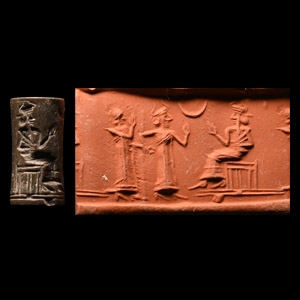
Third Dynasty of Ur Brown Stone Cylinder Seal with Worship Scene
Circa 2060-2000 B.C.Sold for (Inc. bp): £780
Showing two goddesses and a worshipper; accompanied by a museum quality impression and a copy of an old scholarly note by W.G. Lambert, late Professor of Assyriology, University of Birmingham, 1970-1993, which states: 'Cylinder seal of brown stone, 26 x 13 mm. Seated goddess to right, raising a hand, before her a minor goddess introducing a worshipper, both raising a hand. Crescent in sky. Third Dynasty of Ur, c. 2060-2000 B.C. Good engraving, very good condition.' 7.6 grams, 25 mm
From the private collection of a North American lady, formed 1970s-early 1990s, with collection reference no.192. Accompanied by a copy of a scholarly note, handwritten and signed by Professor Wilfrid George Lambert and an old photograph. -
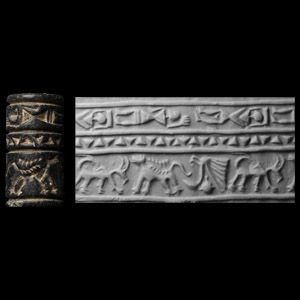
Syrian or Anatolian Black Stone Cylinder Seal with Human Figures
Circa 2500 B.C.Sold for (Inc. bp): £780
Divided into two registers and showing human figures and animals on the lower register; accompanied by a museum quality impression and a copy of an old scholarly note, typed and signed by W.G. Lambert, late Professor of Assyriology, University of Birmingham, 1970-1993, which states: 'Cylinder Seal of Black Stone, 41.5 x 21.5 mm. The engraved surface is divided into two registers by a band consisting of two lines separated by a row of alternately inverted triangles. The upper register shows two human figures sideways. The one, apparently male, hold one hand high while extending the other at the waist. The other, apparently female, holds an oblong object above her head in both hands. The lower register shows two confronting quadrupeds: the one with horns has lowered its head, the other with raised head may be intended as a boar to judge from the markings on its back. Also in the lower register there is a bird tête-bêche to the two animals, and something placed between its head and wing-tip. This is an unusual and impressive seal, from Syria or Anatolia c. 2500 B.C. It is in fine state of preservation. 38.78 grams, 41 mm
UK private collection, acquired 1990-1993. Accompanied by a copy of a scholarly note, typed and signed by Professor Wilfrid George Lambert in 1992.
Seals were the working signatures of the ancient Near East. Pressed or rolled into wet clay, they secured jars, bags, doors and tablets, and left a distinct impression that identified the owner, authorised a transaction, and showed whether a container had been opened. Stamp seals (pressed once to leave a single emblem) appear from the 7th–4th millennia BC and continue throughout later periods; cylinder seals (rolled to create a repeating frieze) develop in Mesopotamia in the late 4th millennium BC and are used into the 1st millennium BC. Beyond administration, seals were miniature artworks and amulets. Their images—gods and worshippers, royal hunts, banquets, heroes and mythic beasts—broadcast rank, piety and profession, and were believed to protect the owner. Materials range from soft stones to hard chalcedonies, haematite and lapis, worked with drills and abrasives to achieve crisp intaglio cutting. Many were worn on cords or rings and followed their owners through life, sometimes into the grave. Seals matter because they underpin the earliest systems of record-keeping and trade. Impressions on tablets and bullae are primary documents for ancient law, economy and religion; the seals themselves preserve that imagery in the round. For collectors, well-cut examples with sharp impressions, good polish and honest ancient wear are especially desirable, and pieces with early collection histories are keenly sought.

