-
.jpg)
Luristan Bronze Arrowhead Group
13th-6th century B.C.Sold for (Inc. bp): £234
Including leaf-shaped, ribbed, triangular and other tanged types. 407 grams total, 11.3-15.2 cm
Acquired 1980-2015. Ex Abelita family collection. This lot is accompanied by an illustrated lot declaration signed by the Head of the Antiquities Department, Dr Raffaele D’Amato. This lot is accompanied by an illustrated lot declaration signed by the Head of the Antiquities Department, Dr Raffaele D'Amato. -
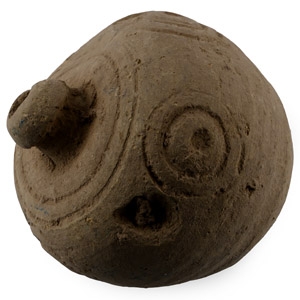
Byzantine 'Greek Fire' Ceramic Fire Bomb or Hand Grenade
9th-11th century A.D.Sold for (Inc. bp): £78
Bulbous body with pointed finial and domed mouth, impressed concentric circles on the shoulder; intended to be filled with explosive liquid and a wick, and used as a hand grenade. 615 grams, 11.1 cm
From an important specialist collection, London, UK, 1990s onwards. Accompanied by an academic paper by military specialist Dr Raffaele D'Amato, dated 15 July 2019 and titled 'Eastern Roman Empire - Greek Fire Bomb or Hand Grenade (μεσαίον kακάβιον) 9th-11th century AD'. This lot is accompanied by an illustrated lot declaration signed by the Head of the Antiquities Department, Dr Raffaele D'Amato.
Apart from the use of siphons or manual flame-throwers called cheirosiphona, special corps of Roman soldiers employed terracotta grenades, in the form of small jars, abundantly evidenced in archaeological excavations. They were called μεσαία kακαβιά or κυτροκακάβια where the former had a bulbous shape and the latter a more cylindrical form. -
.jpg)
Turco-Mongol 'Greek Fire' Ceramic Fire Bomb or Hand Grenade
13th-15th century A.D.Sold for (Inc. bp): £124
A piriform missile with raised lugs arranged in pairs, impressed lines and concentric circles in between, domed filler hole, intended to be filled with explosive liquid and wick, used as a hand grenade. 590 grams, 15 cm
From an important specialist collection, London, UK, 1990s onwards. This lot is accompanied by an illustrated lot declaration signed by the Head of the Antiquities Department, Dr Raffaele D’Amato. This lot is accompanied by an illustrated lot declaration signed by the Head of the Antiquities Department, Dr Raffaele D'Amato. -
.jpg)
Western Asiatic Stone Macehead
3rd-2nd millennium B.C.Sold for (Inc. bp): £117
With plain globular body, circular short shaft expanding to a circular flat base. 370 grams, 75 mm
Ex London, UK, collection, 1990-2000s. This lot is accompanied by an illustrated lot declaration signed by the Head of the Antiquities Department, Dr Raffaele D'Amato. -
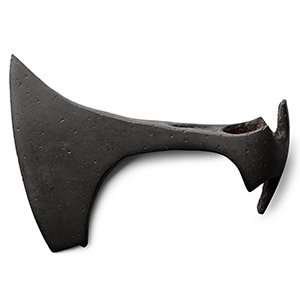
Viking Age Iron Long Bearded Axehead
10th-11th century A.D.Sold for (Inc. bp): £936
Finely curved broad blade with chin to the lower edge, rounded socket with lateral triangular extensions and a rectangular extension to the rear; restored and conserved. 648 grams, 20 cm
From the family collection of a South East London collector; formerly acquired in the late 1950s. This lot is accompanied by an illustrated lot declaration signed by the Head of the Antiquities Department, Dr Raffaele D'Amato.
This type of bearded axe seems to correspond to the E2 category of the Viking axe classification, but also has affinity with the Slavic type of axes Y. Usually these bearded axeheads (skeggöks) had a longer edge, designed to split tree trunks into planks and beams. Some of the bearded axes were known as halfÞynna öx; the neck on such a 'half thin axe' was thinly forged, to make it lighter. -
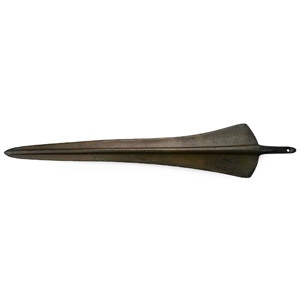
Luristan Bronze Short Sword
2nd-1st millennium B.C.Sold for (Inc. bp): £442
Triangular in plan with thick round-section midrib, rounded shoulders, narrow tip; short tang with hole for fixing pin for the organic grip. 295 grams, 37 cm
Acquired in the 1990s. Ex Abelita family collection. This lot is accompanied by an illustrated lot declaration signed by the Head of the Antiquities Department, Dr Raffaele D'Amato. -
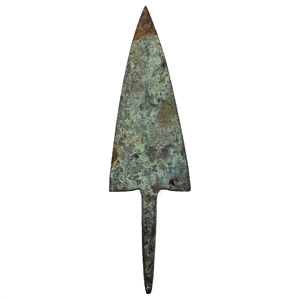
Large Luristan Bronze Arrowhead
2nd-1st millennium B.C.Sold for (Inc. bp): £85
Large triangular point with slightly raised midrib, long flat tang. 28.9 grams, 13.4 cm
Acquired on the UK art market before 2000. Property of an Essex, UK, gentleman. This lot is accompanied by an illustrated lot declaration signed by the Head of the Antiquities Department, Dr Raffaele D'Amato. -
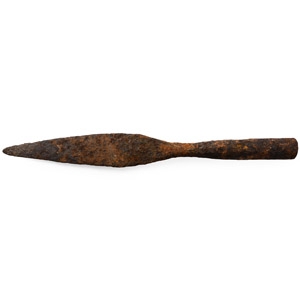
Large Viking Period Iron Socketted Spearhead
9th-11th century A.D.Sold for (Inc. bp): £195
Leaf-shaped blade with circular tapering socket, short neck, pierced to accept a fixing pin; with remains of the wooden shaft in the socket. 538 grams, 37.9 cm
Acquired on the UK art market circa 2005. From an old North Country, UK, collection. This lot is accompanied by an illustrated lot declaration signed by the Head of the Antiquities Department, Dr Raffaele D'Amato. -
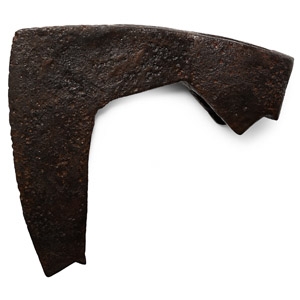
Viking Age Bearded Axehead
9th-10th century ADSold for (Inc. bp): £351
A hand-forged side-axehead with square-section socket, broad blade offset with extension to the lower edge. 838 grams, 17 cm
From the private collection of a London gentleman, from his grandfather's collection formed before the early 1970s. This lot is accompanied by an illustrated lot declaration signed by the Head of the Antiquities Department, Dr Raffaele D'Amato.
The axe belongs to the type C of Petersen classification. They are axes of Eastern type, of narrow bearded type, characterised by an almost completely round hole for the shaft, rather than the more triangular or drop shape we see on the western typologies. -
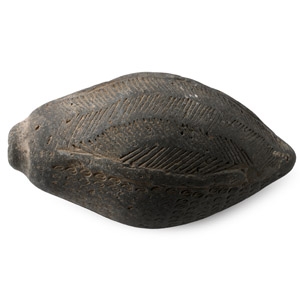
Byzantine 'Greek Fire' Ceramic Fire Bomb or Hand Grenade
9th-11th century A.D.Sold for (Inc. bp): £65
Piriform in profile with domed mouth, vertical raised lugs dividing the body into four fields, two fields with herringbone pattern and the other two with stamped decoration; intended to be filled with explosive liquid and wick, used as a hand grenade. 517 grams, 14.3 cm
From an important specialist collection, London, UK, 1990s onwards. Accompanied by an academic paper by military specialist Dr Raffaele D'Amato, dated 15 July 2019 and titled 'Eastern Roman Empire - Greek Fire Bomb or Hand Grenade (μεσαίον kακάβιον) 9th-11th century AD'. This lot is accompanied by an illustrated lot declaration signed by the Head of the Antiquities Department, Dr Raffaele D'Amato.
Apart from the use of siphons or manual flame-throwers called cheirosiphona, special corps of Roman soldiers employed terracotta grenades, in the form of small jars, abundantly evidenced in archaeological excavations. They were called μεσαία kακαβιά or κυτροκακάβια where the former had a bulbous shape and the latter a more cylindrical form. -
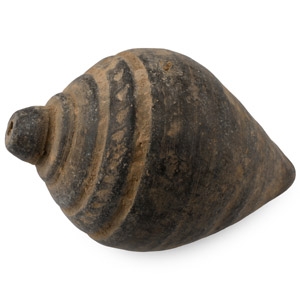
Byzantine 'Greek Fire' Ceramic Fire Bomb or Hand Grenade
9th-11th century A.D.Sold for (Inc. bp): £104
Piriform body with domed mouth, deep circumferential bands to the upper body; intended to be filled with explosive liquid and a wick, and used as a hand grenade. 544 grams, 14 cm
From an important specialist collection, London, UK, 1990s onwards. Accompanied by an academic paper by military specialist Dr Raffaele D'Amato, dated 15 July 2019 and titled 'Eastern Roman Empire - Greek Fire Bomb or Hand Grenade (μεσαίον kακάβιον) 9th-11th century AD'. This lot is accompanied by an illustrated lot declaration signed by the Head of the Antiquities Department, Dr Raffaele D'Amato.
Apart from the use of siphons or manual flame-throwers called cheirosiphona, special corps of Roman soldiers employed terracotta grenades, in the form of small jars, abundantly evidenced in archaeological excavations. They were called μεσαία kακαβιά or κυτροκακάβια where the former had a bulbous shape and the latter a more cylindrical form. -
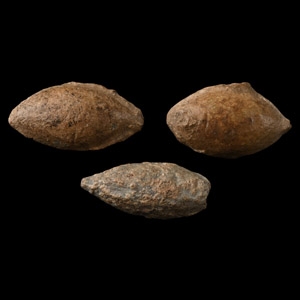
Greek Macedonian Lead Inscribed Slingshot Group
3rd-1st century B.C.Sold for (Inc. bp): £156
Each biconical in profile and lentoid in section with casting seam. 115 grams total, 33-36 mm
Ex German art market, 2000s. Acquired from an EU collector living in London. From the collection of a Surrey, UK, gentleman. This lot is accompanied by an illustrated lot declaration signed by the Head of the Antiquities Department, Dr Raffaele D'Amato.
Lead sling bullet of this almond shape type were often decorated (like one of our specimens) with a winged thunderbolt on one side and on the other side with the inscription DEXAI "Catch!" in high relief. In the Hellenistic armies, the Rhodians were considered formidable slingers, and used as mercenaries by Hellenistic and Roman Consular armies.

